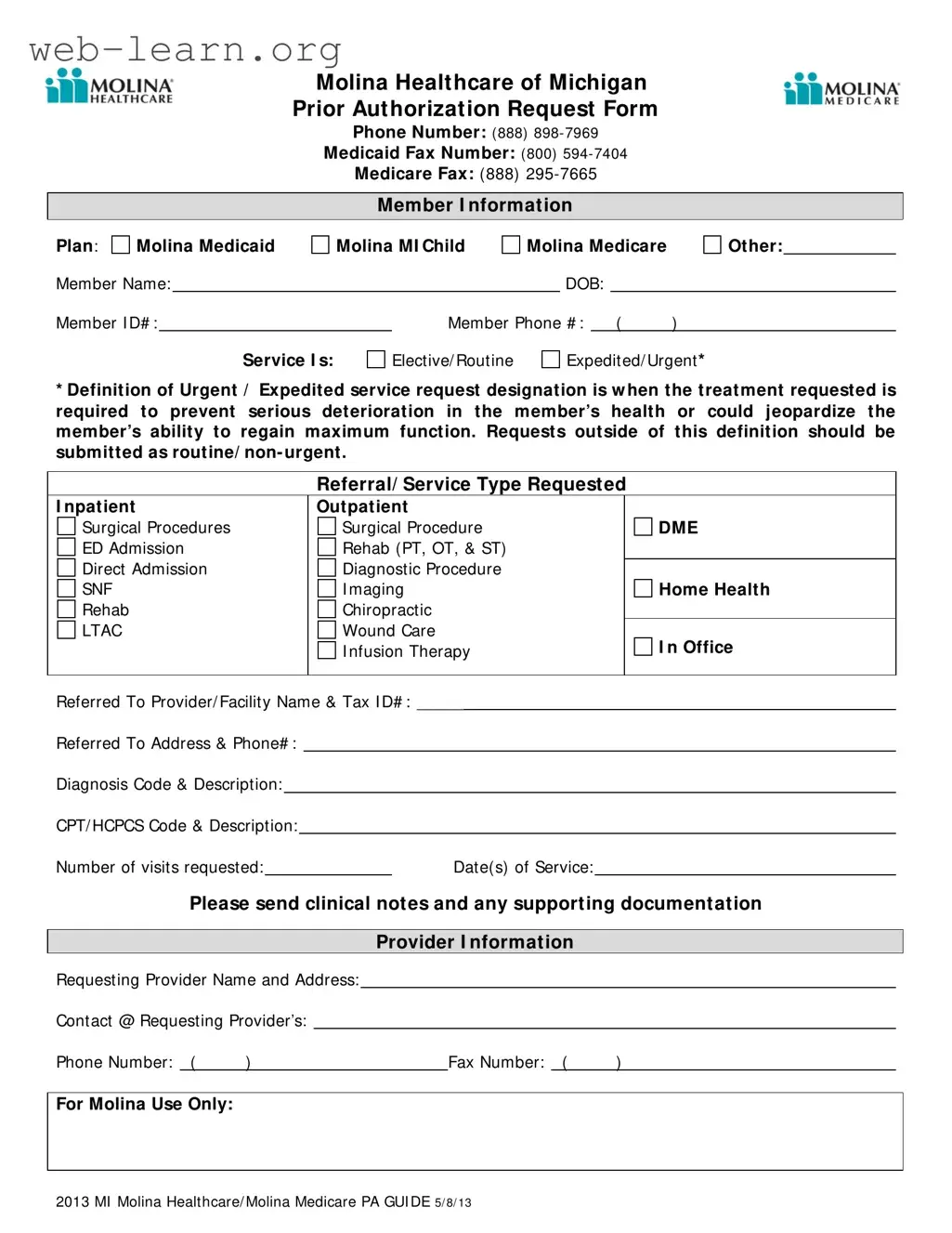
The Michigan Molina Prior Authorization form is a crucial tool for healthcare providers seeking approval for various medical services and treatments under Molina Healthcare's plans. This form facilitates the process of obtaining necessary permissions for a wide range of services, including inpatient and outpatient procedures, surgical interventions, and rehabilitation therapies. It is designed to streamline communication between providers and Molina, ensuring that requests for urgent or elective services are properly documented and evaluated. Providers must fill out essential details such as the member's information, including their name, date of birth, and identification number, alongside the specifics of the service being requested. Additionally, the form requires the diagnosis code and CPT/HCPCS code to provide clarity on the nature of the treatment. It is also important to indicate whether the service is routine or requires expedited attention, especially when the member's health may be at risk. By submitting this form along with supporting clinical notes, healthcare professionals can help ensure that their patients receive timely and appropriate care.
Molina Healthcare of Michigan Prior Authorization Request Form
Phone Number: (888)
Medicaid Fax Number: (800)
Medicare Fax: (888)
Member I nformat ion
Plan: |
Molina Medicaid |
Member Name:
Molina MI Child
Molina Medicare
DOB:
Other:
Member I D# : |
|
Member Phone # : |
( |
) |
Service I s:
Elective/ Routine
Expedited/ Urgent *
*Definition of Urgent / Expedited service request designation is w hen the treat ment requested is required to prevent serious deterioration in the member’s health or could jeopardize the member’s ability to regain maximum function. Requests outside of this definition should be submitted as routine/ non- urgent.
Referral/ Service Type Request ed
|
I npatient |
|
|
|
|
|
|
Outpatient |
|
|
|
||||||
|
Surgical Procedures |
|
|
|
|
|
|
Surgical Procedure |
|
DME |
|
||||||
|
ED Admission |
|
|
|
|
|
|
Rehab (PT, OT, & ST) |
|
|
|
||||||
|
Direct Admission |
|
|
|
|
|
|
Diagnostic Procedure |
|
|
|
||||||
|
SNF |
|
|
|
|
|
|
I maging |
|
Home Health |
|
||||||
|
Rehab |
|
|
|
|
|
|
Chiropractic |
|
|
|
||||||
|
LTAC |
|
|
|
|
|
|
Wound Care |
|
|
|
||||||
|
|
|
|
|
|
|
|
|
I nfusion Therapy |
|
I n Office |
|
|||||
|
|
|
|
|
|
|
|
|
|
|
|
|
|
|
|
|
|
|
Referred To Provider/ Facility Name & Tax I D# : _____ |
|
|
|
|||||||||||||
|
Referred To Address & Phone# : |
|
|
|
|
|
|
|
|
|
|
|
|||||
|
Diagnosis Code & Description: |
|
|
|
|
|
|
|
|
|
|
|
|||||
|
CPT/ HCPCS Code & Description: |
|
|
|
|
|
|
|
|
|
|
|
|||||
|
Number of visits requested: |
|
|
|
|
|
Date(s) of Service: |
|
|
|
|||||||
|
|
Please send clinical not es and any support ing document at ion |
|
||||||||||||||
|
|
|
|
|
|
|
|
|
|
|
|
|
|
|
|
||
|
|
|
|
|
|
|
|
|
|
Provider I nformat ion |
|
|
|
||||
|
Requesting Provider Name and Address: |
|
|
|
|||||||||||||
|
Contact @ Requesting Provider’s: |
|
|
|
|
|
|
|
|
|
|
||||||
|
Phone Number: ( |
) |
|
|
|
|
|
|
|
|
Fax Number: ( |
) |
|
|
|||
|
|
|
|
|
|
|
|
|
|
|
|
|
|
|
|
|
|
|
For Molina Use Only: |
|
|
|
|
|
|
|
|
|
|
|
|
|
|
|
|
|
|
|
|
|
|
|
|
|
|
|
|
|
|
|
|
|
|
2013 MI Molina Healthcare/ Molina Medicare PA GUI DE 5/ 8/ 13
| Fact Name | Details |
|---|---|
| Contact Information | Molina Healthcare of Michigan can be reached at (888) 898-7969 for inquiries related to the Prior Authorization Request Form. |
| Fax Numbers | The Medicaid Fax Number is (800) 594-7404, while the Medicare Fax Number is (888) 295-7665. |
| Service Designation | Requests can be categorized as Elective/Routine or Expedited/Urgent. Urgent requests are defined as those needed to prevent serious health deterioration. |
| Governing Laws | This form is governed by Michigan Medicaid and Medicare regulations, ensuring compliance with state-specific healthcare requirements. |
Completing the Michigan Molina Prior Authorization form requires careful attention to detail. Ensure that all necessary information is accurately filled out to facilitate a smooth approval process. Follow the steps below to complete the form effectively.
After completing the form, submit it to the appropriate fax number based on the member's plan. For Medicaid, use (800) 594-7404; for Medicare, use (888) 295-7665. Ensure that all supporting documents are included to avoid delays in processing.
What is the purpose of the Michigan Molina Prior Authorization form?
The Michigan Molina Prior Authorization form is used to request approval for certain medical services and treatments before they are provided. This process ensures that the requested services are medically necessary and covered under the member's plan. By obtaining prior authorization, healthcare providers can help ensure that patients receive the appropriate care in a timely manner.
Who needs to fill out the Prior Authorization form?
The form must be completed by the healthcare provider requesting the service. This includes information about the patient, the requested service, and the provider's details. It is essential that the provider submits the form accurately to avoid delays in care.
What information is required on the form?
The form requires several key pieces of information, including:
What is the difference between elective and urgent requests?
Elective or routine requests are for services that are not time-sensitive and can be scheduled at the provider's discretion. In contrast, urgent requests are for services that are necessary to prevent serious deterioration in the member's health. Urgent requests should be clearly marked on the form to expedite the review process.
How can I submit the Prior Authorization form?
The completed form can be submitted via fax. For Medicaid requests, use the fax number (800) 594-7404. For Medicare requests, use (888) 295-7665. It is advisable to keep a copy of the submitted form for your records.
What should I do if I do not receive a response?
If you do not receive a response within the expected timeframe, it is important to follow up with Molina Healthcare. You can contact them at (888) 898-7969 to inquire about the status of your request.
What happens if the Prior Authorization request is denied?
If a request is denied, Molina Healthcare will provide a written explanation for the denial. The provider and member have the right to appeal the decision. The appeal process will be outlined in the denial letter, and it is crucial to act promptly to ensure that the appeal is filed within the required timeframe.
Are there any specific services that always require Prior Authorization?
Yes, certain services typically require prior authorization. These may include specialized treatments, certain surgical procedures, and specific diagnostic tests. It is important for providers to verify which services require authorization to avoid unnecessary delays.
Can members request Prior Authorization directly?
While members can express their needs to their healthcare providers, the actual request for prior authorization must be made by the provider. This ensures that all necessary clinical information is included and that the request meets Molina's requirements.
Where can I find additional resources or assistance?
For further assistance, members and providers can visit the Molina Healthcare website or contact customer service. They can provide additional resources, guidance, and support regarding the prior authorization process.
When filling out the Michigan Molina Prior Authorization form, individuals often make several common mistakes that can lead to delays in processing. Understanding these pitfalls can help ensure a smoother experience. One frequent error is leaving out essential member information. This includes the member's name, ID number, and date of birth. Omitting any of these details can result in the form being returned for correction, which can significantly slow down the approval process.
Another common mistake is failing to specify the correct service type. The form requires a clear indication of whether the request is for inpatient, outpatient, or a specific procedure. Not accurately identifying the service can lead to confusion and miscommunication with the healthcare provider. It’s crucial to double-check that the selected service aligns with the treatment being requested.
Many individuals also neglect to provide the diagnosis code and description. This information is vital for the review process. Without it, the request may lack the necessary context for approval. Similarly, including the CPT or HCPCS code is essential. Incorrect or missing codes can result in a denial of the request.
Another mistake occurs when individuals do not include the number of visits requested. This detail is important as it helps Molina Healthcare assess the extent of the treatment needed. Failing to specify this can lead to misunderstandings about the care plan.
In addition, individuals sometimes forget to indicate the urgency of the request. The form allows for both routine and expedited requests, but if the urgency is not clearly marked, it may be processed as a standard request, which can delay necessary care. Understanding the definitions provided in the form can help in making this determination.
Providing incomplete or unclear clinical notes and supporting documentation is another frequent issue. This documentation is essential for the review process, and without it, the request may be rejected. It is advisable to include all relevant medical records and notes that support the need for the requested service.
Another common error is not confirming the contact information for the requesting provider. It is important to ensure that the name, phone number, and fax number are accurate. If there are any issues or questions regarding the request, Molina Healthcare needs to be able to reach the provider quickly.
Some individuals also overlook the importance of signing and dating the form. An unsigned form may be considered invalid, leading to unnecessary delays. Always ensure that the form is signed by the appropriate party to confirm the authenticity of the request.
Lastly, failing to keep a copy of the submitted form can create challenges later on. Having a record of what was submitted allows for easier follow-up if there are questions or issues with the authorization process. Keeping organized records can simplify communication with Molina Healthcare.
By being aware of these common mistakes, individuals can improve their chances of a successful and timely authorization process. Attention to detail and thoroughness can make a significant difference in navigating the complexities of healthcare requests.
The Michigan Molina Prior Authorization form is a crucial document for healthcare providers seeking approval for specific services. However, it often accompanies several other forms and documents that streamline the authorization process. Below is a list of commonly used documents that may be necessary alongside the Prior Authorization form.
These documents play a vital role in ensuring that the authorization process runs smoothly. They provide the necessary information to support the request, helping to secure timely access to care for patients.
When filling out the Michigan Molina Prior Authorization form, it is crucial to follow specific guidelines to ensure a smooth process. Here are seven important do's and don'ts:
Following these guidelines will help facilitate the authorization process and ensure that the necessary services are approved in a timely manner.
Understanding the Michigan Molina Prior Authorization form is essential for both healthcare providers and patients. However, several misconceptions often arise regarding its purpose and use. Here are eight common misconceptions, clarified for better understanding:
By clearing up these misconceptions, patients and providers can navigate the prior authorization process more effectively, ensuring timely and appropriate care.
When filling out and using the Michigan Molina Prior Authorization form, consider the following key takeaways: