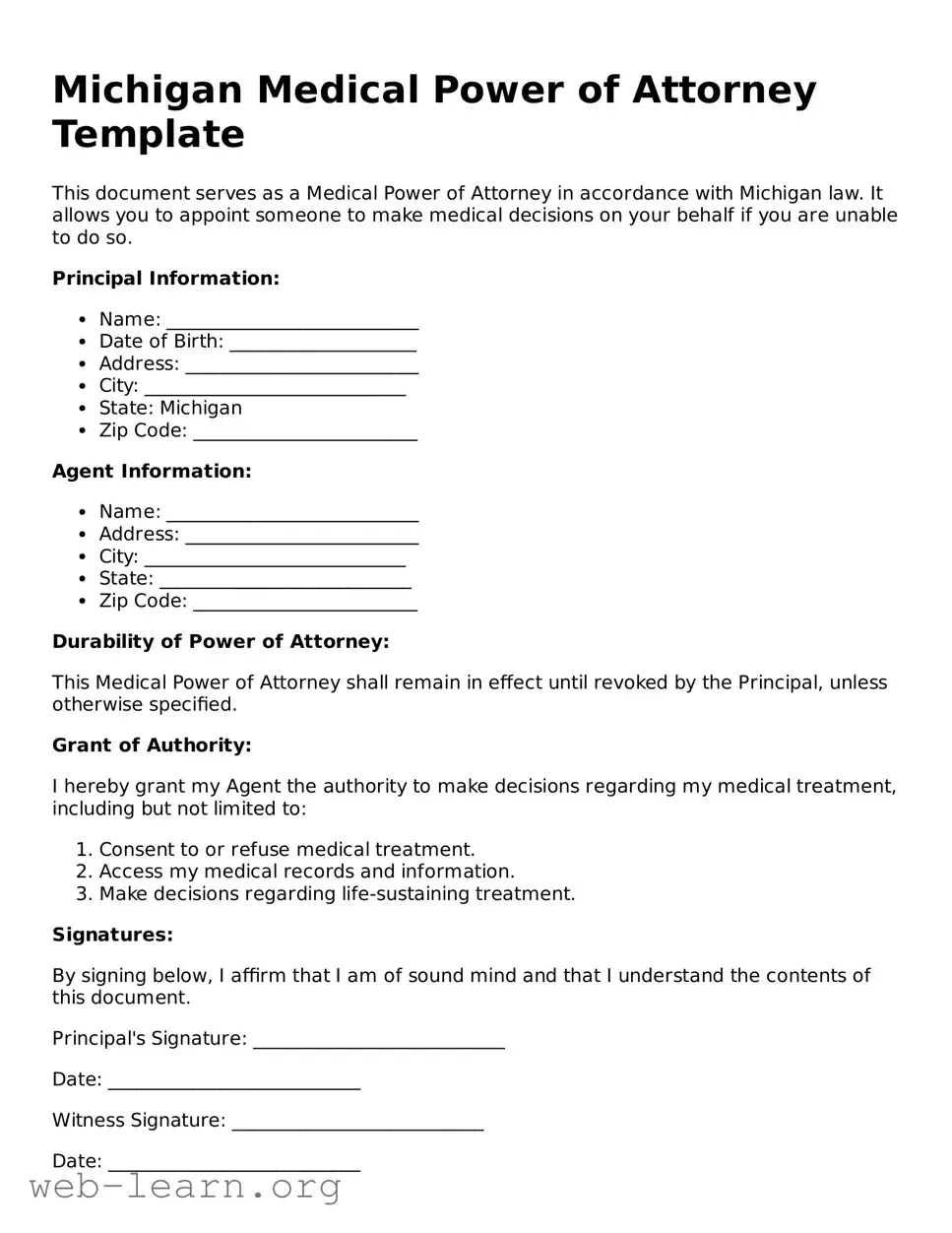
In Michigan, the Medical Power of Attorney form is a crucial legal document that empowers individuals to make healthcare decisions on behalf of another person when they are unable to do so themselves. This form allows you to designate a trusted individual, often referred to as your agent or surrogate, who will have the authority to make medical decisions based on your wishes and best interests. It covers a wide range of medical scenarios, including treatment options, end-of-life care, and the right to access medical records. Importantly, the form ensures that your preferences regarding medical interventions are honored, even if you cannot communicate them at the time. It is vital to complete this document thoughtfully, as it not only reflects your values and desires but also alleviates the burden on family members during challenging times. Understanding the nuances of this form can significantly impact the quality of care you receive and the peace of mind for your loved ones.
Michigan Medical Power of Attorney Template
This document serves as a Medical Power of Attorney in accordance with Michigan law. It allows you to appoint someone to make medical decisions on your behalf if you are unable to do so.
Principal Information:
Agent Information:
Durability of Power of Attorney:
This Medical Power of Attorney shall remain in effect until revoked by the Principal, unless otherwise specified.
Grant of Authority:
I hereby grant my Agent the authority to make decisions regarding my medical treatment, including but not limited to:
Signatures:
By signing below, I affirm that I am of sound mind and that I understand the contents of this document.
Principal's Signature: ___________________________
Date: ___________________________
Witness Signature: ___________________________
Date: ___________________________
Notary Public:
State of Michigan
County of ___________________________
Subscribed and sworn before me on this ____ day of __________, 20__.
Notary Public Signature: ___________________________
My commission expires: ___________________________
| Fact Name | Details |
|---|---|
| Purpose | The Michigan Medical Power of Attorney form allows an individual to appoint someone to make medical decisions on their behalf if they become incapacitated. |
| Governing Law | This form is governed by the Michigan Compiled Laws, specifically MCL 700.5501 through MCL 700.5505. |
| Eligibility | Any adult resident of Michigan can create a Medical Power of Attorney. |
| Signature Requirement | The form must be signed by the principal and witnessed by at least two individuals or notarized. |
| Revocation | The principal can revoke the Medical Power of Attorney at any time, as long as they are mentally competent. |
| Durability | This power of attorney remains effective even if the principal becomes incapacitated, unless revoked. |
Filling out the Michigan Medical Power of Attorney form is a straightforward process. After completing the form, you will need to ensure it is signed and witnessed appropriately to make it valid. Follow these steps carefully to ensure all necessary information is accurately provided.
A Michigan Medical Power of Attorney is a legal document that allows you to designate someone to make healthcare decisions on your behalf if you become unable to do so. This person, known as your agent or proxy, will have the authority to make medical choices according to your wishes.
Your agent can be anyone you trust, such as a family member, friend, or even a professional. However, it’s important that your agent is at least 18 years old and is not your healthcare provider or an employee of your healthcare provider unless they are a relative.
To create a Medical Power of Attorney in Michigan, you need to fill out a form that meets state requirements. You must clearly state your wishes regarding medical treatment and appoint your agent. After completing the form, you should sign it in the presence of a witness or a notary public to ensure it is valid.
Yes, you can revoke your Medical Power of Attorney at any time. To do so, you should notify your agent and any healthcare providers involved in your care. It’s a good idea to create a new document if you wish to appoint a different agent or change your instructions.
If you do not have a Medical Power of Attorney and become unable to make your own healthcare decisions, your family members may need to go through a court process to appoint a guardian. This can be time-consuming and may not reflect your personal wishes regarding your medical care.
Filling out the Michigan Medical Power of Attorney form is a critical task that requires attention to detail. One common mistake is failing to specify the agent clearly. It's essential to provide the full name and contact information of the person you trust to make medical decisions on your behalf. Without this information, your wishes may not be honored.
Another frequent error is neglecting to sign and date the form. A signature is your affirmation of the document's validity. Without it, the form may be considered incomplete, leaving your medical decisions in limbo.
People often overlook the need for witnesses. Michigan law requires that the form be signed in the presence of two witnesses who are not related to you or your agent. Skipping this step can render the document invalid.
Inaccurate or vague language can lead to misunderstandings. It’s vital to be clear about your wishes regarding medical treatments and interventions. Ambiguity can create confusion for your agent and healthcare providers.
Many individuals forget to review the form after completing it. It's a good practice to double-check all information for accuracy. Errors can lead to complications when the document is needed most.
Another mistake is not discussing your choices with your agent. It's important that your agent understands your values and preferences. A conversation ensures they can make decisions that align with your wishes.
Some people fail to keep copies of the completed form. Once signed, distribute copies to your agent, healthcare providers, and family members. This ensures that everyone involved is aware of your decisions.
Lastly, many overlook updating the document as circumstances change. Life events such as a move, a change in relationships, or shifts in health can all necessitate revisions. Regularly review and update your Medical Power of Attorney to reflect your current wishes.
When creating a Michigan Medical Power of Attorney, it is often beneficial to consider additional documents that can complement this form. Each of these documents serves a specific purpose and can help ensure that your healthcare preferences are honored. Below is a list of commonly used forms that individuals may want to include in their planning.
Incorporating these documents into your healthcare planning can provide peace of mind. They help ensure that your wishes are understood and respected, even when you cannot communicate them yourself. Consulting with a legal professional can provide further guidance tailored to individual needs.
The Medical Power of Attorney form is an important document that allows someone to make medical decisions on your behalf if you are unable to do so. It shares similarities with several other legal documents. Here are four documents that are similar to the Medical Power of Attorney:
When filling out the Michigan Medical Power of Attorney form, it's essential to approach the task thoughtfully. Here are some important dos and don'ts to consider:
By following these guidelines, you can ensure that your Medical Power of Attorney accurately reflects your wishes and provides clarity for your loved ones during difficult times.
Understanding the Michigan Medical Power of Attorney form is essential for anyone looking to designate a trusted individual to make healthcare decisions on their behalf. However, several misconceptions can lead to confusion. Here are four common misunderstandings:
Many people believe that the Medical Power of Attorney form is only valid within Michigan. In reality, while it is designed to comply with Michigan laws, other states may recognize it, especially if the individual is traveling or temporarily residing elsewhere. However, it is always advisable to check the specific laws of the state in question.
Some individuals assume that the Medical Power of Attorney also grants authority over financial matters. This is not the case. The Medical Power of Attorney specifically pertains to healthcare decisions. For financial matters, a separate Durable Power of Attorney document is necessary.
There is a common belief that only older adults or those with serious health conditions need a Medical Power of Attorney. However, anyone, regardless of age or health status, can benefit from having this document in place. Unexpected medical emergencies can happen at any time, making it wise for all individuals to consider designating a healthcare agent.
Another misconception is that a Medical Power of Attorney is permanent and cannot be modified. In fact, individuals have the right to revoke or change their Medical Power of Attorney at any time, as long as they are mentally competent. This flexibility allows for updates as personal circumstances change.
By clarifying these misconceptions, individuals can make more informed decisions regarding their healthcare planning and ensure that their wishes are honored when it matters most.
When filling out and using the Michigan Medical Power of Attorney form, it's essential to keep a few key points in mind:
These takeaways can help ensure that your medical preferences are respected and that your chosen agent is prepared to act on your behalf when needed.