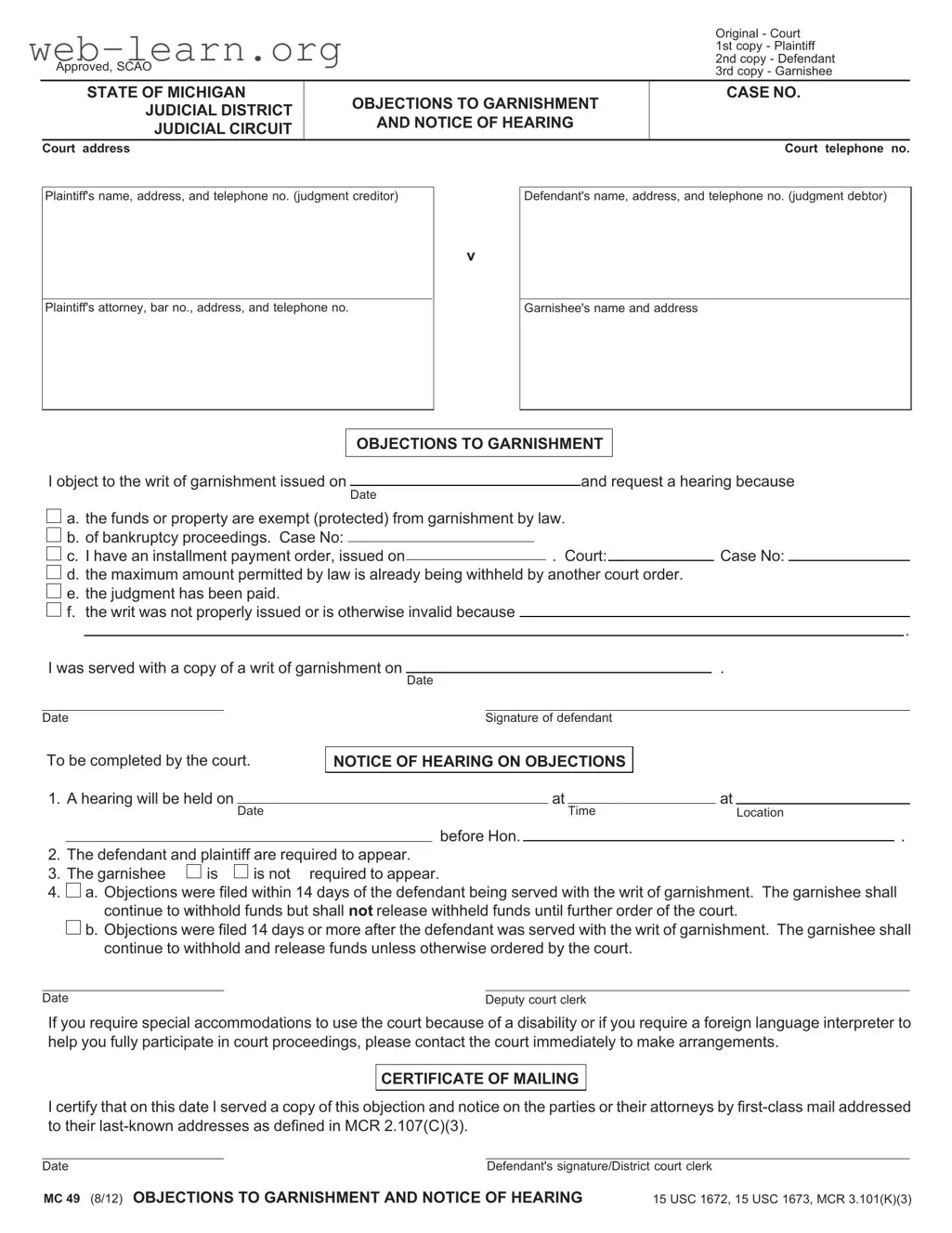
The Michigan MC 49 form plays a crucial role in the garnishment process, allowing individuals to formally object to a writ of garnishment. This legal document is essential for those who believe their funds or property should not be subject to garnishment due to various valid reasons. For instance, a person may claim that the funds are exempt by law, they are currently undergoing bankruptcy proceedings, or they have already paid the judgment in full. Additionally, if there is an existing installment payment order or if the garnishment was improperly issued, the MC 49 form serves as a mechanism to challenge these actions. The form not only requires the individual to outline their objections but also mandates a notice of hearing where both the defendant and plaintiff must appear. Completing this form accurately and submitting it to the appropriate court is vital, as it initiates the process for contesting the garnishment. Furthermore, individuals must be aware of the timelines involved, as objections must be filed within a specific period following the service of the garnishment. Understanding the MC 49 form and its requirements can significantly impact one’s ability to protect their financial interests in the face of garnishment.

|
Original - Court |
|
|
1st copy - Plaintiff |
|
Approved, SCAO |
2nd copy - Defendant |
|
3rd copy - Garnishee |
||
|
STATE OF MICHIGAN JUDICIAL DISTRICT JUDICIAL CIRCUIT
OBJECTIONS TO GARNISHMENT
AND NOTICE OF HEARING
CASE NO.
Court address |
Court telephone no. |
Plaintiff's name, address, and telephone no. (judgment creditor)
Defendant's name, address, and telephone no. (judgment debtor)
v
Plaintiff's attorney, bar no., address, and telephone no.
Garnishee's name and address
OBJECTIONS TO GARNISHMENT
I object to the writ of garnishment issued on |
|
and request a hearing because |
|
Date
a. the funds or property are exempt (protected) from garnishment by law.
b. of bankruptcy proceedings. Case No:
c. I have an installment payment order, issued on. Court:Case No:
d. the maximum amount permitted by law is already being withheld by another court order.
e. the judgment has been paid.
f. the writ was not properly issued or is otherwise invalid because
.
I was served with a copy of a writ of garnishment on |
|
. |
||
|
|
Date |
||
|
|
|
|
|
Date |
|
Signature of defendant |
||
To be completed by the court.
1. A hearing will be held on
Date
NOTICE OF HEARING ON OBJECTIONS
atat
TimeLocation
before Hon. |
|
. |
|
2. |
The defendant and plaintiff are required to appear. |
||
3. |
The garnishee |
is |
is not required to appear. |
4. a. Objections were filed within 14 days of the defendant being served with the writ of garnishment. The garnishee shall continue to withhold funds but shall not release withheld funds until further order of the court.
b. Objections were filed 14 days or more after the defendant was served with the writ of garnishment. The garnishee shall continue to withhold and release funds unless otherwise ordered by the court.
Date |
Deputy court clerk |
If you require special accommodations to use the court because of a disability or if you require a foreign language interpreter to help you fully participate in court proceedings, please contact the court immediately to make arrangements.
CERTIFICATE OF MAILING
I certify that on this date I served a copy of this objection and notice on the parties or their attorneys by
Date |
Defendant's signature/District court clerk |
|
MC 49 (8/12) |
OBJECTIONS TO GARNISHMENT AND NOTICE OF HEARING |
15 USC 1672, 15 USC 1673, MCR 3.101(K)(3) |
Instructions for Filing and Serving an Objection to Garnishment (Form MC 49)
If you received a writ of garnishment (form MC 12, MC 13, or MC 52), you can object to that garnishment only if:
•your money is exempt (protected) from garnishment by law (see the list of exempt funds on the back of your writ of garnishment form),
•you filed for bankruptcy and those proceedings are pending or the debt has been discharged,
•you have an installment payment order signed by a judge (form MC 15a),
•the maximum amount of money that can be garnished by law is already being withheld by another court order,
•you already paid the judgment in full,
•the garnishment was not properly issued (for example, it was issued on false information) or the garnishment
is invalid (for example, the interest, costs, or judgment amount are inaccurate).
You cannot use this form to challenge the judgment or because you are unable to pay the judgment.
1.How do I file an Objection?
You file an objection by completing the form and filing it with the same court that signed the writ of garnishment. There is no cost.
2.Fill out the Objection form.
Write in the court number, case number, the court address and telephone number, and the names, addresses, and telephone numbers of the plaintiff and the defendant exactly as they are on the writ of garnishment.
Write in the date the garnishment was issued (see the lower
Write in the date you complete the form and sign your name.
3.Make four copies of the completed objection form.
4.File the Objection with the court.
File all four copies of your objection with the court in person or by
5.Serve the Objection.
If your case is in the district court, the court will serve the objection and will return one copy to you.
If your case is in the circuit court, when you get the three remaining copies of the objection with the Notice of Hearing completed, serve a copy on the plaintiff and a copy on the garnishee by
For information on preparing for a hearing generally, see the Michigan Court’s
| Fact Name | Fact Description |
|---|---|
| Form Purpose | The MC 49 form is used to object to a garnishment and request a hearing. |
| Governing Law | This form is governed by 15 USC 1672, 15 USC 1673, and MCR 3.101(K)(3). |
| Who Can File | Defendants, or judgment debtors, can file objections to the garnishment. |
| Exemptions | Funds may be exempt from garnishment under specific laws, allowing for objections. |
| Bankruptcy Proceedings | If bankruptcy is pending, a defendant can object to garnishment. |
| Installment Payment Orders | Defendants with an installment payment order can also file an objection. |
| Filing Process | Objections must be filed with the court that issued the garnishment. |
| Hearing Requirement | A hearing will be scheduled, and both the plaintiff and defendant must appear. |
| Service of Notice | Defendants must serve the objection and notice to the plaintiff and garnishee. |
| Deadline for Objections | Objections must be filed within 14 days of receiving the writ of garnishment. |
Completing the Michigan MC 49 form involves several steps that ensure your objections to garnishment are properly filed and served. Following these instructions carefully will help you navigate the process effectively.
After completing these steps, you will be prepared for the upcoming hearing regarding your objections. It is important to bring all relevant documents to support your claims. For additional guidance, consider visiting the Michigan Court’s Self-Help Center.
What is the Michigan MC 49 form?
The Michigan MC 49 form is used to file objections to a writ of garnishment. It allows a defendant (the judgment debtor) to contest the garnishment of their funds or property, providing reasons for the objection and requesting a hearing. This form is essential for ensuring that defendants can protect their rights and assets under Michigan law.
Who can file an objection using the MC 49 form?
Any defendant who has received a writ of garnishment can file an objection using the MC 49 form. The objections can be based on several grounds, including the exemption of funds from garnishment, pending bankruptcy proceedings, or the judgment being paid in full.
What are the valid reasons for filing an objection?
How do I complete the MC 49 form?
To complete the MC 49 form, fill in the required details, including the court number, case number, court address, and the names and addresses of both the plaintiff and defendant. Indicate the date the garnishment was issued and check the appropriate boxes for your objections. Finally, sign and date the form.
What is the process for filing the MC 49 form?
After completing the MC 49 form, make four copies of it. File the original and all copies with the court that issued the writ of garnishment. There is no filing fee. If mailing, include a self-addressed, postage-paid envelope for the court to return copies to you.
What happens after I file the MC 49 form?
Once filed, the court will schedule a hearing regarding your objections. You will receive a Notice of Hearing, which will indicate the date, time, and location of the hearing. Both the defendant and plaintiff are required to attend, while the garnishee may not be required to appear.
What if I miss the deadline to file an objection?
If objections are filed 14 days or more after being served with the writ of garnishment, the garnishee must continue to withhold funds but may also release them unless the court orders otherwise. Timely filing is crucial to protect your rights.
Do I need to attend the hearing?
Yes, both the defendant and the plaintiff must attend the hearing. It is important to bring all relevant documents to support your objections. Failure to appear may result in the court ruling against your objections.
How can I prepare for the hearing?
To prepare for the hearing, gather all documents that support your objections. Familiarize yourself with the reasons for your objection and be ready to explain them clearly. For more guidance on preparing for a hearing, visit the Michigan Court’s Self-Help Center.
Filling out the Michigan MC 49 form can be a straightforward process, but mistakes can lead to delays or complications. One common error is failing to provide complete and accurate information about the parties involved. It's essential to list the plaintiff's and defendant's names, addresses, and telephone numbers exactly as they appear on the writ of garnishment. Inaccuracies can cause confusion and may result in your objection being dismissed.
Another frequent mistake is neglecting to check all applicable reasons for the objection. The form allows you to select multiple reasons for your objection to garnishment. If you only check one box when there are multiple valid reasons, it may weaken your case. Ensure that you thoroughly review the list of reasons and check all that apply to your situation.
Many individuals also overlook the importance of providing the correct dates. You must include the date the garnishment was issued and the date you received the writ. Missing or incorrect dates can complicate the court's understanding of your case and may lead to procedural issues.
Some people forget to sign the form before submitting it. A signature is a critical component of the MC 49 form, as it verifies that the information provided is accurate to the best of your knowledge. Without a signature, the court may reject your objection, requiring you to start the process over.
Additionally, failing to make the necessary copies of the completed objection form can create significant delays. It is essential to prepare four copies: one for the court, one for the plaintiff, one for the garnishee, and one for your records. If you submit fewer copies than required, you may need to return to the court to rectify the issue.
Another common pitfall is not serving the objection correctly. If your case is in circuit court, after receiving the copies with the Notice of Hearing, you must serve the plaintiff and garnishee by first-class mail. If the plaintiff has legal representation, the objection must be sent to the attorney instead. Missing this step can lead to further complications in the hearing process.
Lastly, individuals often forget to prepare for the hearing itself. It is crucial to gather all necessary documents that support your objections before attending the hearing. Failing to bring relevant documentation can weaken your position and hinder your ability to present a strong case to the judge.
The Michigan MC 49 form is a critical document used in the process of objecting to garnishment. However, it is often accompanied by several other forms and documents that facilitate various aspects of the garnishment process. Understanding these documents can help individuals navigate their legal situations more effectively.
In conclusion, familiarity with these accompanying documents can enhance one’s understanding of the garnishment process in Michigan. Each form plays a specific role in ensuring that the rights of all parties are respected and that the legal proceedings are conducted fairly. Properly utilizing these documents can significantly impact the outcome of a garnishment case.
The Michigan MC 49 form, which addresses objections to garnishment, has similarities with several other legal documents. Below is a list of six documents that share characteristics with the MC 49 form:
When filling out the Michigan MC 49 form, there are important guidelines to follow to ensure your objections to garnishment are properly submitted. Here is a list of things you should and shouldn’t do:
By adhering to these guidelines, individuals can navigate the process of objecting to garnishment more effectively and ensure their rights are protected.
This form is specifically for objections to garnishment. It cannot be used to dispute the judgment itself. If a person wishes to contest the judgment, they must pursue other legal avenues.
No filing fee is required when submitting the MC 49 form. This makes it accessible for individuals who may be facing financial difficulties.
In most cases, the garnishee is not required to attend the hearing. Only the defendant and plaintiff must be present, unless otherwise ordered by the court.
Objections must be filed within 14 days of being served with the writ. If filed later, the garnishee may continue to withhold funds unless instructed otherwise by the court.
Individuals can check multiple reasons on the MC 49 form. If more than one reason applies, all relevant objections should be included.
It is essential to bring all relevant documents to support the objections listed on the MC 49 form. This documentation will aid in presenting a strong case during the hearing.
Here are some important points to keep in mind when filling out and using the Michigan MC 49 form:
Understanding these key points can help you navigate the process more effectively and ensure that your objections are properly addressed.