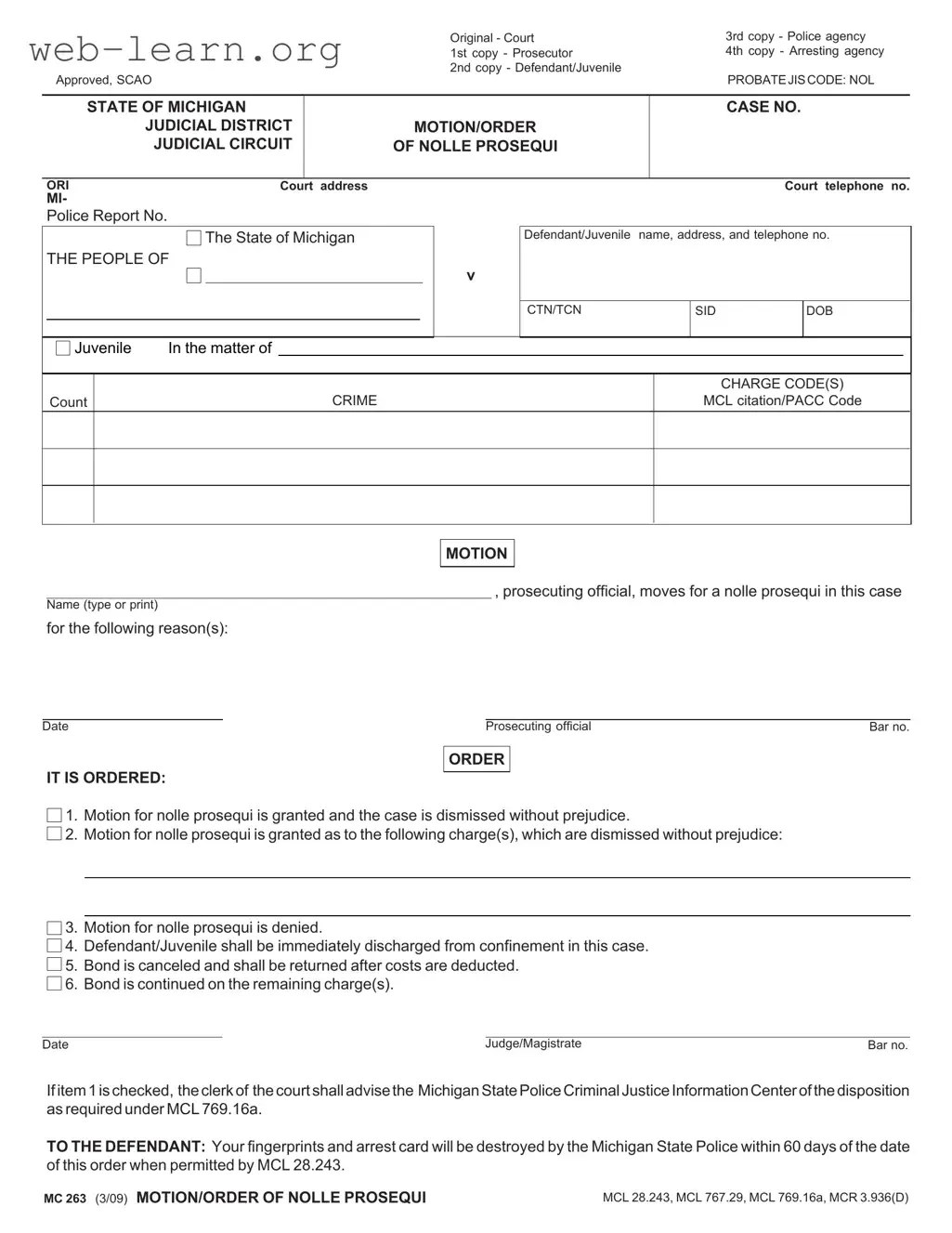
The Michigan MC 263 form plays a crucial role in the legal process, particularly in criminal cases. This form is used to file a motion for nolle prosequi, which is a legal term indicating that the prosecutor has decided to discontinue prosecution of a case. The document is structured to include essential information such as the case number, the defendant's details, and the charges involved. It serves multiple purposes, including the dismissal of charges without prejudice, which allows for the possibility of re-filing in the future. The form also outlines the responsibilities of the court and the prosecutor, detailing whether the motion is granted or denied. Additionally, it addresses the immediate discharge of the defendant from confinement and the status of any bond associated with the case. The form is an important procedural tool that ensures proper communication between the court, the prosecutor, and law enforcement agencies, while also safeguarding the rights of the defendant. Understanding the implications of the MC 263 form is essential for all parties involved in the judicial process in Michigan.
Original - Court |
3rd copy - Police agency |
1st copy - Prosecutor |
4th copy - Arresting agency |
2nd copy - Defendant/Juvenile |
|
Approved, SCAO |
PROBATEJISCODE: NOL |
STATE OF MICHIGAN JUDICIAL DISTRICT JUDICIAL CIRCUIT
MOTION/ORDER
OF NOLLE PROSEQUI
CASE NO.
ORI |
Court address |
MI-
Police Report No.
The State of Michigan
THE PEOPLE OF
v
Court telephone no.
Defendant/Juvenile name, address, and telephone no.
CTN/TCN
SID
DOB
Juvenile |
In the matter of |
Count
CRIME
CHARGE CODE(S)
MCL citation/PACC Code
MOTION
Name (type or print)
for the following reason(s):
Date
IT IS ORDERED:
, prosecuting official, moves for a nolle prosequi in this case
Prosecuting official |
Bar no. |
ORDER
1. Motion for nolle prosequi is granted and the case is dismissed without prejudice.
2. Motion for nolle prosequi is granted as to the following charge(s), which are dismissed without prejudice:
3. |
Motion for nolle prosequi is denied. |
|
||
4. |
Defendant/Juvenile shall be immediately discharged from confinement in this case. |
|
||
5. |
Bond is canceled and shall be returned after costs are deducted. |
|
||
6. |
Bond is continued on the remaining charge(s). |
|
||
|
|
|
|
|
Date |
|
|
Judge/Magistrate |
Bar no. |
Ifitem1ischecked, theclerkof thecourtshalladvisethe MichiganStatePoliceCriminalJusticeInformationCenterofthedisposition as required under MCL 769.16a.
TO THE DEFENDANT: Your fingerprints and arrest card will be destroyed by the Michigan State Police within 60 days of the date of this order when permitted by MCL 28.243.
MC 263 (3/09) MOTION/ORDER OF NOLLE PROSEQUI |
MCL 28.243, MCL 767.29, MCL 769.16a, MCR 3.936(D) |
| Fact Name | Detail |
|---|---|
| Form Purpose | The Michigan MC 263 form is used to request a nolle prosequi, which is a legal term meaning that the prosecution is voluntarily discontinuing the case. |
| Governing Laws | This form is governed by several laws, including MCL 28.243, MCL 767.29, MCL 769.16a, and MCR 3.936(D). |
| Copies Required | The form requires multiple copies: one for the court, one for the police agency, one for the prosecutor, one for the arresting agency, and one for the defendant or juvenile. |
| Dismissal Without Prejudice | If the motion is granted, the case is dismissed without prejudice, allowing for the possibility of future prosecution. |
| Immediate Discharge | Upon granting the motion, the defendant or juvenile shall be immediately discharged from confinement related to the case. |
| Bond Information | If a bond was posted, it will be canceled and returned after deducting any applicable costs. |
| Fingerprint Destruction | Fingerprints and arrest records will be destroyed by the Michigan State Police within 60 days of the order, as allowed by MCL 28.243. |
| Filing Requirements | The prosecuting official must complete the form, including their name and bar number, to initiate the motion. |
| Clerk Notification | If the motion is granted, the court clerk is required to notify the Michigan State Police Criminal Justice Information Center of the disposition. |
Filling out the Michigan MC 263 form requires careful attention to detail. This form serves specific legal purposes, and accuracy is essential to ensure proper processing. The following steps outline how to complete the form effectively.
Once the form is completed, it should be submitted to the appropriate court. It is important to retain copies for personal records and to ensure that all parties involved are informed of the proceedings.
The Michigan MC 263 form is a legal document known as the Motion/Order of Nolle Prosequi. It is used in the state of Michigan when a prosecuting official decides to dismiss a case without prejudice. This means that the case can potentially be reopened in the future. The form outlines the details of the case, including the charges against the defendant or juvenile.
The prosecuting official is responsible for filling out the MC 263 form. This official must provide their name, bar number, and the reasons for seeking a nolle prosequi. The form must also include information about the defendant or juvenile, such as their name, address, and date of birth.
Once the MC 263 form is filed, the judge or magistrate will review it. They have the authority to grant or deny the motion for nolle prosequi. If granted, the case is dismissed without prejudice, and the defendant or juvenile is discharged from confinement. If denied, the case will continue through the judicial process.
When a case is dismissed "without prejudice," it means that the prosecution can refile the charges in the future if they choose to do so. This is different from a dismissal "with prejudice," which would prevent the prosecution from bringing the same charges again.
If the motion for nolle prosequi is granted, the defendant or juvenile is immediately discharged from any confinement related to the case. Additionally, any bond that was posted will be canceled and returned after deducting any applicable costs. This provides a sense of relief for those who may have been anxious about their legal situation.
Upon the granting of the nolle prosequi, the Michigan State Police will destroy the fingerprints and arrest card of the defendant or juvenile within 60 days, as long as permitted by law. This helps to ensure that the individual does not carry the burden of an arrest record for a case that has been dismissed.
Yes, since the dismissal is without prejudice, the prosecution retains the right to reinstate the charges at a later date. This means that while the immediate legal pressure may be lifted, the case is not permanently closed.
If you have additional questions about the MC 263 form or its implications, it is advisable to consult with a legal professional. They can provide personalized guidance based on your specific situation and help clarify any uncertainties you may have.
Filling out the Michigan MC 263 form can be a straightforward process, but several common mistakes can lead to complications. One of the most frequent errors is failing to provide complete and accurate information about the defendant or juvenile. Missing details such as the full name, address, or date of birth can delay processing and cause unnecessary confusion.
Another mistake often made is neglecting to check the appropriate boxes. The form includes specific options regarding the motion for nolle prosequi, and overlooking these can lead to incorrect filings. It is crucial to ensure that all relevant charges are clearly indicated to avoid ambiguity.
Many individuals also forget to include the correct case number. This number is vital for the court to identify the specific case being referenced. Without it, the court may misplace or improperly process the motion, leading to further delays.
In addition, signatures are sometimes missing or incorrectly placed. The prosecuting official must sign the form, and any failure to do so can render the motion invalid. Ensuring that the signature is present and legible is essential for the document's acceptance.
Another common error involves the date. It is important to date the form correctly, as this can affect the timeline of the case. An incorrect date can lead to confusion about when the motion was filed and when the associated actions should take place.
People often overlook the need for multiple copies of the form. The MC 263 requires that different parties receive specific copies, including the police agency and the prosecutor. Not providing the necessary copies can result in a lack of communication between involved parties.
Additionally, failing to follow the specific instructions regarding the submission of the form can be problematic. Each court may have its own requirements for how documents should be filed, and not adhering to these can lead to rejection of the form.
Another mistake is not keeping a copy of the submitted form for personal records. Having a copy can be useful for future reference or if any issues arise regarding the motion.
Some individuals may also misinterpret the legal implications of the motion. Understanding what a nolle prosequi entails is critical, as it can affect the defendant's future legal standing. Consulting with a legal professional can help clarify any uncertainties.
Finally, people sometimes fail to double-check the form for errors before submission. Simple typos or inaccuracies can lead to significant delays. Taking the time to review the form thoroughly can help ensure that all information is correct and complete.
The Michigan MC 263 form, known as the Motion/Order of Nolle Prosequi, is an important document in the legal process. It allows a prosecutor to voluntarily dismiss charges against a defendant. However, there are several other forms and documents that are often used in conjunction with the MC 263 form. Each of these documents serves a specific purpose in the judicial process, ensuring that all parties are properly informed and that the legal proceedings are conducted fairly.
Understanding these forms and their purposes can help individuals navigate the legal system more effectively. Each document plays a vital role in ensuring that justice is served and that all parties are treated fairly throughout the process.
The Michigan MC 263 form, which is a motion/order of nolle prosequi, shares similarities with several other legal documents. Each of these documents serves a specific purpose in the legal process, often involving the dismissal of charges or the management of criminal cases. Below is a list of seven documents that are similar to the Michigan MC 263 form, along with a brief explanation of each:
Filling out the Michigan MC 263 form can be a straightforward process if you follow the right steps. Here are some essential dos and don'ts to keep in mind:
By following these guidelines, you can help ensure that your submission is processed smoothly and efficiently. Taking the time to double-check your work can save you from unnecessary delays or complications.
Understanding the Michigan MC 263 form is crucial for anyone involved in the legal process. However, several misconceptions can lead to confusion. Here are four common misunderstandings:
Being aware of these misconceptions can help individuals navigate the legal system more effectively. Understanding the true implications of the MC 263 form is essential for anyone involved in a case.
Here are some key takeaways about filling out and using the Michigan MC 263 form: