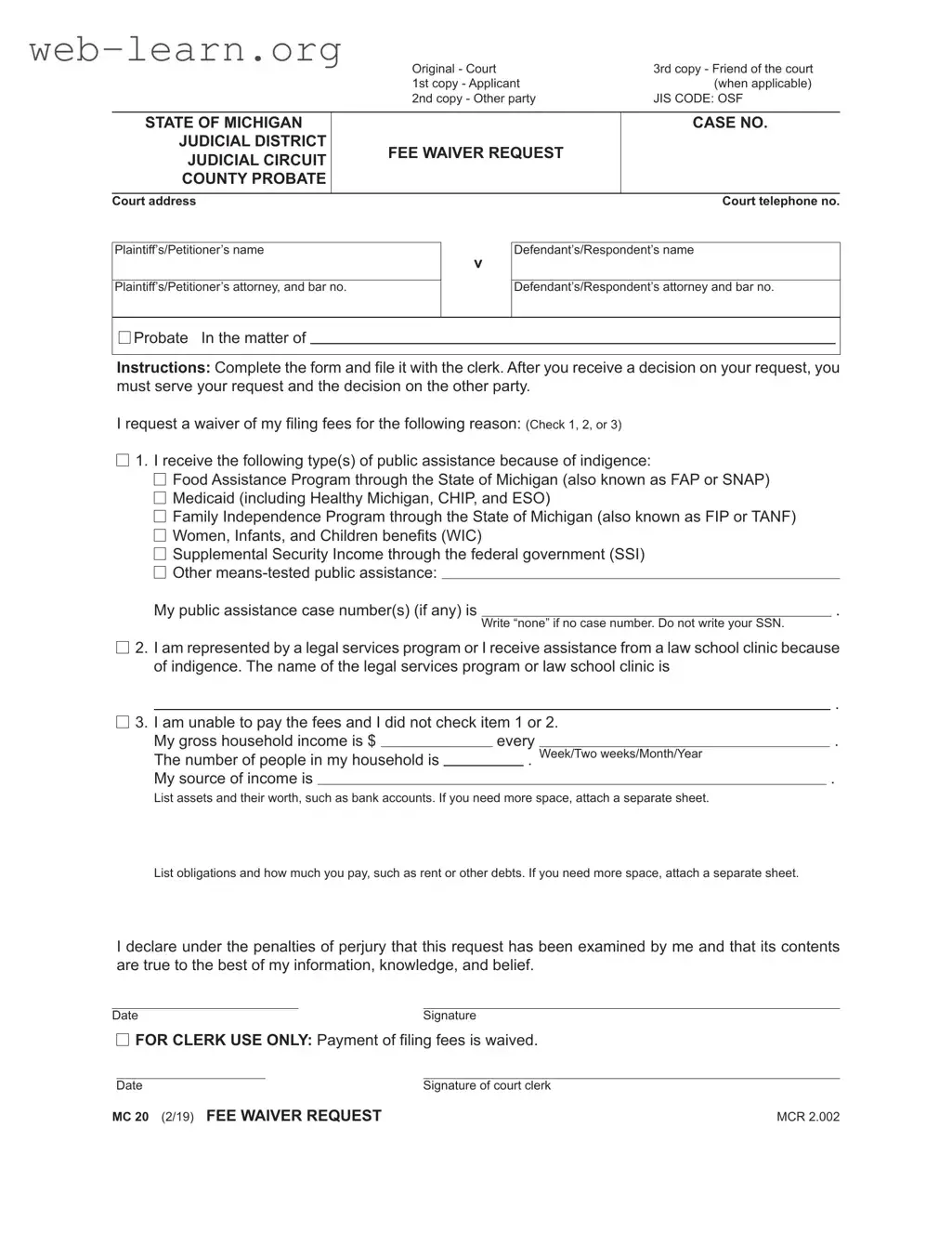
The Michigan MC 20 form is a crucial document for individuals seeking relief from court filing fees due to financial hardship. This form is specifically designed for those who may struggle to pay these fees, ensuring access to the judicial system for all, regardless of their economic situation. It serves multiple purposes: applicants can request a fee waiver by indicating their eligibility based on public assistance programs, legal representation, or personal financial circumstances. The form requires applicants to provide information about their income, household size, and any relevant assets or obligations. Upon completion, it must be filed with the court clerk, and a decision will follow. If approved, the waiver allows individuals to proceed with their cases without the burden of upfront fees. Understanding the MC 20 form is essential for anyone navigating the legal landscape in Michigan, as it can significantly impact their ability to access justice.

Original - Court |
3rd copy - Friend of the court |
1st copy - Applicant |
(when applicable) |
2nd copy - Other party |
JIS CODE: OSF |
STATE OF MICHIGAN JUDICIAL DISTRICT JUDICIAL CIRCUIT COUNTY PROBATE
FEE WAIVER REQUEST
CASE NO.
Court address
Plaintiff’s/Petitioner’s name
Plaintiff’s/Petitioner’s attorney, and bar no.
v
Court telephone no.
Defendant’s/Respondent’s name
Defendant’s/Respondent’s attorney and bar no.
Probate In the matter of
Instructions: Complete the form and file it with the clerk. After you receive a decision on your request, you must serve your request and the decision on the other party.
I request a waiver of my filing fees for the following reason: (Check 1, 2, or 3)
1. I receive the following type(s) of public assistance because of indigence:
Food Assistance Program through the State of Michigan (also known as FAP or SNAP)
Medicaid (including Healthy Michigan, CHIP, and ESO)
Family Independence Program through the State of Michigan (also known as FIP or TANF)
Women, Infants, and Children benefits (WIC)
Supplemental Security Income through the federal government (SSI) Other
My public assistance case number(s) (if any) is |
|
. |
|
Write “none” if no case number. Do not write your SSN. |
|
2. I am represented by a legal services program or I receive assistance from a law school clinic because of indigence. The name of the legal services program or law school clinic is
|
|
|
|
|
|
|
|
|
. |
3. I am unable to pay the fees and I did not check item 1 or 2. |
|
||||||||
|
My gross household income is $ |
|
every |
|
. |
||||
|
The number of people in my household is |
|
|
. Week/Two weeks/Month/Year |
|
||||
|
My source of income is |
|
|
|
|
|
. |
||
List assets and their worth, such as bank accounts. If you need more space, attach a separate sheet.
List obligations and how much you pay, such as rent or other debts. If you need more space, attach a separate sheet.
I declare under the penalties of perjury that this request has been examined by me and that its contents are true to the best of my information, knowledge, and belief.
Date |
|
Signature |
FOR CLERK USE ONLY: Payment of filing fees is waived.
|
Date |
|
Signature of court clerk |
MC 20 (2/19) FEE WAIVER REQUEST |
MCR 2.002 |
||

Fee Waiver Request (2/19)Case No.
ORDER
IT IS ORDERED:
1. Payment of filing fees is waived because:
a. Your gross household income is under 125% of the federal poverty guidelines.
b. Your gross household income is above 125% of the federal poverty guidelines, but payment of the fees would constitute a financial hardship for you.
c. Other:
If you become able to pay the fees before this case is resolved, you must notify the court.
2. The fee waiver request is denied because:
a. Your gross household income is above 125% of the federal poverty guidelines and payment of the fees would not constitute a financial hardship for you.
b. Other:
Date |
|
Judge |
Bar no. |
| Fact Name | Description |
|---|---|
| Form Purpose | The Michigan MC 20 form is used to request a waiver of filing fees in probate cases, ensuring access to the court system for individuals who cannot afford these costs. |
| Governing Law | This form is governed by the Michigan Court Rules, specifically MCR 2.002, which outlines the procedures for fee waivers. |
| Eligibility Criteria | Applicants must demonstrate financial need through public assistance programs, legal representation from a services program, or a declaration of income and household size. |
| Submission Process | After completing the form, it must be filed with the court clerk. Following a decision, the applicant is required to serve the request and the decision to the other party involved. |
| Copies Required | The form must be submitted in multiple copies: original for the court, one for the Friend of the Court, one for the applicant, and one for the other party. |
| Outcome Notification | The court will notify the applicant whether the fee waiver request is granted or denied, along with the reasons for the decision, which may include income levels and financial hardship considerations. |
Completing the Michigan MC 20 form is an important step if you are seeking a waiver for filing fees. After you fill out the form, you will need to submit it to the court clerk. Once a decision is made regarding your request, you must serve both your request and the court's decision to the other party involved in the case.
What is the Michigan MC 20 form?
The Michigan MC 20 form is a Fee Waiver Request used in the state of Michigan. It allows individuals to request a waiver of court filing fees due to financial hardship. This form is crucial for those who may not be able to afford the costs associated with legal proceedings.
Who should use the MC 20 form?
This form is intended for individuals who are facing financial difficulties and cannot afford to pay court filing fees. If you receive public assistance, are represented by a legal services program, or have a low income, you may qualify to use this form.
How do I fill out the MC 20 form?
To complete the MC 20 form, provide your personal information, including your name, address, and case number. Indicate the reason for your fee waiver request by checking the appropriate box. You will also need to disclose your income, household size, and any assets or obligations. Be honest and thorough, as this information will be used to assess your financial situation.
What happens after I submit the MC 20 form?
Once you file the form with the court clerk, you will receive a decision regarding your fee waiver request. It’s important to serve a copy of both your request and the court’s decision to the other party involved in your case. This ensures that everyone is informed of your financial status and the court's ruling.
How will the court determine if my fee waiver request is approved?
The court will evaluate your request based on your gross household income, household size, and whether paying the fees would cause financial hardship. If your income is below 125% of the federal poverty guidelines, your request is likely to be approved. If it’s above that threshold, the court will consider your overall financial situation.
What should I do if my fee waiver request is denied?
If your request for a fee waiver is denied, you will be informed of the reasons behind the decision. You may have the option to appeal the decision or seek assistance to better understand your financial situation and explore other options for legal aid.
Can I apply for a fee waiver if I have assets?
Yes, you can still apply for a fee waiver even if you have assets. However, the court will assess your overall financial situation, including your income, expenses, and the nature of your assets. Be prepared to provide detailed information about your financial status.
Is there a deadline for submitting the MC 20 form?
It is crucial to submit the MC 20 form as soon as possible, ideally when you file your initial court documents. Delaying your request may impact your case and your ability to participate in legal proceedings without incurring fees.
Filling out the Michigan MC 20 form can be a daunting task, and it is not uncommon for individuals to make mistakes that could delay their requests for a fee waiver. One frequent error is failing to provide complete information about public assistance. When checking off the types of assistance received, it is essential to include all applicable programs. Omitting a program, such as Medicaid or the Family Independence Program, may lead to a denial of the request. Always ensure that you list all relevant assistance programs to give the court a full picture of your financial situation.
Another common mistake is neglecting to include case numbers where applicable. If you receive public assistance, the form prompts you to provide your case number. Forgetting to include this information can hinder the processing of your request. If you do not have a case number, simply writing "none" is crucial. This small detail can prevent unnecessary confusion and help expedite your application.
Individuals often miscalculate their gross household income, which is a critical component of the fee waiver request. It is vital to report your income accurately, as this figure determines eligibility for the waiver. Additionally, many people overlook the requirement to indicate the frequency of their income, whether it is weekly, bi-weekly, monthly, or yearly. Providing this information ensures that the court understands your financial circumstances correctly. Double-checking these numbers can save time and prevent potential issues.
Lastly, some applicants forget to sign and date the form. This step is not merely a formality; it is a declaration under penalties of perjury that the information provided is true. A missing signature can result in the court rejecting the application outright. Always remember to review the form carefully before submission, ensuring that all required fields are filled in and that you have signed and dated the document appropriately.
The Michigan MC 20 form is a Fee Waiver Request that allows individuals to request a waiver of court filing fees due to financial hardship. When submitting this form, there are several other documents that may be needed to support your case or fulfill court requirements. Below is a list of commonly used forms and documents that often accompany the MC 20 form.
Gathering the right documents can help streamline the process and improve your chances of obtaining a fee waiver. Always check with the court or a legal professional if you have questions about which documents are necessary for your specific situation.
Filling out the Michigan MC 20 form can be a crucial step in requesting a waiver for filing fees. To ensure your application is processed smoothly, here are some essential dos and don’ts to keep in mind:
By following these guidelines, you can help ensure that your fee waiver request is handled efficiently. Take your time to review the form, and don’t hesitate to ask for help if you have questions. Your financial well-being is important, and this process can provide the relief you need.
Understanding the Michigan MC 20 form can be challenging. Here are seven common misconceptions about this fee waiver request form:
By addressing these misconceptions, individuals can better understand the Michigan MC 20 form and navigate the process more effectively.
When filling out the Michigan MC 20 form, there are several important points to keep in mind. This form is essential for individuals seeking a waiver of court filing fees due to financial hardship.
By following these key takeaways, you can navigate the process of filling out and submitting the Michigan MC 20 form more effectively.