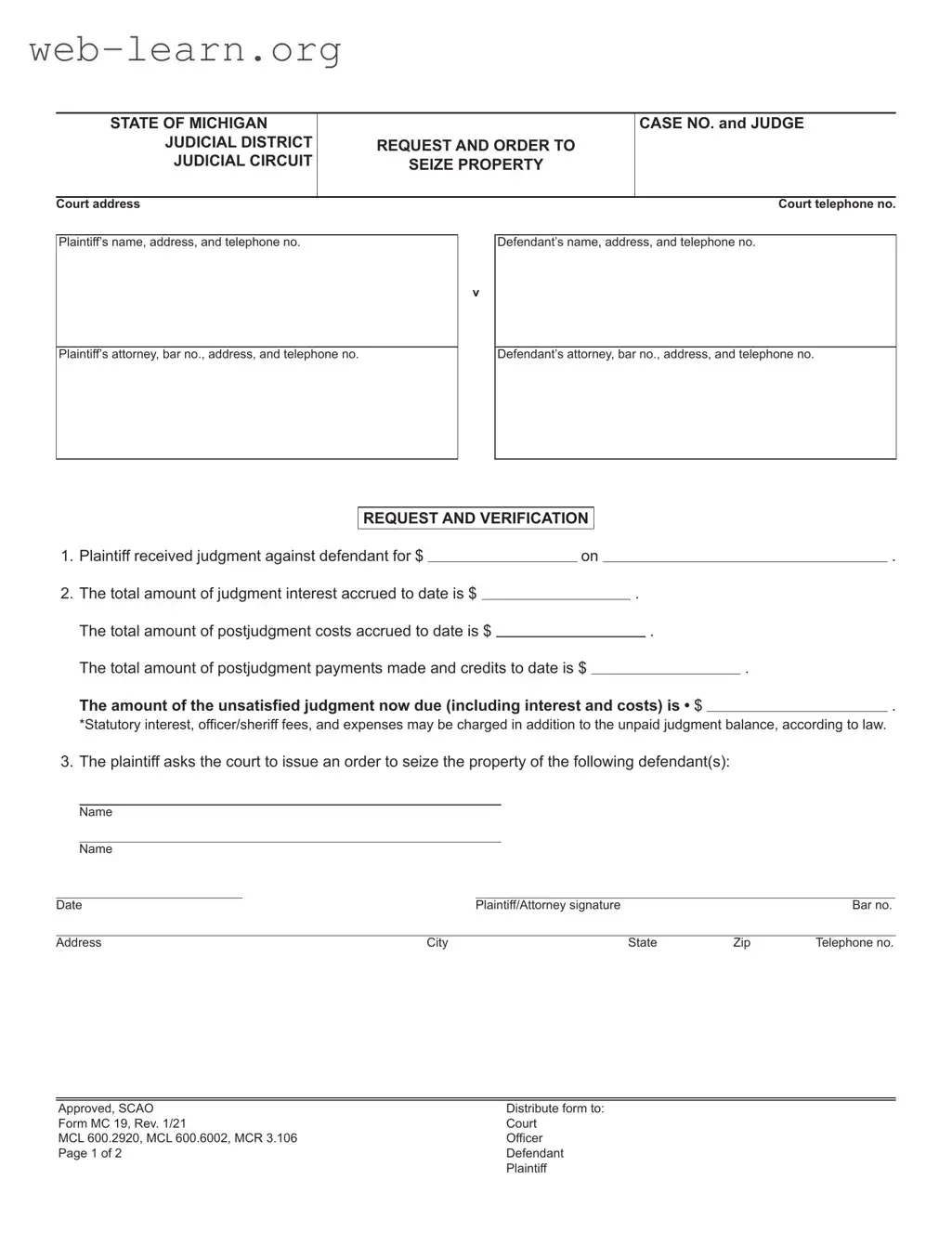
The Michigan MC 19 form plays a critical role in the legal process of seizing property to satisfy a judgment. This form serves as both a request and an order, allowing plaintiffs to seek the court's assistance in recovering unpaid debts. It outlines essential information, including the case number, names and addresses of both the plaintiff and defendant, and details about the judgment amount and accrued interest. The form also specifies the types of property that can be seized, ranging from personal belongings like vehicles and money to real estate, provided they are not exempt from seizure. Additionally, it details the responsibilities of the sheriff or authorized court officer tasked with executing the order, including the collection and deposit of sale proceeds. The MC 19 form ensures that all parties involved are informed of their rights and obligations, fostering transparency in the enforcement of court judgments.

STATE OF MICHIGAN JUDICIAL DISTRICT JUDICIAL CIRCUIT
Court address
REQUEST AND ORDER TO
SEIZE PROPERTY
CASE NO. and JUDGE
Court telephone no.
Plaintiff’s name, address, and telephone no.
Defendant’s name, address, and telephone no.
v
Plaintiff’s attorney, bar no., address, and telephone no.
Defendant’s attorney, bar no., address, and telephone no.
|
|
REQUEST AND VERIFICATION |
|
|
|
|
|
|
|
|||||
1. |
Plaintiff received judgment against defendant for $ |
|
on |
|
|
|
|
|
. |
|||||
2. |
The total amount of judgment interest accrued to date is $ |
|
|
|
|
|
. |
|
|
|
|
|||
|
The total amount of postjudgment costs accrued to date is $ |
|
|
|
|
|
. |
|
|
|
||||
|
The total amount of postjudgment payments made and credits to date is $ |
|
|
|
|
|
. |
|
||||||
|
The amount of the unsatisfied judgment now due (including interest and costs) is • $ |
|
|
. |
||||||||||
*Statutory interest, officer/sheriff fees, and expenses may be charged in addition to the unpaid judgment balance, according to law.
3. The plaintiff asks the court to issue an order to seize the property of the following defendant(s):
Name
Name
Date |
|
Plaintiff/Attorney signature |
Bar no. |
|
Address |
City |
State |
Zip |
Telephone no. |
Approved, SCAO |
Distribute form to: |
Form MC 19, Rev. 1/21 |
Court |
MCL 600.2920, MCL 600.6002, MCR 3.106 |
Officer |
Page 1 of 2 |
Defendant |
|
Plaintiff |

Request and Order to Seize Property (1/21) |
Case No. |
Page 2 of 2 |
|
ORDER
TO ANY SHERIFF, DEPUTY SHERIFF, OR AUTHORIZED COURT OFFICER - YOU ARE ORDERED TO:
1.Seize and sell, according to law, any of the personal property (as determined by the officer) of defendant(s) named above in the Request and Verification that is not exempt from seizure, as will be sufficient to satisfy the plaintiff’s demand, costs, and any statutory fees and expenses. Personal property may include, but is not limited to motor vehicles or money, wherever located.
2.If sufficient personal property of defendant(s) cannot be found within your jurisdiction, seize and sell any of the real property of defendant(s) not exempt from seizure, as will be sufficient to satisfy plaintiff’s demand, costs, and any statutory fees and expenses.
3.Collect from the sale of the property enough money to pay all of your statutory fees and statutory expenses.
4. Deposit proceeds of sale with the court plaintiff after deducting statutory fees and statutory expenses.
5. Claim and Delivery Only: Seize the property described in the attached judgment for claim and delivery and deliver to the plaintiff(s); or if the property is not found in the possession of the defendant(s), levy the value of it.
6.You must endorse the month, day, year, and hour that you receive this order, and that time is the effective date of this order. You must return this order not less than 20 days, nor more than 90 days, from the effective date. If you have begun to serve this order on or before the return date, you may complete the service and return after the return date.
7.You may not continue collecting on this order after the return date except as indicated in item 6.
8. Order to be served by |
|
|
|
. |
Authorized court officer/Deputy sheriff |
||||
|
|
|
|
|
Judge signature and date
ENDORSEMENT: I certify that I received this order on |
|
|
. |
Date and time |
|||
|
|
|
|
|
|
Authorized court officer/Deputy sheriff |
|
TO THE DEFENDANT: The person taking property must provide you with a receipt of all money paid by you and an inventory of the property taken. You may send the plaintiff a request to review postjudgment costs and fees.
| Fact Name | Fact Description |
|---|---|
| Form Title | The form is officially titled "Request and Order to Seize Property." It is used in Michigan courts. |
| Form Number | The form is designated as MC 19. |
| Governing Laws | This form is governed by Michigan Compiled Laws (MCL) 600.2920 and 600.6002, as well as Michigan Court Rules (MCR) 3.106. |
| Purpose | The purpose of the form is to request the court to issue an order for the seizure of property to satisfy a judgment. |
| Judgment Requirement | The plaintiff must have received a judgment against the defendant for a specified amount before filing this request. |
| Property Types | The order allows for the seizure of both personal and real property, depending on availability and exemption status. |
| Signature Requirement | The form must be signed by the plaintiff or their attorney, who must also provide their bar number and contact information. |
| Effective Date | The effective date of the order is the date the authorized officer receives it, which must be endorsed on the form. |
| Return Timeline | The order must be returned to the court within 20 to 90 days from the effective date, depending on service status. |
| Receipt Requirement | The officer taking property must provide a receipt for any money paid and an inventory of the property taken to the defendant. |
Completing the Michigan MC 19 form is a crucial step in the process of requesting a court order to seize property. This form must be filled out accurately and completely to ensure the request is processed without delays. Follow the steps outlined below to fill out the form correctly.
Once the form is completed, it is essential to file it with the appropriate court promptly. Make sure to keep copies for your records and follow any additional instructions provided by the court regarding the next steps in the process.
The Michigan MC 19 form is a legal document used to request and order the seizure of property from a defendant to satisfy a court judgment. It outlines the plaintiff's request for the court to authorize the seizure of either personal or real property that is not exempt from seizure.
The MC 19 form can be used by plaintiffs who have received a judgment against a defendant in a court case. It is intended for those seeking to recover unpaid amounts from the judgment through property seizure.
The form requires several key pieces of information, including:
The MC 19 form allows for the seizure of both personal and real property. Personal property may include items such as motor vehicles or cash. If personal property is insufficient, real property may be seized as well.
Once the court approves the MC 19 form, a sheriff or authorized court officer is ordered to seize the specified property. They must follow legal procedures to ensure the seizure is conducted properly and fairly.
The proceeds from the sale of seized property are used to cover the plaintiff's judgment, costs, and any statutory fees. After deducting these amounts, the remaining funds are deposited with the court for the plaintiff.
The order must be executed within 20 to 90 days from the effective date. If the officer begins the service before the return date, they may complete it even after the return date has passed.
Defendants have the right to receive a receipt for any money paid and an inventory of the property taken. They should also be informed about the seizure process and their rights under the law.
While the MC 19 form is a standardized document, specific details can be filled in according to the case. However, any modifications to the form itself should be done with caution and ideally under the guidance of a legal professional.
The MC 19 form can typically be obtained from the Michigan court's website or directly from the court where the case is being heard. It is important to use the most current version of the form.
Filling out the Michigan MC 19 form can be a straightforward process, but many people make common mistakes that can delay their case. One frequent error is failing to provide complete information in the "Request and Verification" section. This part requires specific details about the judgment amount, accrued interest, and any post-judgment costs. Leaving any of these fields blank can lead to complications or even rejection of the form.
Another mistake is not accurately identifying the defendant's details. It's crucial to include the full name and, if available, the date of birth of the defendant. Omitting this information can result in confusion and may hinder the court's ability to enforce the order. Ensure that all names are spelled correctly and that the addresses provided are current.
People often overlook the importance of signatures. The plaintiff or their attorney must sign the form in the designated area. Without a signature, the court may not consider the request valid. Additionally, it’s essential to include the attorney's bar number if applicable. This detail helps the court verify the attorney's credentials and ensures the request is processed smoothly.
Lastly, many individuals forget to pay attention to the timeline outlined in the form. The order must be returned within a specific time frame, usually between 20 to 90 days from the effective date. Ignoring this deadline can lead to complications in the enforcement of the order. It’s vital to mark your calendar and keep track of important dates to avoid unnecessary setbacks.
The Michigan MC 19 form is a critical document used in the process of seizing property to satisfy a judgment. However, it is often accompanied by several other forms and documents that play essential roles in the legal proceedings. Below is a list of these documents, each described briefly to provide clarity on their purposes and functions.
These forms collectively support the legal process surrounding property seizure in Michigan, ensuring that both plaintiffs and defendants are given fair treatment and that the judicial system operates smoothly. Understanding these documents can significantly aid individuals navigating the complexities of property seizure and judgment enforcement.
When filling out the Michigan MC 19 form, it is important to follow certain guidelines to ensure accuracy and compliance. Below is a list of things you should and shouldn't do.
Following these guidelines can help ensure that the process goes smoothly and that your rights are protected. If you have any questions or concerns, consider seeking assistance from a legal professional.
Understanding the Michigan MC 19 form can be challenging, and several misconceptions often arise. Here are six common misunderstandings about this form:
By clarifying these misconceptions, individuals can better navigate the complexities of the Michigan MC 19 form and understand their rights and responsibilities in the property seizure process.