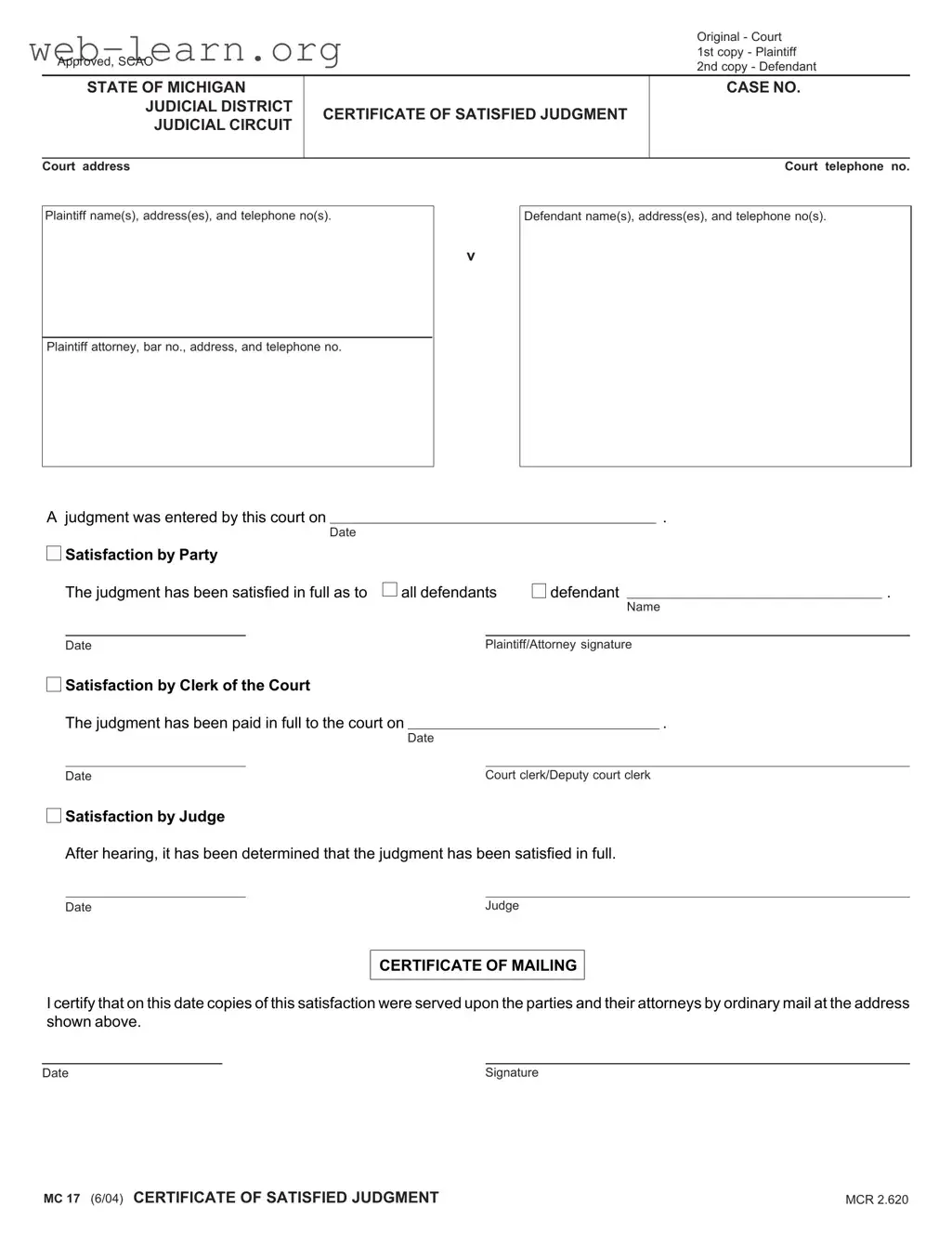
The Michigan MC 17 form plays a crucial role in the legal landscape, particularly when it comes to the documentation of satisfied judgments. This form is essential for both plaintiffs and defendants, as it officially certifies that a judgment rendered by the court has been fully satisfied. It includes vital information such as the case number, names and addresses of all parties involved, and the judgment date. The form is structured to accommodate multiple parties, ensuring clarity and compliance with legal standards. Once the judgment has been satisfied, either the plaintiff or the court can complete the appropriate section to indicate this status. This can be done through a signature from the plaintiff or their attorney, a clerk of the court, or even a judge, depending on the circumstances. Additionally, the form includes a certificate of mailing, which serves as proof that all relevant parties have been notified of the judgment's satisfaction. Understanding the MC 17 form is essential for anyone navigating the judicial system in Michigan, as it helps to formally close the chapter on a legal matter and provides peace of mind to those involved.
|
Original - Court |
|
Approved, SCAO |
1st copy - Plaintiff |
|
2nd copy - Defendant |
||
|
STATE OF MICHIGAN JUDICIAL DISTRICT JUDICIAL CIRCUIT
CERTIFICATE OF SATISFIED JUDGMENT
CASE NO.
Court address
Plaintiff name(s), address(es), and telephone no(s).
Plaintiff attorney, bar no., address, and telephone no.
A judgment was entered by this court on
Date
v
Court telephone no.
Defendant name(s), address(es), and telephone no(s).
.
Satisfaction by Party
The judgment has been satisfied in full as to |
all defendants |
defendant |
|
. |
|
|
Name |
|
|
|
Date |
|
Plaintiff/Attorney signature |
Satisfaction by Clerk of the Court |
|
|
|
|
The judgment has been paid in full to the court on |
|
. |
||
|
|
Date |
||
|
|
|
|
|
Date |
|
Court clerk/Deputy court clerk |
||
Satisfaction by Judge |
|
|
|
|
After hearing, it has been determined that the judgment has been satisfied in full.
Date |
Judge |
CERTIFICATE OF MAILING
I certify that on this date copies of this satisfaction were served upon the parties and their attorneys by ordinary mail at the address shown above.
Date |
Signature |
MC 17 (6/04) CERTIFICATE OF SATISFIED JUDGMENT |
MCR 2.620 |
| Fact Name | Details |
|---|---|
| Form Title | Certificate of Satisfied Judgment |
| Form Code | MC 17 |
| Governing Law | Michigan Court Rules (MCR) 2.620 |
| Purpose | This form certifies that a judgment has been satisfied in full. |
| Original Form | The original is court-approved and must be filed with the court. |
| Copies Required | One copy is for the plaintiff and another for the defendant. |
| Judgment Entry | The form includes details about when the judgment was entered. |
| Signature Requirement | The plaintiff or their attorney must sign to confirm satisfaction. |
| Clerk's Role | The court clerk must also sign to indicate the judgment was paid in full. |
| Mailing Certification | A certificate of mailing is included to confirm service to all parties. |
Filling out the Michigan MC 17 form is a straightforward process. This form is used to certify that a judgment has been satisfied. After completing the form, it should be submitted to the appropriate court for approval. Below are the steps to accurately fill out the MC 17 form.
The Michigan MC 17 form, also known as the Certificate of Satisfied Judgment, is a legal document used to confirm that a judgment issued by a court has been fully satisfied. This means that the debtor has paid the amount owed as determined by the court. The form is essential for officially recording that the obligation has been met, which can help clear the debtor’s credit record.
The MC 17 form must be completed by either the plaintiff (the person who won the judgment) or the court clerk. If the plaintiff has received payment in full, they can sign the form to indicate that the judgment has been satisfied. In some cases, the court clerk may also fill out the form to confirm that payment has been made to the court.
To fill out the MC 17 form, you will need to provide specific information including:
Make sure all information is accurate to avoid any delays in processing.
Once the MC 17 form is submitted to the court, it will be reviewed and processed. If everything is in order, the court will officially record that the judgment has been satisfied. You will receive confirmation, and the judgment will be updated in the court's records, which can also positively impact the debtor's credit report.
Typically, there is no fee for filing the MC 17 form itself, but it is always a good idea to check with the specific court where your case was filed. Some courts may have administrative fees for processing documents or for providing copies.
Many Michigan courts now offer electronic filing options, which may include the MC 17 form. Check with your local court's website for specific guidelines and procedures for electronic submissions. If e-filing is not available, you will need to submit the form in person or by mail.
Filling out the Michigan MC 17 form, which serves as a Certificate of Satisfied Judgment, requires attention to detail. One common mistake occurs when individuals neglect to include the correct case number. This number is crucial for identifying the specific judgment being satisfied. Omitting or miswriting this number can lead to significant delays in processing.
Another frequent error involves the plaintiff's information. It is essential to ensure that the names, addresses, and telephone numbers of all plaintiffs are accurately listed. If any of this information is incorrect or incomplete, it may hinder communication and create confusion about the parties involved.
People often overlook the section regarding the defendant's details. Just as with the plaintiff's information, the names, addresses, and phone numbers of all defendants must be filled out correctly. Inaccuracies here can result in the court being unable to confirm that the judgment has been satisfied for all parties.
Another mistake relates to the signature requirement. The form must be signed by either the plaintiff or their attorney. Failing to provide a signature can invalidate the document, making it essential to double-check that this critical step is completed.
Individuals sometimes forget to indicate the date of satisfaction. This date is significant as it marks when the judgment was fulfilled. Without this information, the court may not have a clear record of when the obligations were met, which can lead to further complications.
Additionally, the section for the clerk of the court's signature can be overlooked. This signature confirms that the judgment has been paid in full to the court. If this part is left blank, the form may be deemed incomplete, delaying the satisfaction process.
Another area of confusion often arises with the certificate of mailing. It is important to certify that copies of the satisfaction have been sent to all relevant parties. Neglecting to complete this section may lead to disputes over whether proper notification was given.
Finally, individuals may fail to keep a copy of the completed form for their records. Retaining a copy is vital for future reference and can serve as proof that the judgment was satisfied. Without this documentation, individuals may face challenges in case of any disputes regarding the status of the judgment.
The Michigan MC 17 form, which serves as a Certificate of Satisfied Judgment, is often accompanied by various other forms and documents that facilitate the legal process. Below is a list of related documents that may be used in conjunction with the MC 17 form, each serving a specific purpose.
These documents play crucial roles in the legal process, ensuring that all parties are informed and that the court's records are accurate. Proper use of these forms can streamline the resolution of legal matters.
The Michigan MC 17 form, known as the Certificate of Satisfied Judgment, serves a specific purpose in the legal process. Several other documents share similarities with this form, particularly in their function and structure. Here are four documents that are comparable to the MC 17 form:
When filling out the Michigan MC 17 form, it's important to be careful and thorough. Here are some key things to keep in mind:
Following these guidelines will help ensure that your form is filled out correctly and processed without unnecessary delays.
The Michigan MC 17 form, known as the Certificate of Satisfied Judgment, is essential for those involved in legal proceedings regarding the satisfaction of a judgment. However, several misconceptions surround its purpose and usage. Below are four common misunderstandings:
This is not true. While the plaintiff may initiate the process, the form is relevant for all parties involved. Defendants also need to be aware of the judgment's satisfaction, as it affects their legal standing.
Filing the form indicates that the judgment has been satisfied, but it does not erase the judgment from public records. It serves as an official acknowledgment that the obligations have been met.
There are specific timelines and procedures that must be followed when filing this form. It is crucial to ensure that the judgment has indeed been satisfied before submission to avoid complications.
While attorneys can assist in the process, individuals representing themselves can also file the form. It is important to follow the guidelines provided by the court to ensure proper filing.
When filling out the Michigan MC 17 form, there are several important points to keep in mind. This form is essential for certifying that a judgment has been satisfied. Here are key takeaways:
By following these guidelines, you can effectively complete the MC 17 form and ensure that all necessary parties are informed about the satisfaction of the judgment.