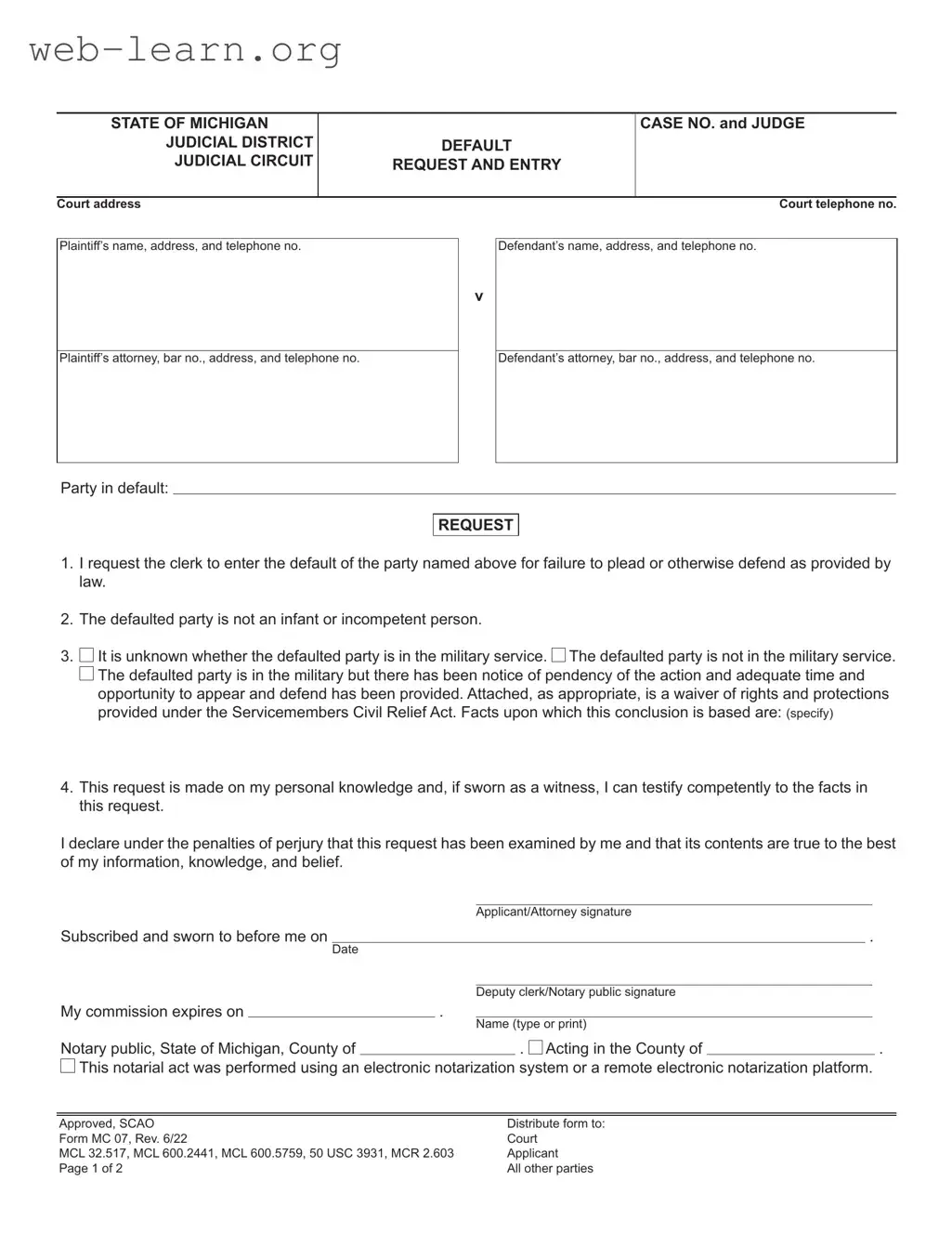
The Michigan MC 07 form serves as a crucial legal document within the state’s judicial system, specifically designed for cases where a party has failed to respond to a lawsuit. This form is essential for plaintiffs seeking to obtain a default judgment against a defendant who has not entered a plea or otherwise defended themselves in court. It consists of several key components, including an application for default, an entry of default, and an affidavit that must be completed by the applicant prior to submission. The application section requests the court clerk to officially recognize the default of the non-responsive party, while the entry section confirms that this default has been recorded. Furthermore, the affidavit requires the applicant to affirm several important facts, such as the nature of the claim and the status of the defaulted party regarding age, competency, and military service. Each part of the form plays a pivotal role in ensuring that the legal process adheres to court rules and that the rights of all parties are respected. Completing the MC 07 form accurately is vital, as it lays the groundwork for obtaining a judgment based on the claims made against the defaulted party, providing a clear path toward resolution in civil litigation.

STATE OF MICHIGAN JUDICIAL DISTRICT JUDICIAL CIRCUIT
DEFAULT
REQUEST AND ENTRY
CASE NO. and JUDGE
Court address |
Court telephone no. |
Plaintiff’s name, address, and telephone no.
Defendant’s name, address, and telephone no.
v
Plaintiff’s attorney, bar no., address, and telephone no.
Defendant’s attorney, bar no., address, and telephone no.
Party in default:
REQUEST
1.I request the clerk to enter the default of the party named above for failure to plead or otherwise defend as provided by law.
2.The defaulted party is not an infant or incompetent person.
3. It is unknown whether the defaulted party is in the military service. The defaulted party is not in the military service.
The defaulted party is in the military but there has been notice of pendency of the action and adequate time and opportunity to appear and defend has been provided. Attached, as appropriate, is a waiver of rights and protections provided under the Servicemembers Civil Relief Act. Facts upon which this conclusion is based are: (specify)
4.This request is made on my personal knowledge and, if sworn as a witness, I can testify competently to the facts in this request.
I declare under the penalties of perjury that this request has been examined by me and that its contents are true to the best of my information, knowledge, and belief.
|
|
|
|
|
Applicant/Attorney signature |
|
||||
Subscribed and sworn to before me on |
|
. |
|
|||||||
|
|
Date |
|
|
|
|
|
|
|
|
|
|
|
|
|
|
|
|
|
|
|
|
|
|
|
|
Deputy clerk/Notary public signature |
|
||||
My commission expires on |
|
. |
|
|
|
|
|
|
||
|
|
|
|
|
Name (type or print) |
|
||||
Notary public, State of Michigan, County of |
|
|
|
. Acting in the County of |
|
. |
||||
This notarial act was performed using an electronic notarization system or a remote electronic notarization platform. |
|
|||||||||
|
|
|
|
|
|
|
|
|
|
|
|
|
|
|
|
|
|
|
|
|
|
Approved, SCAO |
|
Distribute form to: |
|
|||||||
Form MC 07, Rev. 6/22 |
|
Court |
|
|||||||
MCL 32.517, MCL 600.2441, MCL 600.5759, 50 USC 3931, MCR 2.603 |
Applicant |
|
||||||||
Page 1 of 2 |
|
All other parties |
|
|||||||

Default Request and Entry (6/22)
Page 2 of 2
NOTE: Default can be entered by a district court clerk without the request of a party.
Case No.
DEFAULT ENTRY
The default of the party named above for failure to plead or otherwise defend is entered.
Use note: The party who sought the entry of the default is responsible for serving all parties in accordance with MCR 2.603(A)(2).
Court clerk signature and date
CERTIFICATE OF MAILING
I served a copy of this default request and entry on the parties or their attorneys by
Date |
Signature |
| Fact Name | Details |
|---|---|
| Form Purpose | The Michigan MC 07 form is used to request a default judgment against a party who has failed to respond to a legal complaint. |
| Governing Laws | This form is governed by Michigan Court Rule 2.603 and Michigan Compiled Laws (MCL) 32.17; MSA 4.609, as well as 50 USC 520. |
| Required Signatures | The form must be signed by the applicant or their attorney, and it also requires a signature from a deputy court clerk or notary public. |
| Affidavit Requirement | An affidavit must be completed by the applicant before the form is filed with the court, confirming specific claims about the defaulted party. |
| Default Entry | The court clerk will enter the default for the party who has failed to plead or defend the case. |
| Claim Specifics | The claim must be for a specific amount, which can be calculated, and the applicant must provide details about damages, interest, and costs. |
| Military Status | The applicant must verify that the defaulted party is not an infant or incompetent and must confirm their military status. |
After gathering the necessary information, you are ready to fill out the Michigan MC 07 form. This form is essential for requesting a default judgment when a party has failed to respond to a legal action. Ensure that you have all required details at hand before starting the process.
Once the form is completed, make copies for your records and submit it to the court. Be sure to follow any additional local court rules regarding filing procedures. Timeliness is crucial, so act promptly to avoid delays in your case.
What is the Michigan MC 07 form?
The Michigan MC 07 form is a legal document used to request the entry of default against a party who has failed to respond to a legal complaint. This form is essential in civil cases where one party, the plaintiff, seeks a judgment due to the other party's lack of response or defense.
Who needs to fill out the MC 07 form?
The form must be completed by the plaintiff or their attorney. It is crucial for individuals who are pursuing a case and have not received a response from the defendant. Proper completion of this form ensures that the court recognizes the defendant's default.
What information is required on the MC 07 form?
The MC 07 form requires several key pieces of information, including:
What does it mean to enter a default?
Entering a default means that the court acknowledges the defendant's failure to respond or defend against the claims made by the plaintiff. This can lead to a default judgment, where the court may grant the plaintiff the relief sought without further input from the defendant.
What is the affidavit section of the MC 07 form?
The affidavit section requires the applicant to swear that the information provided is true. It includes statements about the nature of the claim, the status of the defendant, and whether the claim is based on a written document. This section ensures that the court has verified information before proceeding with the default entry.
Can the MC 07 form be filed electronically?
Many courts in Michigan allow for electronic filing of documents, including the MC 07 form. It is advisable to check with the specific court where the case is filed to determine their electronic filing procedures and requirements.
What happens after the MC 07 form is filed?
Once the MC 07 form is filed, the court clerk will review it. If everything is in order, the court will enter the default against the defendant. The plaintiff may then proceed to seek a default judgment, which may involve a hearing or submission of additional documents to the court.
Is there a fee associated with filing the MC 07 form?
Yes, there is typically a filing fee associated with submitting the MC 07 form. The amount can vary by court, so it is important to verify the specific fee schedule with the court where the form will be filed.
What should I do if the defendant responds after the default is entered?
If the defendant responds after a default has been entered, they may file a motion to set aside the default. The court will then review the motion and decide whether to allow the defendant to proceed with their defense. It is advisable to seek legal guidance in such situations to ensure proper procedures are followed.
Filling out the Michigan MC 07 form can be straightforward, but many people make common mistakes that can lead to delays or complications in their case. One frequent error is failing to provide complete contact information for all parties involved. Missing names, addresses, or phone numbers can cause confusion and hinder the court's ability to process the application.
Another common mistake is neglecting to sign the application or affidavit. Both the applicant and the attorney must provide their signatures. Omitting a signature can result in the application being rejected outright, wasting time and resources.
Many applicants also overlook the requirement to specify the total amount due, including damages, interest, and costs. Leaving this section blank or providing an inaccurate total can lead to complications during the judgment process. It’s essential to ensure all figures are accurate and clearly stated.
Some individuals mistakenly assume that the court will automatically verify the military status of the defaulted party. It is crucial to check the appropriate box regarding military service status. Failing to do so may lead to legal repercussions if the defaulted party is indeed in military service.
Another frequent oversight involves the affidavit section. The affidavit must be completed before filing the application. Some applicants forget this step, which can delay proceedings. Ensure that the affidavit is filled out correctly and submitted with the application.
People often misinterpret the requirement regarding claims based on written evidence. If the claim is based on a note or other written evidence, it must be attached to the application. Failing to include this documentation can result in the court not recognizing the claim.
Additionally, some applicants do not provide adequate proof of notice to the defaulted party. The form requires confirmation that the defaulted party was informed about the action. Without this proof, the court may question the validity of the default application.
Lastly, forgetting to include the bill of costs can lead to issues. This document is essential for the court to understand the financial implications of the case. Always attach the bill of costs if applicable to ensure a smooth process.
By avoiding these common mistakes, individuals can enhance their chances of successfully navigating the Michigan MC 07 form process. Attention to detail is key in legal matters, and ensuring all sections are completed accurately will help facilitate a more efficient resolution.
The Michigan MC 07 form is a critical document used in the process of obtaining a default judgment in civil cases. However, several other forms and documents are often used in conjunction with it to ensure a comprehensive legal process. Below is a list of these related documents, each serving a specific purpose.
Using these forms in conjunction with the Michigan MC 07 ensures that all procedural requirements are met, facilitating a smoother legal process. Proper documentation is crucial for protecting the rights of all parties involved.
The Michigan MC 07 form serves as a critical document in the default judgment process. Several other documents share similarities in purpose and function. Here are six such documents:
Filling out the Michigan MC 07 form can be a straightforward process if you know what to do and what to avoid. Here’s a guide to help you navigate this important document.
By following these guidelines, you can improve your chances of a smooth and successful application process. Take your time, be thorough, and ensure that you meet all requirements. Good luck!
This form is applicable in a variety of civil cases where a plaintiff seeks a default judgment against a defendant who has failed to respond. It is not limited to specific case types.
The form requires the plaintiff to specify the amount of damages, interest, and costs. This information must be clear and substantiated to support the request for a default judgment.
While the form initiates the process for obtaining a default judgment, the court must still review the application and may require additional information or hearings before granting the judgment.
The affidavit must be completed and signed by the applicant before the application is filed with the court. This ensures that all necessary declarations are made upfront.
While attorneys often file this form, self-represented plaintiffs can also use it. The court system provides resources to assist individuals who choose to represent themselves.
A default judgment can be set aside if the defaulted party shows good cause and files a motion within a certain timeframe. Therefore, they may still have an opportunity to contest the judgment.
This form is just one step in the broader legal process. After a default judgment is entered, further actions may be necessary to enforce the judgment or collect the awarded amount.
When filling out and using the Michigan MC 07 form, it is essential to understand the following key points:
Understanding these takeaways will help ensure that your application for default judgment is processed smoothly and efficiently.