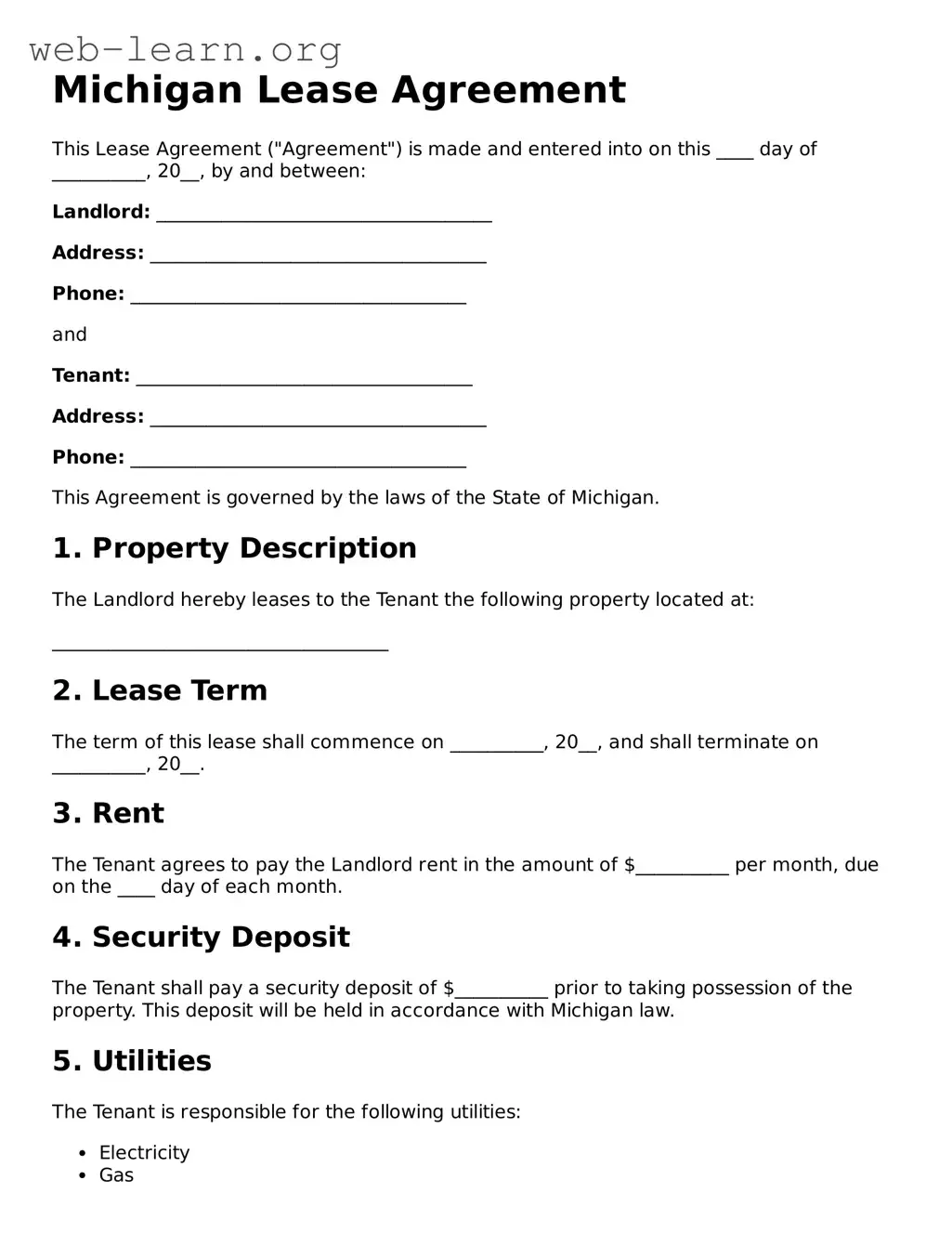
The Michigan Lease Agreement form serves as a crucial document in the landlord-tenant relationship, outlining the terms and conditions under which a property is rented. This legally binding contract typically covers essential elements such as the duration of the lease, rental payment details, security deposits, and maintenance responsibilities. It also specifies the rights and obligations of both parties, ensuring clarity and protection against potential disputes. Additional provisions may address issues like pet policies, utilities, and rules regarding property alterations. By clearly delineating these aspects, the Michigan Lease Agreement helps foster a transparent and fair rental experience, promoting a harmonious living environment for tenants while safeguarding the interests of landlords.
Michigan Lease Agreement
This Lease Agreement ("Agreement") is made and entered into on this ____ day of __________, 20__, by and between:
Landlord: ____________________________________
Address: ____________________________________
Phone: ____________________________________
and
Tenant: ____________________________________
Address: ____________________________________
Phone: ____________________________________
This Agreement is governed by the laws of the State of Michigan.
1. Property Description
The Landlord hereby leases to the Tenant the following property located at:
____________________________________
2. Lease Term
The term of this lease shall commence on __________, 20__, and shall terminate on __________, 20__.
3. Rent
The Tenant agrees to pay the Landlord rent in the amount of $__________ per month, due on the ____ day of each month.
4. Security Deposit
The Tenant shall pay a security deposit of $__________ prior to taking possession of the property. This deposit will be held in accordance with Michigan law.
5. Utilities
The Tenant is responsible for the following utilities:
6. Maintenance and Repairs
The Tenant agrees to maintain the property in good condition. The Landlord will be responsible for major repairs unless damage is caused by the Tenant's negligence.
7. Termination
Either party may terminate this Agreement by providing written notice at least ____ days prior to the intended termination date.
8. Governing Law
This Agreement shall be governed by and construed in accordance with the laws of the State of Michigan.
9. Signatures
By signing below, both parties agree to the terms outlined in this Lease Agreement.
Landlord Signature: ____________________________ Date: __________
Tenant Signature: _____________________________ Date: __________
| Fact Name | Details |
|---|---|
| Governing Law | The Michigan Lease Agreement is governed by the Michigan Compiled Laws. |
| Parties Involved | The lease agreement typically includes a landlord and a tenant. |
| Property Description | The agreement must clearly describe the rental property, including the address. |
| Lease Duration | It specifies the length of the lease, which can be fixed-term or month-to-month. |
| Rent Payment | The amount of rent, payment due date, and acceptable payment methods are outlined. |
| Security Deposit | The form details the amount of the security deposit and conditions for its return. |
| Maintenance Responsibilities | It defines the responsibilities of both the landlord and tenant regarding maintenance. |
| Termination Conditions | The agreement includes conditions under which either party can terminate the lease. |
Filling out the Michigan Lease Agreement form is a straightforward process. This document outlines the terms between a landlord and tenant, ensuring that both parties understand their rights and responsibilities. Follow these steps to complete the form accurately.
Once you’ve completed the form, review it carefully to ensure all information is accurate. Both parties should keep a copy of the signed agreement for their records.
What is a Michigan Lease Agreement?
A Michigan Lease Agreement is a legally binding document that outlines the terms and conditions under which a landlord rents property to a tenant. This agreement typically includes details such as the rental amount, duration of the lease, and responsibilities of both parties. It's essential for protecting the rights of both landlords and tenants by clearly stating what is expected from each party.
What are the key components of a Michigan Lease Agreement?
Several important elements should be included in a Michigan Lease Agreement:
How can I modify a Michigan Lease Agreement?
Modifying a Michigan Lease Agreement is possible, but it must be done carefully. Both the landlord and tenant must agree to any changes. Here are the steps to follow:
Keep in mind that significant changes may require a new lease agreement altogether. Always consult with a legal professional if you’re unsure.
What should I do if a dispute arises regarding the lease?
If a dispute arises, the first step is to communicate directly with the other party. Open dialogue can often resolve misunderstandings. If that doesn’t work, consider the following options:
Remember, keeping a record of all communications and agreements can be helpful if the situation escalates.
Filling out a Michigan Lease Agreement can be a straightforward process, but many individuals make common mistakes that can lead to misunderstandings or disputes later on. One frequent error is failing to include the full names of all tenants. It’s crucial that every person who will be living in the rental unit is listed. This ensures that all parties are legally recognized and responsible under the terms of the lease.
Another common mistake is neglecting to specify the rental term. Whether it’s a month-to-month agreement or a fixed-term lease, clarity is essential. Without this information, it can lead to confusion about when the lease begins and ends, potentially resulting in unintentional lease violations.
Many tenants also overlook the importance of detailing the rental amount and payment terms. It’s not enough to simply state the rent; you must also include when it is due and acceptable payment methods. This helps prevent disputes over missed payments or late fees.
Some individuals forget to include a security deposit clause. This is a vital part of any lease agreement. Clearly stating the amount of the deposit, the conditions for its return, and any deductions that may apply can protect both the landlord and the tenant.
Another mistake is not addressing maintenance responsibilities. It’s essential to outline who is responsible for repairs and maintenance of the property. This can save time and frustration if issues arise during the lease period.
Failing to include pet policies is a frequent oversight. If pets are allowed, it’s important to specify any related fees or restrictions. Conversely, if pets are not allowed, this should be clearly stated to avoid misunderstandings.
Some tenants forget to read the fine print. Each lease agreement contains specific terms and conditions that could impact the living situation. Taking the time to understand these provisions can prevent future conflicts.
Another mistake is not providing proper notice for lease termination. Depending on the type of lease, different notice periods may apply. Not adhering to these requirements can lead to unexpected charges or legal complications.
Lastly, individuals sometimes fail to keep copies of the signed lease. Having a copy for reference is essential in case any disputes arise. It serves as a record of the agreed-upon terms and can be invaluable in protecting your rights.
When entering into a rental agreement in Michigan, several additional forms and documents may be necessary to ensure clarity and protect the rights of both landlords and tenants. Below is a list of commonly used documents that complement the Michigan Lease Agreement. Each document serves a specific purpose in the leasing process.
These documents play an essential role in the rental process. By ensuring that all parties are informed and protected, they contribute to a smoother leasing experience. It is advisable to carefully review each document and seek assistance if needed to ensure compliance with Michigan laws.
When filling out the Michigan Lease Agreement form, it’s essential to approach the task with care. This document serves as a binding contract between a landlord and a tenant, outlining the terms of the rental arrangement. Here are some important dos and don’ts to keep in mind.
Understanding the Michigan Lease Agreement form is crucial for both landlords and tenants. However, several misconceptions can lead to confusion. Here are six common misunderstandings:
Many people believe that lease agreements are uniform across the board. In reality, each lease can be tailored to the specific needs of the landlord and tenant. This customization can include terms regarding pets, maintenance responsibilities, and payment schedules.
Some tenants and landlords think that a verbal agreement is enough to establish a lease. However, a written lease provides legal protection for both parties and clarifies expectations, making it essential to have everything documented.
While security deposits are generally refundable, this is not a guarantee. Deductions can occur for damages beyond normal wear and tear, unpaid rent, or cleaning costs. It's important to understand the conditions under which a deposit may be withheld.
Many tenants think that lease terms can be modified whenever they wish. In fact, changes to the lease must be agreed upon by both parties and documented in writing to be enforceable.
Some believe that landlords have unrestricted access to the rental property. In Michigan, landlords must provide reasonable notice before entering, except in emergencies. This protects tenants' privacy and rights.
It is a common misconception that lease agreements must last for a full year. In reality, leases can be short-term or long-term, depending on what the landlord and tenant agree upon.
Addressing these misconceptions can help both landlords and tenants navigate their agreements more effectively and ensure a smoother rental experience.
When filling out and using the Michigan Lease Agreement form, it’s essential to keep a few key points in mind. Understanding these can help ensure a smooth rental experience for both landlords and tenants.
Free Rental Agreement Template - The Lease Agreement is essential for ensuring a smooth rental experience.
Free Printable Lease Rental Agreement - The Lease Agreement can include penalties for late payments.
Free Lease Agreement Florida - Includes information on insurance requirements.
Lease Agreement Colorado - This form can help clarify the process for returning the security deposit at lease end.