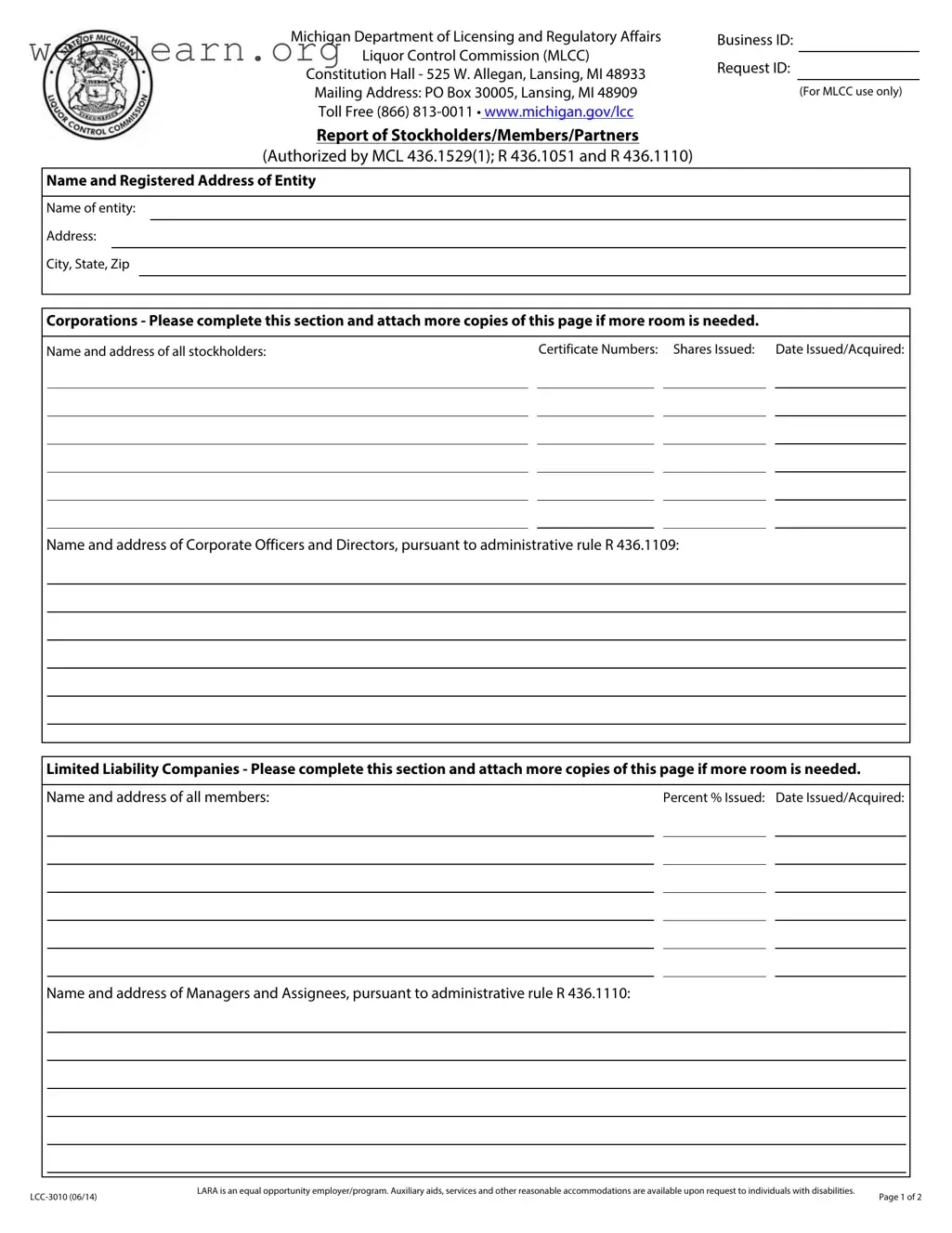
The Michigan LCC 3010 form serves as a crucial document for businesses operating within the liquor industry in Michigan. This form, officially known as the Report of Stockholders/Members/Partners, is required by the Michigan Department of Licensing and Regulatory Affairs (LARA) and the Liquor Control Commission (MLCC). It collects essential information about the ownership structure of a business, including details about stockholders, members, and partners. The form necessitates the submission of specific data such as the names and addresses of all individuals involved, their respective shares or ownership percentages, and the dates these shares were issued or acquired. Corporations, limited liability companies, and limited partnerships each have designated sections to provide this information accurately. Additionally, the applicant must certify the truthfulness of the information submitted, acknowledging the legal implications of providing false statements. The LCC 3010 form is integral to ensuring compliance with Michigan's liquor regulations, thereby promoting transparency and accountability within the industry.

Michigan Department of Licensing and Regulatory Affairs
Liquor Control Commission (MLCC)
Constitution Hall - 525 W. Allegan, Lansing, MI 48933 Mailing Address: PO Box 30005, Lansing, MI 48909 Toll Free (866)
Report of Stockholders/Members/Partners
(Authorized by MCL 436.1529(1); R 436.1051 and R 436.1110)
Business ID:
Request ID:
(For MLCC use only)
Name and Registered Address of Entity
Name of entity:
Address:
City, State, Zip
Corporations - Please complete this section and attach more copies of this page if more room is needed.
Name and address of all stockholders: |
|
Certificate Numbers: Shares Issued: Date Issued/Acquired: |
||||
|
|
|
|
|
|
|
|
|
|
|
|
|
|
|
|
|
|
|
|
|
|
|
|
|
|
|
|
|
|
|
|
|
|
|
|
|
|
|
|
|
|
Name and address of Corporate Officers and Directors, pursuant to administrative rule R 436.1109:
Limited Liability Companies - Please complete this section and attach more copies of this page if more room is needed.
Name and address of all members: |
|
Percent % Issued: Date Issued/Acquired: |
||
|
|
|
|
|
|
|
|
|
|
|
|
|
|
|
|
|
|
|
|
|
|
|
|
|
|
|
|
|
|
Name and address of Managers and Assignees, pursuant to administrative rule R 436.1110:
LARA is an equal opportunity employer/program. Auxiliary aids, services and other reasonable accommodations are available upon request to individuals with disabilities. |
Page 1 of 2 |
|
|

Michigan Department of Licensing and Regulatory Affairs
Liquor Control Commission (MLCC)
Constitution Hall - 525 W. Allegan, Lansing, MI 48933 Mailing Address: PO Box 30005, Lansing, MI 48909 Toll Free (866)
Report of Stockholders/Members/Partners
(Authorized by MCL 436.1529(1); R 436.1051 and R 436.1110)
Business ID:
Request ID:
(For MLCC use only)
Limited Partnerships - Please complete this section and attach more copies of this page if more room is needed.
Name and address of all partners: |
|
Percent % Issued: Date Issued/Acquired: |
||
|
|
|
|
|
|
|
|
|
|
|
|
|
|
|
|
|
|
|
|
|
|
|
|
|
|
|
|
|
|
Name and address of Managers, pursuant to administrative rule R 436.1111:
Signature of Applicant:
I certify that the information contained in this form is true and accurate to the best of my knowledge and belief. I agree to comply with all requirements of the Michigan Liquor Control Code and Administrative Rules. I also understand that providing false or fraudulent information is a violation of the Liquor Control Code pursuant to MCL 436.2003.
Date |
Print name of applicant/licensee and title |
Signature of applicant/licensee |
LARA is an equal opportunity employer/program. Auxiliary aids, services and other reasonable accommodations are available upon request to individuals with disabilities. |
Page 2 of 2 |
|
|
| Fact Name | Details |
|---|---|
| Governing Laws | This form is authorized by MCL 436.1529(1), R 436.1051, and R 436.1110. |
| Purpose | The LCC 3010 form reports stockholders, members, or partners of an entity applying for a liquor license. |
| Submission Requirements | Entities must provide the names and addresses of all stockholders, members, or partners, along with relevant details. |
| Equal Opportunity Statement | The Michigan Department of Licensing and Regulatory Affairs is an equal opportunity employer and offers accommodations for individuals with disabilities. |
After completing the Michigan LCC 3010 form, you will need to submit it to the Michigan Liquor Control Commission (MLCC). Ensure that all required sections are filled out accurately. This form is important for reporting stockholders, members, or partners associated with your business entity.
What is the Michigan LCC 3010 form?
The Michigan LCC 3010 form is a report that must be submitted to the Michigan Liquor Control Commission (MLCC). It provides detailed information about the stockholders, members, or partners of a business entity that holds a liquor license in Michigan. This form is essential for ensuring compliance with the Michigan Liquor Control Code.
Who needs to fill out the LCC 3010 form?
Any business entity that is licensed to sell or distribute liquor in Michigan must complete this form. This includes corporations, limited liability companies (LLCs), and limited partnerships. Each type of entity has specific sections within the form that need to be filled out accurately.
What information is required on the form?
The LCC 3010 form requires various details, including:
Make sure to provide complete and accurate information to avoid any delays in processing.
How do I submit the LCC 3010 form?
The completed LCC 3010 form can be submitted to the MLCC either by mail or in person. The mailing address is:
Michigan Department of Licensing and Regulatory Affairs
Liquor Control Commission
Constitution Hall
525 W. Allegan
Lansing, MI 48933
Ensure that you send it to the correct address and keep a copy for your records.
Is there a deadline for submitting the LCC 3010 form?
Yes, the LCC 3010 form must be submitted within a specified timeframe, typically when there are changes in ownership or at the time of license renewal. Always check with the MLCC for the most current deadlines to avoid any penalties.
What happens if I provide false information on the form?
Providing false or fraudulent information on the LCC 3010 form is a serious violation of the Liquor Control Code. This can lead to penalties, including fines, suspension, or revocation of your liquor license. It's crucial to ensure all information is accurate and truthful.
Can I attach additional pages to the form?
Yes, if you need more space to list stockholders, members, or partners, you can attach additional pages. Just make sure to clearly label them and ensure all information is consistent with the main form.
Who needs to sign the LCC 3010 form?
The form must be signed by the applicant or licensee. This individual certifies that all information provided is accurate and that they agree to comply with all relevant laws and regulations. This signature is essential for the form to be considered valid.
Where can I find more information about the LCC 3010 form?
For additional details or guidance regarding the LCC 3010 form, you can visit the MLCC website at www.michigan.gov/lcc. The website offers resources, contact information, and updates related to liquor licensing in Michigan.
What if I have a disability and need assistance with the form?
The MLCC provides auxiliary aids and services for individuals with disabilities. If you require assistance, it is recommended to contact the MLCC directly to discuss your needs and ensure you receive the necessary support.
When filling out the Michigan LCC 3010 form, individuals often make several common mistakes that can lead to delays or issues with their application. One frequent error is failing to provide complete information. Each section of the form requires specific details about stockholders, members, or partners. Omitting any required information can result in the form being returned for corrections.
Another mistake is not signing the application. The form explicitly requires the signature of the applicant, certifying that the information is accurate. Without a signature, the application cannot be processed, causing unnecessary delays.
People also tend to overlook the need for additional copies of the form. If there are more stockholders, members, or partners than the space provided allows, individuals must attach additional copies. Failing to do so can lead to incomplete submissions.
Another common issue is incorrectly entering dates. The form asks for the date issued or acquired for shares or membership interests. Providing the wrong date can raise questions about the legitimacy of the ownership structure, potentially complicating the approval process.
Individuals sometimes make the mistake of not including the correct business ID or request ID. These identifiers are crucial for processing the application. Without them, the Liquor Control Commission may struggle to match the form with the corresponding business records.
In some cases, applicants forget to double-check the names and addresses of stockholders, members, or partners. Any discrepancies in this information can lead to confusion and may require additional verification steps, further delaying the process.
Another frequent error involves incomplete descriptions of ownership percentages. The form requires clear percentages for each stockholder or member. If these percentages do not add up to 100% or are left blank, it can raise red flags during the review.
People may also neglect to review the administrative rules referenced in the form. Understanding these rules is essential for compliance and can help avoid common pitfalls that might arise during the application process.
Lastly, individuals sometimes fail to keep a copy of the submitted form for their records. This oversight can create challenges if there are questions or issues later on, as having a copy can provide clarity and support for any inquiries.
By being aware of these common mistakes, applicants can improve their chances of a smooth and efficient application process when submitting the Michigan LCC 3010 form.
The Michigan LCC 3010 form is essential for reporting stockholders, members, or partners in a business applying for or renewing a liquor license. Along with this form, several other documents are often required to ensure compliance with state regulations. Below is a list of these documents and a brief description of each.
These documents, when submitted alongside the Michigan LCC 3010 form, help establish a comprehensive view of the business's structure and compliance with Michigan's liquor licensing laws. Ensure all information is accurate and complete to facilitate the licensing process.
The Michigan LCC 3010 form serves as a report of stockholders, members, or partners for businesses involved in liquor control. Several other documents share similarities with this form in terms of purpose and required information. Below is a list of ten such documents:
When filling out the Michigan LCC 3010 form, keep these important tips in mind:
Here are eight misconceptions about the Michigan LCC 3010 form, along with clarifications for each:
This form is applicable to various business entities, including corporations, limited liability companies (LLCs), and limited partnerships. Each type must provide specific information as required.
All members, partners, and corporate officers must be reported, regardless of the business structure. This ensures full transparency.
A signature from the applicant is mandatory. This certifies that the information provided is accurate and complies with the Liquor Control Code.
This form must be submitted promptly to avoid delays in processing. Timely submission is crucial for compliance with state regulations.
Incomplete forms will likely be rejected. Ensure all required sections are filled out thoroughly before submission.
While the owner typically completes the form, authorized representatives can also fill it out, provided they have the necessary permissions.
This form is also used for updates to existing licenses. Any changes in ownership or structure must be reported using this form.
Understanding and complying with the referenced administrative rules is essential. Failure to do so can lead to penalties or denial of the application.
When completing the Michigan LCC 3010 form, there are several important aspects to keep in mind. The following key takeaways will help ensure the process goes smoothly: