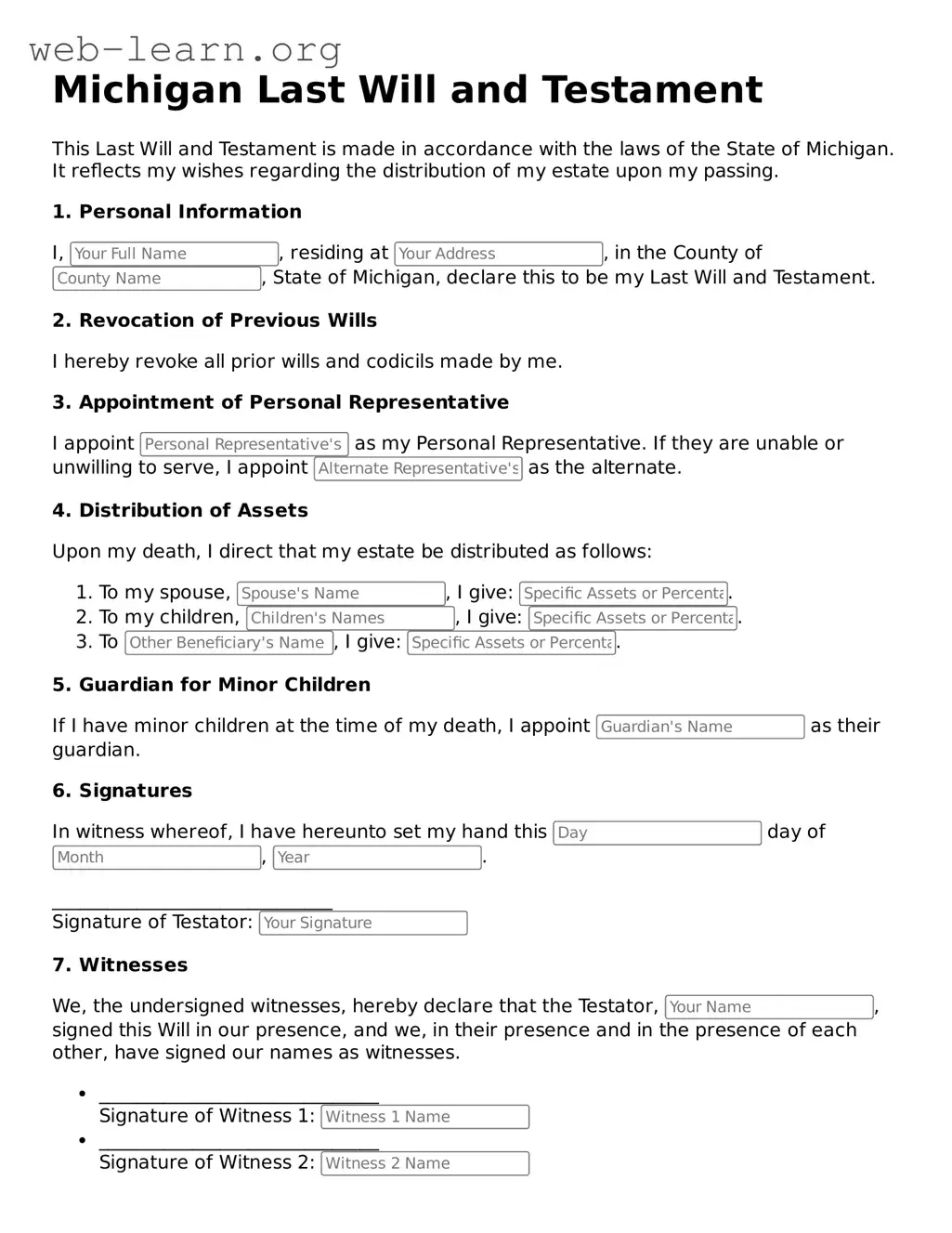
Creating a Last Will and Testament is an essential step in ensuring your wishes are honored after your passing. In Michigan, this legal document serves as a guide for distributing your assets, appointing guardians for minor children, and designating an executor to manage your estate. It allows you to specify how your property should be divided among your loved ones, ensuring that your intentions are clear and legally binding. Additionally, the form provides a space for you to express any specific wishes regarding funeral arrangements. By taking the time to complete this form, you can bring peace of mind to yourself and your family, knowing that your affairs will be handled according to your desires. Understanding the components of the Michigan Last Will and Testament form is vital, as it lays the groundwork for a smooth transition during a difficult time.
Michigan Last Will and Testament
This Last Will and Testament is made in accordance with the laws of the State of Michigan. It reflects my wishes regarding the distribution of my estate upon my passing.
1. Personal Information
I, , residing at , in the County of , State of Michigan, declare this to be my Last Will and Testament.
2. Revocation of Previous Wills
I hereby revoke all prior wills and codicils made by me.
3. Appointment of Personal Representative
I appoint as my Personal Representative. If they are unable or unwilling to serve, I appoint as the alternate.
4. Distribution of Assets
Upon my death, I direct that my estate be distributed as follows:
5. Guardian for Minor Children
If I have minor children at the time of my death, I appoint as their guardian.
6. Signatures
In witness whereof, I have hereunto set my hand this day of , .
______________________________
Signature of Testator:
7. Witnesses
We, the undersigned witnesses, hereby declare that the Testator, , signed this Will in our presence, and we, in their presence and in the presence of each other, have signed our names as witnesses.
This document is executed in accordance with the Michigan Compiled Laws, Act 386 of 1998, as amended.
| Fact Name | Description |
|---|---|
| Legal Requirement | In Michigan, a Last Will and Testament must be in writing to be valid. |
| Witnesses | The will must be signed by at least two witnesses who are present at the same time. |
| Age Requirement | Testators must be at least 18 years old to create a valid will in Michigan. |
| Revocation | A will can be revoked by creating a new will or by destroying the original document. |
| Governing Law | The Michigan Probate Code governs the creation and execution of wills. |
| Self-Proving Will | A self-proving will includes a notarized affidavit from the witnesses, simplifying the probate process. |
Filling out the Michigan Last Will and Testament form is an important step in planning for the future. After completing the form, it is advisable to review it carefully to ensure all information is accurate and reflects your wishes. Once finalized, the document should be signed and witnessed according to Michigan law to ensure its validity.
What is a Last Will and Testament?
A Last Will and Testament is a legal document that outlines how a person's assets and affairs will be handled after their death. It allows individuals to specify who will inherit their property, name guardians for minor children, and appoint an executor to manage the estate. This document ensures that a person's wishes are honored and can help avoid disputes among heirs.
Why do I need a Last Will and Testament in Michigan?
Having a Last Will and Testament is important for several reasons. In Michigan, if you pass away without a will, your assets will be distributed according to state law, which may not align with your wishes. A will allows you to take control over the distribution of your estate, ensuring that your loved ones receive what you intended.
Who can create a Last Will and Testament in Michigan?
In Michigan, any person who is at least 18 years old and of sound mind can create a Last Will and Testament. This means you must understand the nature of the document and the consequences of your decisions. It is advisable to seek guidance if you have any questions about your capacity to create a will.
What are the requirements for a valid Last Will and Testament in Michigan?
To be valid in Michigan, a Last Will and Testament must meet certain criteria:
Can I change or revoke my Last Will and Testament?
Yes, you can change or revoke your Last Will and Testament at any time while you are still alive. To make changes, you can create a new will or add a codicil, which is a document that modifies your existing will. Make sure to follow the same signing and witnessing requirements as the original will to ensure validity.
What happens if I die without a will in Michigan?
If you die without a will, your estate will be distributed according to Michigan's intestacy laws. This means that your assets will be divided among your relatives according to a predetermined order. This process can be lengthy and may not reflect your wishes, making it crucial to have a will in place.
Do I need an attorney to create a Last Will and Testament in Michigan?
While it is not legally required to have an attorney draft your will, it is highly recommended. An attorney can provide valuable guidance and ensure that your will complies with Michigan laws. If your estate is complex or if you have specific wishes, consulting with a legal professional can help avoid potential issues down the road.
How should I store my Last Will and Testament?
Once your Last Will and Testament is completed, store it in a safe and accessible place. Common options include a fireproof safe at home, a safety deposit box, or with your attorney. Inform your executor and trusted family members about the location of your will to ensure it can be easily found when needed.
Can I use a template for my Last Will and Testament?
Yes, you can use a template to create your Last Will and Testament. However, ensure that the template complies with Michigan laws and meets your specific needs. While templates can be a helpful starting point, consider consulting with an attorney for personalized advice and to avoid any legal pitfalls.
Filling out a Last Will and Testament form can be a daunting task, and many individuals make common mistakes that can lead to confusion or disputes later on. One frequent error is failing to properly identify the beneficiaries. It’s essential to clearly state who will inherit your assets. Ambiguities in names or relationships can create complications, especially if there are multiple individuals with similar names.
Another mistake is not updating the will regularly. Life changes such as marriage, divorce, or the birth of children can significantly affect your wishes. If you don’t revise your will to reflect these changes, your document may not accurately represent your intentions, potentially leaving loved ones in difficult situations.
Some people overlook the importance of having witnesses. In Michigan, a will must be signed in the presence of at least two witnesses who are not beneficiaries. Neglecting this step can render the will invalid, which could result in the state deciding how your assets are distributed instead of your chosen beneficiaries.
Additionally, individuals often forget to sign and date the document. A will that is unsigned is not legally binding, and without a date, it can lead to questions about its validity. It’s crucial to ensure that all necessary signatures are in place before considering the will complete.
Another common oversight is not including a self-proving affidavit. This document can simplify the probate process by allowing the will to be accepted without the need for witness testimony. Omitting this step can lead to delays and complications when the time comes to execute your wishes.
Lastly, some individuals may fail to consider the implications of their choices regarding guardianship for minor children. It is vital to designate a guardian in your will. If you neglect to do so, the court will make that decision, which may not align with your preferences. Taking the time to thoughtfully consider these aspects can prevent unnecessary complications for your loved ones.
When creating a Last Will and Testament in Michigan, it’s important to consider other related documents that can help ensure your wishes are carried out effectively. Each of these documents plays a unique role in estate planning and can provide additional clarity and support for your overall plan.
Incorporating these documents into your estate planning can provide peace of mind and ensure that your wishes are honored. Each document serves a specific purpose, and together they create a comprehensive plan for your future and the future of your loved ones.
The Last Will and Testament is a crucial legal document that outlines how a person's assets will be distributed after their passing. Several other documents serve similar purposes or relate to estate planning. Here are seven documents that share similarities with a Last Will and Testament:
Each of these documents plays a vital role in estate planning and can work in conjunction with a Last Will and Testament to ensure that an individual's wishes are honored.
When filling out the Michigan Last Will and Testament form, it's essential to approach the task with care. Here are some important do's and don'ts to keep in mind:
Following these guidelines can help ensure that your wishes are honored and that the process goes smoothly for your loved ones.
When it comes to creating a Last Will and Testament in Michigan, several misconceptions can lead to confusion. Understanding these myths is crucial for anyone looking to ensure their wishes are carried out after their passing. Here are seven common misconceptions:
Many people believe that a will must be notarized to be valid. In Michigan, while notarization is not required, it can help prove the authenticity of the document in court.
This is a common myth. Everyone can benefit from having a will, regardless of their financial situation. A will helps ensure that your wishes regarding asset distribution are respected.
While it is true that Michigan recognizes formal wills, handwritten or holographic wills can be valid if they meet certain criteria. However, they may be more prone to disputes.
This misconception is misleading. In Michigan, you can change or revoke your will at any time as long as you are of sound mind. This flexibility allows you to adapt to life changes.
While a spouse may inherit a portion of the estate, not all assets automatically transfer to them. The distribution depends on how the assets are titled and the specific terms of the will.
Wills can do more than just distribute property. They can also appoint guardians for minor children and designate an executor to manage the estate, ensuring your wishes are followed.
While some may think that drafting a will requires a lawyer and significant expense, many resources are available. Simple wills can often be created using templates or online services, making it accessible to most people.
Understanding these misconceptions can empower individuals to take control of their estate planning. A well-crafted will can provide peace of mind and ensure that one's wishes are honored.
When filling out and using the Michigan Last Will and Testament form, there are several important considerations to keep in mind. The following points summarize key takeaways:
Following these guidelines can help ensure that the will accurately reflects your intentions and complies with Michigan law.
How to Make a Will in Arkansas - Facilitates a smoother probate process by providing clear instructions.
Will Template Georgia - Can be created with or without legal assistance, depending on complexity.
Free Idaho Will Form - Can help avoid lengthy court battles over the estate.
Connecticut Will - A Last Will can help ensure that your legacy continues as you intended.