Homepage Blank Michigan L 4258 Form
Outline

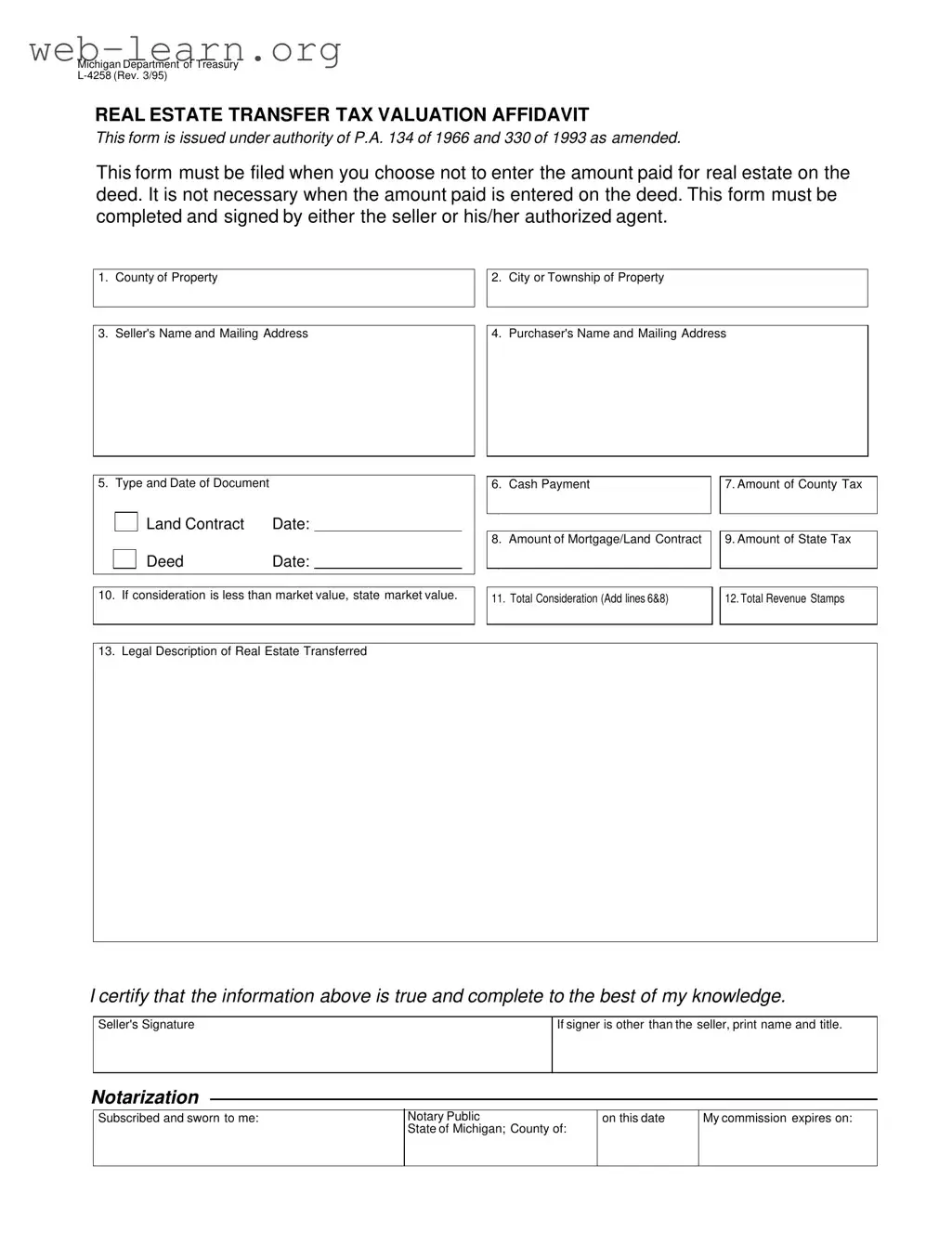
The Michigan L-4258 form, officially known as the Real Estate Transfer Tax Valuation Affidavit, plays a crucial role in the process of transferring real estate in Michigan. Issued under the authority of specific public acts, this form is necessary when the buyer and seller opt not to disclose the sale price directly on the deed. It serves as a formal declaration of the transaction details, ensuring that the state collects the appropriate transfer taxes. The form must be filled out accurately by either the seller or an authorized agent, capturing essential information such as the property’s location, the names and addresses of both the seller and purchaser, and the type of document involved in the transaction. Additionally, it requires the disclosure of any cash payments and mortgage amounts, along with a declaration of the total consideration for the property. If the sale price is below the market value, the form mandates that the market value be stated. Not only does the L-4258 facilitate compliance with tax regulations, but it also helps to create a transparent record of the transaction. Completing this form correctly is vital, as it requires signatures and notarization, underscoring the importance of accuracy and honesty in real estate dealings.

Sample - Michigan L 4258 Form

Michigan Department of Treasury

L-4258 (Rev. 3/95)

REAL ESTATE TRANSFER TAX VALUATION AFFIDAVIT

This form is issued under authority of P.A. 134 of 1966 and 330 of 1993 as amended.

This form must be filed when you choose not to enter the amount paid for real estate on the deed. It is not necessary when the amount paid is entered on the deed. This form must be completed and signed by either the seller or his/her authorized agent.

1. County of Property

3. Seller's Name and Mailing Address

2. City or Township of Property

4. Purchaser's Name and Mailing Address

5. Type and Date of Document

Land Contract

Date:

DeedDate:

10. If consideration is less than market value, state market value.

6. Cash Payment

$

8. Amount of Mortgage/Land Contract

$

11. Total Consideration (Add lines 6&8)

7.Amount of County Tax

9.Amount of State Tax

12. Total Revenue Stamps

13. Legal Description of Real Estate Transferred

I certify that the information above is true and complete to the best of my knowledge.

Seller's Signature

If signer is other than the seller, print name and title.

NOTARIZATION

Subscribed and sworn to me:

Notary Public

State of Michigan; County of:

on this date

My commission expires on:

Form Information

Fact Name Description
Form Title Michigan Department of Treasury L-4258 - Real Estate Transfer Tax Valuation Affidavit
Governing Laws This form is issued under authority of P.A. 134 of 1966 and P.A. 330 of 1993, as amended.
Filing Requirement The form must be filed when the amount paid for real estate is not entered on the deed.
Who Completes the Form Either the seller or an authorized agent must complete and sign the form.
Information Required Includes details such as seller's name, purchaser's name, property location, and financial details.
Notarization The form must be notarized, confirming the accuracy of the provided information.

Detailed Guide for Filling Out Michigan L 4258

Filling out the Michigan L 4258 form is straightforward. This form is necessary when you opt not to list the amount paid for real estate on the deed. After completing the form, it must be signed by the seller or their authorized agent, and then notarized. Here’s how to fill it out step by step.

  1. Begin by entering the County of Property where the real estate is located.
  2. Next, provide the City or Township of Property.
  3. Fill in the Seller's Name and Mailing Address.
  4. Then, enter the Purchaser's Name and Mailing Address.
  5. Indicate the Type and Date of Document. Specify whether it's a Land Contract or a Deed and include the respective dates.
  6. Record the Cash Payment amount in the designated space.
  7. Next, enter the Amount of Mortgage/Land Contract.
  8. If the consideration is less than the market value, state the market value.
  9. Add the amounts from lines 6 and 8 to calculate the Total Consideration and write it down.
  10. Fill in the Amount of County Tax.
  11. Next, record the Amount of State Tax.
  12. Calculate the Total Revenue Stamps and write that amount down.
  13. Provide the Legal Description of Real Estate Transferred.
  14. Finally, sign the form as the seller. If someone else is signing, print their name and title.
  15. Ensure the form is notarized by a Notary Public. They will need to fill out their information and sign.

Obtain Answers on Michigan L 4258

  1. What is the Michigan L 4258 form?

    The Michigan L 4258 form, also known as the Real Estate Transfer Tax Valuation Affidavit, is a document required by the Michigan Department of Treasury. This form must be filed when the seller chooses not to disclose the sale amount on the deed. It serves to provide necessary information regarding the transaction for tax purposes.

  2. When is the L 4258 form necessary?

    The form is necessary in situations where the amount paid for real estate is not included on the deed. If the sale amount is explicitly stated on the deed, there is no need to file the L 4258. It helps ensure that the appropriate transfer taxes are calculated and reported.

  3. Who needs to complete the L 4258 form?

    The form must be completed and signed by either the seller or an authorized agent representing the seller. This requirement ensures that the information provided is accurate and verified by someone involved in the transaction.

  4. What information is required on the L 4258 form?

    • County and city or township of the property
    • Seller's name and mailing address
    • Purchaser's name and mailing address
    • Type of document (e.g., deed or land contract) and relevant dates
    • Details regarding cash payment and any mortgage or land contract amounts
    • Market value if the consideration is less than market value
    • Total consideration and revenue stamps
    • Legal description of the real estate being transferred
  5. Is notarization required for the L 4258 form?

    Yes, the form must be notarized. The seller or authorized agent must sign the document in the presence of a notary public. This adds a layer of verification to the information provided, ensuring that it is accurate and legally binding.

  6. What happens if the L 4258 form is not filed?

    If the L 4258 form is not filed when required, it may lead to complications in the property transfer process. This can include delays in recording the deed or potential penalties related to unpaid transfer taxes. It is important to ensure that all necessary forms are completed and submitted to avoid such issues.

Common mistakes

Filling out the Michigan L 4258 form can be a straightforward process, but several common mistakes can lead to delays or complications. One frequent error occurs when individuals fail to provide accurate information about the property’s location. The county and city or township sections must be filled out correctly to ensure the form is processed without issues. Missing or incorrect details can result in the form being returned for correction.

Another common mistake is neglecting to include the seller’s and purchaser’s names and mailing addresses. This information is crucial for identification and communication purposes. Omitting this information can lead to confusion and may hinder the transfer process.

Many people also overlook the requirement to indicate the type and date of the document. Whether it is a land contract or a deed, this detail is essential for categorizing the transaction appropriately. Failing to specify this can lead to misunderstandings regarding the nature of the transfer.

Inaccurate calculations often arise when determining the total consideration. It is important to add the cash payment and the amount of the mortgage or land contract accurately. Errors in these figures can affect tax assessments and lead to penalties.

Additionally, some individuals may forget to provide the market value if the consideration is less than the market value. This information is necessary for tax purposes and ensures compliance with state regulations. Neglecting this requirement can raise questions during the review process.

Finally, the notarization section is sometimes improperly completed. The form must be signed in the presence of a notary public, and the notary’s information must be filled out accurately. Failing to do so can invalidate the affidavit, causing further delays.

Documents used along the form

The Michigan L-4258 form is a crucial document for real estate transactions, particularly when the purchase amount isn't disclosed on the deed. However, it is often accompanied by other forms and documents that serve various purposes in the real estate transfer process. Understanding these additional documents can help ensure a smooth transaction.

  • Michigan Property Transfer Affidavit (Form 2766): This form is used to report the sale of property to the local assessing office. It includes details about the property and the sale, ensuring that property taxes are accurately assessed based on the new ownership.
  • Deed: The deed is the legal document that transfers ownership of the property from the seller to the buyer. It must be signed and recorded to be effective. The deed outlines the parties involved, the property description, and any conditions of the sale.
  • Closing Statement (HUD-1 or Closing Disclosure): This document summarizes the financial aspects of the real estate transaction, including the purchase price, closing costs, and any adjustments. It provides transparency to both the buyer and seller regarding the financial obligations involved.
  • Title Insurance Policy: This policy protects the buyer and lender from any potential claims against the property title. It ensures that the buyer has clear ownership and that there are no undisclosed liens or encumbrances on the property.
  • Affidavit of Title: This document is often signed by the seller to affirm that they hold clear title to the property and that there are no undisclosed claims or issues. It serves as a declaration of the seller's ownership status.
  • Mortgage or Loan Documents: If the buyer is financing the purchase, these documents outline the terms of the loan, including interest rates, repayment schedules, and any obligations of the borrower. They are essential for understanding the financial responsibilities associated with the property.

Each of these documents plays a significant role in the real estate transaction process in Michigan. Familiarity with them can help buyers and sellers navigate their responsibilities and rights more effectively, leading to a successful transfer of property ownership.

Similar forms

The Michigan L 4258 form is a specific document used for real estate transactions. Several other forms serve similar purposes in various contexts. Below is a list of documents that share similarities with the L 4258 form:

  • IRS Form 1099-S: This form is used to report the sale or exchange of real estate. Like the L 4258, it requires details about the property and the parties involved in the transaction.
  • Michigan L-4260: This is a property transfer affidavit that provides information about the sale. It is similar in function, as it also must be filed when the sale price is not included in the deed.
  • Real Estate Purchase Agreement: This document outlines the terms of the sale between buyer and seller. It includes details such as price and property description, similar to the information required on the L 4258.
  • Property Deed: A deed transfers ownership of real estate. While it may include the sale amount, the L 4258 is used when that amount is not specified on the deed.
  • Closing Disclosure: This document provides a detailed account of the final costs associated with a real estate transaction. It parallels the L 4258 by summarizing financial aspects of the sale.
  • Affidavit of Value: This form is often used to declare the value of property for tax purposes. It serves a similar role in confirming the property's worth, akin to the market value statement in the L 4258.
  • Sales Contract: This agreement between buyer and seller outlines the terms of the sale. It is similar to the L 4258 in that it captures essential details about the transaction.

Dos and Don'ts

When filling out the Michigan L 4258 form, it is crucial to follow specific guidelines to ensure accuracy and compliance. Here’s a list of things you should and shouldn’t do:

  • Do provide accurate information regarding the property location, including the county and city or township.
  • Do include the seller's name and mailing address clearly to avoid any confusion.
  • Do ensure that the purchaser's name and mailing address are also correctly filled out.
  • Do state the type and date of the document accurately, whether it’s a land contract or deed.
  • Do calculate the total consideration correctly by adding the cash payment and the amount of mortgage or land contract.
  • Do sign the form to certify that the information provided is true and complete.
  • Do have the form notarized to validate the signatures if required.
  • Don’t leave any sections blank; every part of the form must be filled out to prevent delays.
  • Don’t use incorrect or outdated information for the property’s legal description.
  • Don’t forget to check for any additional requirements specific to your county.
  • Don’t submit the form without double-checking for errors or omissions.
  • Don’t assume that notarization is optional; verify if it is necessary for your situation.
  • Don’t neglect to keep a copy of the completed form for your records.
  • Don’t submit the form late; adhere to any deadlines to avoid penalties.

Misconceptions

Understanding the Michigan L 4258 form is essential for anyone involved in real estate transactions in the state. However, several misconceptions can lead to confusion. Here are eight common misunderstandings about this form:

  • It is always required. Many people believe that the L 4258 form must be filed for every real estate transaction. In reality, it is only necessary when the amount paid for the property is not included on the deed.
  • Only sellers need to sign it. Some assume that only the seller is required to complete and sign the form. However, the seller or their authorized agent can sign it, allowing for flexibility in who submits the information.
  • It only applies to sales. There is a misconception that the form is only relevant for traditional sales. In fact, it is also applicable for land contracts and other types of property transfers.
  • Filing the form is optional. Many believe that submitting the L 4258 is optional if the deed does not state the sale price. This is incorrect; the form must be filed in such cases to comply with state regulations.
  • It is only for residential properties. Some people think this form is limited to residential real estate. However, it applies to all types of real estate transactions, including commercial properties.
  • Market value is irrelevant. A common misunderstanding is that the market value does not need to be stated if the consideration is less than the market value. In fact, the form requires you to disclose the market value in such cases.
  • Notarization is not important. Some individuals believe that notarization of the form is a mere formality. In truth, notarization is crucial as it verifies the authenticity of the signatures and the information provided.
  • The form is outdated. There is a belief that the L 4258 form is no longer relevant due to its revision date. While it may not have been updated recently, it remains an essential document for real estate transactions in Michigan.

By understanding these misconceptions, individuals can better navigate the requirements of the Michigan L 4258 form and ensure compliance during their real estate transactions.

Key takeaways

When dealing with real estate transactions in Michigan, understanding the L 4258 form is essential. Here are some key takeaways to help you navigate this process:

  • Purpose of the Form: The Michigan L 4258 form is required when you choose not to disclose the amount paid for real estate on the deed.
  • Who Must File: Either the seller or an authorized agent must complete and sign the form.
  • Information Required: The form requires details such as the county, city or township, names and addresses of both the seller and purchaser, and the type of document involved.
  • Consideration Amount: If the consideration is less than the market value, you must state the market value on the form.
  • Tax Information: The form includes sections for the cash payment, mortgage or land contract amount, and the respective county and state tax amounts.
  • Legal Description: A legal description of the real estate being transferred is also necessary for clarity and record-keeping.
  • Notarization: The form must be notarized, confirming that the information provided is true and complete.

Filling out the L 4258 form accurately is crucial for compliance and ensuring a smooth transaction. Take your time to gather the necessary information, and do not hesitate to seek assistance if needed.