Homeschooling in Michigan offers families the flexibility to tailor education to their children's needs. A crucial step in this process is the Michigan Homeschool Letter of Intent form. This form serves as a formal notification to the local school district that parents intend to homeschool their children. It includes essential details such as the names of the children being homeschooled, their birth dates, and the address of the home education program. Submitting this letter is important for compliance with state regulations and helps establish a clear record of the family's educational intentions. Parents should also be aware of the timelines for submission and any additional documentation that may be required. Understanding the nuances of this form can make the transition to homeschooling smoother and ensure that families meet their legal obligations while fostering a rich learning environment at home.
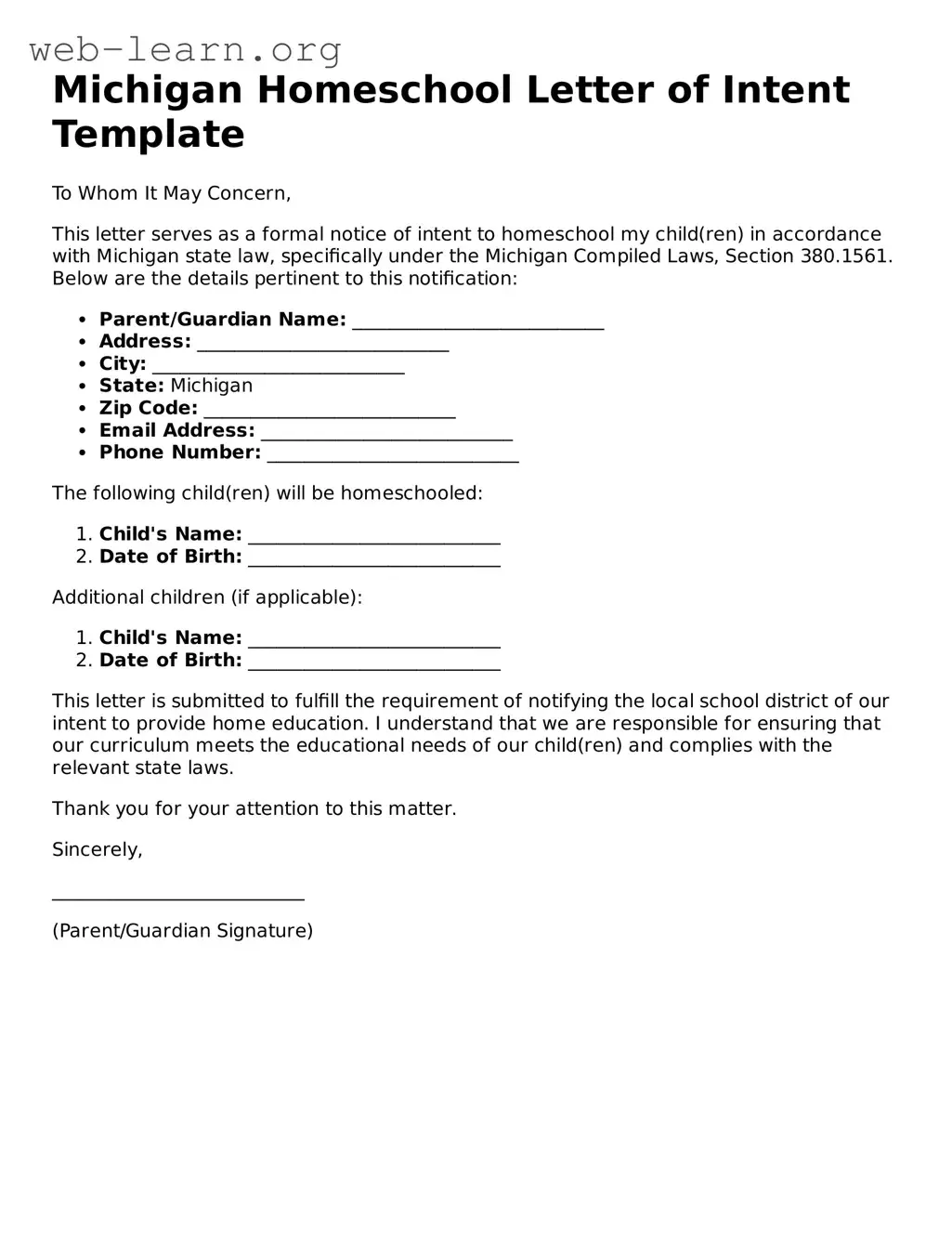
Michigan Homeschool Letter of Intent Template
To Whom It May Concern,
This letter serves as a formal notice of intent to homeschool my child(ren) in accordance with Michigan state law, specifically under the Michigan Compiled Laws, Section 380.1561. Below are the details pertinent to this notification:
The following child(ren) will be homeschooled:
Additional children (if applicable):
This letter is submitted to fulfill the requirement of notifying the local school district of our intent to provide home education. I understand that we are responsible for ensuring that our curriculum meets the educational needs of our child(ren) and complies with the relevant state laws.
Thank you for your attention to this matter.
Sincerely,
___________________________
(Parent/Guardian Signature)
| Fact Name | Description |
|---|---|
| Purpose | The Michigan Homeschool Letter of Intent form notifies the local school district of a family's decision to homeschool their child. |
| Governing Law | This form is governed by the Michigan Compiled Laws, specifically MCL 380.1561. |
| Submission Deadline | The form must be submitted within 10 days of beginning the homeschooling process. |
| Required Information | Parents must provide the child's name, age, and the address of the homeschooling location. |
After completing the Michigan Homeschool Letter of Intent form, you will need to submit it to the appropriate school district. This form serves as a notification of your intention to homeschool your child. It is important to ensure all information is accurate and complete before submission.
The Michigan Homeschool Letter of Intent is a formal document that parents or guardians must submit to notify their local school district of their intention to homeschool their child. This letter serves as a declaration that the parents will be providing educational instruction at home, in accordance with Michigan law.
Any parent or guardian who chooses to homeschool their child in Michigan must file this letter. This requirement applies to children who are of compulsory school age, which is typically between the ages of 6 and 18. If you decide to homeschool your child, you must inform the school district where you reside.
The Letter of Intent should be submitted at the beginning of the school year or when you first decide to homeschool your child. It’s advisable to send the letter as soon as you make the decision to ensure compliance with state regulations. If you are withdrawing your child from public school, do this promptly to avoid any potential attendance issues.
The letter must include specific information about the child, such as:
Some parents also choose to include additional details, such as the educational curriculum they plan to use, although this is not a requirement.
While there is no mandated format, the letter should be clear and concise. It is recommended to write it in a formal tone and include all the necessary information. Many families use a template to ensure they cover all required elements, but the content should be tailored to your specific situation.
Once the Letter of Intent is submitted, the school district will typically acknowledge receipt. After this, you are free to begin homeschooling your child. It is important to keep a copy of the letter for your records. Additionally, you should be prepared to provide educational records if requested by the district.
Yes, you can change your mind at any time. If you decide to enroll your child back into public or private school, you should notify the school district. It's best to do this in writing to maintain clear communication and avoid any misunderstandings regarding your child's educational status.
When filling out the Michigan Homeschool Letter of Intent form, individuals often make common mistakes that can lead to delays or complications. One frequent error is failing to provide complete and accurate information. The form requires specific details about the child, including their name and age. Omitting any of this information can cause the submission to be incomplete.
Another mistake is not signing the form. A signature is essential to validate the intent to homeschool. If the form is submitted without a signature, it may be returned, causing frustration and delays in starting the homeschooling process.
Many people also overlook the deadline for submitting the form. In Michigan, the letter must be filed within a certain timeframe. Missing this deadline can result in the need to wait until the next school year to begin homeschooling.
Some individuals mistakenly believe that they only need to submit the form once. In reality, if there are any changes in the homeschooling situation, such as a new address or a change in the child’s educational status, an updated letter of intent must be filed.
Another common oversight is not keeping a copy of the submitted form. It is essential to retain a copy for personal records. This documentation may be necessary for future reference or in case of inquiries from local education authorities.
Additionally, people sometimes fail to check the local school district's requirements. While the state has general guidelines, local districts may have specific policies regarding homeschooling. Not being aware of these can lead to misunderstandings.
Some individuals might also neglect to include the date when the homeschooling is set to begin. This date is important for record-keeping and helps clarify the family's intent to the school district.
Another mistake is not updating the form if the family moves. If a family relocates, they must inform the school district of the new address. Failing to do so can create confusion and potential issues with compliance.
Lastly, some people may misinterpret the purpose of the form. It is not a request for permission but rather a notification of intent. Understanding this distinction is crucial for a smooth homeschooling experience.
The Michigan Homeschool Letter of Intent form is an essential document for families choosing to educate their children at home. Along with this form, several other documents may be required or beneficial for a smooth homeschooling experience. Below is a list of commonly used forms and documents.
Having these documents prepared can streamline the homeschooling process and ensure compliance with state requirements. Each document serves a specific purpose and contributes to a well-organized homeschooling experience.
When filling out the Michigan Homeschool Letter of Intent form, it is important to approach the process with care and attention to detail. Below are five essential dos and don'ts to keep in mind.
By following these guidelines, you can navigate the process more smoothly and set a solid foundation for your homeschooling journey in Michigan.
Misconception 1: The Letter of Intent is a complex legal document.
Many people believe that the Michigan Homeschool Letter of Intent is filled with legal jargon and complicated terms. In reality, the form is straightforward and easy to complete. It simply requires basic information about the student and the educational plan.
Misconception 2: You must submit the Letter of Intent every year.
Some parents think that they need to file a new Letter of Intent each year. However, once you submit the form, you do not need to resubmit it unless there is a change in your homeschooling status or if you decide to enroll your child in a public school.
Misconception 3: The Letter of Intent requires a specific curriculum.
It is a common belief that the form mandates a particular curriculum or educational approach. In truth, the Michigan Homeschool Letter of Intent does not dictate how you must educate your child. You have the freedom to choose the curriculum that best fits your child’s needs.
Misconception 4: Submitting the Letter of Intent means you will be monitored by the state.
Many parents worry that filing the Letter of Intent will subject them to ongoing oversight from state authorities. This is not the case. After submitting the form, you are not required to report your progress or submit assessments to the state, allowing for greater autonomy in your homeschooling journey.
Filling out and using the Michigan Homeschool Letter of Intent form is an important step for parents who wish to educate their children at home. Here are some key takeaways to keep in mind:
Do You Get Paid to Home School - Assists in ensuring compliance with local educational regulations.
Home Schooling in Idaho - Establishes a record of educational intent for the school district.