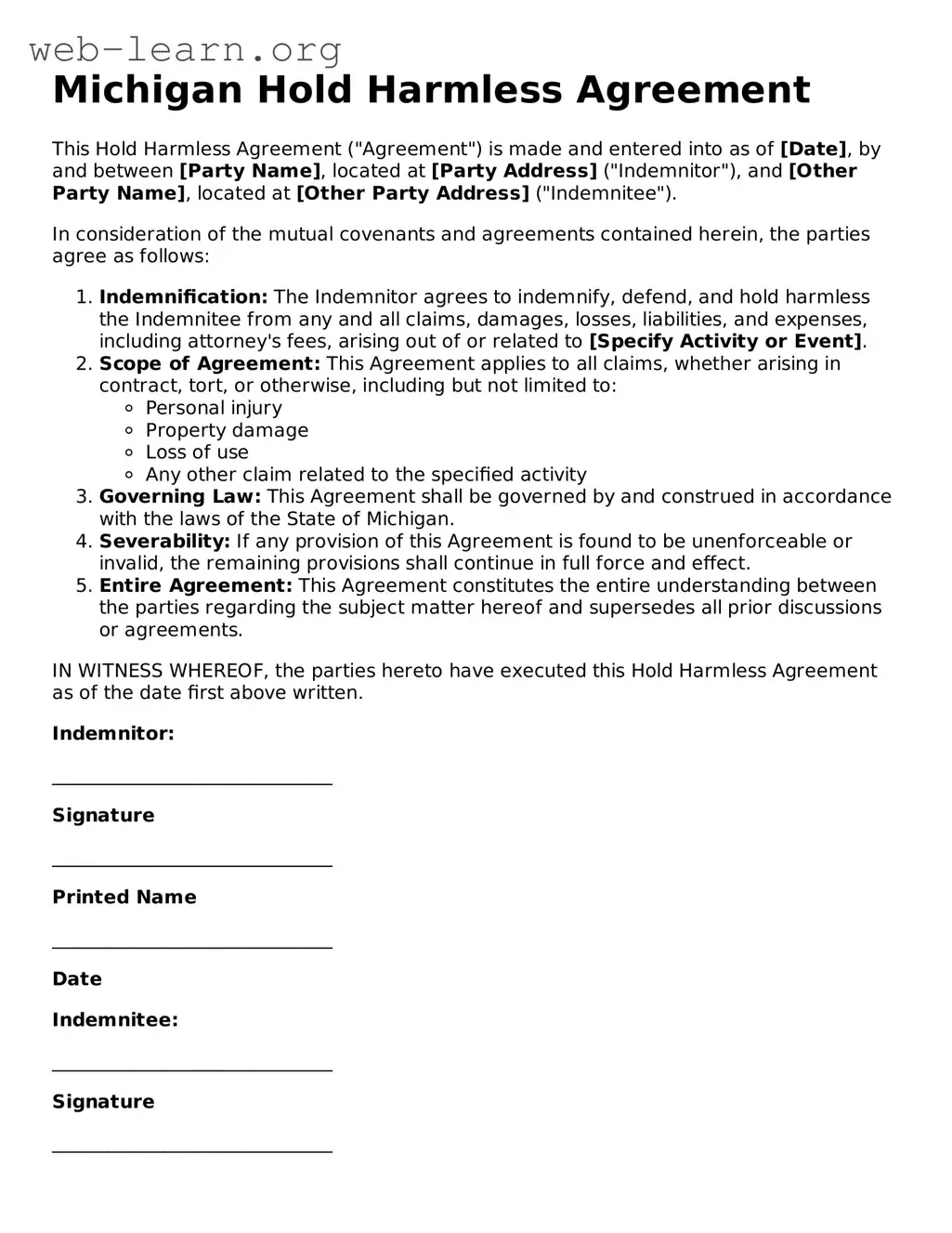
The Michigan Hold Harmless Agreement form plays a crucial role in various legal and business transactions, providing a layer of protection for parties involved in an agreement. This form is designed to safeguard one party from liability or claims that may arise from the actions or negligence of another party. Typically, it is utilized in contexts such as rental agreements, construction projects, and events where one party may be exposed to risks associated with the activities of another. By signing this agreement, individuals or organizations agree to assume responsibility for any potential damages or injuries, thereby releasing the other party from legal claims. Understanding the nuances of this form is essential, as it outlines the specific terms and conditions under which liability is waived. Furthermore, it often includes clauses that define the scope of indemnification, ensuring that all parties are clear about their rights and responsibilities. Whether you are a property owner, contractor, or event organizer, familiarity with the Michigan Hold Harmless Agreement can help mitigate risks and foster smoother transactions.
Michigan Hold Harmless Agreement
This Hold Harmless Agreement ("Agreement") is made and entered into as of [Date], by and between [Party Name], located at [Party Address] ("Indemnitor"), and [Other Party Name], located at [Other Party Address] ("Indemnitee").
In consideration of the mutual covenants and agreements contained herein, the parties agree as follows:
IN WITNESS WHEREOF, the parties hereto have executed this Hold Harmless Agreement as of the date first above written.
Indemnitor:
______________________________
Signature
______________________________
Printed Name
______________________________
Date
Indemnitee:
______________________________
Signature
______________________________
Printed Name
______________________________
Date
| Fact Name | Description |
|---|---|
| Purpose | The Michigan Hold Harmless Agreement is designed to protect one party from liability for injuries or damages that may occur during an activity or event. |
| Governing Law | This agreement is governed by Michigan state law, specifically under contract law principles. |
| Parties Involved | Typically, the agreement involves two parties: the indemnitor (the party providing protection) and the indemnitee (the party being protected). |
| Scope of Protection | The agreement can cover various liabilities, including personal injury, property damage, and legal fees, depending on the terms set by the parties. |
| Enforceability | For the agreement to be enforceable, it must be clear, specific, and voluntarily signed by both parties. |
| Limitations | Michigan law may not allow a hold harmless agreement to protect against gross negligence or willful misconduct. |
| Common Uses | These agreements are often used in recreational activities, construction contracts, and events where liability risks are present. |
Filling out the Michigan Hold Harmless Agreement form is a straightforward process. You will need to provide specific information about the parties involved and the nature of the agreement. Once completed, the form will serve as a record of the understanding between the parties.
What is a Michigan Hold Harmless Agreement?
A Michigan Hold Harmless Agreement is a legal document designed to protect one party from liability for any damages or injuries that may occur during a specific event or activity. This agreement typically involves two parties: one party agrees to assume responsibility for certain risks, while the other party is released from liability. These agreements are commonly used in various situations, including rental agreements, construction projects, and recreational activities.
Who should use a Hold Harmless Agreement?
Individuals and organizations engaging in activities that carry potential risks should consider using a Hold Harmless Agreement. This includes property owners renting out their space, event organizers, contractors, and recreational facility operators. By using this agreement, parties can clarify their responsibilities and minimize legal exposure in case of accidents or injuries.
What are the key components of the agreement?
A typical Michigan Hold Harmless Agreement includes several essential components:
Is a Hold Harmless Agreement enforceable in Michigan?
Yes, Hold Harmless Agreements are generally enforceable in Michigan, provided they meet certain legal requirements. The language must be clear and unambiguous, and the agreement must not violate public policy or involve gross negligence. Courts may review the agreement for fairness and clarity before enforcing it, so it is advisable to consult with a legal professional when drafting or signing such documents.
Can a Hold Harmless Agreement protect against all types of liability?
No, a Hold Harmless Agreement cannot protect against all types of liability. While it can shield one party from certain risks, it may not be effective against claims arising from intentional misconduct or gross negligence. Additionally, some statutory liabilities may not be waivable under Michigan law. It is crucial for parties to understand the limitations of the agreement and to seek legal advice if necessary.
Filling out the Michigan Hold Harmless Agreement form can be straightforward, but many people make common mistakes that can lead to complications. One frequent error is failing to provide complete information. Each section of the form requires specific details. Omitting any part, such as names, dates, or addresses, can render the agreement invalid.
Another mistake is not reading the entire document before signing. It's crucial to understand what you are agreeing to. Many individuals skim through the terms, which can result in unexpected liabilities. Take the time to review the agreement thoroughly.
Some people also forget to date the form. A signature without a date can create confusion about when the agreement was made. This oversight can complicate matters if any disputes arise later.
Additionally, using unclear or ambiguous language can lead to misunderstandings. The agreement should be straightforward. If you use vague terms, it may not hold up in court. Be clear and precise about the responsibilities and liabilities involved.
Another common error is not having the agreement witnessed or notarized when required. Some situations may necessitate additional verification. Skipping this step can weaken the enforceability of the agreement.
People often neglect to keep a copy of the signed agreement. After signing, it’s essential to store a copy for your records. If disputes arise, having documentation is crucial for reference.
Lastly, many individuals fail to consult a legal expert before signing. While the form may seem simple, legal implications can be complex. Seeking professional advice can help ensure that your interests are adequately protected.
When engaging in activities that involve potential risks, individuals and organizations often utilize a Michigan Hold Harmless Agreement. However, this document is typically accompanied by several other forms and documents to ensure comprehensive legal protection. Below is a list of commonly used documents that complement the Hold Harmless Agreement.
Utilizing these documents alongside the Michigan Hold Harmless Agreement can significantly enhance legal protection for all parties involved. Each document serves a unique purpose, and together they create a robust framework for managing risks effectively.
The Hold Harmless Agreement form shares similarities with several other legal documents. Here’s a list of seven documents that are comparable:
When filling out the Michigan Hold Harmless Agreement form, it is important to follow certain guidelines to ensure accuracy and compliance. Here are five things you should and shouldn't do:
Many people have misunderstandings about the Michigan Hold Harmless Agreement form. Here are nine common misconceptions and clarifications to help clear things up.
The agreement does not cover every possible liability. It typically protects against claims arising from specific activities or events outlined in the agreement.
Individuals can also use Hold Harmless Agreements. They are useful for anyone entering into an agreement where there is a risk of liability.
While it provides some level of protection, it does not completely eliminate the possibility of being sued. Courts may not enforce the agreement if it is deemed unreasonable or if negligence is involved.
Each agreement should be tailored to fit the specific situation. A generic form may not provide adequate protection for your unique circumstances.
Both parties can benefit from a Hold Harmless Agreement. It clarifies responsibilities and can foster trust between the parties involved.
While verbal agreements can exist, a written Hold Harmless Agreement is much more enforceable and clear, making it easier to resolve disputes.
Agreements can be modified if both parties consent to the changes. It’s important to document any amendments in writing.
Notarization is not required for a Hold Harmless Agreement to be valid in Michigan. However, having it notarized can add an extra layer of authenticity.
Hold Harmless Agreements can be used in various contexts, including events, property use, and even professional services, not just physical activities.
Understanding these misconceptions can help you make informed decisions about using a Hold Harmless Agreement in Michigan.
When filling out and using the Michigan Hold Harmless Agreement form, it's important to keep in mind several key points to ensure that the document serves its intended purpose effectively.
By keeping these points in mind, you can effectively fill out and utilize the Michigan Hold Harmless Agreement form, ensuring that all parties are aware of their rights and responsibilities.
What Is a Hold Harmless Agreement - By signing, parties agree to indemnify each other against claims or losses.
Hold Harmless Agreement - This form can be vital in construction contracts, protecting contractors from liability related to job site injuries.