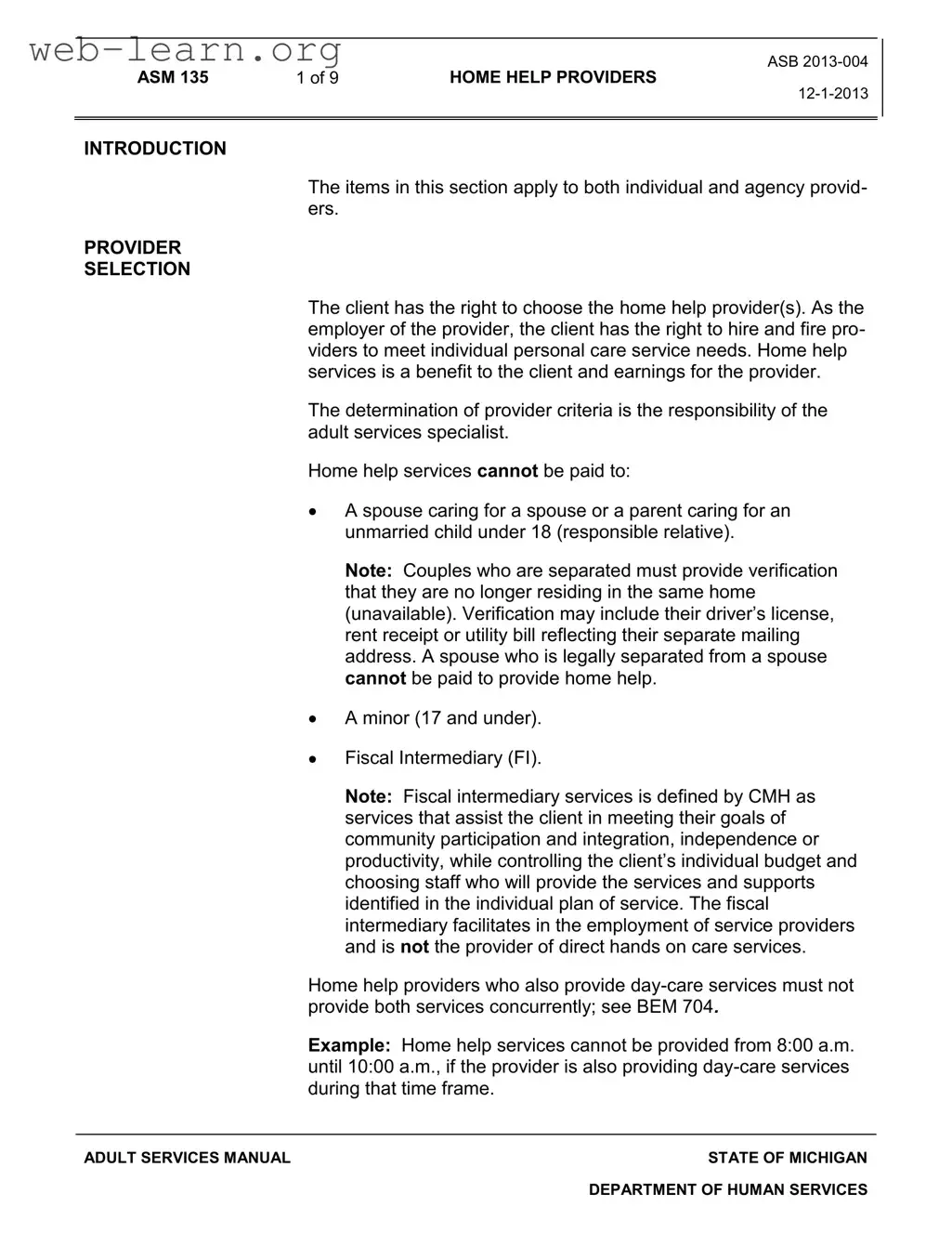
The Michigan Gov Homehelp form is an essential document that facilitates the provision of home help services to clients in need. This form outlines the rights and responsibilities of both clients and providers, ensuring that personal care needs are met effectively. Clients have the freedom to select their home help providers, whether individuals or agencies, and maintain the authority to hire or terminate their services as necessary. However, certain restrictions apply, such as prohibiting spouses from providing care for one another or parents from caring for their unmarried children under 18. The form also specifies criteria that providers must meet, including age, ability to follow instructions, and physical health. Additionally, it emphasizes the importance of a face-to-face interview between the client and provider, which helps establish a clear understanding of the services required. Clients and providers must keep accurate logs of the services rendered and submit these records quarterly to ensure proper payment. The Home Help Services Statement of Employment serves as a formal agreement, summarizing the employment terms and confirming mutual understanding between the client and provider. Overall, the Michigan Gov Homehelp form plays a critical role in supporting individuals who require assistance while promoting accountability and transparency in the home help service process.

|
|
ASB |
ASM 135 |
1 of 9 |
HOME HELP PROVIDERS |
INTRODUCTION
The items in this section apply to both individual and agency provid- ers.
PROVIDER
SELECTION
The client has the right to choose the home help provider(s). As the employer of the provider, the client has the right to hire and fire pro- viders to meet individual personal care service needs. Home help services is a benefit to the client and earnings for the provider.
The determination of provider criteria is the responsibility of the adult services specialist.
Home help services cannot be paid to:
A spouse caring for a spouse or a parent caring for an unmarried child under 18 (responsible relative).
Note: Couples who are separated must provide verification
that they are no longer residing in the same home
(unavailable). Verification may include their driver’s license, rent receipt or utility bill reflecting their separate mailing address. A spouse who is legally separated from a spouse cannot be paid to provide home help.
A minor (17 and under).
Fiscal Intermediary (FI).
Note: Fiscal intermediary services is defined by CMH as services that assist the client in meeting their goals of
community participation and integration, independence or productivity, while controlling the client’s individual budget and
choosing staff who will provide the services and supports identified in the individual plan of service. The fiscal intermediary facilitates in the employment of service providers and is not the provider of direct hands on care services.
Home help providers who also provide
Example: Home help services cannot be provided from 8:00 a.m. until 10:00 a.m., if the provider is also providing
ADULT SERVICES MANUAL |
STATE OF MICHIGAN |
DEPARTMENT OF HUMAN SERVICES

|
|
ASB |
ASM 135 |
2 of 9 |
HOME HELP PROVIDERS |
PROVIDER
CRITERIA
Determine the provider's ability to meet the following minimum cri- teria in a
Age
The provider must be 18 years and older.
Ability
To follow instructions and home help program procedures.
To perform the services required.
To handle emergencies.
Physical Health
The provider’s health must be adequate to perform the needed ser- vices.
Knowledge
The provider must know when to seek assistance from appropriate sources in the event of an emergency.
Personal
Qualities
The provider must be dependable and able to meet job demands.
Training
The provider must be willing to participate in available training pro- grams if necessary.
Home help payment may be terminated if the provider fails to meet any of the provider criteria.
PROVIDER
INTERVIEW
An initial
Explain the following points to the client and the provider during the initial interview:
ADULT SERVICES MANUAL |
STATE OF MICHIGAN |
DEPARTMENT OF HUMAN SERVICES

ASB
ASM 135 |
3 of 9 |
HOME HELP PROVIDERS |
The provider is employed by the client not the State of
Michigan.
As the employer, the client has the right to hire and fire the provider.
A provider who receives public assistance must report all income received as a home help provider to their family independence specialist or eligibility specialist.
The client and provider are responsible for notifying the adult services specialist within 10 business days of any change in providers or hours of care.
The provider and/or client is responsible for notifying the adult services specialist within 10 business days if the client is hospitalized.
Note: Home help services cannot be paid the day a client is admitted into the hospital but can be paid the day of discharge.
The provider must keep a log of the services provided on the
on a quarterly basis. The log must be signed by both the provider and client or the client’s representative.
All earned income must be reported to the IRS; see
www.irs.gov.
No federal, state or city income taxes are withheld from the warrant.
Parents who are caring for an adult child do not have FICA withheld.
Note: Parents who wish to have FICA withheld must be assigned in ASCAP as other relative in the Provider Assignment screen.
All individual providers will receive a
Department of Community Health.
Provider must display a valid picture identification card and social security card.
ADULT SERVICES MANUAL |
STATE OF MICHIGAN |
DEPARTMENT OF HUMAN SERVICES

ASB
ASM 135 |
4 of 9 |
HOME HELP PROVIDERS |
The client and provider must sign the
Note: Providers determined to be a business/agency are exempt from signing the
All providers must sign a
Provider Agreement, before payments are authorized.
Note: Providers are required to complete and sign the agreement only once. If there is a signature date on Bridges/ASCAP provider screen, another
PROVIDER
ENROLLMENT
All home help providers must be enrolled in Bridges by a designee at the local county DHS office prior to authorizing payment. Once a provider is enrolled, Bridges will assign the provider a seven digit identification number. The adult services specialist must allow 24 hours from the time of enrollment for Bridges to interface with
ASCAP.
Instructions for enrolling a provider on Bridges are found on the Office of Training and Staff Development home page. Instruc- tions on assigning a provider in ASCAP are in the ASCAP User Guide located on the adult services home page.
PERSONAL CARE SERVICES PROVIDER LOG
Each individual provider must keep a log of home help services delivered. The DHS- 721 is used for this purpose.
Tasks on the provider logs are automatically marked with an X when printed from ASCAP based on the client’s home help
functional assessment.
The provider must indicate what services were provided and on which days of the month.
ADULT SERVICES MANUAL |
STATE OF MICHIGAN |
DEPARTMENT OF HUMAN SERVICES

ASB
ASM 135 |
5 of 9 |
HOME HELP PROVIDERS |
The client and the provider must sign the log when it is completed to verify that the services approved for payment were delivered.
The log must be submitted to the local office quarterly. Provider logs must be received within 10 business days after the last service date on the log. Failure to do so will result in suspension of payment.
The adult services specialist must initial and date the log upon receipt, demonstrating review of the log.
Retain the log in the client’s case record.
A separate log is required for each provider.
Incomplete logs must be returned to the client/provider for completion.
Agency/business providers have the option of submitting monthly invoices in lieu of the
The service (s) provided, and
The date(s) of service.
See ASM 136, Agency Providers.
HOME HELP STATEMENT OF EMPLOYMENT
The purpose of the
An employment statement must be signed by each provider who renders service to a client.
The statement of employment does the following:
Confirms an understanding of the personal care services provided, how often services are provided, and wages to be paid.
ADULT SERVICES MANUAL |
STATE OF MICHIGAN |
DEPARTMENT OF HUMAN SERVICES

ASB
ASM 135 |
6 of 9 |
HOME HELP PROVIDERS |
Requires positive identification of the provider by means of a picture ID and social security card.
Documents an understanding by both parties that the client, not the State of Michigan, is the employer of the provider.
Stipulates that the client must report any changes in the work schedule to the adult services specialist.
Instructs the provider to repay the State of Michigan for services they did not provide.
Informs the provider that a
Informs a provider receiving public assistance that this employment must be reported to the Department of Human Services
Requires the client and provider must sign the
Distribution of Employment Statement
The adult services specialist will make two copies of the completed and signed form and distribute as follows:
Give one copy to the client.
Give one copy to the provider.
Place the original form in the client’s case record.
MEDICAL ASSISTANCE HOME HELP PROVIDER AGREEMENT
Federal regulations require that all providers of Medicaid covered services complete and sign a provider agreement. This agreement states providers will abide by Medicaid policies in providing services to program clients and in receiving payment from the program. In order to meet this requirement, the Michigan Department of Community Health (MDCH) developed the MSA- 4678, Medical Assistance Home Help Provider Agreement.
ADULT SERVICES MANUAL |
STATE OF MICHIGAN |
DEPARTMENT OF HUMAN SERVICES

ASB
ASM 135 |
7 of 9 |
HOME HELP PROVIDERS |
All home help services providers must have a completed and signed
Procedure
The adult services specialist will furnish a copy of the
Before forwarding the
Assign Provider Tab.
Send the
Provider Enrollment Lewis Cass Building 3rd Floor
320 S. Walnut
Lansing, Michigan 48913
MDCH Provider Enrollment scans the provider agreements and files them under the provider identification numbers.
Locating MSA-
4678 Signature
Date in ASCAP
To locate the
Select Client.
Select the HIS $ icon.
Click on the Provider/TimeTask/Service Plan button. Highlight the provider.
Locate the 4678 Date field. This is a read only field, reflecting what is in Bridges.
ADULT SERVICES MANUAL |
STATE OF MICHIGAN |
DEPARTMENT OF HUMAN SERVICES

ASB
ASM 135 |
8 of 9 |
HOME HELP PROVIDERS |
If there is a date in the signature date field, a
Note: The signature date can also be found in ASCAP under the Client’s for Provider tab. Access this screen by clicking on the utilities menu and selecting Client’s for Provider. Search by the
provider name or identification number and click on the provider name. The provider information is displayed on the detail screen, including the
LOCAL OFFICE
INDIVIDUAL HOME
HELP PROVIDER
HOURLY RATE
Each local DHS office has an established individual home help pro- vider rate. Specialists must not authorize above or below the estab- lished rate.
Cases with hourly rates above the established county rate must be substantiated by an approval letter
PROVIDER
INCOME
VERIFICATION
Requests received by the local office for verification of provider income or employment should be forwarded to MDCH at:
Michigan Department of Community Health
Long Term Care Services Policy Section
Capital Commons Building, 6th Floor
P.O. Box 30479
Lansing, Michigan 48909
OR
FAX to
ADULT SERVICES MANUAL |
STATE OF MICHIGAN |
DEPARTMENT OF HUMAN SERVICES

|
|
ASB |
ASM 135 |
9 of 9 |
HOME HELP PROVIDERS |
JOINT POLICY
DEVELOPMENT
The Adult Services Manual (ASM) policy has been developed jointly by the Michigan Department of Community Health (MDCH) and the Department of Human Services (DHS)
ADULT SERVICES MANUAL |
STATE OF MICHIGAN |
DEPARTMENT OF HUMAN SERVICES
| Fact Name | Description |
|---|---|
| Provider Selection | The client has the right to choose their home help provider. They can hire and fire providers as needed. |
| Provider Criteria | Providers must be at least 18 years old and capable of performing the required services. They should also handle emergencies effectively. |
| Home Help Payment Restrictions | Payments cannot be made to a spouse caring for a spouse or a parent caring for an unmarried child under 18. |
| Provider Enrollment | All providers must be enrolled in the Bridges system before payments can be authorized. This is done through a local county DHS office. |
| Service Log Requirements | Providers must keep a log of services provided using the DHS-721 form. This log must be signed by both the client and provider. |
| Governing Law | The Home Help program operates under the Adult Services Manual and is regulated by the Michigan Department of Human Services. |
Filling out the Michigan Gov Homehelp form is an important step in securing the necessary home help services. After completing the form, you will submit it to the appropriate department for processing. This ensures that the services can be authorized and payments can begin.
What is the Michigan Gov Homehelp form?
The Michigan Gov Homehelp form is a document used to facilitate home help services for individuals in need of personal care. This form outlines the responsibilities of both the client and the provider, ensuring a clear understanding of the employment relationship. It serves as an agreement summarizing the services provided, the frequency of those services, and the wages to be paid.
Who can be a home help provider?
To be eligible as a home help provider, an individual must be at least 18 years old and capable of performing the required services. They should be able to follow instructions, handle emergencies, and demonstrate adequate physical health. Additionally, the provider must possess personal qualities such as dependability and a willingness to participate in necessary training programs.
Can family members serve as home help providers?
Generally, family members cannot serve as home help providers. Specifically, a spouse cannot be paid to provide care for their spouse, and a parent cannot be paid to care for an unmarried child under 18. However, parents caring for adult children may qualify under certain conditions, but they must ensure proper documentation is in place.
What documentation is required for home help services?
Several documents are necessary for home help services. The client and provider must sign the MSA-4676, Home Help Services Statement of Employment, and the MSA-4678, Home Help Services Provider Agreement. Additionally, providers must keep a log of services provided using the DHS-721 form, which must be submitted quarterly. This log must be signed by both the client and the provider to confirm that services were delivered as approved.
What happens if a provider does not meet the criteria?
If a home help provider fails to meet the established criteria, their payment for services may be terminated. It is crucial for both the client and the provider to understand these requirements to ensure continued eligibility for home help services.
How is payment processed for home help services?
Payment for home help services is processed through the Michigan Department of Human Services. Providers must be enrolled in the Bridges system, and after enrollment, they will receive a unique identification number. Payments are authorized only after the necessary forms are signed and submitted, including the employment statement and provider agreement. It is important for providers to keep accurate logs of services to avoid any delays in payment.
Completing the Michigan Gov Homehelp form can be a straightforward process; however, several common mistakes can hinder the application. One frequent error is failing to provide accurate identification information for both the client and the provider. Incomplete or incorrect details can lead to delays in processing the application or even denial of services. It is essential that all names, addresses, and identification numbers are entered correctly to avoid complications.
Another common mistake involves not understanding the eligibility criteria for home help providers. Applicants often overlook the stipulation that a spouse cannot be paid to provide home help services for their partner. This misunderstanding can lead to unnecessary complications and potential disqualification from receiving assistance. Clear awareness of the rules regarding who can serve as a provider is crucial.
Additionally, applicants may neglect to document changes in the status of the provider or the client. The form requires that any changes, such as hospitalization or a change in providers, be reported within 10 business days. Failing to do so can result in payment suspension or other administrative issues. Keeping accurate records and promptly notifying the relevant authorities can help maintain the flow of services.
Another mistake is not completing the required logs accurately. The DHS-721, Personal Care Services Provider Log, must be maintained and submitted quarterly. Incomplete logs or failure to submit them on time can lead to payment suspension. It is important for both the client and provider to sign the log to confirm that services were delivered as agreed.
Some applicants mistakenly believe that the Home Help Services Statement of Employment (MSA-4676) does not need to be signed if they have previously completed it. Each new provider must sign this document to confirm their understanding of the employment terms. Overlooking this requirement can delay payment authorization.
Moreover, applicants sometimes misunderstand the role of the fiscal intermediary. They may assume that the fiscal intermediary provides direct care services, which is not the case. The intermediary facilitates employment and budgeting but does not deliver hands-on care. Clarifying this distinction can prevent confusion during the application process.
Another area of confusion arises with the submission of invoices by agency providers. Some applicants do not realize that agency providers can opt to submit monthly invoices instead of the DHS-721 log. Understanding these options can streamline the payment process and ensure compliance with the requirements.
Lastly, failing to report all income accurately can have serious consequences. Providers receiving public assistance must disclose all earnings to their family independence specialist. Not doing so may result in penalties or loss of benefits. Being transparent about income is essential for compliance with federal and state regulations.
Awareness of these common mistakes can significantly improve the experience of filling out the Michigan Gov Homehelp form. Careful attention to detail, understanding eligibility criteria, and maintaining accurate records are vital for a successful application process.
When applying for home help services in Michigan, several important documents accompany the Michigan Gov Homehelp form. Each of these documents plays a crucial role in ensuring a smooth application process and compliance with state regulations. Below is a list of commonly used forms that you may need to complete or submit along with your application.
Understanding these documents and their purposes can help streamline the application process for home help services. Ensuring that all necessary forms are completed accurately will facilitate timely approval and support for those in need of assistance.
Personal Care Agreement: Similar to the Michigan Gov Homehelp form, a Personal Care Agreement outlines the responsibilities of both the caregiver and the client. It ensures that both parties understand the services to be provided and the payment terms.
Service Provider Contract: This document details the terms of engagement between a service provider and a client. Like the Homehelp form, it specifies the services to be provided and the expectations of both parties.
Employment Agreement: An Employment Agreement formalizes the relationship between an employer and employee. It shares similarities with the Homehelp form in that it outlines job responsibilities, payment, and conditions for termination.
Caregiver Agreement: This document is specifically for caregivers, detailing their duties and the compensation structure. It aligns with the Homehelp form by emphasizing the importance of clear communication between the caregiver and the client.
Home Care Services Agreement: This agreement sets forth the terms under which home care services will be provided. It is similar to the Homehelp form as it includes service details, payment terms, and the rights of both the client and provider.
Provider Enrollment Form: Like the Michigan Gov Homehelp form, a Provider Enrollment Form is used to register a caregiver with a specific agency or program, ensuring they meet necessary qualifications.
Client Intake Form: This form gathers essential information from clients seeking services. It is similar to the Homehelp form in that it collects data needed to assess the client's requirements and preferences.
Service Log: A Service Log tracks the services provided over time. Similar to the Personal Care Services Provider Log (DHS-721) mentioned in the Homehelp form, it ensures accountability and proper documentation of care.
Care Plan: A Care Plan outlines the specific needs and services for a client. This document shares similarities with the Homehelp form by detailing the services required to meet the client's health and personal care needs.
W-2 Form: While primarily a tax document, the W-2 Form is relevant for home help providers as it reports their earnings. This aspect connects to the Homehelp form’s emphasis on income reporting and tax responsibilities.
When filling out the Michigan Gov Homehelp form, it's important to follow specific guidelines to ensure a smooth process. Here’s a list of things you should and shouldn’t do: