The Michigan General Power of Attorney form serves as a vital legal document that empowers an individual, known as the principal, to designate another person, referred to as the agent or attorney-in-fact, to make decisions on their behalf. This form is particularly useful in situations where the principal may be unable to manage their affairs due to illness, absence, or incapacity. It covers a wide range of responsibilities, including financial matters, real estate transactions, and other legal decisions. Importantly, the authority granted can be broad or limited, depending on the principal's wishes. The form must be signed by the principal and, in many cases, witnessed or notarized to ensure its validity. Understanding the implications of this document is crucial, as it can significantly impact the principal’s life and the management of their affairs. Additionally, it is essential to note that the powers granted can be revoked at any time, provided the principal is still capable of making decisions. This flexibility allows individuals to maintain control over their personal and financial matters, ensuring that their best interests are upheld even when they cannot actively participate in those decisions.
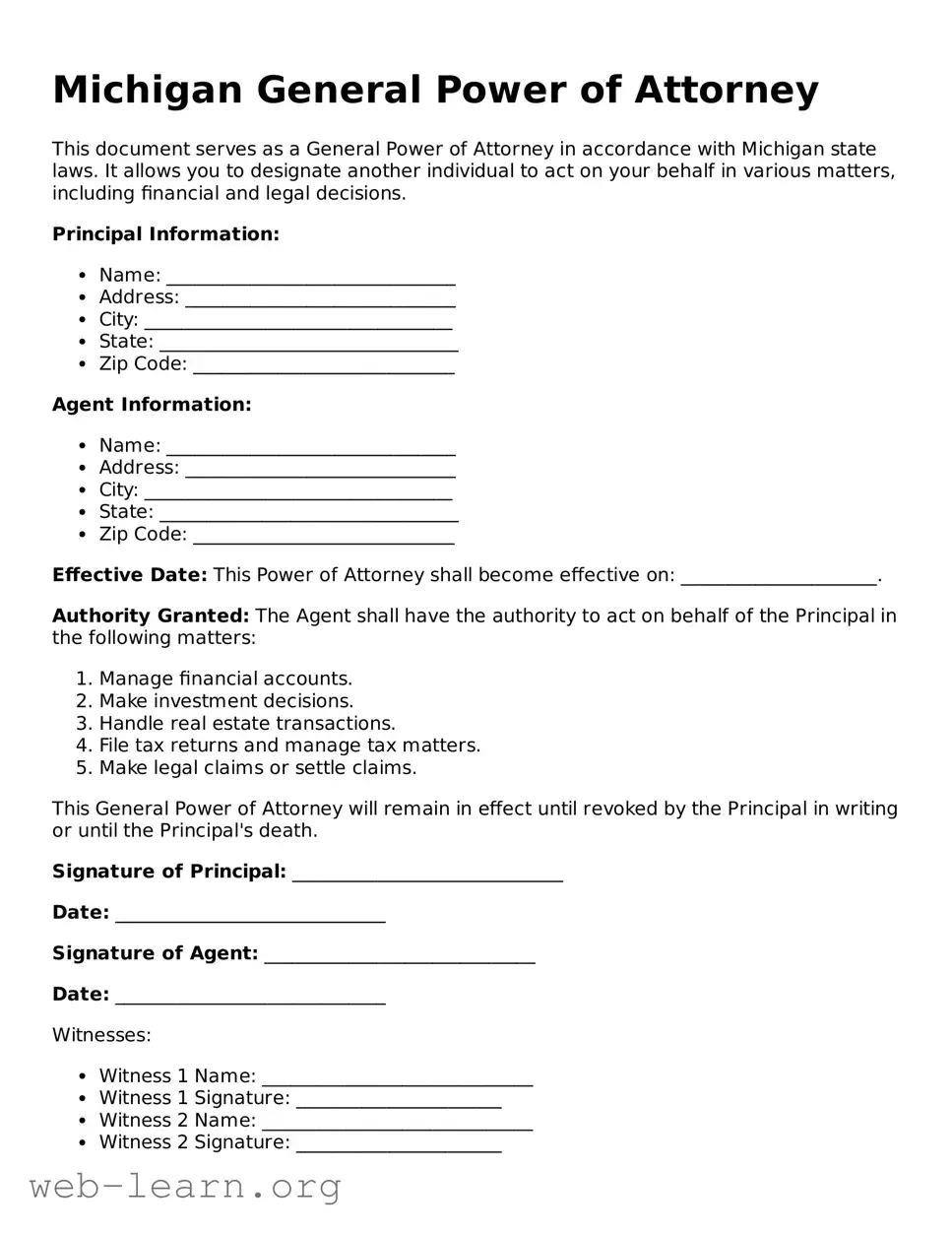
Michigan General Power of Attorney
This document serves as a General Power of Attorney in accordance with Michigan state laws. It allows you to designate another individual to act on your behalf in various matters, including financial and legal decisions.
Principal Information:
Agent Information:
Effective Date: This Power of Attorney shall become effective on: _____________________.
Authority Granted: The Agent shall have the authority to act on behalf of the Principal in the following matters:
This General Power of Attorney will remain in effect until revoked by the Principal in writing or until the Principal's death.
Signature of Principal: _____________________________
Date: _____________________________
Signature of Agent: _____________________________
Date: _____________________________
Witnesses:
This document should be signed in the presence of a notary public to ensure its validity.
| Fact Name | Description |
|---|---|
| Definition | A Michigan General Power of Attorney allows an individual (the principal) to designate another person (the agent) to make financial and legal decisions on their behalf. |
| Governing Law | The Michigan General Power of Attorney is governed by the Michigan Compiled Laws, specifically MCL 700.5501 to MCL 700.5516. |
| Durability | This form can be made durable, meaning it remains effective even if the principal becomes incapacitated, unless stated otherwise in the document. |
| Revocation | The principal has the right to revoke the General Power of Attorney at any time, as long as they are mentally competent to do so. |
| Agent's Authority | The agent's powers can be broad or limited, depending on the specific wishes of the principal outlined in the document. |
After obtaining the Michigan General Power of Attorney form, the next steps involve carefully filling it out to ensure it meets your needs. Accuracy is essential, as this document grants authority to another person to act on your behalf in specified matters.
A Michigan General Power of Attorney is a legal document that allows one person (the principal) to appoint another person (the agent) to make decisions on their behalf. This can include financial, legal, and business matters. The agent can act in the principal's best interest when the principal is unable to do so themselves.
The agent can have broad powers, including but not limited to:
Specific powers can be outlined in the document, allowing the principal to limit or expand the agent's authority as needed.
A Michigan General Power of Attorney typically takes effect immediately upon signing. However, the principal can choose to make it effective at a later date or upon a specific event, such as incapacitation.
Yes, a principal can revoke a General Power of Attorney at any time, as long as they are mentally competent. This is done by providing written notice to the agent and any relevant institutions or parties that may be relying on the document.
No, you do not need a lawyer to create a General Power of Attorney in Michigan. However, consulting with a legal professional can help ensure that the document meets your specific needs and complies with state laws.
A General Power of Attorney becomes invalid if the principal is incapacitated, unless it is a Durable Power of Attorney. A Durable Power of Attorney remains effective even if the principal becomes unable to make decisions.
Before signing, consider the following:
It’s crucial to choose someone who will act in your best interest and to be clear about what decisions they can make on your behalf.
You can obtain a Michigan General Power of Attorney form from various sources, including online legal services, law offices, or state government websites. Ensure that the form you choose complies with Michigan state laws.
Filling out the Michigan General Power of Attorney form can be straightforward, but many people make common mistakes that can lead to complications. One frequent error is not clearly identifying the agent. The agent is the person who will make decisions on your behalf. If the agent's name is misspelled or unclear, it could cause issues later. Always double-check the spelling and ensure that the agent is someone you trust.
Another mistake is failing to specify the powers granted. The form allows you to choose what authority your agent will have. Some people leave this section vague, which can create confusion. Clearly outline the powers you wish to grant, such as handling financial matters or making healthcare decisions. This clarity helps avoid misunderstandings in the future.
People often forget to sign and date the form. A Power of Attorney is not valid without your signature. Additionally, if you do not date it, it may lead to questions about when the authority begins. Make sure to sign in the appropriate place and include the date to ensure the document is legally binding.
Lastly, individuals sometimes overlook the need for witnesses or notarization. In Michigan, certain situations require the document to be witnessed or notarized to be valid. Check the specific requirements for your situation. Taking these extra steps can help ensure that your Power of Attorney is accepted without any issues.
When creating a Michigan General Power of Attorney, several other documents may be necessary to ensure comprehensive legal coverage. Each of these forms serves a specific purpose and can enhance the effectiveness of your power of attorney. Below is a list of commonly used forms that complement the General Power of Attorney.
Having these documents in place can provide clarity and security in various situations. Each form serves a unique purpose, and together they create a robust legal framework for managing personal and financial affairs.
The General Power of Attorney (GPOA) form shares similarities with several other legal documents. Each serves a specific purpose in granting authority or managing affairs. Here are six documents that are comparable to the GPOA:
When filling out the Michigan General Power of Attorney form, there are several important considerations to keep in mind. Below is a list of things you should and shouldn't do.
When it comes to the Michigan General Power of Attorney form, several misconceptions can lead to confusion. Understanding the truth behind these misconceptions can help individuals make informed decisions. Here are four common misunderstandings:
This is not entirely true. While a General Power of Attorney often focuses on financial decisions, it can also grant authority for other matters, such as healthcare and legal issues. The scope of authority depends on how the document is drafted.
This is a common misunderstanding. In Michigan, a standard General Power of Attorney becomes ineffective if the principal is no longer able to make decisions due to incapacity. To ensure authority continues in such situations, a Durable Power of Attorney should be considered.
While it is true that individuals can choose their agents, there are specific requirements. The agent must be at least 18 years old and mentally competent. Additionally, the principal should select someone they trust, as the agent will have significant control over their affairs.
This is incorrect. A principal has the right to revoke a General Power of Attorney at any time, as long as they are mentally competent. Revocation should be done in writing and communicated to the agent and any relevant institutions.
Filling out and using the Michigan General Power of Attorney form is a significant step in planning for your future. Here are some key takeaways to consider:
By following these guidelines, you can ensure that your General Power of Attorney serves its intended purpose effectively.