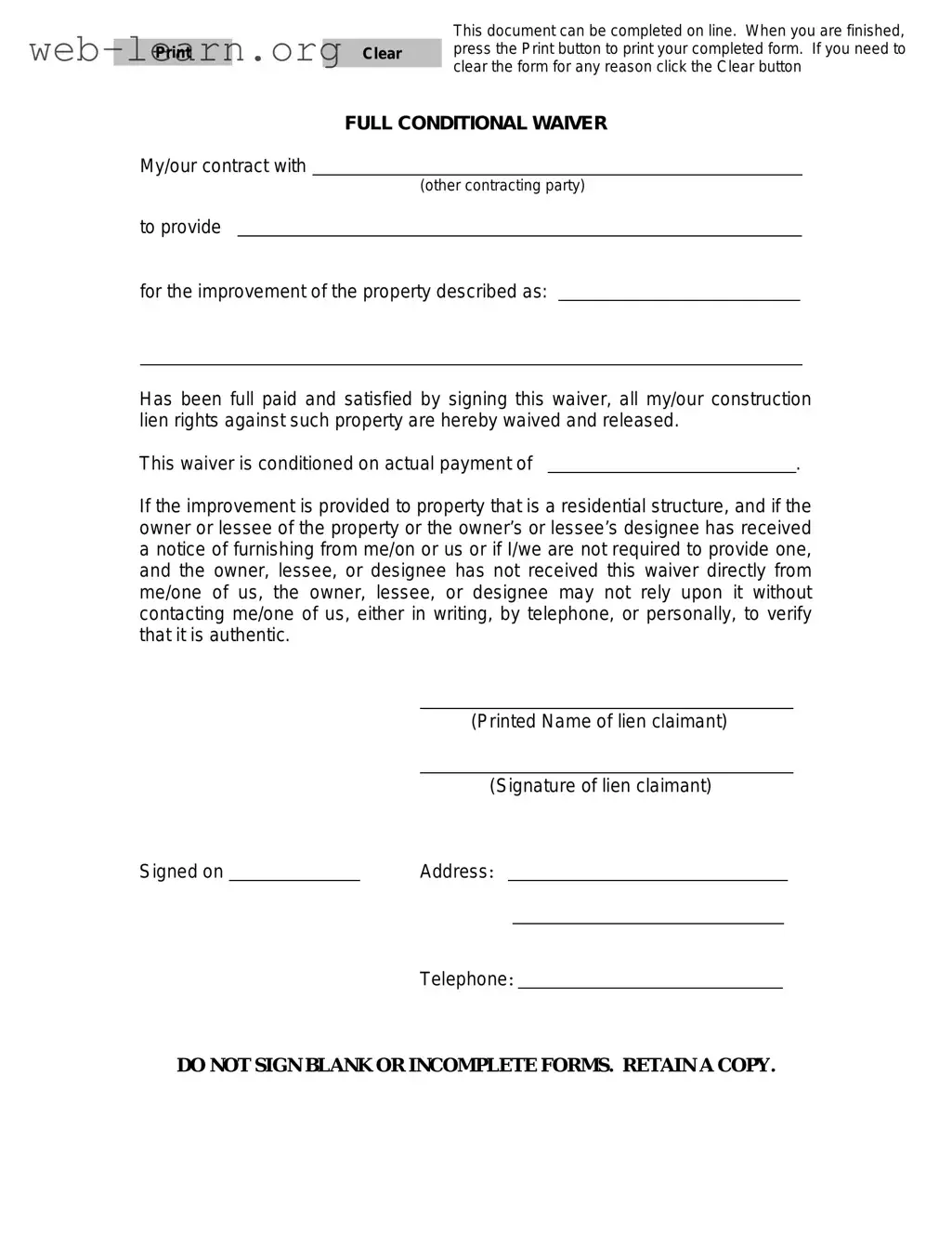
The Michigan Full Conditional Waiver form serves as an essential document in construction and property improvement transactions, ensuring that all parties are clear about their rights and obligations. This form can be conveniently completed online, allowing users to easily fill in the necessary information before printing it for signatures. By signing this waiver, the lien claimant acknowledges that their contract with the other party has been fully paid and satisfied. Consequently, they waive any construction lien rights against the specified property. However, it’s important to note that this waiver is conditional, meaning it relies on actual payment being made. If the improvement pertains to a residential structure, specific conditions apply regarding the notice of furnishing. For instance, if the property owner or their designee has not received the waiver directly from the lien claimant, they should verify its authenticity before relying on it. The form also emphasizes the importance of not signing blank or incomplete documents and encourages the retention of a copy for personal records. Overall, this form is a vital tool for maintaining transparency and protecting the interests of all parties involved in property improvements in Michigan.

|
|
|
This document can be completed on line. When you are finished, |
|
Clear |
press the Print button to print your completed form. If you need to |
|
|
|
|
clear the form for any reason click the Clear button |
|
|
|
FULL CONDITIONAL WAIVER
My/our contract with
(other contracting party)
to provide
for the improvement of the property described as:
Has been full paid and satisfied by signing this waiver, all my/our construction lien rights against such property are hereby waived and released.
This waiver is conditioned on actual payment of |
|
. |
If the improvement is provided to property that is a residential structure, and if the owner or lessee of the property or the owner’s or lessee’s designee has received a notice of furnishing from me/on or us or if I/we are not required to provide one, and the owner, lessee, or designee has not received this waiver directly from me/one of us, the owner, lessee, or designee may not rely upon it without contacting me/one of us, either in writing, by telephone, or personally, to verify that it is authentic.
(Printed Name of lien claimant)
(Signature of lien claimant)
Signed on |
|
Address: |
Telephone:
DO NOT SIGN BLANK OR INCOMPLETE FORMS. RETAIN A COPY.
| Fact Name | Description |
|---|---|
| Form Purpose | This form is used to waive construction lien rights after full payment for property improvements. |
| Online Completion | The form can be filled out online, making it accessible and convenient for users. |
| Printing Instructions | After completing the form, users must press the Print button to obtain a hard copy. |
| Clear Functionality | A Clear button is available to erase all entries if needed before printing. |
| Condition of Waiver | The waiver is only valid if actual payment has been made for the improvements. |
| Verification Requirement | If the waiver is not received directly by the property owner or lessee, they must verify its authenticity. |
| Governing Law | This form is governed by Michigan state laws related to construction liens. |
Completing the Michigan Full Conditional Waiver form is a straightforward process. After filling out the necessary fields, you will be able to print the document for your records. Ensure all information is accurate and complete before submitting it to the relevant parties.
After printing, retain a copy for your records. This ensures you have proof of the waiver and the details of the transaction should any questions arise in the future.
What is the purpose of the Michigan Full Conditional Waiver form?
The Michigan Full Conditional Waiver form serves to release construction lien rights against a property once payment has been fully satisfied. By signing this document, the lien claimant acknowledges that they have received payment for their services or materials provided for property improvement. This waiver is conditional, meaning it only takes effect upon actual payment being received.
How do I complete the form?
The form can be completed online. After filling in the necessary information, ensure to press the Print button to obtain a hard copy of the completed form. If you need to start over, use the Clear button to reset the form. It is essential to avoid signing any blank or incomplete forms to ensure the waiver is valid.
What should I include in the form?
Key information to include in the form consists of:
Make sure all sections are filled out completely to avoid complications.
What are the implications of signing this waiver?
By signing the Michigan Full Conditional Waiver, you are waiving your rights to file a construction lien against the property for the work completed. This means that if payment is not received, you cannot pursue lien rights unless the conditions of the waiver are not met. It is crucial to ensure that actual payment has been received before signing.
Can the waiver be used for residential properties?
Yes, the waiver can be used for residential properties. However, if the property owner, lessee, or their designee has received a notice of furnishing from you, it is important to note that they cannot rely on the waiver unless they have received it directly from you. They must verify its authenticity by contacting you, either in writing, by phone, or in person.
Filling out the Michigan Full Conditional Waiver form can be straightforward, but several common mistakes can lead to complications. One frequent error is failing to provide complete information regarding the contracting party. It is essential to specify the name of the other contracting party clearly. Without this detail, the waiver may not be enforceable, and the intended protections could be compromised.
Another mistake often made is neglecting to indicate the amount that has been paid and satisfied. This section is crucial as it conditions the waiver on actual payment. If this information is omitted, it creates ambiguity about the terms of the waiver. This lack of clarity can lead to disputes regarding the rights of all parties involved.
Many individuals also overlook the importance of signing the form. A signature is a necessary component of the waiver, as it signifies agreement and acknowledgment of the terms outlined. Without a signature, the waiver is considered incomplete and may not hold legal weight. It is advisable to review the form thoroughly before submission to ensure all required fields are filled out.
Lastly, some individuals fail to retain a copy of the completed waiver. Keeping a copy is vital for personal records and can serve as proof of the waiver in case any issues arise in the future. Without a retained copy, it may be challenging to verify the terms of the waiver or the agreement made with the contracting party.
The Michigan Full Conditional Waiver form is an important document in construction and contracting that helps protect the rights of all parties involved. However, it is often used alongside other forms and documents to ensure clarity and compliance with legal requirements. Below is a list of related documents that may be necessary in conjunction with the Full Conditional Waiver.
Understanding these documents and their purposes can help ensure smoother transactions in construction projects. Properly utilizing the Michigan Full Conditional Waiver along with these related forms can protect the interests of all parties involved, ultimately leading to successful project completion.
The Michigan Full Conditional Waiver form shares similarities with several other documents in the construction and contracting field. Here are six such documents:
When filling out the Michigan Full Conditional Waiver form, it’s important to follow certain guidelines to ensure the process goes smoothly. Here’s a list of things you should and shouldn’t do:
By adhering to these guidelines, you can help ensure that your waiver is processed correctly and that your rights are protected.
Misconception 1: The waiver is effective without actual payment.
Many people believe that signing the Michigan Full Conditional Waiver automatically releases their lien rights. However, this waiver is only effective if actual payment has been made. If payment does not occur, the waiver holds no legal weight.
Misconception 2: The waiver can be signed without verification.
Some assume that once the waiver is signed, it can be handed over without further checks. In reality, if the waiver is not received directly by the property owner or lessee, they should verify its authenticity. This step is crucial to ensure that the waiver is legitimate.
Misconception 3: The waiver is only for commercial properties.
There is a common belief that the Michigan Full Conditional Waiver applies only to commercial properties. This is incorrect. The waiver can also apply to residential structures, provided certain conditions are met.
Misconception 4: The waiver can be signed in any condition.
Some individuals think they can sign a blank or incomplete form. This is a dangerous assumption. The instructions clearly state that one should never sign a blank or incomplete form, as it may lead to unintended consequences.
Misconception 5: The waiver is a one-time document.
Many people believe that once they sign the waiver, they do not need to worry about it again. However, if additional payments or contracts arise, a new waiver may be necessary. Each situation can require its own documentation to protect lien rights effectively.
When using the Michigan Full Conditional Waiver form, it is essential to follow specific guidelines to ensure its effectiveness. Here are key takeaways to consider:
Taking these steps seriously will help protect your rights and ensure that the waiver is properly executed.