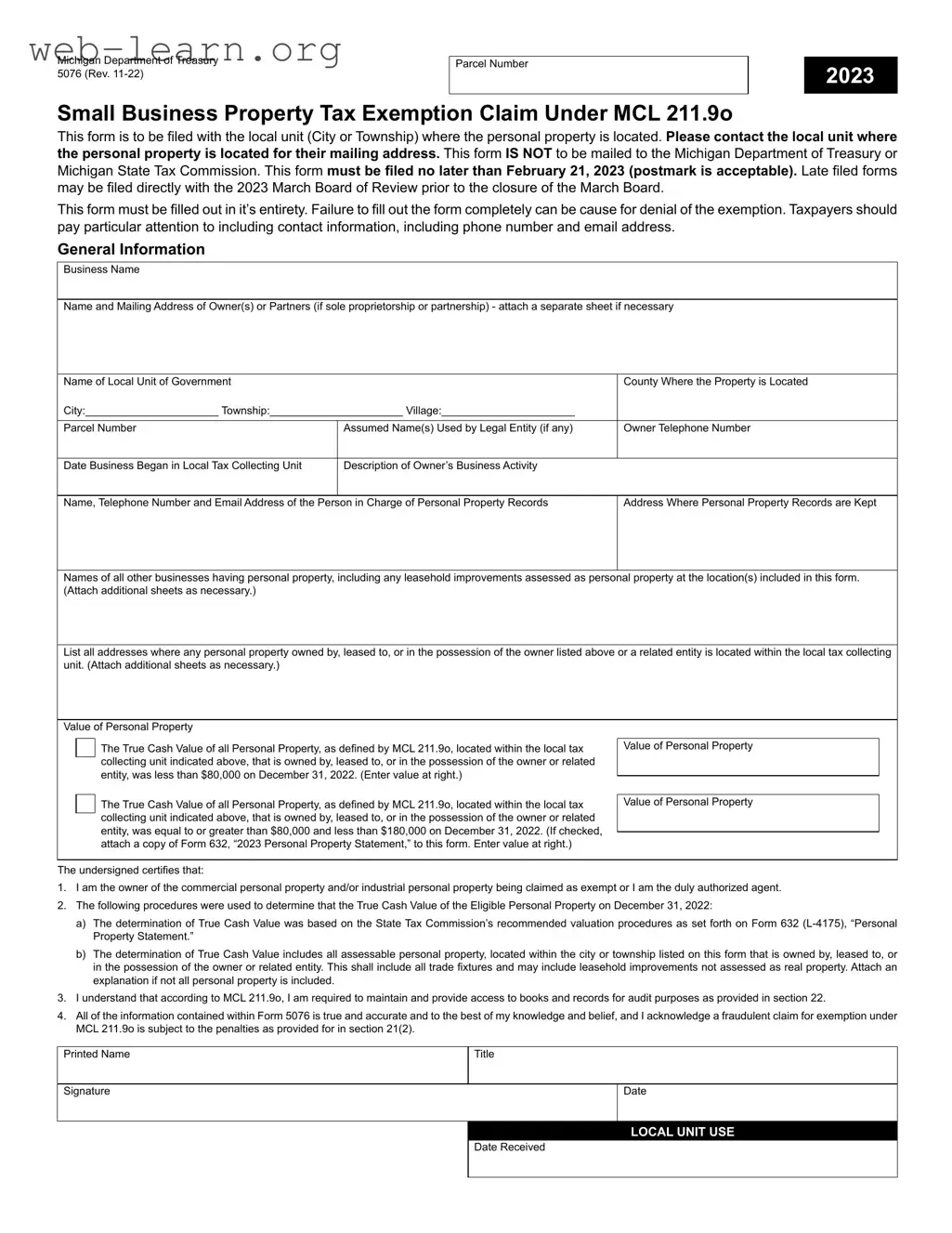
The Michigan Exemption form, officially known as the Department of Treasury Form 5076, serves as a critical tool for small businesses seeking relief from personal property taxes. This form must be submitted to the local unit of government—either a city or township—where the personal property is situated. It is essential to note that the form is not to be sent to the Michigan Department of Treasury or the Michigan State Tax Commission. To qualify for the Small Business Property Tax Exemption, the combined true cash value of the eligible personal property must be less than $80,000 as of December 31, 2021. The form requires detailed information about the business, including the owner's name, contact details, and a description of the business activities. Timeliness is crucial; the form must be filed by February 22, 2022, although late submissions can be made directly to the March Board of Review, provided they are submitted before the board closes. Completeness is equally important, as any omissions can lead to denial of the exemption. Furthermore, businesses must maintain accurate records for audit purposes, ensuring compliance with state regulations. This exemption is particularly beneficial for small businesses, allowing them to allocate resources more effectively while fostering growth and sustainability.
Michigan Department of Treasury 5076 (Rev.
Parcel Number
2023
Small Business Property Tax Exemption Claim Under MCL 211.9o
This form is to be filed with the local unit (City or Township) where the personal property is located. Please contact the local unit where the personal property is located for their mailing address. This form IS NOT to be mailed to the Michigan Department of Treasury or
Michigan State Tax Commission. This form must be filed no later than February 21, 2023 (postmark is acceptable). Late filed forms may be filed directly with the 2023 March Board of Review prior to the closure of the March Board.
This form must be filled out in it’s entirety. Failure to fill out the form completely can be cause for denial of the exemption. Taxpayers should pay particular attention to including contact information, including phone number and email address.
General Information
Business Name
Name and Mailing Address of Owner(s) or Partners (if sole proprietorship or partnership) - attach a separate sheet if necessary
Name of Local Unit of Government |
|
County Where the Property is Located |
City:______________________ Township:______________________ Village:______________________ |
|
|
|
|
|
Parcel Number |
Assumed Name(s) Used by Legal Entity (if any) |
Owner Telephone Number |
Date Business Began in Local Tax Collecting Unit
Description of Owner’s Business Activity
Name, Telephone Number and Email Address of the Person in Charge of Personal Property Records
Address Where Personal Property Records are Kept
Names of all other businesses having personal property, including any leasehold improvements assessed as personal property at the location(s) included in this form. (Attach additional sheets as necessary.)
List all addresses where any personal property owned by, leased to, or in the possession of the owner listed above or a related entity is located within the local tax collecting unit. (Attach additional sheets as necessary.)
Value of Personal Property
The True Cash Value of all Personal Property, as defined by MCL 211.9o, located within the local tax collecting unit indicated above, that is owned by, leased to, or in the possession of the owner or related entity, was less than $80,000 on December 31, 2022. (Enter value at right.)
Value of Personal Property
The True Cash Value of all Personal Property, as defined by MCL 211.9o, located within the local tax |
Value of Personal Property |
collecting unit indicated above, that is owned by, leased to, or in the possession of the owner or related |
|
entity, was equal to or greater than $80,000 and less than $180,000 on December 31, 2022. (If checked, |
|
|
|
attach a copy of Form 632, “2023 Personal Property Statement,” to this form. Enter value at right.) |
|
The undersigned certifies that:
1.I am the owner of the commercial personal property and/or industrial personal property being claimed as exempt or I am the duly authorized agent.
2.The following procedures were used to determine that the True Cash Value of the Eligible Personal Property on December 31, 2022:
a)The determination of True Cash Value was based on the State Tax Commission’s recommended valuation procedures as set forth on Form 632
b)The determination of True Cash Value includes all assessable personal property, located within the city or township listed on this form that is owned by, leased to, or in the possession of the owner or related entity. This shall include all trade fixtures and may include leasehold improvements not assessed as real property. Attach an explanation if not all personal property is included.
3.I understand that according to MCL 211.9o, I am required to maintain and provide access to books and records for audit purposes as provided in section 22.
4.All of the information contained within Form 5076 is true and accurate and to the best of my knowledge and belief, and I acknowledge a fraudulent claim for exemption under MCL 211.9o is subject to the penalties as provided for in section 21(2).
Printed Name
Title
Signature
Date
LOCAL UNIT USE
Date Received
5076, Page 2
Instructions for Small Business Property Tax Exemption Claim Under
MCL 211.9o (Form 5076)
MCL 211.9o provides for a personal property tax exemption for “eligible personal property.” This is commonly referred to as the
Small Business Taxpayer Exemption. MCL 211.9o defines “eligible personal property” as meeting all of the following criteria:
•The personal property must be classified as industrial personal property or commercial personal property as defined in MCL 211.34c or would be classified as industrial personal property or commercial personal property if not exempt and
•The combined true cash value of all industrial personal property and commercial personal property owned by, leased by or in the possession of the owner or a related entity claiming the exemption is less than $180,000 in the local tax collecting unit and
•The property is not leased to or used by a person that previously owned the property or a person that, directly or indirectly controls, is controlled by, or under common control with the person that previously owned the property.
Personal Property Valued Less than $80,000
In order to claim an exemption for personal property valued less than $80,000, this form must be filed with the local unit (City or Township) where the personal property is located no later than February 21, 2023 (postmark is acceptable). This form IS NOT to be mailed to the Michigan Department of Treasury or the Michigan State Tax Commission. Please contact the local unit where the personal property is located for their mailing address. Late filed forms may be filed directly with the local unit March Board of Review prior to the closure of the March Board of Review. Taxpayers must contact the local unit directly to determine the March Board of Review dates.
Taxpayers must appear in person or have a representative appear on their behalf in order to late file with the March Board of Review.
Once the exemption is granted for personal property valued at less than $80,000, the taxpayer will continue to receive the exemption until they no longer qualify for the exemption. Once they no longer qualify, the taxpayer is required to file a rescission form and a personal property statement no later than February 20th of the year that the property is no longer eligible. Failure to file the rescission form will result in significant penalty and interest as prescribed in MCL 211.9o.
This form will exempt property owned only by the entity filing the form. If personal property is leased to or used by an entity other than the property’s owner, the owner of that personal property must file the form for that property, not the lessee or the user. The owner may file the form and claim the exemption only if the True Cash Value of all of the commercial or industrial personal property located within the local tax collecting unit that is owned by, leased to, or in the possession of the owner or a related entity was less than $80,000 on December 31, 2022.
This form must be filled out in it’s entirety. Failure to fill out the form completely can be cause for denial of the exemption. Taxpayers should pay particular attention to including contact information, including phone number and email address.
Once an exemption is granted for personal property valued at less than $80,000, taxpayers are not required to file a “Personal Property Statement” (Form 632) in the year they are claiming the exemption.
Personal Property Valued Greater than or Equal to $80,000 but Less than $180,000
In order to claim an exemption for personal property valued at $80,000 or more but less than $180,000, this form along Form 632 Personal Property Statement must be filed ANNUALLY with the local unit (City or Township) where the personal property is located no later than February 20 of each year (postmark is acceptable). If February 20 is a Saturday, Sunday, or legal holiday, this form and accompanying personal property statement must be filed the next day that is not a Saturday, Sunday, or legal holiday of that year. This form IS NOT to be mailed to the Michigan Department of Treasury or the Michigan State Tax Commission. Please contact the local unit where the personal property is located for their mailing address. Late filed forms may be filed directly with the local unit March Board of Review prior to the closure of the March Board of Review. Taxpayers must contact the local unit directly to determine the March Board of Review dates.
NOTICE: Questions regarding this form should be directed to the assessor of the city or township where the personal property is located. This form is issued under the authority of Public Act 206 of 1893. Additional detailed information on the Small Business Taxpayer Personal Property Exemption can be found on the State Tax Commission website at www.michigan.gov/ statetaxcommission.
| Fact Name | Details |
|---|---|
| Form Title | Michigan Department of Treasury 5076 (Rev. 07-21) |
| Purpose | This form is used to claim the Small Business Property Tax Exemption under MCL 211.9o. |
| Filing Deadline | Forms must be filed by February 22, 2022. Late submissions can be made to the March Board of Review. |
| Governing Law | The exemption is governed by MCL 211.9o, which outlines eligibility criteria for personal property tax exemptions. |
| Eligibility Criteria | Eligible personal property must have a true cash value of less than $80,000 as of December 31, 2021. |
| Filing Location | Submit the form to the local unit (City or Township) where the personal property is located. |
| Contact Information | Include complete contact details, such as phone number and email, to avoid denial of the exemption. |
Completing the Michigan Exemption form involves providing specific information about your business and personal property. It is essential to fill out the form accurately and completely to ensure that your exemption claim is processed without issues. Below are the steps to guide you through the process of filling out the form.
The Michigan Exemption form, officially known as Form 5076, is used by small businesses to claim a property tax exemption on eligible personal property. This exemption is available under MCL 211.9o, which allows businesses with a True Cash Value of less than $80,000 to potentially avoid paying personal property taxes.
Any small business owner who has commercial or industrial personal property located within a local tax collecting unit in Michigan may need to file this form. If your business's personal property meets the eligibility criteria, you should complete and submit this form to claim the exemption.
The form must be filed no later than February 22, 2022, and it’s important to note that a postmark is acceptable. If you miss this deadline, you may still file a late claim directly with the March Board of Review before it closes. However, you or a representative must appear in person to do so.
This form should be submitted to the local unit of government—either a city or township—where your personal property is located. Do not send it to the Michigan Department of Treasury or the Michigan State Tax Commission. For the correct mailing address, you should contact your local unit directly.
It’s crucial to fill out the Michigan Exemption form in its entirety. If any section is left incomplete, it could lead to the denial of your exemption claim. Pay special attention to include all necessary contact information, such as your phone number and email address.
If your business no longer meets the criteria for the exemption, you are required to file a rescission form and a personal property statement by February 20th of the year in which you become ineligible. Failing to do so can result in significant penalties and interest on any additional taxes owed.
No, if you file Form 5076, you are not required to submit a Personal Property Statement (Form 632) for that year. This simplifies the process for small businesses claiming the exemption, allowing them to focus on their operations without the added paperwork burden.
Completing the Michigan Exemption Form can be a straightforward process, but several common mistakes can lead to complications or denial of the exemption. Awareness of these potential pitfalls is essential for a successful submission.
One frequent error is failing to provide complete information. The form requires detailed contact information, including a phone number and email address. Omitting any of these details can result in delays or denial of the exemption. It is crucial to ensure that all sections of the form are filled out thoroughly and accurately.
Another mistake often made is missing the filing deadline. The form must be submitted to the local unit by February 22, 2022. Late submissions can only be accepted under specific circumstances, such as during the March Board of Review. If individuals do not adhere to this timeline, they risk losing the opportunity for exemption.
Many applicants also overlook the requirement to attach additional sheets when necessary. If the business has multiple locations or additional partners, it is important to provide that information clearly. Not including these attachments can lead to incomplete submissions, which may be grounds for denial.
Additionally, some individuals misunderstand the eligibility criteria for the exemption. The combined true cash value of all personal property must be less than $80,000. Failing to accurately assess the value of the property can result in an incorrect claim. It is advisable to review the valuation procedures carefully to ensure compliance.
Lastly, some applicants may not fully understand the implications of filing a fraudulent claim. The form includes a certification that all information is true and accurate. Misrepresentation can lead to significant penalties. It is vital to ensure that all information provided is correct and reflective of the actual circumstances.
The Michigan Exemption form is an essential document for small businesses seeking a property tax exemption. However, it is often accompanied by other forms and documents that help clarify the exemption process. Below is a list of additional documents commonly used alongside the Michigan Exemption form.
Understanding these documents can help small business owners navigate the exemption process more effectively. Proper preparation and timely submission can lead to significant tax savings and compliance with state requirements.
The Michigan Exemption form shares similarities with several other documents used in tax exemption claims and personal property assessments. Below are four such documents, each highlighting their similarities:
When filling out the Michigan Exemption form, it is important to adhere to specific guidelines to ensure the process goes smoothly. Below is a list of things to do and avoid.
Misconceptions about the Michigan Exemption form can lead to confusion and missed opportunities for small business owners. Here are four common misunderstandings:
Understanding these misconceptions can help ensure that small business owners navigate the exemption process successfully and take advantage of the benefits available to them.
When filling out and using the Michigan Exemption form, it is essential to understand the key aspects to ensure a smooth process. Below are important takeaways regarding the Michigan Exemption form:
Understanding these key points can help navigate the process of claiming the Small Business Property Tax Exemption effectively. For any questions, reach out to the local assessor for assistance.