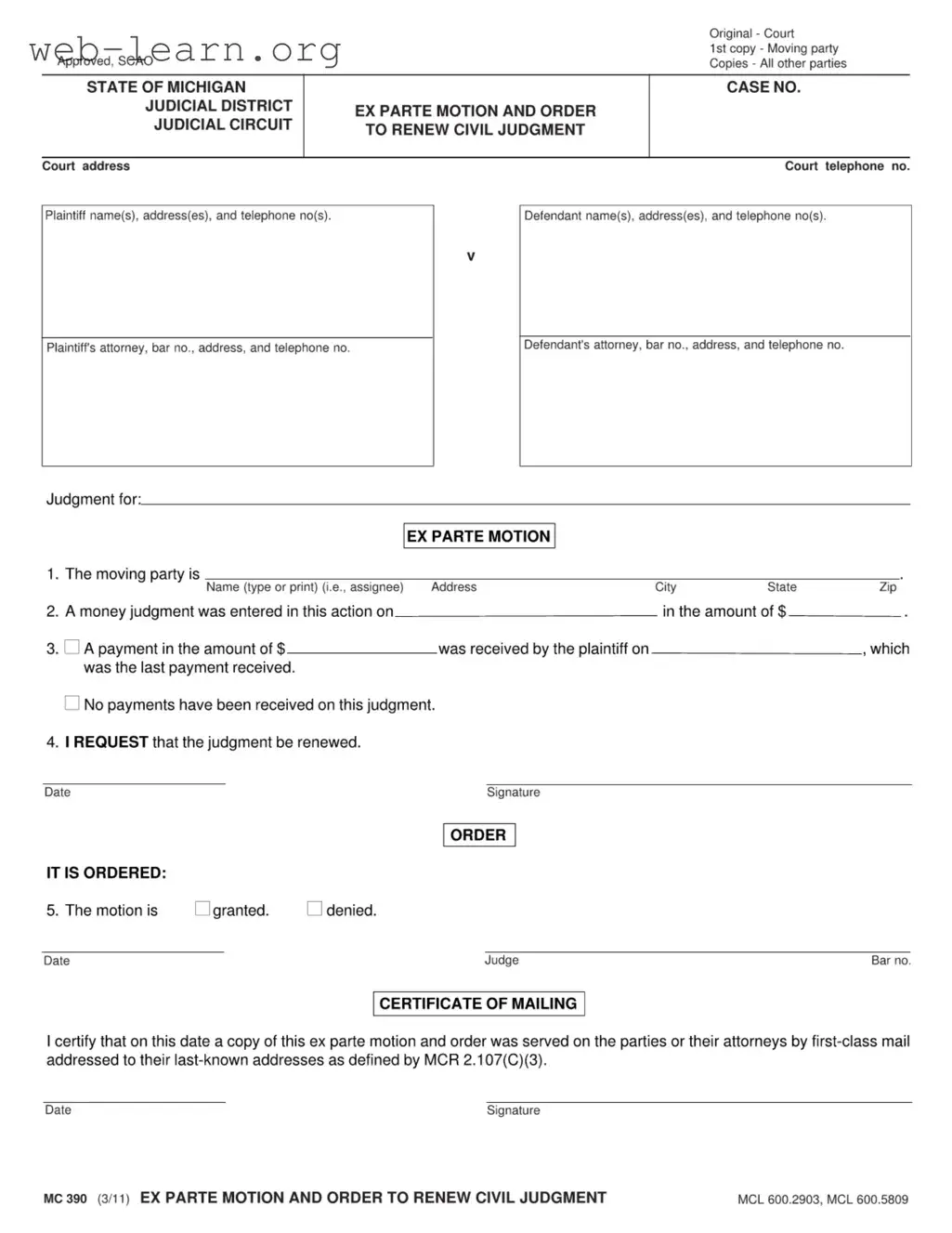
In the realm of civil law, the Michigan Ex Parte form plays a crucial role in the process of renewing civil judgments. This form is designed for situations where a party seeks to extend the validity of a previously awarded money judgment. It streamlines the process by allowing the moving party to submit their request without the need for a formal hearing, making it a valuable tool for those who may be unable to locate the other party or who wish to expedite the renewal process. The form includes essential details such as the names and addresses of both the plaintiff and defendant, the case number, and specific information regarding the original judgment and any payments received. By completing this form, individuals can formally request the court to renew a judgment, ensuring that their rights to collect on the debt remain intact. Additionally, the form requires certification of mailing, which serves to notify all parties involved, thereby maintaining transparency throughout the process. Understanding the Michigan Ex Parte form is vital for anyone navigating the complexities of civil judgments, as it not only facilitates the legal procedure but also empowers individuals to take proactive steps in managing their financial rights.
| Fact Name | Details |
|---|---|
| Form Purpose | The Michigan Ex Parte form is used to request the renewal of a civil judgment. This allows the original judgment to remain enforceable beyond its initial expiration period. |
| Governing Laws | This form is governed by Michigan Compiled Laws (MCL) 600.2903 and MCL 600.5809, which outline the procedures for renewing civil judgments. |
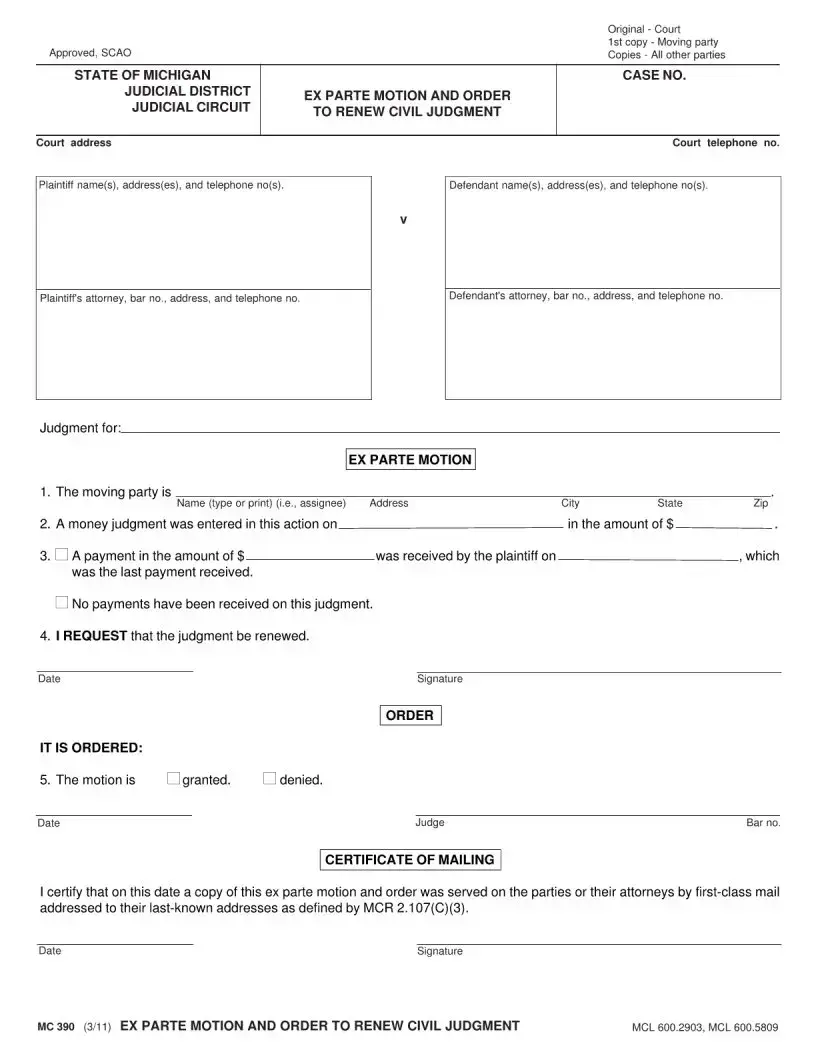
| Filing Requirements | The moving party must provide the court with the original form, along with copies for all other parties involved in the case. |
| Payment Information | In the form, the moving party must indicate the last payment received towards the judgment. If no payments have been made, this must also be stated clearly. |
| Judicial Review | The judge will review the motion and can either grant or deny the request for renewal. This decision is documented on the form. |
| Service of Notice | A certificate of mailing is included, confirming that all parties or their attorneys received a copy of the motion and order by first-class mail. |
After completing the Michigan Ex Parte form, you will need to file it with the court and serve copies to all relevant parties. Make sure to keep track of deadlines and any required follow-up actions.
What is the Michigan Ex Parte form?
The Michigan Ex Parte form is a legal document used to request the renewal of a civil judgment. It allows the moving party to submit a motion to the court without the need for a hearing, provided that certain conditions are met. This form is typically utilized when a money judgment has been entered, and the moving party seeks to extend the validity of that judgment.
Who can file an Ex Parte motion?
Any party to the original judgment, known as the moving party, can file an Ex Parte motion. This includes the plaintiff or their assignee. It is essential that the moving party has the necessary information regarding the original judgment, such as the date it was entered and the amount of the last payment received.
What information is required to complete the form?
The form requires specific details, including:
Providing accurate and complete information is crucial to ensure the motion is processed correctly.
What happens after the Ex Parte motion is filed?
Once the motion is filed, the court will review the request. The judge will either grant or deny the motion based on the information provided. If granted, the judgment will be renewed, and the moving party will receive a copy of the order. If denied, the moving party will also be notified.
How is the Ex Parte motion served to other parties?
The moving party is responsible for serving a copy of the Ex Parte motion and order to all other parties involved in the case. This is typically done by first-class mail to the last-known addresses of the parties or their attorneys, as outlined in the Michigan Court Rules.
Filling out the Michigan Ex Parte form can be straightforward, but many individuals make common mistakes that can lead to delays or complications in the legal process. One frequent error is failing to include complete contact information for all parties involved. This includes not only names but also addresses and telephone numbers. Omitting any of this information can hinder the court's ability to communicate effectively with all parties.
Another mistake often seen is neglecting to provide accurate details about the judgment. Specifically, individuals may forget to include the date the original money judgment was entered. This information is crucial for the court to assess the validity of the renewal request. Additionally, the amount of the last payment received should be clearly stated. If this information is missing or incorrect, it can result in the denial of the motion.
Many people also overlook the requirement to sign the form. A signature validates the motion and confirms that the information provided is true and correct. Without a signature, the form is incomplete and may not be processed. Furthermore, individuals sometimes forget to date the form, which is another essential element that can lead to complications.
Providing insufficient information about the payment history is another common error. The form asks for details about the last payment received, and failing to specify whether any payments have been made can create confusion. If no payments have been received, this must be clearly indicated to avoid misunderstandings.
Another mistake is not following the proper mailing procedures outlined in the form. The certificate of mailing must be completed to confirm that all parties have been notified. Failure to do so can result in disputes about whether the other parties were informed of the motion.
Additionally, individuals sometimes forget to check the box indicating whether the motion is granted or denied. This can lead to uncertainty about the court's decision and may require additional follow-up. Ensuring that this section is completed accurately is vital for clarity.
Finally, not keeping a copy of the completed form for personal records is a mistake that can have lasting consequences. Having a copy allows individuals to reference the submitted information in future communications or hearings. Keeping organized records is essential for anyone involved in legal proceedings.
The Michigan Ex Parte form is a critical document for those looking to renew a civil judgment. However, several other forms and documents often accompany it, providing essential information and facilitating the legal process. Below is a list of commonly used documents that you may encounter alongside the Michigan Ex Parte form.
Understanding these documents can help streamline the process of renewing a civil judgment in Michigan. Each plays a role in ensuring that all parties are informed and that the legal requirements are met effectively. Being prepared with the right forms can make a significant difference in the outcome of your case.
The Michigan Ex Parte form is a specific legal document used to request the renewal of a civil judgment without the need for a hearing. Several other documents serve similar purposes in various legal contexts. Below is a list of documents that share similarities with the Michigan Ex Parte form:
When filling out the Michigan Ex Parte form, attention to detail is crucial. Here are eight important do's and don'ts to consider:
Following these guidelines can help streamline the process and increase the likelihood of a successful motion. Proper preparation is essential for a favorable outcome.
Understanding the Michigan Ex Parte form is crucial for anyone involved in civil judgments. However, several misconceptions can lead to confusion. Here are six common misunderstandings:
By clearing up these misconceptions, individuals can navigate the process more effectively and ensure they are following the correct procedures.
When dealing with the Michigan Ex Parte form for renewing a civil judgment, it is essential to understand a few key points to ensure a smooth process.