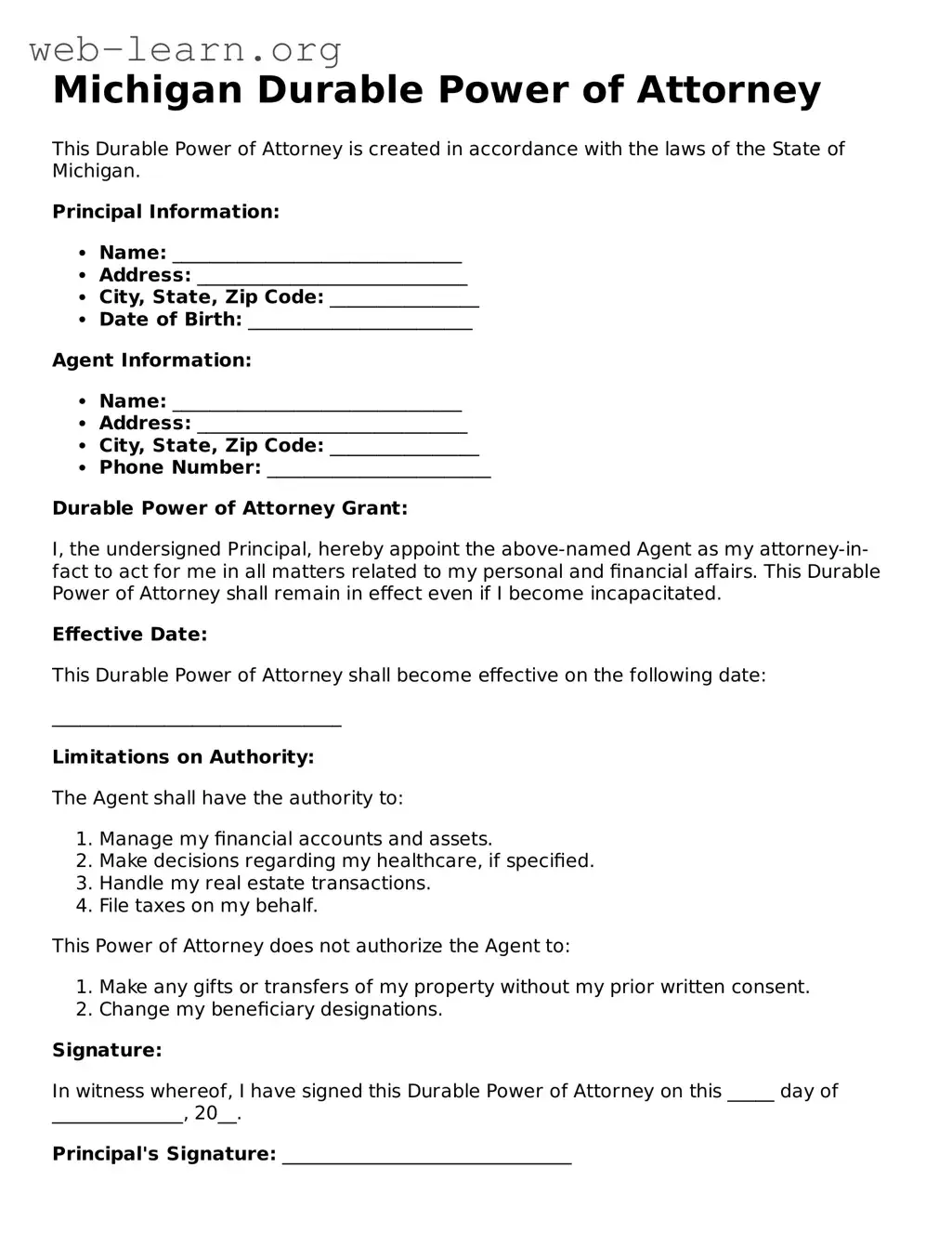
In Michigan, the Durable Power of Attorney form serves as a vital legal document that empowers individuals to designate someone they trust to make important financial and legal decisions on their behalf, should they become unable to do so themselves. This form is particularly significant because it remains effective even if the person who created it becomes incapacitated, ensuring that their affairs can be managed without interruption. Key aspects of the form include the ability to specify the powers granted to the agent, which can range from handling financial transactions to managing real estate. Additionally, the document allows for the appointment of a successor agent, providing a backup option should the primary agent be unable or unwilling to act. Understanding the nuances of this form is essential for anyone looking to safeguard their interests and ensure that their wishes are respected in times of need.
Michigan Durable Power of Attorney
This Durable Power of Attorney is created in accordance with the laws of the State of Michigan.
Principal Information:
Agent Information:
Durable Power of Attorney Grant:
I, the undersigned Principal, hereby appoint the above-named Agent as my attorney-in-fact to act for me in all matters related to my personal and financial affairs. This Durable Power of Attorney shall remain in effect even if I become incapacitated.
Effective Date:
This Durable Power of Attorney shall become effective on the following date:
_______________________________
Limitations on Authority:
The Agent shall have the authority to:
This Power of Attorney does not authorize the Agent to:
Signature:
In witness whereof, I have signed this Durable Power of Attorney on this _____ day of ______________, 20__.
Principal's Signature: _______________________________
Witness Information:
Notary Public:
State of Michigan, County of _______________
Subscribed and sworn before me on this _____ day of ______________, 20__.
Notary Signature: _______________________________
My Commission Expires: ______________________
| Fact Name | Details |
|---|---|
| Definition | A Michigan Durable Power of Attorney allows someone to make financial decisions on your behalf if you become incapacitated. |
| Governing Law | The form is governed by the Michigan Compiled Laws, specifically MCL 700.5501 to 700.5516. |
| Durability | This document remains effective even if you become incapacitated, unlike a standard Power of Attorney. |
| Agent Authority | You can grant your agent broad or limited powers, depending on your preferences. |
| Signature Requirement | The form must be signed by you and witnessed by at least one individual or notarized. |
| Revocation | You can revoke the Durable Power of Attorney at any time as long as you are competent. |
| Agent's Duties | Your agent must act in your best interest and keep accurate records of transactions. |
| Healthcare Decisions | This form does not cover healthcare decisions; a separate document is needed for that. |
| Filing | The Durable Power of Attorney does not need to be filed with the court to be effective. |
| Age Requirement | You must be at least 18 years old to create a Durable Power of Attorney in Michigan. |
Filling out the Michigan Durable Power of Attorney form is an important step in designating someone to make decisions on your behalf regarding financial matters. Once you have completed the form, it will need to be signed and possibly notarized to ensure its validity. Here are the steps to guide you through the process of filling out the form.
Once completed, keep a copy for your records and provide copies to your agent and any relevant financial institutions. It's essential to ensure that everyone involved understands the authority granted and the responsibilities that come with it.
A Durable Power of Attorney is a legal document that allows you to appoint someone to make decisions on your behalf if you become unable to do so. This could be due to illness, injury, or other circumstances. The "durable" aspect means that the authority granted remains in effect even if you become incapacitated.
You can choose anyone you trust to act as your agent. This person can be a family member, friend, or even a professional, such as an attorney. However, it's important to select someone who understands your wishes and will act in your best interest.
The powers you grant can vary widely. Common powers include:
Be sure to specify any limitations or conditions you want to impose on your agent's authority.
No, you do not need a lawyer to create a Durable Power of Attorney in Michigan. However, consulting with a legal professional can ensure that the document meets your specific needs and complies with state laws.
To create a DPOA, you must fill out the appropriate form, which can often be found online or at legal stationery stores. After completing the form, you must sign it in front of a notary public. This step is crucial, as it helps validate the document.
Yes, you can revoke your DPOA at any time as long as you are competent. To do so, you should create a written revocation document and notify your agent and any institutions that may have a copy of the original DPOA.
If you become incapacitated without a DPOA, your family may need to go through a court process to have someone appointed as your guardian. This can be time-consuming and may not align with your wishes.
Yes, you can appoint multiple agents. You can specify whether they must act together or if they can act independently. Consider the dynamics of your relationships, as this choice can impact decision-making.
A Durable Power of Attorney created in Michigan is generally valid in other states, but some states may have different requirements. It is advisable to check the laws in your new state or consider creating a new DPOA that complies with local laws.
If you grant your agent the authority to make healthcare decisions, they will be able to make choices about your medical treatment if you are unable to communicate your wishes. It's essential to discuss your healthcare preferences with your agent to ensure they understand your values and desires.
Filling out the Michigan Durable Power of Attorney form can be a straightforward process, but there are common mistakes that people often make. One significant error is failing to specify the powers granted. Without clear definitions, the appointed agent may not have the authority needed to act on behalf of the principal.
Another frequent mistake is not signing the document in the presence of a notary public. Michigan law requires that the Durable Power of Attorney be notarized to ensure its validity. Skipping this step can lead to challenges in the document’s acceptance later.
Many individuals also neglect to date the form. A date is crucial as it establishes when the powers begin. If the document is undated, it may cause confusion about its effectiveness, especially if the principal’s circumstances change.
People sometimes overlook the importance of discussing the decision with the appointed agent. It is essential for the agent to understand their responsibilities and the principal's wishes. Failing to communicate can lead to misunderstandings and conflict.
Another mistake is using outdated forms. Legal documents can change over time, and using an old version may not comply with current laws. Always ensure that the most recent form is being used to avoid complications.
Additionally, some individuals do not consider alternate agents. Appointing a backup ensures that someone can step in if the primary agent is unavailable or unwilling to serve. This oversight can leave the principal without representation in critical situations.
People may also forget to review the form for accuracy after filling it out. Typos or incorrect information can lead to disputes or invalidation of the document. Taking the time to double-check can prevent future issues.
Not understanding the scope of the powers granted is another common pitfall. Some individuals may give their agents too much authority, while others may restrict them unnecessarily. It’s important to find a balance that meets the principal’s needs.
Failing to keep copies of the signed document can cause problems as well. It is essential to distribute copies to the agent, family members, and any relevant institutions. This ensures that everyone involved is aware of the principal’s wishes.
Lastly, many people do not update their Durable Power of Attorney when their circumstances change. Life events such as marriage, divorce, or the death of an agent can necessitate a review and possible revision of the document. Regular updates help ensure that the document remains relevant and effective.
A Michigan Durable Power of Attorney form is a crucial document that allows individuals to appoint someone to make financial or medical decisions on their behalf if they become incapacitated. However, several other forms and documents often accompany this form to ensure comprehensive planning and clarity in decision-making. Here are some of the key documents that may be used alongside the Michigan Durable Power of Attorney:
Incorporating these documents into estate planning can provide clarity and peace of mind. Each serves a specific purpose and addresses different aspects of personal and financial decision-making, ensuring that individuals' wishes are respected and followed. Careful consideration of these forms can lead to more effective planning for the future.
When filling out the Michigan Durable Power of Attorney form, it is crucial to approach the task with care. Here are ten things to consider, divided into what you should do and what you should avoid.
Things You Should Do:
Things You Shouldn't Do:
Understanding the Michigan Durable Power of Attorney (DPOA) is crucial for making informed decisions about your financial and medical affairs. Unfortunately, several misconceptions can lead to confusion. Here are ten common misconceptions about the Michigan Durable Power of Attorney form:
By understanding these misconceptions, individuals can make better decisions regarding their legal and financial planning in Michigan.
Filling out and using the Michigan Durable Power of Attorney form can be straightforward if you keep these key points in mind:
By following these guidelines, you can ensure that your Durable Power of Attorney form is filled out correctly and serves its intended purpose.
Power of Attorney Arizona - A Durable Power of Attorney can cover financial matters, healthcare decisions, or both, depending on your preferences.
How to Get Power of Attorney in Florida - The document can be effective for both short-term and long-term needs.
Durable Power of Attorney Indiana - The principal should ensure the agent understands their financial situation and preferences.