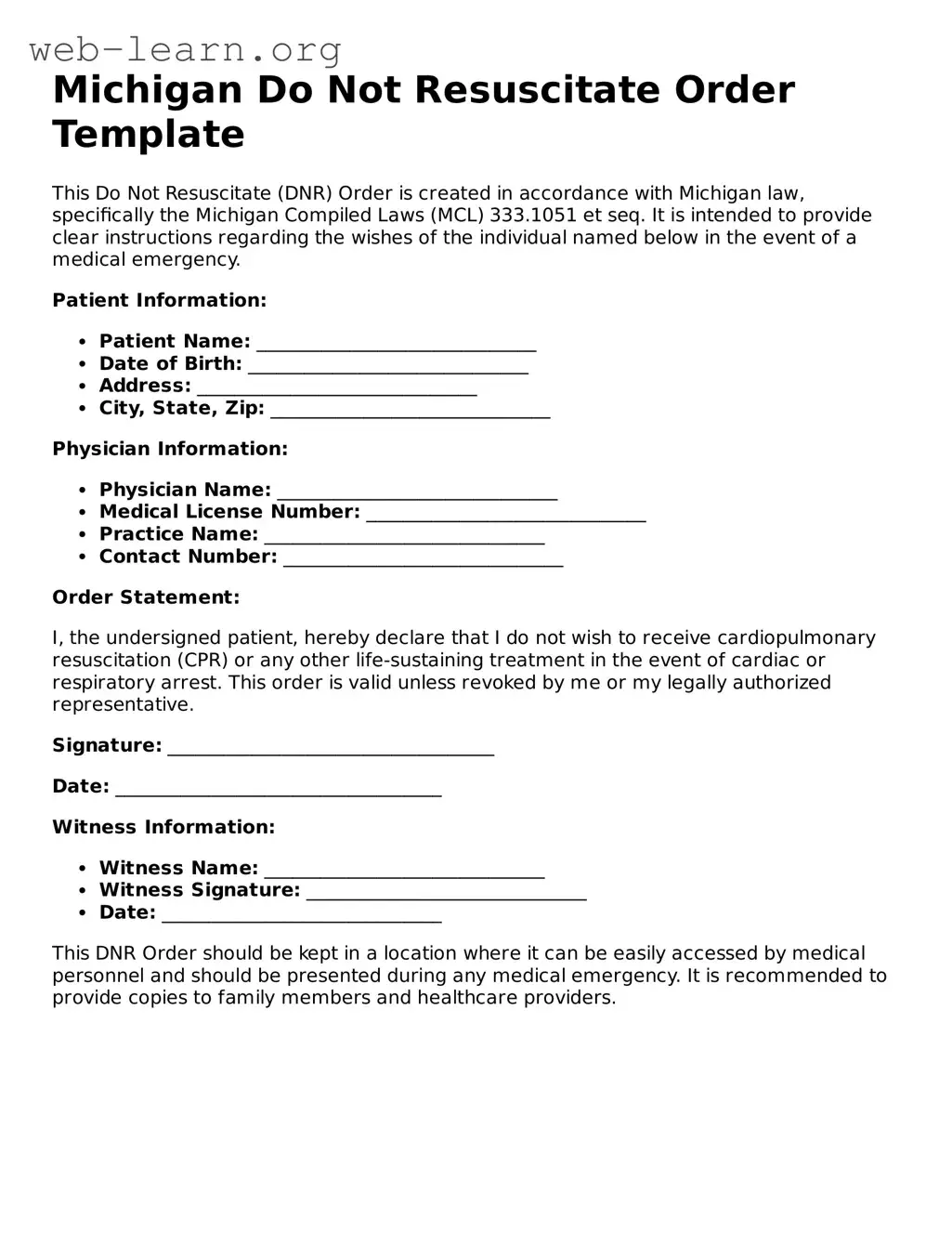
The Michigan Do Not Resuscitate (DNR) Order form serves as a critical document for individuals who wish to make their end-of-life medical preferences known. This form is designed for patients who may not want to receive cardiopulmonary resuscitation (CPR) in the event of a cardiac or respiratory arrest. It is important to understand that the DNR Order is not a blanket refusal of medical treatment; rather, it specifically addresses resuscitation efforts. By completing this form, individuals can ensure their wishes are respected by healthcare providers and family members during critical moments. The DNR Order must be signed by a physician and can be presented in various healthcare settings, including hospitals and nursing homes. Additionally, it is essential for patients to discuss their decisions with their loved ones and healthcare professionals to ensure clarity and understanding of their choices. The form also includes spaces for patient information, signatures, and, in some cases, the involvement of a witness or notary, reinforcing its legal standing. Overall, the Michigan DNR Order form is a vital tool for empowering individuals to take control of their healthcare decisions at the end of life.
Michigan Do Not Resuscitate Order Template
This Do Not Resuscitate (DNR) Order is created in accordance with Michigan law, specifically the Michigan Compiled Laws (MCL) 333.1051 et seq. It is intended to provide clear instructions regarding the wishes of the individual named below in the event of a medical emergency.
Patient Information:
Physician Information:
Order Statement:
I, the undersigned patient, hereby declare that I do not wish to receive cardiopulmonary resuscitation (CPR) or any other life-sustaining treatment in the event of cardiac or respiratory arrest. This order is valid unless revoked by me or my legally authorized representative.
Signature: ___________________________________
Date: ___________________________________
Witness Information:
This DNR Order should be kept in a location where it can be easily accessed by medical personnel and should be presented during any medical emergency. It is recommended to provide copies to family members and healthcare providers.
| Fact Name | Details |
|---|---|
| Definition | A Michigan Do Not Resuscitate (DNR) Order is a legal document that instructs medical personnel not to perform cardiopulmonary resuscitation (CPR) if a person's heart stops or they stop breathing. |
| Governing Law | The Michigan DNR Order is governed by the Michigan Compiled Laws, specifically MCL 333.1051 to 333.1055. |
| Eligibility | Any adult who is capable of making their own medical decisions can complete a DNR Order. This includes individuals with terminal illnesses or those who wish to avoid aggressive life-saving measures. |
| Form Requirements | The DNR Order must be signed by the patient or their legal representative and a physician. It should be readily available to emergency medical personnel and healthcare providers. |
Filling out the Michigan Do Not Resuscitate Order form is an important step in making your healthcare preferences known. Once the form is completed, it should be shared with your healthcare provider and kept in a place where it can be easily accessed in case of an emergency.
What is a Do Not Resuscitate (DNR) Order in Michigan?
A Do Not Resuscitate Order is a legal document that allows a person to refuse resuscitation efforts in the event of a medical emergency. In Michigan, this order specifically instructs healthcare providers not to perform CPR or other life-saving measures if the person's heart stops or they stop breathing.
Who can request a DNR Order?
In Michigan, any adult who is capable of making their own medical decisions can request a DNR Order. This includes individuals with terminal illnesses, serious medical conditions, or those who wish to avoid aggressive medical interventions at the end of life.
How do I obtain a DNR Order form?
You can obtain a DNR Order form from various sources, including hospitals, healthcare providers, or the Michigan Department of Health and Human Services website. It's important to ensure that the form is the official state version to ensure its validity.
What information is required on the DNR Order form?
The form typically requires the following information:
Is a DNR Order valid in all healthcare settings?
Yes, a properly completed DNR Order is valid in all healthcare settings in Michigan, including hospitals, nursing homes, and at home. However, it’s crucial to communicate your wishes to your healthcare providers and family members to ensure they are aware of your decision.
Can I change or revoke my DNR Order?
Yes, you can change or revoke your DNR Order at any time. To do this, simply complete a new DNR Order form or verbally communicate your decision to your healthcare provider. It’s advisable to inform your family and caregivers about any changes to ensure they are aware of your current wishes.
What happens if I do not have a DNR Order?
If you do not have a DNR Order and your heart stops or you stop breathing, healthcare providers are required to perform resuscitation efforts, including CPR. This may not align with your wishes if you prefer to avoid aggressive medical interventions.
How can I ensure my DNR Order is respected?
To ensure your DNR Order is respected, keep a copy of the signed form in an easily accessible location. Share copies with your healthcare providers, family members, and anyone involved in your care. Discuss your wishes openly to avoid confusion during a medical emergency.
Filling out the Michigan Do Not Resuscitate (DNR) Order form is a crucial step for individuals who wish to express their preferences regarding medical treatment in the event of a life-threatening situation. However, many people make mistakes that can lead to confusion or unintended consequences. Understanding these common pitfalls can help ensure that your wishes are honored.
One frequent error occurs when individuals fail to provide complete and accurate information. The DNR form requires specific details, such as the patient's name, date of birth, and signature. Omitting any of this information can render the document invalid. It's essential to double-check that all sections are filled out correctly before submitting the form.
Another common mistake is not discussing the DNR order with family members or healthcare providers. Many individuals assume that their loved ones understand their wishes, but this is often not the case. A lack of communication can lead to misunderstandings during critical moments. It is advisable to have open conversations about your DNR preferences to ensure everyone is on the same page.
Some people mistakenly believe that a DNR order is only necessary for those who are terminally ill. In reality, anyone can choose to fill out a DNR order, regardless of their current health status. This misconception may lead individuals to delay completing the form until they feel their health is in jeopardy, which can be too late to make an informed decision.
Additionally, individuals sometimes forget to keep their DNR order accessible. Once the form is completed, it should be kept in a location where it can be easily found by medical personnel, such as on the refrigerator or with other important documents. If the DNR order is not readily available, healthcare providers may not be aware of your wishes during an emergency.
Finally, people often overlook the importance of regularly reviewing and updating their DNR orders. Life circumstances can change, and so can personal preferences regarding medical treatment. It is wise to revisit the DNR order periodically to ensure it still reflects your wishes and to make any necessary updates.
When considering a Do Not Resuscitate (DNR) Order in Michigan, individuals may also encounter several other important forms and documents. Each of these serves a specific purpose in ensuring that a person's healthcare preferences are honored. Below is a list of commonly used forms that complement the DNR Order.
Understanding these documents can help individuals and their families navigate complex healthcare decisions. Each form plays a vital role in ensuring that personal wishes regarding medical treatment are respected and followed, particularly in critical situations.
When filling out the Michigan Do Not Resuscitate Order form, it is important to follow certain guidelines to ensure that your wishes are clearly communicated. Here are some dos and don'ts to consider:
Understanding the Michigan Do Not Resuscitate (DNR) Order form is crucial for making informed healthcare decisions. However, several misconceptions can cloud people's understanding of this important document. Here are five common misconceptions:
This is not true. A DNR order specifically addresses resuscitation efforts in the event of cardiac arrest. It does not prevent you from receiving other medical treatments, such as medications, pain management, or comfort care.
While legal advice can be helpful, it is not necessary to have a lawyer to fill out a DNR form. The process is designed to be straightforward, allowing individuals to make their wishes known without legal representation.
This misconception can lead to confusion. A DNR can be appropriate for anyone who wishes to forgo resuscitation, regardless of their overall health status. The decision is personal and should reflect individual values and preferences.
While communicating your wishes is important, a verbal expression is not legally binding. To ensure that your preferences are followed, it is essential to complete the official DNR form and have it properly signed.
This is a common misunderstanding. Once a DNR order is in place and properly documented, it reflects your wishes. Family members cannot override it unless you have designated them as decision-makers in a legal advance directive.
Being informed about the Michigan DNR Order form can empower individuals to make decisions that align with their healthcare preferences. Clear communication with healthcare providers and family members is essential to ensure that your wishes are respected.
Filling out and using the Michigan Do Not Resuscitate Order form is an important step in ensuring your healthcare preferences are respected. Here are key takeaways to consider:
Understanding these points will help you navigate the process effectively and ensure your wishes are clearly communicated.
Is a Dnr an Advance Directive - Patients should consider their values and beliefs when deciding whether to complete a DNR form.
Do Not Resuscitate Form Indiana - A DNR can be an important part of a patient’s overall healthcare strategy, particularly for those with chronic or terminal conditions.
What's a Dnr - A DNR Order helps ensure that patients receive care that aligns with their values and preferences.