When navigating the emotional and legal complexities of a divorce, the Michigan Divorce Settlement Agreement form plays a crucial role in outlining the terms agreed upon by both parties. This document addresses significant aspects such as the division of marital assets and debts, child custody arrangements, and spousal support obligations. It ensures that both individuals have a clear understanding of their rights and responsibilities post-divorce. The form also facilitates a smoother transition by formalizing agreements related to child support and visitation schedules, which can be vital for maintaining stability for any children involved. By clearly documenting these terms, the agreement serves as a legally binding contract, providing peace of mind and clarity for both parties as they move forward with their lives. Understanding how to effectively complete this form can empower individuals to take control of their divorce proceedings, making the process less daunting and more manageable.
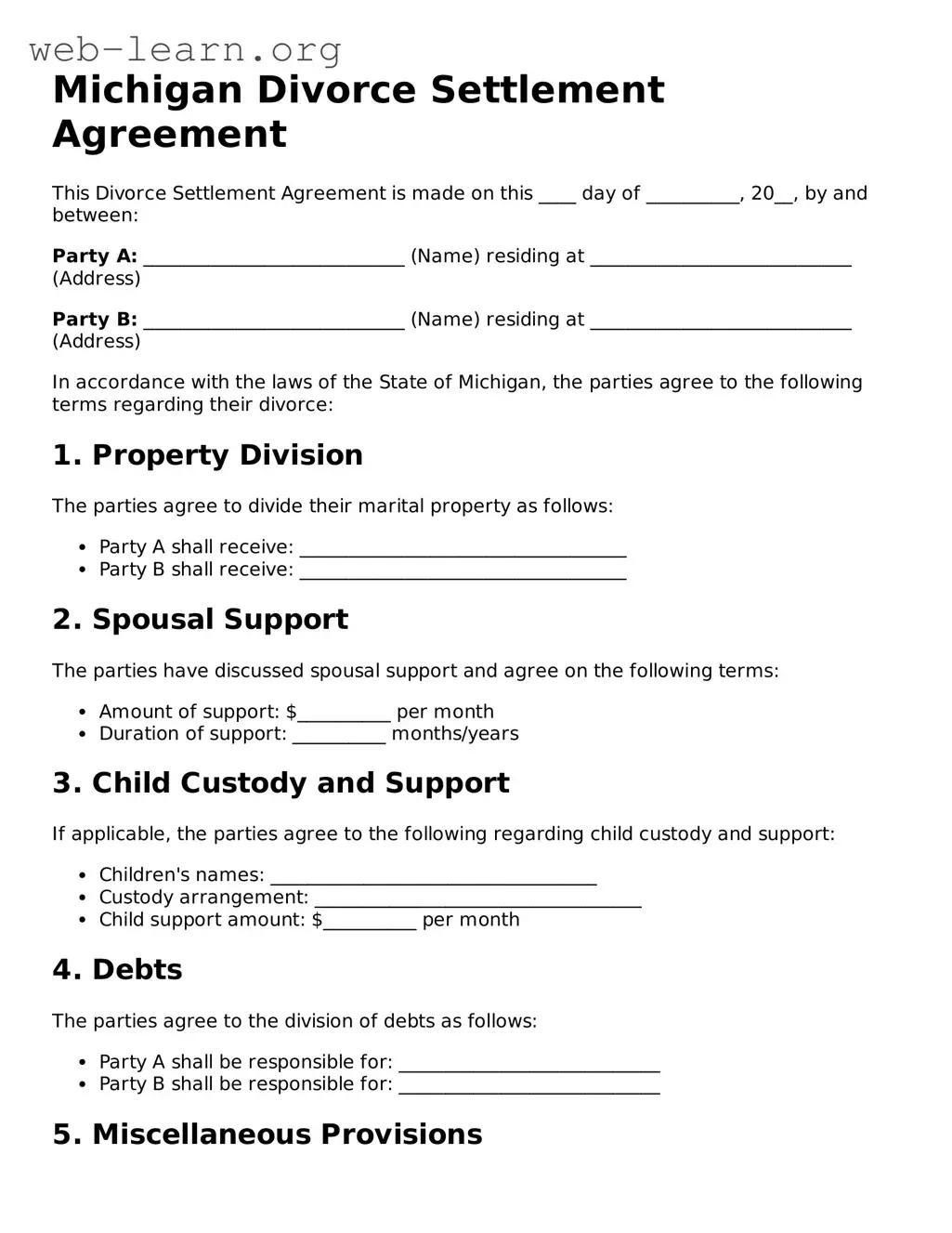
Michigan Divorce Settlement Agreement
This Divorce Settlement Agreement is made on this ____ day of __________, 20__, by and between:
Party A: ____________________________ (Name) residing at ____________________________ (Address)
Party B: ____________________________ (Name) residing at ____________________________ (Address)
In accordance with the laws of the State of Michigan, the parties agree to the following terms regarding their divorce:
1. Property Division
The parties agree to divide their marital property as follows:
2. Spousal Support
The parties have discussed spousal support and agree on the following terms:
3. Child Custody and Support
If applicable, the parties agree to the following regarding child custody and support:
4. Debts
The parties agree to the division of debts as follows:
5. Miscellaneous Provisions
Other agreements include:
6. Signatures
By signing below, both parties agree to the terms outlined in this Divorce Settlement Agreement.
Party A Signature: ____________________________ Date: __________
Party B Signature: ____________________________ Date: __________
This agreement is made in accordance with the laws of the State of Michigan.
| Fact Name | Description |
|---|---|
| Governing Law | The Michigan Divorce Settlement Agreement is governed by Michigan Compiled Laws, specifically the Michigan Divorce Act (MCL 552.1 et seq.). |
| Purpose | This form is used to outline the terms of a divorce settlement between parties, covering issues such as asset division, child custody, and support obligations. |
| Mutual Agreement | Both spouses must agree to the terms outlined in the settlement agreement for it to be valid and enforceable. |
| Filing Requirement | The completed Divorce Settlement Agreement must be filed with the court as part of the divorce proceedings. |
| Modification | Once approved by the court, the terms can only be modified through a subsequent court order, typically requiring a showing of changed circumstances. |
| Legal Representation | While it is not required, having legal representation can help ensure that the agreement is fair and complies with state laws. |
| Enforcement | If one party fails to comply with the terms of the agreement, the other party can seek enforcement through the court. |
Once you have the Michigan Divorce Settlement Agreement form in front of you, it's time to fill it out accurately. This form will require specific information about your situation, so take your time to ensure everything is correct. Follow these steps to complete the form properly.
After completing the form, you'll need to file it with the appropriate court. Be sure to keep copies for your records and for your spouse. This will help ensure a smoother process moving forward.
A Michigan Divorce Settlement Agreement is a legal document that outlines the terms of a divorce between two parties. It details how assets, debts, and responsibilities will be divided, including child custody and support arrangements if applicable.
This agreement is crucial because it helps prevent future disputes. By clearly outlining each party's rights and obligations, it provides a framework that both parties can refer to after the divorce is finalized.
A comprehensive Divorce Settlement Agreement should include:
To create this agreement, both parties should negotiate terms amicably. It is advisable to consult with a lawyer to ensure that the agreement complies with Michigan law and protects your interests.
Yes, modifications can be made, but both parties must agree to the changes. It's best to document any modifications in writing and have them signed to avoid confusion later.
Yes, once signed and approved by the court, the agreement becomes legally binding. Both parties are required to adhere to the terms outlined in the document.
If the parties cannot reach an agreement, they may need to engage in mediation or go to court. A judge will then make decisions regarding the divorce terms based on the best interests of any children involved and equitable distribution of assets.
While it is not mandatory to have a lawyer, it is highly recommended. A lawyer can provide guidance, ensure compliance with legal standards, and help protect your rights throughout the process.
The agreement must be filed with the circuit court in the county where either spouse resides. Ensure that you follow local court rules for filing procedures.
After filing, the court will review the agreement. If everything is in order, the judge will approve it, and the divorce will be finalized. You will receive a copy of the signed agreement for your records.
Filling out the Michigan Divorce Settlement Agreement form can be a daunting task. Many individuals make common mistakes that can lead to delays or complications in the divorce process. Understanding these pitfalls is essential for a smoother experience.
One frequent mistake is not providing complete information. Each section of the form is important, and leaving out details can cause confusion later. For example, when listing assets or debts, ensure that all items are accounted for. Omitting even a single asset can lead to disputes down the line.
Another common error involves incorrect calculations. When determining the value of shared property or debts, accuracy is crucial. Double-checking figures can prevent misunderstandings between both parties. It's also advisable to consult with financial professionals if there are complex assets involved.
People often forget to date and sign the form. A missing signature can render the agreement invalid. It is essential to ensure that both parties have signed and dated the document before submitting it to the court.
Additionally, some individuals fail to keep copies of the completed form. Having a personal record of the agreement can be invaluable. It serves as a reference in case any disputes arise in the future.
Misunderstanding the terms of the agreement is another significant mistake. Each provision should be read and comprehended fully. If there are any uncertainties, seeking clarification from a legal professional can help avoid future complications.
Many people neglect to consider tax implications. Certain decisions made in the settlement can have long-term financial effects. Consulting with a tax advisor can provide insights into how the agreement may impact future tax obligations.
In some cases, individuals may not fully disclose all income sources. Full transparency is necessary for a fair settlement. Failing to report all income can lead to legal repercussions and affect the overall fairness of the agreement.
Another mistake is overlooking the importance of child support and custody provisions. These sections require careful consideration and should reflect the best interests of the children involved. It is crucial to approach these topics thoughtfully to avoid future conflicts.
Finally, some people rush through the process. Taking the time to review the entire agreement is vital. Rushing can lead to oversights that may complicate the divorce proceedings. A thorough review ensures that all aspects of the settlement are understood and agreed upon.
When navigating the process of divorce in Michigan, several forms and documents are often utilized alongside the Divorce Settlement Agreement. Each of these documents serves a specific purpose and helps clarify various aspects of the divorce settlement. Understanding these documents can facilitate a smoother transition through the legal process.
Each of these documents plays a vital role in the divorce process, helping to ensure that all legal requirements are met and that both parties understand their rights and responsibilities. Familiarity with these forms can lead to a more efficient and less stressful divorce experience.
When filling out the Michigan Divorce Settlement Agreement form, it's important to approach the process with care. Here are some key things to keep in mind:
Following these guidelines can help streamline the process and ensure that your interests are protected.
Misconception 1: The Divorce Settlement Agreement is only for couples with children.
This is not true. While the form addresses child custody and support when applicable, it is also designed for couples without children. It covers property division, spousal support, and other important matters regardless of whether children are involved.
Misconception 2: The form is only necessary if both parties agree on all terms.
Many people believe that the Divorce Settlement Agreement is only needed when there is mutual agreement. However, it serves as a formal record of any agreements reached and can also be used in contested cases to outline what each party is willing to accept.
Misconception 3: Completing the form guarantees a quick divorce.
While having a completed Divorce Settlement Agreement can streamline the process, it does not guarantee a swift resolution. The court still needs to review and approve the agreement, which can take time depending on the court's schedule and other factors.
Misconception 4: The form is a one-size-fits-all solution.
This is misleading. Each Divorce Settlement Agreement should be tailored to the specific circumstances of the couple. Factors such as assets, debts, and personal situations vary widely, necessitating individualized agreements.
Misconception 5: Legal advice is unnecessary when filling out the form.
Some individuals may think they can complete the form without professional help. However, legal advice can provide clarity on rights and obligations, ensuring that the agreement is fair and enforceable.
When filling out and using the Michigan Divorce Settlement Agreement form, keep these key takeaways in mind:
Following these steps can help ensure a smoother divorce process in Michigan.
Is Colorado a Community Property State - The settlement agreement can serve as a guide for future interactions.
How Long Do You Have to Be Married to Get Half of Everything in Florida - Emotional considerations can also play a role in the negotiation of the agreement.
Louisiana Community Property Settlement Form - The document should be clear to avoid misunderstandings later on.