In the realm of real estate transactions, understanding the Michigan Deed form is essential for anyone looking to transfer property ownership within the state. This legal document serves as a formal declaration of the transfer of title from one party to another, encapsulating vital information such as the names of the grantor and grantee, a precise description of the property, and any specific terms or conditions that may apply to the transfer. The form varies slightly depending on the type of deed being utilized—be it a warranty deed, quitclaim deed, or another variant—each serving different purposes and offering varying levels of protection for the parties involved. Additionally, the Michigan Deed form must be executed and notarized to ensure its validity, and it often requires recording with the county register of deeds to provide public notice of the ownership change. Understanding these components can empower individuals to navigate the complexities of property transactions with greater confidence and clarity.
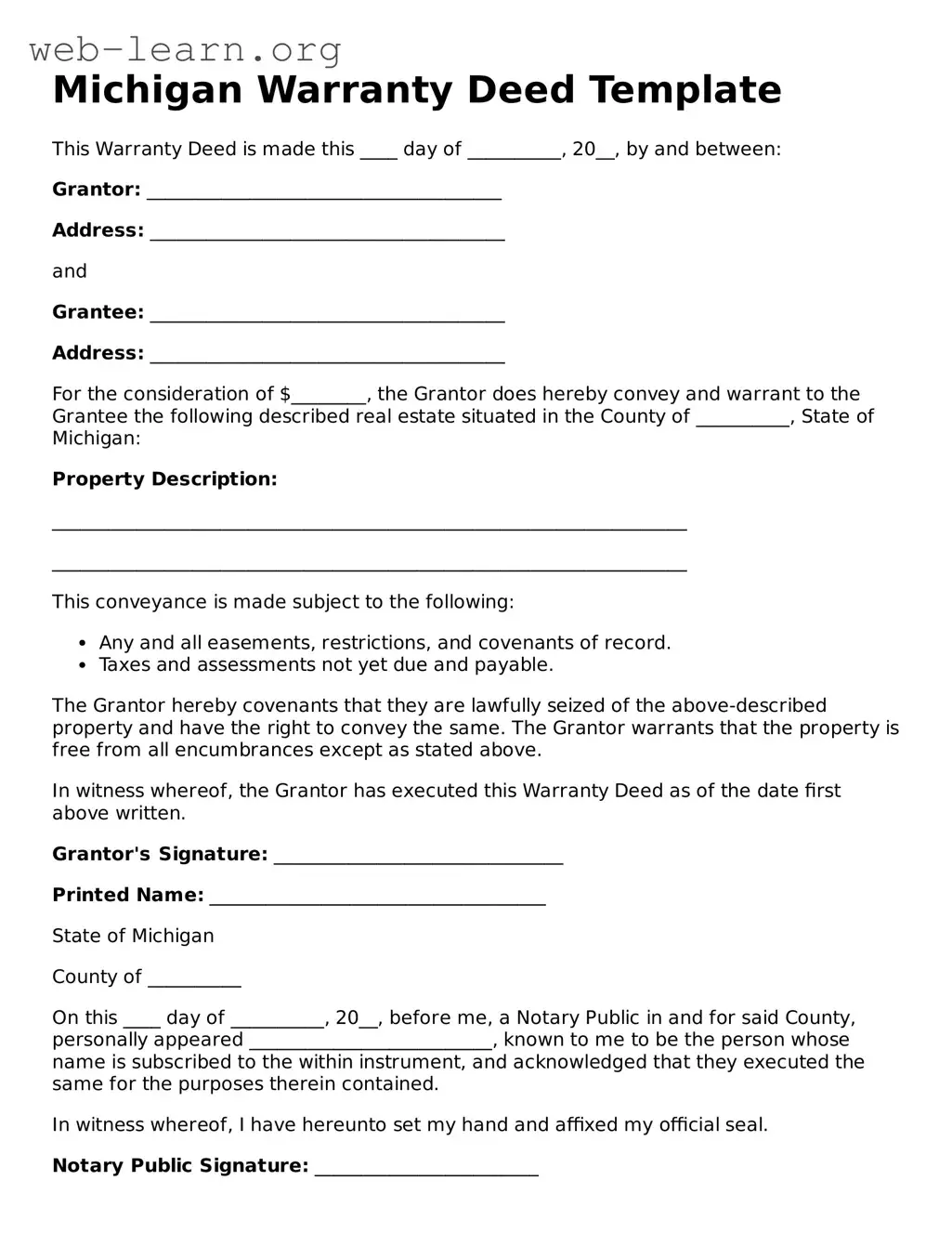
Michigan Warranty Deed Template
This Warranty Deed is made this ____ day of __________, 20__, by and between:
Grantor: ______________________________________
Address: ______________________________________
and
Grantee: ______________________________________
Address: ______________________________________
For the consideration of $________, the Grantor does hereby convey and warrant to the Grantee the following described real estate situated in the County of __________, State of Michigan:
Property Description:
____________________________________________________________________
____________________________________________________________________
This conveyance is made subject to the following:
The Grantor hereby covenants that they are lawfully seized of the above-described property and have the right to convey the same. The Grantor warrants that the property is free from all encumbrances except as stated above.
In witness whereof, the Grantor has executed this Warranty Deed as of the date first above written.
Grantor's Signature: _______________________________
Printed Name: ____________________________________
State of Michigan
County of __________
On this ____ day of __________, 20__, before me, a Notary Public in and for said County, personally appeared __________________________, known to me to be the person whose name is subscribed to the within instrument, and acknowledged that they executed the same for the purposes therein contained.
In witness whereof, I have hereunto set my hand and affixed my official seal.
Notary Public Signature: ________________________
My Commission Expires: ________________________
| Fact Name | Description |
|---|---|
| Governing Law | The Michigan Deed form is governed by Michigan state law, specifically the Michigan Compiled Laws (MCL) 565.201 et seq. |
| Types of Deeds | Michigan recognizes several types of deeds, including warranty deeds, quitclaim deeds, and fiduciary deeds. |
| Recording Requirements | To be valid, the Michigan Deed must be recorded with the county register of deeds where the property is located. |
| Signature Requirements | The deed must be signed by the grantor (the person transferring the property) in the presence of a notary public. |
Once you have the Michigan Deed form ready, it's important to fill it out accurately to ensure the transfer of property goes smoothly. Follow these steps carefully to complete the form properly.
After completing the form, it’s essential to file it with the appropriate county register of deeds office. This will officially record the transfer and protect the rights of the new property owner.
What is a Michigan Deed form?
A Michigan Deed form is a legal document used to transfer ownership of real property in the state of Michigan. This form establishes the rights of the new owner and outlines the specifics of the property being transferred. It is essential for ensuring that the transfer is recognized by the state and is legally binding.
What types of deeds are available in Michigan?
Michigan recognizes several types of deeds, including:
How do I complete a Michigan Deed form?
To complete a Michigan Deed form, follow these steps:
Do I need a lawyer to prepare a Michigan Deed form?
While it is not mandatory to hire a lawyer to prepare a Michigan Deed form, it can be beneficial. A lawyer can ensure that the deed is filled out correctly, complies with state laws, and addresses any specific concerns related to the property or transaction.
Where do I file the Michigan Deed form?
The completed Michigan Deed form must be filed with the county register of deeds where the property is located. This filing makes the transfer of ownership public record and protects the rights of the new owner.
Is there a fee for filing a Michigan Deed form?
Yes, there is typically a fee associated with filing a Michigan Deed form. The fee varies by county, so it is advisable to check with the local register of deeds for the specific amount. Additional fees may apply for obtaining copies of the deed.
What happens if I don’t file the deed?
If the deed is not filed, the transfer of ownership may not be legally recognized. This can lead to complications, such as disputes over property rights or difficulties in selling the property in the future.
Can I revoke a Michigan Deed form after it has been filed?
Once a deed has been filed, revoking it is not straightforward. Generally, a new deed must be executed to transfer ownership back to the original owner or to a new owner. Legal advice may be necessary to navigate this process.
What should I do if there are errors in the Michigan Deed form?
If errors are discovered in the deed after it has been filed, it is essential to correct them promptly. This may involve drafting a corrective deed or filing an affidavit of correction, depending on the nature of the error. Consulting a lawyer can provide guidance on the best course of action.
Are there any tax implications when transferring property with a Michigan Deed form?
Yes, transferring property can have tax implications, including potential capital gains taxes or transfer taxes. It is advisable to consult with a tax professional or attorney to understand the specific tax consequences associated with the transfer of property in Michigan.
Filling out a Michigan Deed form can seem straightforward, but many people make common mistakes that can lead to complications later on. One frequent error is failing to include the correct legal description of the property. It’s essential to provide a precise description, as vague terms can cause confusion or disputes in the future.
Another common mistake is not signing the deed. While this may sound simple, a deed without a signature is not valid. Both the grantor (the person transferring the property) and the grantee (the person receiving the property) must sign the document. Omitting a signature can delay the transfer and create legal headaches.
People often forget to date the deed. A date is crucial because it establishes when the transfer of property took place. Without a date, it can be difficult to prove when the ownership change occurred, which may lead to legal complications.
In addition, many individuals overlook the need for a notary public. A deed must be notarized to be valid in Michigan. This means that the signatures must be witnessed and certified by a notary. Skipping this step can invalidate the entire deed.
Another mistake is using the wrong type of deed. There are several types of deeds, such as warranty deeds and quitclaim deeds, each serving different purposes. Choosing the wrong one can affect the rights and responsibilities of the parties involved.
Some people also neglect to provide the correct information about the grantee. The grantee’s name should be clearly stated, and it should match the name on their identification. Incorrect names can lead to ownership disputes down the line.
Additionally, failing to check for any existing liens or encumbrances on the property can be a costly oversight. Before transferring property, it’s wise to ensure there are no legal claims against it. This can save future owners from unexpected financial burdens.
Many individuals make the mistake of not consulting with a legal expert. While it might seem like an unnecessary expense, having a professional review the deed can prevent errors that could lead to costly legal issues later.
Lastly, some people do not keep a copy of the completed deed. After filing, it’s important to retain a copy for personal records. This document serves as proof of ownership and can be essential for future transactions or legal matters.
When transferring property in Michigan, the deed form is just one of several important documents that may be necessary to ensure a smooth transaction. Understanding these accompanying forms can help clarify the process and protect the interests of all parties involved.
Each of these documents plays a crucial role in the property transfer process in Michigan. Familiarity with them not only aids in navigating the complexities of real estate transactions but also helps protect the rights and interests of everyone involved.
The Deed form shares similarities with several other legal documents. Here are eight documents that have comparable features:
When filling out the Michigan Deed form, it is essential to approach the task with care. Here are some important guidelines to follow, as well as some common pitfalls to avoid.
Following these guidelines can help ensure a smooth and successful filing of your Michigan Deed form. Taking the time to do it right will save you potential issues down the road.
Understanding the Michigan Deed form is essential for anyone involved in property transactions in the state. However, several misconceptions often arise. Here’s a breakdown of nine common misunderstandings:
Many people believe that all deeds serve the same purpose. In reality, there are different types of deeds, such as warranty deeds and quitclaim deeds, each with its own legal implications and protections.
While notarization is important for many legal documents, a deed in Michigan does not necessarily need to be notarized to be valid. However, having it notarized can help establish authenticity.
Although it is wise to consult a lawyer, especially for complex transactions, many individuals can prepare their own deeds using templates and guidelines provided by the state.
Some people think deeds are only required when buying or selling property. However, deeds are also necessary for transfers between family members, gifts, or estate planning.
While it is true that recorded deeds are public records, they can be amended or corrected through a new deed if errors are found or if changes are needed.
The type of deed can influence how property taxes are assessed. For instance, transferring property via a quitclaim deed may have different tax implications compared to a warranty deed.
Not all deeds require filing with the county clerk. For example, some transfers may not necessitate recording if they are between family members, but doing so is often advisable.
It’s a common belief that a deed guarantees clear title to the property. However, a deed does not provide this guarantee; title insurance is often recommended to protect against potential claims.
People often think deeds only matter during the sale process. In truth, understanding the deed and its implications is crucial for ongoing ownership responsibilities and rights.
Clarifying these misconceptions can help individuals navigate property transactions more effectively and avoid potential pitfalls. Always consider seeking professional advice when dealing with real estate matters.
When filling out and using the Michigan Deed form, it is essential to keep several key points in mind to ensure accuracy and compliance with state requirements.
By following these guidelines, individuals can navigate the process of completing and using the Michigan Deed form effectively.
Warranty Deed Form - A quitclaim deed transfers whatever interest the grantor has without guarantees.
What Does a House Deed Look Like in Illinois - It is essential to ensure the deed is executed correctly to avoid future disputes.
Alabama Deed Transfer Form - Deeds can sometimes include clauses for specific conditions or restrictions.
Quick Claim Deeds Kansas - Using the correct Deed form can simplify future property transactions.