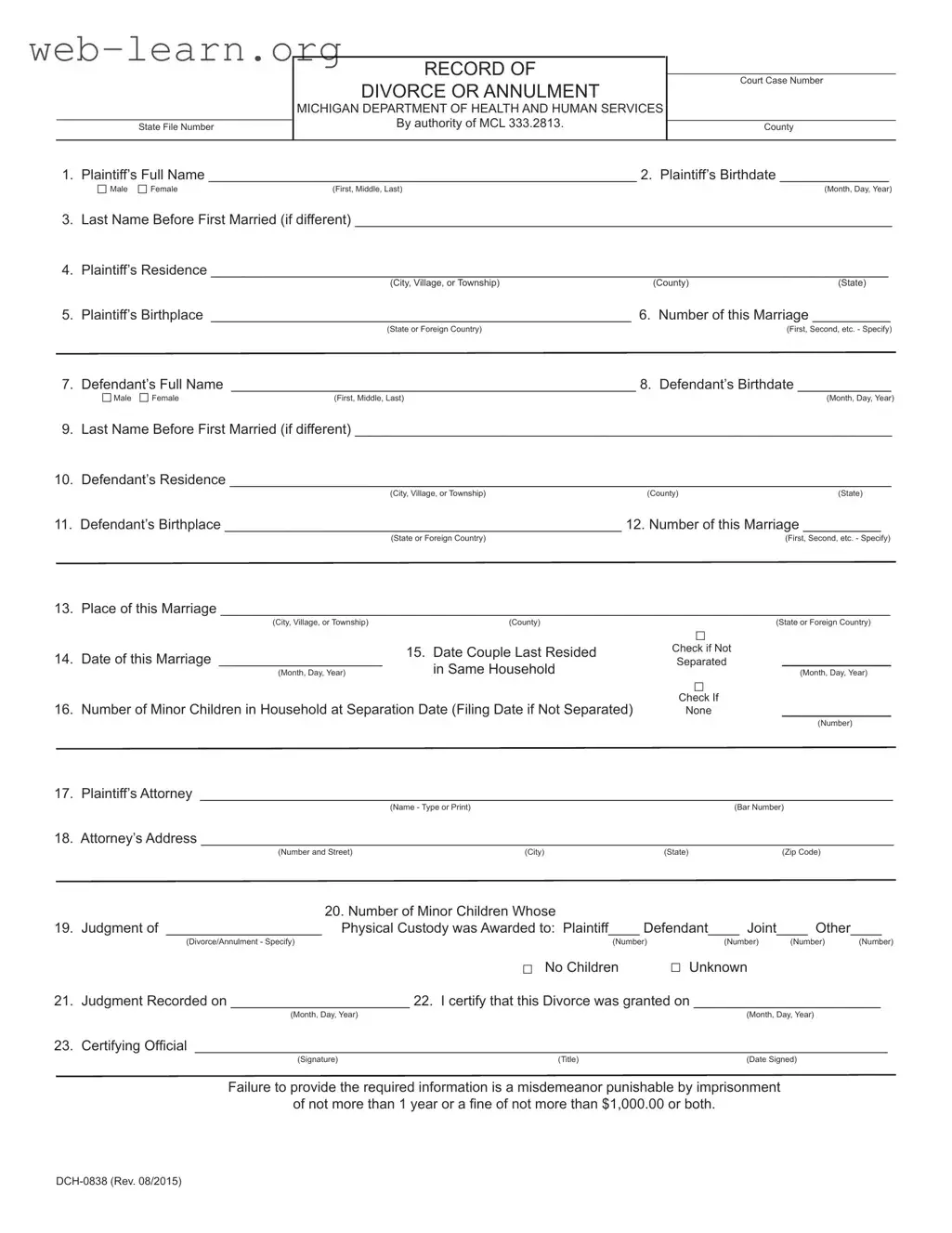
The Michigan DCH 0838 form serves as a critical document in the process of recording a divorce or annulment within the state. This form is essential for both the legal and administrative aspects of marriage dissolution, capturing vital information about the parties involved. It includes sections for the full names, birthdates, and residences of both the plaintiff and defendant, ensuring that the identities of those seeking the divorce are clearly established. Additionally, the form requires details about previous marriages, the number of children involved, and the specific circumstances surrounding the marriage, such as the date it took place and the location where the couple last resided together. The form also accommodates information regarding legal representation, ensuring that any attorney involved is properly noted. Importantly, the DCH 0838 emphasizes the need for accuracy, as failure to provide the required information can lead to legal penalties. This document not only formalizes the end of a marital relationship but also serves as a record that can impact various aspects of family law, including custody and support arrangements.

__________________________________
State File Number
RECORD OF
DIVORCE OR ANNULMENT
MICHIGAN DEPARTMENT OF HEALTH AND HUMAN SERVICES
By authority of MCL 333.2813.
_________________________________
Court Case Number
_________________________________
County
1. Plaintiff’s Full Name _______________________________________________________ 2. |
Plaintiff’s Birthdate ______________ |
||||
□ |
Male |
□ |
Female |
(First, Middle, Last) |
(Month, Day, Year) |
|
|
||||
3.Last Name Before First Married (if different) _____________________________________________________________________
4.Plaintiff’s Residence _______________________________________________________________________________________
(City, Village, or Township)(County)(State)
5. |
Plaintiff’s Birthplace ______________________________________________________ 6. Number of this Marriage __________ |
|||||
|
|
|
|
|
(State or Foreign Country) |
(First, Second, etc. - Specify) |
7. |
Defendant’s Full Name ____________________________________________________ 8. Defendant’s Birthdate ____________ |
|||||
|
□ |
Male |
□ |
Female |
(First, Middle, Last) |
(Month, Day, Year) |
9.Last Name Before First Married (if different) _____________________________________________________________________
10.Defendant’s Residence _____________________________________________________________________________________
(City, Village, or Township)(County)(State)
11. Defendant’s Birthplace ___________________________________________________ 12. Number of this Marriage __________
|
|
(State or Foreign Country) |
|
(First, Second, etc. - Specify) |
||
13. |
Place of this Marriage ______________________________________________________________________________________ |
|||||
|
(City, Village, or Township) |
(County) |
□ |
(State or Foreign Country) |
||
|
|
|
|
|
||
14. |
Date of this Marriage _____________________ |
15. Date Couple Last Resided |
Check if Not |
|
|
|
Separated |
______________ |
|||||
in Same Household |
||||||
|
(Month, Day, Year) |
□ |
(Month, Day, Year) |
|||
|
|
|
|
|
||
|
|
|
Check If |
|
|
|
16. |
Number of Minor Children in Household at Separation Date (Filing Date if Not Separated) |
None |
______________ |
|||
|
|
|
|
(Number) |
|
|
17. |
Plaintiff’s Attorney _________________________________________________________________________________________ |
|||||
|
|
(Name - Type or Print) |
(Bar Number) |
|
||
18. |
Attorney’s Address _________________________________________________________________________________________ |
|||||
|
(Number and Street) |
(City) |
(State) |
(Zip Code) |
|
|
|
20. Number of Minor Children Whose |
|
|
|
||
19. |
Judgment of ____________________ Physical Custody was Awarded to: Plaintiff____ Defendant____ Joint____ Other____ |
|||||
|
(Divorce/Annulment - Specify) |
(Number) |
(Number) |
(Number) |
(Number) |
|
|
|
□ No Children |
□ Unknown |
|
|
|
21. |
Judgment Recorded on _______________________ 22. I certify that this Divorce was granted on ________________________ |
|||||
|
(Month, Day, Year) |
|
(Month, Day, Year) |
|
||
23. |
Certifying Oficial _________________________________________________________________________________________ |
|||||
|
(Signature) |
(Title) |
(Date Signed) |
|
||
Failure to provide the required information is a misdemeanor punishable by imprisonment
of not more than 1 year or a ine of not more than $1,000.00 or both.
| Fact Name | Details |
|---|---|
| Purpose | The DCH-0838 form is used to record a divorce or annulment in Michigan. |
| Governing Law | This form is authorized under Michigan Compiled Laws (MCL) 333.2813. |
| Information Required | The form requires personal details from both the plaintiff and defendant, including names, birthdates, and addresses. |
| Consequences of Inaccuracy | Providing false information on this form can lead to misdemeanor charges, with penalties including fines and imprisonment. |
Completing the Michigan DCH-0838 form requires careful attention to detail. This form is essential for recording a divorce or annulment in Michigan. Gather all necessary information beforehand to ensure a smooth process.
What is the Michigan DCH 0838 form?
The Michigan DCH 0838 form is a record of divorce or annulment. It is used to document the legal dissolution of a marriage in the state of Michigan. This form is essential for maintaining accurate records within the Michigan Department of Health and Human Services.
Who needs to complete the DCH 0838 form?
Both parties involved in the divorce or annulment must provide information for the DCH 0838 form. This includes the plaintiff (the person filing for divorce) and the defendant (the other spouse). Completing this form accurately is crucial for the legal process.
What information is required on the form?
The DCH 0838 form requires various details, including:
Accurate completion of these fields is essential for the form to be processed correctly.
What happens if the form is not completed correctly?
If the DCH 0838 form is not filled out correctly, it may lead to delays in processing the divorce or annulment. Incomplete or inaccurate information can result in the need to resubmit the form, which could prolong the legal proceedings.
Is there a deadline for submitting the DCH 0838 form?
Yes, the form should be submitted as soon as possible after the divorce or annulment is granted. Timely submission helps ensure that the divorce is officially recorded and that all legal obligations are met.
What are the consequences of failing to provide required information?
Failure to provide the necessary information on the DCH 0838 form is considered a misdemeanor. This can lead to penalties, including imprisonment for up to one year or fines up to $1,000, or both.
Where can I obtain the DCH 0838 form?
The DCH 0838 form can typically be obtained from the Michigan Department of Health and Human Services website or your local court. It’s advisable to use the most recent version of the form to ensure compliance with current regulations.
Filling out the Michigan DCH 0838 form is an essential step in the divorce or annulment process. However, many individuals make common mistakes that can lead to delays or complications. One frequent error is failing to provide complete names. It’s important to include the full name of both the plaintiff and defendant, including any middle names. Omitting a middle name or using initials can cause confusion and may require additional verification.
Another common mistake involves incorrect birthdates. It’s crucial to ensure that the birthdates entered for both parties are accurate. A simple typo can lead to significant issues down the line, especially when verifying identities. Double-checking this information before submission can save a lot of time and hassle later.
People often overlook the section regarding the last name before the first marriage. If a party has changed their name, it’s essential to provide the name used before marriage. This detail is vital for legal records and can affect future legal proceedings, so it should not be neglected.
Inaccurate addresses can also create problems. When filling out the residence section, it’s important to include the full address, including city, county, and state. Missing any part of this information may result in delays in processing the form, as the court needs to have accurate contact details for both parties.
Some individuals forget to specify the number of this marriage. Whether it’s the first, second, or subsequent marriage, indicating the correct number is necessary. This information helps the court understand the context of the divorce and can influence decisions regarding custody and property division.
Another mistake involves the section about minor children. When listing the number of minor children in the household at the time of separation, it’s essential to be accurate. Misreporting this number can lead to complications in custody arrangements and child support calculations.
Finally, failing to sign and date the form is a critical oversight. The certifying official must ensure that their signature is present, along with the title and date signed. Without this, the form may be considered incomplete, resulting in further delays. Taking the time to review the form carefully before submission can help avoid these common pitfalls.
The Michigan DCH 0838 form is an important document used to record the details of a divorce or annulment. When navigating the divorce process, several other forms and documents may also be necessary to ensure all legal requirements are met. Below is a list of additional forms commonly used alongside the DCH 0838 form, each serving a specific purpose in the divorce proceedings.
Each of these documents plays a significant role in the divorce process, helping to facilitate communication and ensure that all legal obligations are fulfilled. Understanding the purpose of each form can aid individuals in navigating the complexities of divorce more effectively.
The Michigan DCH 0838 form, which records details about a divorce or annulment, shares similarities with several other legal documents. Each document serves a specific purpose in the legal process surrounding marriage and family law. Below is a list of nine documents that are comparable to the DCH 0838 form:
Each of these documents plays a critical role in the legal proceedings surrounding marriage dissolution. Understanding their similarities and purposes can help individuals navigate the complexities of family law more effectively.
When filling out the Michigan DCH 0838 form, it’s important to follow certain guidelines to ensure accuracy and compliance. Here are some do's and don'ts to keep in mind:
The Michigan DCH 0838 form is essential for recording a divorce or annulment, but several misconceptions surround its use and requirements. Here are ten common misconceptions:
When filling out the Michigan DCH 0838 form, consider the following key takeaways: