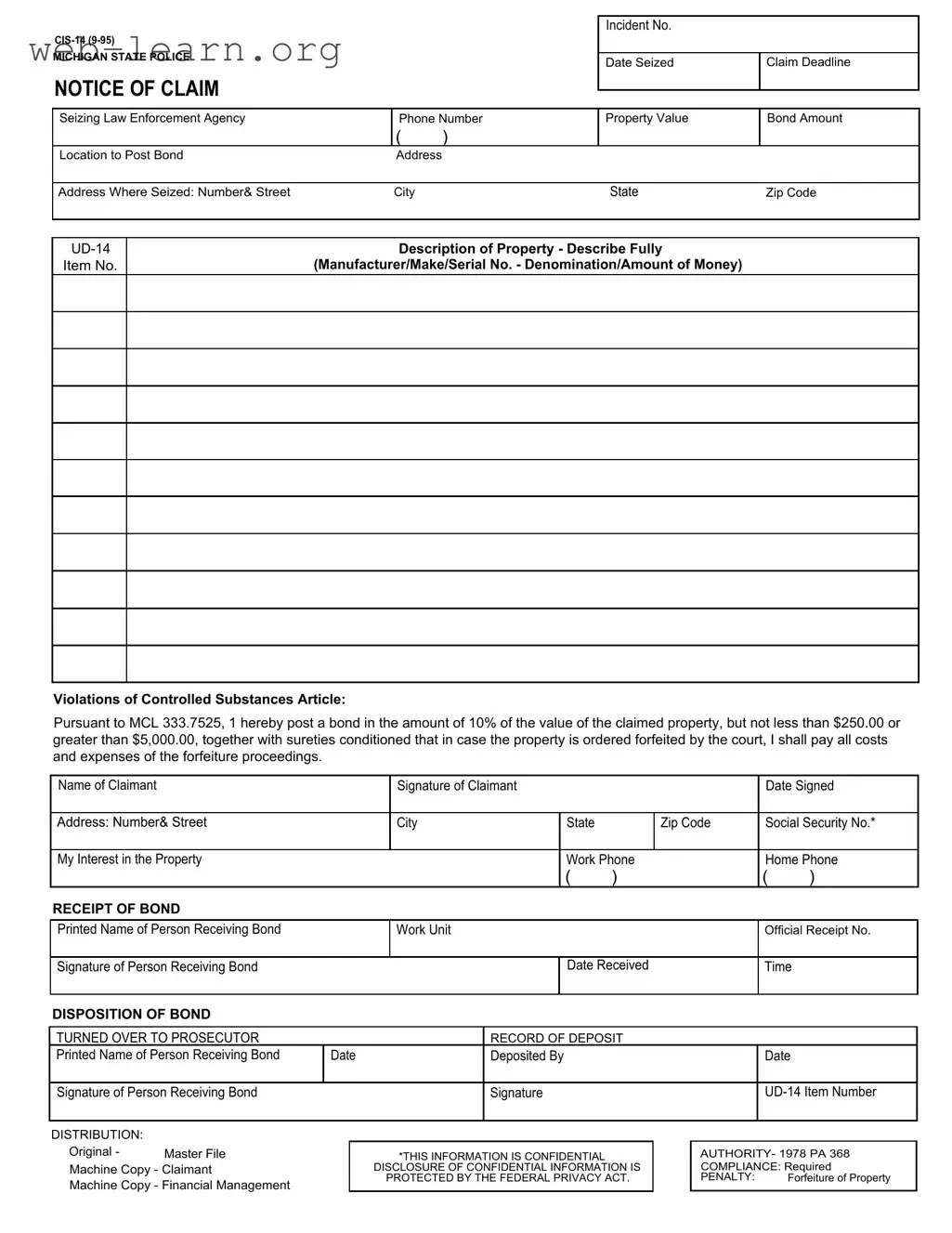
When dealing with property seized by law enforcement in Michigan, understanding the Michigan CIS-14 form is essential for individuals seeking to reclaim their assets. This form serves as a formal notice of claim, allowing claimants to assert their rights over property that has been confiscated, typically in connection with violations of controlled substances laws. Key components of the CIS-14 include details such as the incident number, the date the property was seized, and the seizing agency's contact information. Additionally, it outlines the required bond amount, which is set at 10% of the property’s value, with a minimum of $250 and a maximum of $5,000. Claimants must provide a thorough description of the seized property, including manufacturer details and serial numbers, to substantiate their claim. The form also emphasizes the importance of timely submission, as there is a deadline by which the claim must be filed. Furthermore, it highlights the potential consequences of forfeiture, underscoring the need for careful compliance with the legal requirements. With the right approach, individuals can navigate this complex process and work towards the recovery of their property.

MICHIGAN STATE POLICE
NOTICE OF CLAIM
Incident No.
Date Seized |
Claim Deadline |
|
|
Seizing Law Enforcement Agency |
Phone Number |
Property Value |
Bond Amount |
|
|
( |
) |
|
|
Location to Post Bond |
Address |
|
|
|
|
|
|
|
|
Address Where Seized: Number& Street |
City |
|
State |
Zip Code |
|
|
|
|
|
Item No.
Description of Property - Describe Fully
(Manufacturer/Make/Serial No. - Denomination/Amount of Money)
Violations of Controlled Substances Article:
Pursuant to MCL 333.7525, 1 hereby post a bond in the amount of 10% of the value of the claimed property, but not less than $250.00 or greater than $5,000.00, together with sureties conditioned that in case the property is ordered forfeited by the court, I shall pay all costs and expenses of the forfeiture proceedings.
Name of Claimant |
|
Signature of Claimant |
|
|
Date Signed |
|||
|
|
|
|
|
|
|
|
|
Address: Number& Street |
|
City |
|
State |
|
Zip Code |
Social Security No.* |
|
|
|
|
|
|
|
|
||
My Interest in the Property |
|
|
|
Work Phone |
Home Phone |
|||
|
|
|
|
( |
) |
|
( |
) |
RECEIPT OF BOND |
|
|
|
|
|
|
|
|
|
|
|
|
|
|
|
|
|
Printed Name of Person Receiving Bond |
|
Work Unit |
|
|
|
|
Official Receipt No. |
|
|
|
|
|
|
|
|
||
Signature of Person Receiving Bond |
|
|
|
Date Received |
Time |
|
||
|
|
|
|
|
|
|
|
|
DISPOSITION OF BOND |
|
|
|
|
|
|
|
|
|
|
|
|
|
|
|
|
|
TURNED OVER TO PROSECUTOR |
|
|
RECORD OF DEPOSIT |
|
|
|||
Printed Name of Person Receiving Bond |
Date |
|
Deposited By |
|
|
Date |
|
|
|
|
|
|
|
|
|
||
Signature of Person Receiving Bond |
|
|
Signature |
|
|
|||
|
|
|
|
|
|
|
|
|
DISTRIBUTION: |
|
Original - |
Master File |
Machine Copy - Claimant
Machine Copy - Financial Management
*THIS INFORMATION IS CONFIDENTIAL DISCLOSURE OF CONFIDENTIAL INFORMATION IS PROTECTED BY THE FEDERAL PRIVACY ACT.
AUTHORITY- 1978 PA 368 COMPLIANCE: Required
PENALTY: |
Forfeiture of Property |
| Fact Name | Fact Detail |
|---|---|
| Form Title | CIS-14 (9-95) Michigan State Police Notice of Claim |
| Governing Law | MCL 333.7525 governs the bond posting for property claims. |
| Claim Deadline | Claimants must adhere to specific deadlines for submitting claims. |
| Bond Amount | The bond must be 10% of the property value, with a minimum of $250 and a maximum of $5,000. |
| Property Description | Claimants must provide a detailed description of the seized property, including manufacturer, make, and serial number. |
| Confidential Information | Social Security numbers and other personal information are confidential under federal privacy laws. |
| Receipt of Bond | A receipt is issued to the claimant upon bond submission, confirming receipt and details. |
| Distribution of Copies | Originals are filed in the master file, while machine copies go to the claimant and financial management. |
| Property Forfeiture | Failure to comply with bond conditions may result in forfeiture of the claimed property. |
| Contact Information | Claimants must provide contact details, including work and home phone numbers. |
Filling out the Michigan CIS-14 form is an important step in the claims process for seized property. After completing the form, you will need to submit it to the appropriate law enforcement agency, along with any required bond. This ensures that your claim is formally recognized and processed.
Once you have completed the form, make sure to keep a copy for your records. Submit the original form along with the bond to the designated law enforcement agency. They will process your claim and provide you with a receipt for the bond.
What is the Michigan CIS-14 form?
The Michigan CIS-14 form is a legal document used to file a notice of claim regarding property that has been seized by law enforcement. This form is specifically designed for individuals who wish to contest the seizure of their property, typically in cases involving controlled substances. It outlines the necessary information regarding the seizure, including details about the property and the claimant.
What information is required on the CIS-14 form?
To complete the CIS-14 form, the following information must be provided:
What is the bond requirement associated with the CIS-14 form?
When filing a claim using the CIS-14 form, the claimant must post a bond. This bond amounts to 10% of the property’s value, with a minimum of $250.00 and a maximum of $5,000.00. The bond serves as a financial guarantee that the claimant will pay all costs and expenses if the court orders the property to be forfeited.
How does one submit the CIS-14 form?
The completed CIS-14 form must be submitted to the law enforcement agency that seized the property. It is important to ensure that the form is filled out completely and accurately to avoid any delays in processing the claim. The claimant should retain a copy of the submitted form for their records.
What happens after submitting the CIS-14 form?
After submission, the law enforcement agency will review the claim. The claimant will receive a receipt confirming the bond submission. The agency may then forward the claim to the prosecutor’s office for further action. The claimant will need to be prepared for potential court proceedings regarding the forfeiture of the property.
What are the consequences of not filing the CIS-14 form on time?
If the CIS-14 form is not filed by the specified claim deadline, the claimant may lose their right to contest the seizure of their property. This could lead to the forfeiture of the property without further recourse. Timeliness is crucial in these situations.
Is the information provided on the CIS-14 form confidential?
Yes, the information provided on the CIS-14 form is considered confidential. The Federal Privacy Act protects this information from unauthorized disclosure. However, certain details may still be accessible in the context of legal proceedings.
Filling out the Michigan CIS-14 form correctly is crucial for individuals seeking to claim property seized by law enforcement. However, many people make common mistakes that can lead to delays or complications in the claims process. Understanding these errors can help claimants navigate the form more effectively.
One frequent mistake is failing to provide complete and accurate information regarding the property being claimed. The section that asks for a full description of the property, including the manufacturer, make, serial number, and any relevant details, is essential. Incomplete descriptions can lead to confusion and may result in the claim being denied or delayed.
Another common error involves the bond amount. Claimants must post a bond equal to 10% of the property's value, with a minimum of $250 and a maximum of $5,000. Some individuals miscalculate this amount or fail to understand the requirements, leading to insufficient bonding. This oversight can hinder the processing of their claim.
Additionally, claimants often overlook the importance of signing the form. The signature of the claimant is a legal requirement that certifies the information provided is accurate. Without this signature, the form may be considered incomplete, and the claim could be dismissed.
Providing incorrect contact information is another mistake that can create issues. Claimants should ensure that their phone numbers and addresses are accurate and up to date. This information is vital for communication regarding the status of the claim and any additional requirements that may arise.
Lastly, many individuals fail to pay attention to the deadline for filing the claim. The form specifies a claim deadline that must be adhered to. Missing this deadline can result in the forfeiture of the right to claim the property, making it essential to be aware of and respect the timeline outlined in the form.
The Michigan CIS-14 form is a crucial document used in the process of claiming seized property. Alongside this form, there are several other documents that may be required to facilitate the claim process. Below is a list of these forms and a brief description of each.
These documents play a vital role in the claims process, ensuring that all necessary information is collected and that the rights of the claimant are protected. Properly completing and submitting these forms can significantly impact the outcome of a property claim.
The Michigan CIS-14 form is a legal document used to claim property that has been seized by law enforcement. It serves specific purposes related to property claims and forfeiture proceedings. There are several other documents that share similarities with the CIS-14 form, each serving unique but related functions. Here’s a list of ten such documents:
Each of these documents plays a role in the legal process surrounding seized property, ensuring that claimants have the opportunity to assert their rights and interests. Understanding these documents can help individuals navigate the complexities of property claims and forfeiture in Michigan.
When filling out the Michigan CIS-14 form, careful attention is crucial to ensure that the process goes smoothly. Here are some important do's and don'ts to consider:
By adhering to these guidelines, you can help ensure that your claim is processed efficiently and effectively.
Understanding the Michigan CIS-14 form can be challenging due to various misconceptions. Here are seven common misunderstandings about this form:
This form applies to any seized property, regardless of its value. It is not limited to high-value items.
A bond is required, typically amounting to 10% of the property’s value, with a minimum of $250 and a maximum of $5,000.
The bond is a security measure. If the property is forfeited, the bond covers costs associated with the forfeiture process.
There is a claim deadline that must be adhered to, which varies depending on the circumstances of the seizure.
Some information, such as Social Security numbers, is confidential and protected under the Federal Privacy Act.
Completing the form does not guarantee that the property will be returned. The outcome depends on legal proceedings.
When filling out the Michigan CIS-14 form, keep these key takeaways in mind: