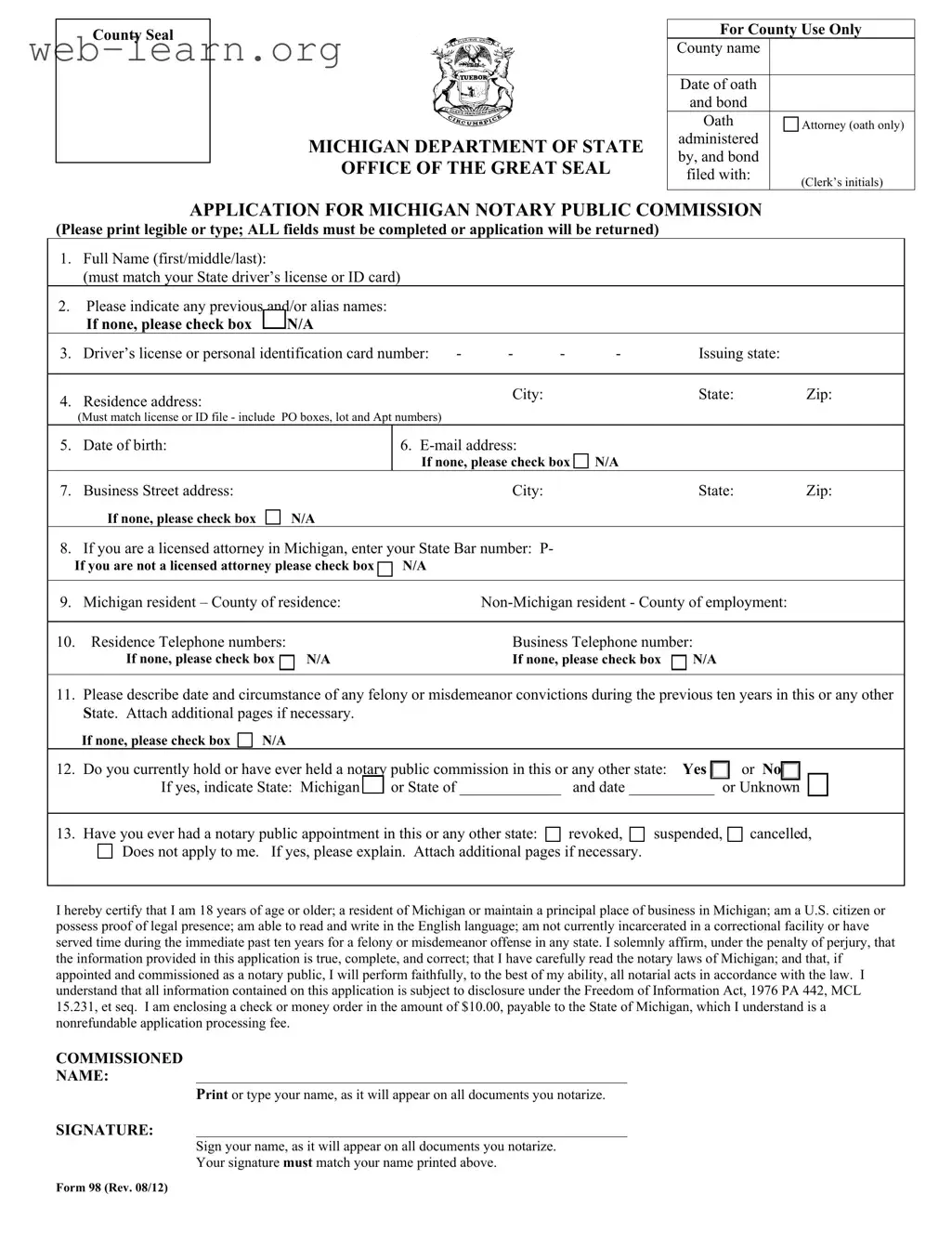
The Michigan 98 form is essential for individuals seeking to become a notary public in the state of Michigan. This application requires comprehensive personal information, including your full name, residence address, and contact details. You must provide your driver's license number and indicate any previous names you may have used. The form also requires you to disclose any felony or misdemeanor convictions within the past ten years and to confirm your eligibility based on age, residency, and legal status. If you are a licensed attorney, you can bypass the surety bond requirement, but you still need to provide your State Bar number. The application process involves swearing an oath and filing a $10,000 surety bond with your local county clerk, along with a nonrefundable fee of $10. Once your application is completed and submitted, you cannot act as a notary public until you receive your commission card, which typically arrives within 14 business days. Understanding the requirements and steps outlined in the Michigan 98 form is crucial for a smooth application process and successful commissioning as a notary public.
County Seal
MICHIGAN DEPARTMENT OF STATE
OFFICE OF THE GREAT SEAL
For County Use Only
County name
Date of oath |
|
and bond |
|
Oath |
Attorney (oath only) |
administered |
|
by, and bond |
|
filed with: |
(Clerk’s initials) |
|
APPLICATION FOR MICHIGAN NOTARY PUBLIC COMMISSION
(Please print legible or type; ALL fields must be completed or application will be returned)
1.Full Name (first/middle/last):
(must match your State driver’s license or ID card)
2.Please indicate any previous and/or alias names:
|
If none, please check box |
|
N/A |
|
|
|
|
|
|
|
|
|
|
|
|
|
|
||
3. |
Driver’s license or personal identification card number: |
- |
- |
- |
- |
Issuing state: |
|
||
|
|
|
|
|
|
|
|
|
|
4. |
Residence address: |
|
|
|
City: |
|
|
State: |
Zip: |
|
|
|
|
|
|
|
|
||
(Must match license or ID file - include PO boxes, lot and Apt numbers)
5. Date of birth:
6.
If none, please check box |
N/A |
7. Business Street address:
If none, please check box
City: |
State: |
Zip: |
N/A
8.If you are a licensed attorney in Michigan, enter your State Bar number: P-
If you are not a licensed attorney please check box N/A
9. Michigan resident – County of residence: |
|||
|
|
|
|
10. Residence Telephone numbers: |
|
Business Telephone number: |
|
If none, please check box |
N/A |
If none, please check box |
N/A |
11.Please describe date and circumstance of any felony or misdemeanor convictions during the previous ten years in this or any other State. Attach additional pages if necessary.
If none, please check box |
N/A |
|
|
|
|
|
|
|
|
|
|
|
|
|
|
|
|
|
|
|
|
||
12. Do you currently hold or have ever held a notary public commission in this or any other state: Yes |
|
|
or No |
|
|
|
|
|
|||
|
|
|
|
|
|
|
|
|
|
|
|
If yes, indicate State: Michigan |
|
or State of _____________ and date ___________ |
or Unknown |
|
|
||||||
|
|
|
|
|
|
|
|
|
|
|
|
13. Have you ever had a notary public appointment in this or any other state: |
revoked, |
suspended, |
Does not apply to me. If yes, please explain. Attach additional pages if necessary. |
|
|
cancelled,
I hereby certify that I am 18 years of age or older; a resident of Michigan or maintain a principal place of business in Michigan; am a U.S. citizen or possess proof of legal presence; am able to read and write in the English language; am not currently incarcerated in a correctional facility or have served time during the immediate past ten years for a felony or misdemeanor offense in any state. I solemnly affirm, under the penalty of perjury, that the information provided in this application is true, complete, and correct; that I have carefully read the notary laws of Michigan; and that, if appointed and commissioned as a notary public, I will perform faithfully, to the best of my ability, all notarial acts in accordance with the law. I understand that all information contained on this application is subject to disclosure under the Freedom of Information Act, 1976 PA 442, MCL 15.231, et seq. I am enclosing a check or money order in the amount of $10.00, payable to the State of Michigan, which I understand is a nonrefundable application processing fee.
COMMISSIONED
NAME:
Print or type your name, as it will appear on all documents you notarize.
SIGNATURE:
Sign your name, as it will appear on all documents you notarize.
Your signature must match your name printed above.
Form 98 (Rev. 08/12)
THIS APPLICATION MUST FIRST BE PROCESSED AT YOUR LOCAL COUNTY CLERK’S OFFICE BEFORE MAILING IT TO THE OFFICE OF THE GREAT SEAL.
Application for commission: A notary public who is currently commissioned in the State of Michigan may not submit a new application for commission earlier than 60 days prior to current commission expiration.
Commissioned name: Your commissioned name may differ from your full name as it appears on your driver license or personal
identification card (Example: Jane Marie Doe could be Jane Doe, J.M. Doe or J. Doe).
Oath and bond filing requirements: Before sending the application to the Office of the Great Seal, you must swear a constitutional oath of office, file a $10,000.00 surety bond, and pay a $10.00 filing fee with the county clerk. Information on where to obtain your surety bond and the cost is available from insurance agents and other companies that will solicit your business. A list of licensed surety agencies can also be found through our Web site at www.Michigan.gov/sos. If you are a licensed attorney in Michigan, you are not required to file a surety bond; enter your State Bar number on line 8. Your license status will be verified by the Office of the Great Seal.
Submitting application and fees to the Office of the Great Seal: After swearing the oath, filing your bond with the county clerk (if applicable) and paying the nonrefundable filing fee to the county clerk’s office, mail your completed application to:
Michigan Department of State
Office of the Great Seal
7064 Crowner Drive
Lansing, MI 48918
A $10.00 check or money order payable to the “State of Michigan” must accompany the application. Please do not send cash. This must occur within 90 days from the date the oath is administered and bond filed with the county clerk (MCL 55.273).
Receiving your commission: You may not act as a notary public until the required oath, bond (if applicable), and fees are filed with the county clerk, you submit your application and fees to the Office of the Great Seal, and receive your commission information. Your notary public commission card, with commission expiration date information, will be mailed to the residence address provided on your application. For Department of Correction employees, your commission card will be mailed to your business address. Please expect to receive your card within 14 business days after the Office of the Great Seal receives your application for processing. The residence address you list must match what is on file with the Michigan Department of State for your driver’s license or personal identification card. If you provide a different address, your application will be returned to you with instructions on how to change your address using the Michigan Change of Address/Voter Registration form available on our Web site, www.Michigan.gov/sos, or by visiting a Secretary of State Branch office.
Term of appointment: Notary commissions expire six (6) years from your next birthday at the time of commission issuance.
Change of name or address: All changes of name and/or address must be reported to the Office of the Great Seal on the Michigan Notary Public Request for Duplicate/Notice of Change form, available at our Web site www.Michigan.gov/sos. The name and residence address you list must match what is on file with the Michigan Department of State for your driver’s license or personal identification card. If you provide a different name and/or address, your Request for Duplicate/Notice of Change form will be returned to you with instructions on how to change your address using the Michigan Change of Address/Voter Registration form available on our Web site, www.Michigan.gov/sos, or in the case of a name change, by visiting a Secretary of State branch office.
Notary public stamp and/or seal: Contact your local office supply store or printing shop for information on purchasing these items. The State of Michigan does not furnish or sell these items or make any recommendations on where to obtain them. Use of these items is not required in the State of Michigan.
Please direct any questions about your notary application to the Office of the Great Seal at (888)
| Fact Name | Details |
|---|---|
| Form Purpose | The Michigan 98 form is used to apply for a notary public commission in Michigan. |
| Governing Law | This form is governed by the Michigan Notary Public Act, MCL 55.271 et seq. |
| Eligibility Criteria | Applicants must be at least 18 years old, a resident of Michigan, and able to read and write in English. |
| Application Fee | A nonrefundable fee of $10.00 is required when submitting the application. |
| Oath Requirement | Before submission, applicants must take a constitutional oath of office at their local county clerk’s office. |
| Bond Requirement | Most applicants must file a $10,000 surety bond, unless they are licensed attorneys in Michigan. |
| Submission Process | After completing the oath and bond filing, applicants must mail the form to the Office of the Great Seal. |
| Commission Duration | Notary commissions are valid for six years from the date of issuance. |
| Address Verification | The residence address provided must match the one on file with the Michigan Department of State. |
| Processing Time | Applicants can expect to receive their notary public commission card within 14 business days after submission. |
Completing the Michigan 98 form requires careful attention to detail. Each section must be filled out accurately to avoid delays in processing. After the form is completed, it must be submitted to the county clerk's office for initial processing before being mailed to the Office of the Great Seal.
The Michigan 98 form is an application for a notary public commission in the state of Michigan. It must be completed accurately and submitted to the local county clerk’s office before mailing it to the Office of the Great Seal. This form collects essential information about the applicant, including their personal details, residency, and any prior notary commissions.
You will need to provide various details such as:
Before mailing the form, you must complete the following steps:
Make sure to complete these steps at your local county clerk’s office first.
After completing the oath, bond, and paying the fee, mail your application to:
Michigan Department of State
Office of the Great Seal
7064 Crowner Drive
Lansing, MI 48918
Include a check or money order for $10 made out to the State of Michigan. Do not send cash.
Once your application is processed, you can expect to receive your notary public commission card within 14 business days. This card will be mailed to the residence address you provided on your application.
If you change your name or address, you must report this to the Office of the Great Seal using the Michigan Notary Public Request for Duplicate/Notice of Change form. Ensure that your new information matches what is on file with the Michigan Department of State.
You will need to contact a local office supply store or printing shop to purchase a notary stamp or seal. The State of Michigan does not provide these items, nor do they endorse any specific vendors.
Filling out the Michigan 98 form is a crucial step in becoming a notary public in the state of Michigan. However, many applicants make common mistakes that can lead to delays or even rejection of their application. Understanding these pitfalls can save time and ensure a smoother process.
One frequent mistake is failing to match the full name exactly as it appears on the applicant's driver’s license or ID card. This includes first, middle, and last names. If there are discrepancies, the application may be returned. Always double-check this detail to avoid unnecessary complications.
Another common error involves the residence address. It is essential that the address provided matches what is on file with the Michigan Department of State. This means including all relevant details, such as apartment numbers and PO boxes. Omitting these details can result in the application being sent back.
Some applicants neglect to complete all fields on the form. Every section must be filled out, even if the answer is "N/A." Leaving any field blank can trigger a return of the application. It’s a simple step that can easily be overlooked but is vital for processing.
Providing incorrect or outdated contact information is another mistake. Applicants should ensure that their email and phone numbers are current. If the Office of the Great Seal needs to reach out for clarification or additional information, having accurate contact details is crucial.
Finally, many people forget to include the required payment with their application. The fee of $10.00 must accompany the form, and it should be in the form of a check or money order made out to the State of Michigan. Submitting the application without this payment will lead to delays in processing.
By avoiding these common mistakes, applicants can streamline their experience and increase the likelihood of a successful application for their notary public commission in Michigan.
The Michigan 98 form is essential for anyone seeking to become a notary public in Michigan. However, several other documents are often needed in conjunction with this application. Each plays a vital role in the process of becoming a notary and ensuring compliance with state laws.
Understanding these documents is crucial for anyone looking to become a notary public in Michigan. Each one contributes to the overall integrity of the notarial process and ensures compliance with state regulations.
The Michigan 98 form is an application for a notary public commission. It has similarities to several other documents used in various legal and administrative contexts. Below are four documents that share common elements with the Michigan 98 form:
When filling out the Michigan 98 form, it is essential to follow certain guidelines to ensure your application is processed smoothly. Below is a list of things you should and shouldn't do:
Here are some common misconceptions about the Michigan 98 form, along with clarifications for each:
This is incorrect. You must swear an oath and file a bond before submitting the application to the Office of the Great Seal.
Actually, the application must first be processed at your local county clerk’s office before mailing it.
Your full name must match your state driver’s license or ID card, and the license number is required.
This is not true. You cannot act as a notary public until you have received your commission information.
All changes must be reported to the Office of the Great Seal using the proper forms.
In fact, the application processing fee is nonrefundable, so be sure to consider this before applying.
Your residence address must match what is on file with the Michigan Department of State for your ID.
Cash is not accepted. You must send a check or money order made out to the State of Michigan.
Key Takeaways for Filling Out and Using the Michigan 98 Form: