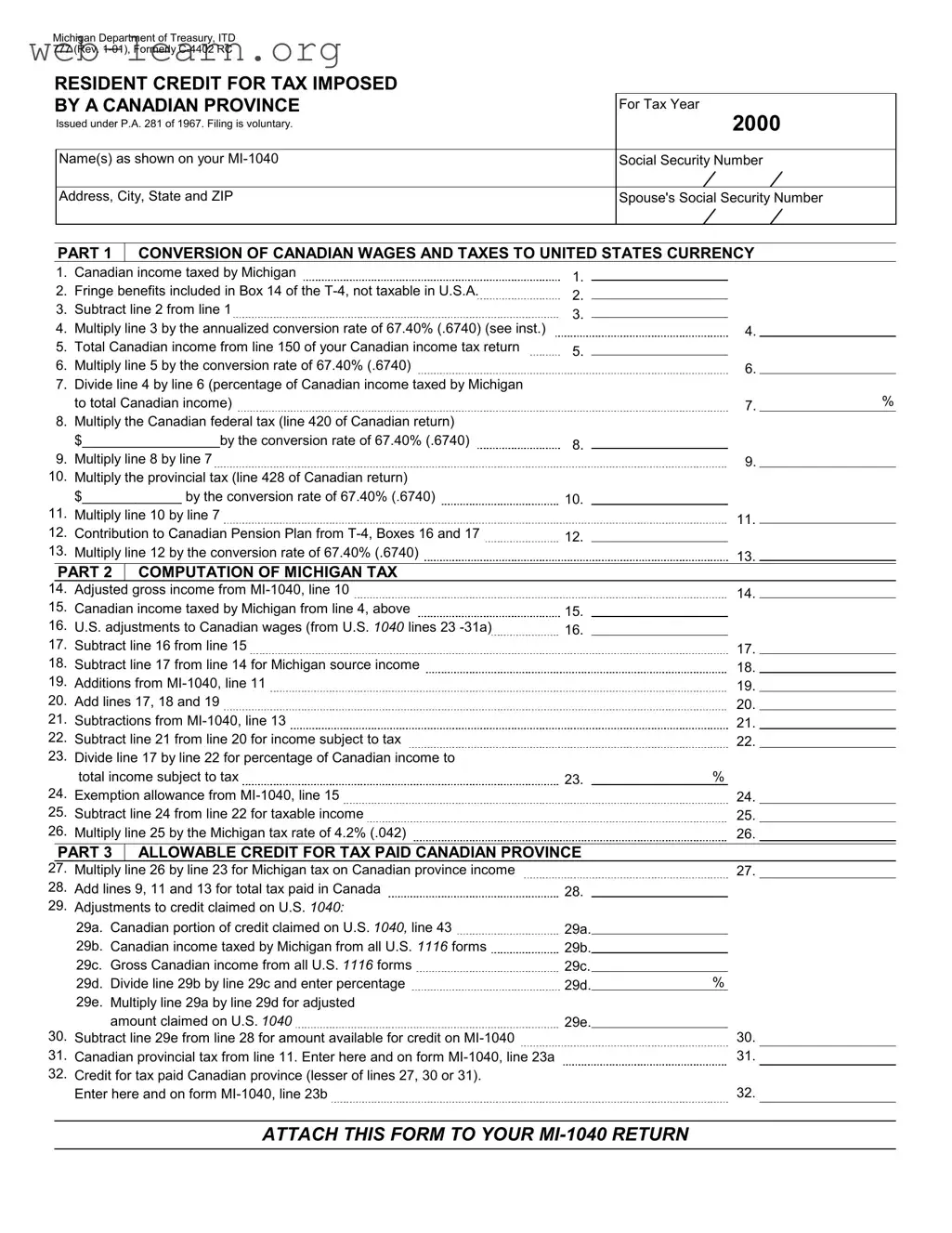
The Michigan 777 form, officially designated as ITD 777 (Rev. 1-01), is a critical document for individuals who have earned income in Canada and are subject to tax in both Canada and Michigan. This form is used to claim a resident credit for taxes imposed by a Canadian province, allowing taxpayers to avoid double taxation on their income. Issued under Public Act 281 of 1967, the filing of this form is voluntary but can provide significant financial relief. The form requires personal information, including the taxpayer's name, Social Security number, and address, as well as that of their spouse if applicable. It consists of three main parts: the conversion of Canadian wages and taxes to U.S. currency, the computation of Michigan tax, and the calculation of the allowable credit for taxes paid to a Canadian province. Each section guides the taxpayer through specific calculations, ensuring that Canadian income and taxes are accurately converted and reported. The form culminates in determining the credit amount that can be claimed on the Michigan income tax return, MI-1040, which can ultimately reduce the taxpayer's overall tax liability.
Michigan Department of Treasury, ITD
777 (Rev.
RESIDENT CREDIT FOR TAX IMPOSED |
|
|
|
BY A CANADIAN PROVINCE |
For Tax Year |
Issued under P.A. 281 of 1967. Filing is voluntary. |
2000 |
|
|
Name(s) as shown on your |
Social Security Number |
|
|
Address, City, State and ZIP |
Spouse's Social Security Number |
|
|
PART 1
CONVERSION OF CANADIAN WAGES AND TAXES TO UNITED STATES CURRENCY
1. |
Canadian income taxed by Michigan |
1. |
|
|
|
2. |
Fringe benefits included in Box 14 of the |
2. |
|
|
|
3. |
Subtract line 2 from line 1 |
3. |
|
|
|
4. |
Multiply line 3 by the annualized conversion rate of 67.40% (.6740) (see inst.) |
|
5. |
Total Canadian income from line 150 of your Canadian income tax return |
5. |
|
|
6.Multiply line 5 by the conversion rate of 67.40% (.6740)
7.Divide line 4 by line 6 (percentage of Canadian income taxed by Michigan to total Canadian income)
8.Multiply the Canadian federal tax (line 420 of Canadian return)
|
$__________________by the conversion rate of 67.40% (.6740) |
8. |
|
|
|
9. |
Multiply line 8 by line 7 |
|
10. |
Multiply the provincial tax (line 428 of Canadian return) |
|
|
$_____________ by the conversion rate of 67.40% (.6740) |
10. |
11. |
Multiply line 10 by line 7 |
|
12. |
Contribution to Canadian Pension Plan from |
12. |
13. |
Multiply line 12 by the conversion rate of 67.40% (.6740) |
|
4.
6.
7.%
11.
13.
PART 2 COMPUTATION OF MICHIGAN TAX
14.Adjusted gross income from
15.Canadian income taxed by Michigan from line 4, above
16.U.S. adjustments to Canadian wages (from U.S. 1040 lines 23
17.Subtract line 16 from line 15
18.Subtract line 17 from line 14 for Michigan source income
19.Additions from
20.Add lines 17, 18 and 19
21.Subtractions from
22.Subtract line 21 from line 20 for income subject to tax
23.Divide line 17 by line 22 for percentage of Canadian income to
total income subject to tax
24.Exemption allowance from
25.Subtract line 24 from line 22 for taxable income
26.Multiply line 25 by the Michigan tax rate of 4.2% (.042)
14.
15.
16.
17.
18.
19.
20.
21.
22.
23.%
24.
25.
26.
PART 3 ALLOWABLE CREDIT FOR TAX PAID CANADIAN PROVINCE
27. |
Multiply line 26 by line 23 for Michigan tax on Canadian province income |
|
|
28. |
Add lines 9, 11 and 13 for total tax paid in Canada |
28. |
|
29. |
Adjustments to credit claimed on U.S. 1040: |
|
|
|
29a. |
Canadian portion of credit claimed on U.S. 1040, line 43 |
29a. |
|
29b. |
Canadian income taxed by Michigan from all U.S. 1116 forms |
29b. |
|
29c. |
Gross Canadian income from all U.S. 1116 forms |
29c. |
|
29d. |
Divide line 29b by line 29c and enter percentage |
29d. |
|
29e. |
Multiply line 29a by line 29d for adjusted |
|
|
|
amount claimed on U.S. 1040 |
29e. |
30.Subtract line 29e from line 28 for amount available for credit on
31.Canadian provincial tax from line 11. Enter here and on form
32.Credit for tax paid Canadian province (lesser of lines 27, 30 or 31). Enter here and on form
27.
%
30.
31.
32.
ATTACH THIS FORM TO YOUR
| Fact Name | Description |
|---|---|
| Form Title | The Michigan 777 form is officially titled "Resident Credit for Tax Imposed by a Canadian Province." |
| Governing Law | This form is issued under Public Act 281 of 1967, which governs tax credits for residents earning income in Canada. |
| Filing Status | Filing the Michigan 777 form is voluntary, allowing taxpayers to claim a credit for taxes paid to a Canadian province. |
| Currency Conversion | Taxpayers must convert Canadian wages and taxes into U.S. currency using an annualized conversion rate of 67.40%. |
| Part Structure | The form is divided into three parts: conversion of Canadian wages, computation of Michigan tax, and allowable credit for tax paid to Canada. |
| Adjusted Gross Income | Line 14 of the form requires taxpayers to input their adjusted gross income from the MI-1040. |
| Tax Rate | The Michigan tax rate applicable on the taxable income calculated from this form is 4.2%. |
| Exemption Allowance | Taxpayers must subtract their exemption allowance from the total income subject to tax to determine their taxable income. |
| Credit Calculation | Line 32 calculates the credit for tax paid to a Canadian province, which is the lesser of three calculated amounts. |
| Attachment Requirement | Taxpayers must attach the Michigan 777 form to their MI-1040 return when filing. |
Completing the Michigan 777 form involves providing specific information about your income and taxes related to Canadian provinces. This form is a part of your tax filing process and must be attached to your MI-1040 return.
Next, proceed to Part 1, which focuses on converting Canadian wages and taxes into U.S. currency.
After completing Part 1, move on to Part 2, which calculates your Michigan tax.
Finally, complete Part 3 to determine your allowable credit for tax paid to the Canadian province.
After completing the form, ensure that it is attached to your MI-1040 return before submission.
The Michigan 777 form, also known as the Resident Credit for Tax Imposed by a Canadian Province, is used by Michigan residents who have earned income in Canada and paid taxes to a Canadian province. This form allows taxpayers to claim a credit for taxes paid to Canada against their Michigan tax liability. It is issued under Public Act 281 of 1967.
Residents of Michigan who have income that was taxed by a Canadian province may need to file this form. It is particularly relevant for individuals who have received wages or other income from Canada and have paid taxes on that income to a Canadian province. Filing the form is voluntary, but it can help reduce Michigan tax liability.
The form includes a specific section for converting Canadian wages and taxes into U.S. currency. You will need to use the annualized conversion rate of 67.40%. This involves several steps, including calculating the total Canadian income, subtracting non-taxable fringe benefits, and multiplying the results by the conversion rate. Detailed instructions are provided on the form to guide you through this process.
To complete the form, you will need the following information:
This information is necessary to accurately calculate the credit for taxes paid to Canada.
The credit is calculated by first determining the Michigan tax on the Canadian income. This involves several steps, including calculating your total income subject to tax and determining the percentage of Canadian income to total income. The final credit amount is the lesser of the Michigan tax on Canadian income, the amount available for credit on the MI-1040, or the Canadian provincial tax paid.
The Michigan 777 form must be attached to your MI-1040 return. It should be submitted to the Michigan Department of Treasury along with your completed tax return. Ensure that all necessary calculations and documentation are included to avoid delays in processing.
If you require assistance, consider consulting a tax professional who is familiar with both U.S. and Canadian tax laws. Additionally, the Michigan Department of Treasury provides resources and guidance on their website. They may also offer customer service support to answer specific questions regarding the form.
Filling out the Michigan 777 form can be a complex task, and many individuals make common mistakes that can lead to delays or inaccuracies in their tax filings. One frequent error occurs when taxpayers fail to accurately report their names and Social Security numbers. These details must match exactly with the information on the MI-1040 form. A mismatch can result in processing delays or even rejection of the return.
Another common mistake involves the conversion of Canadian wages and taxes into U.S. currency. Taxpayers sometimes overlook the importance of using the correct conversion rate. The form specifies a conversion rate of 67.40%, and failing to apply this consistently throughout the calculations can lead to incorrect amounts being reported.
In Part 1 of the form, it is crucial to ensure that all relevant Canadian income and taxes are included. Some individuals mistakenly omit fringe benefits that are included in Box 14 of the T-4 form, which are not taxable in the U.S. This oversight can skew the calculations and affect the overall credit claimed.
Additionally, errors in calculations are common. For instance, when determining the percentage of Canadian income taxed by Michigan, taxpayers may miscalculate the figures in lines 7 and 22. Double-checking each step of the math is essential to ensure accuracy. A small arithmetic error can lead to a significantly different tax outcome.
Moving to Part 2, individuals often misinterpret the instructions regarding U.S. adjustments to Canadian wages. This can result in incorrect figures being subtracted from the adjusted gross income, leading to an inaccurate representation of Michigan source income. Understanding how to properly apply these adjustments is vital for an accurate filing.
Another mistake occurs when taxpayers neglect to include all necessary additions and subtractions from their MI-1040. Lines 19 and 21 must be carefully reviewed to ensure that all applicable amounts are accurately reported. Missing these figures can affect the taxable income calculation.
In Part 3, taxpayers frequently miscalculate the allowable credit for taxes paid to the Canadian province. For example, when multiplying line 26 by line 23, individuals may fail to correctly apply the figures, leading to an incorrect tax credit amount. This can ultimately result in overpaying or underpaying taxes.
Finally, many taxpayers forget to attach the Michigan 777 form to their MI-1040 return. This final step is crucial for ensuring that the credit is recognized by the state. Without this attachment, the tax return may be considered incomplete, leading to further complications.
The Michigan 777 form is essential for residents claiming a credit for taxes paid to a Canadian province. When filing this form, several other documents may be necessary to ensure accurate reporting and compliance. Below is a list of commonly used forms and documents that accompany the Michigan 777 form.
Having these forms and documents ready can streamline the filing process and help ensure that you receive the appropriate credits and deductions. Always check for the most current forms and requirements to stay compliant with tax regulations.
The Michigan 777 form is a specific document used for claiming a credit for taxes imposed by a Canadian province. It shares similarities with several other tax-related forms. Below is a list of nine documents that are similar to the Michigan 777 form, along with explanations of how they relate to it:
Understanding these similarities can help taxpayers navigate the complexities of international tax credits and ensure they are maximizing their potential benefits. Each form serves a unique purpose, yet they all require careful attention to detail and accurate reporting of income.
When filling out the Michigan 777 form, it’s essential to approach the task with care and attention to detail. Here are some important do's and don'ts to keep in mind:
By following these guidelines, you can navigate the process of completing the Michigan 777 form with greater confidence and ease. Remember, thoroughness and accuracy are your best allies in tax preparation.
The following are common misconceptions about the Michigan 777 form:
Here are some important points to keep in mind when filling out and using the Michigan 777 form: