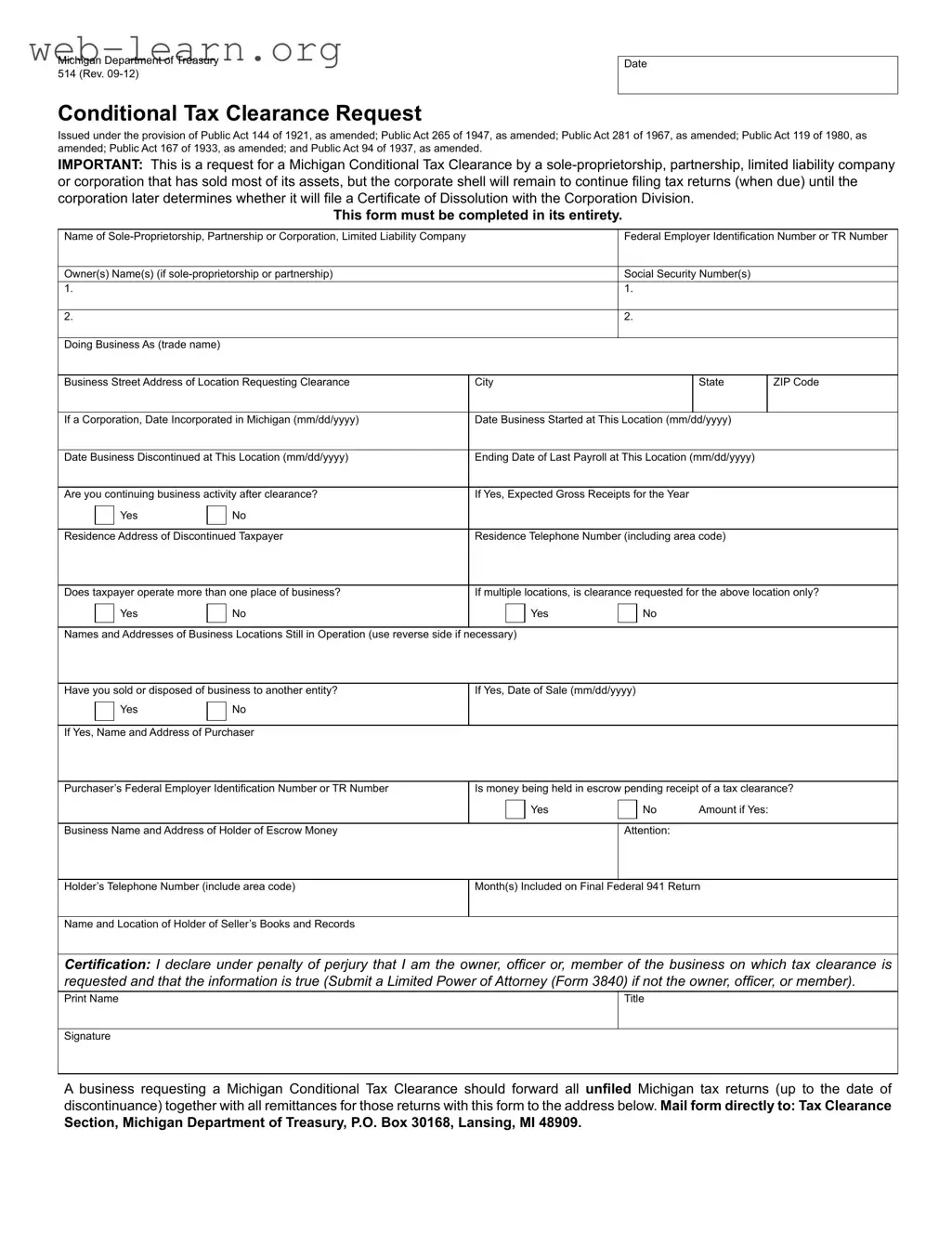
The Michigan 514 form is an essential document for businesses navigating the complexities of tax clearance in the state. Specifically designed for sole proprietorships, partnerships, limited liability companies, and corporations that have sold most of their assets, this form serves as a request for a Conditional Tax Clearance. It allows the business to maintain its corporate structure while fulfilling tax obligations until a final decision regarding dissolution is made. Completing the form requires detailed information about the business, including its name, federal identification number, and the owners' social security numbers. Additionally, it asks for the business's operational history, such as the dates of incorporation, commencement, and discontinuation at the specified location. The form also inquires about ongoing business activities and any sales or disposals of the business to other entities. It’s crucial to provide accurate information, as the form must be signed under penalty of perjury by an authorized individual. To ensure a smooth process, businesses must also submit any unfiled Michigan tax returns along with the form. This comprehensive approach helps the Michigan Department of Treasury assess tax compliance and facilitate the clearance process efficiently.

Michigan Department of Treasury 514 (Rev.
Date
Conditional Tax Clearance Request
Issued under the provision of Public Act 144 of 1921, as amended; Public Act 265 of 1947, as amended; Public Act 281 of 1967, as amended; Public Act 119 of 1980, as amended; Public Act 167 of 1933, as amended; and Public Act 94 of 1937, as amended.
IMPORTANT: This is a request for a Michigan Conditional Tax Clearance by a
This form must be completed in its entirety.
Name of |
|
|
|
Federal Employer Identiication Number or TR Number |
||||||||
|
|
|
|
|
|
|||||||
Owner(s) Name(s) (if |
|
|
|
Social Security Number(s) |
|
|||||||
1. |
|
|
|
|
|
|
|
1. |
|
|
|
|
|
|
|
|
|
|
|
|
|
|
|
|
|
2. |
|
|
|
|
|
|
|
2. |
|
|
|
|
|
|
|
|
|
|
|
|
|
|
|
|
|
Doing Business As (trade name) |
|
|
|
|
|
|
|
|
|
|||
|
|
|
|
|
|
|
|
|
|
|
|
|
Business Street Address of Location Requesting Clearance |
City |
|
|
State |
|
ZIP Code |
||||||
|
|
|
|
|
|
|
|
|
|
|
|
|
If a Corporation, Date Incorporated in Michigan (mm/dd/yyyy) |
Date Business Started at This Location (mm/dd/yyyy) |
|
||||||||||
|
|
|
|
|
|
|
|
|
|
|
||
Date Business Discontinued at This Location (mm/dd/yyyy) |
Ending Date of Last Payroll at This Location (mm/dd/yyyy) |
|
||||||||||
|
|
|
|
|
|
|
|
|
|
|
|
|
Are you continuing business activity after clearance? |
If Yes, Expected Gross Receipts for the Year |
|
|
|
||||||||
|
|
Yes |
|
No |
|
|
|
|
|
|
|
|
|
|
|
|
|
|
|
|
|
|
|
||
|
|
|
|
|
|
|
|
|
|
|
||
|
|
|
|
|
|
|
||||||
Residence Address of Discontinued Taxpayer |
Residence Telephone Number (including area code) |
|
||||||||||
|
|
|
|
|
|
|||||||
Does taxpayer operate more than one place of business? |
If multiple locations, is clearance requested for the above location only? |
|||||||||||
|
|
|
|
|
|
|
|
|
|
|
|
|
|
|
Yes |
|
No |
|
|
Yes |
|
No |
|
|
|
|
|
|
|
|
|
|
|
|
|
|
|
|
|
|
|
|
|
|
|
|
|
||||
Names and Addresses of Business Locations Still in Operation (use reverse side if necessary) |
|
|
|
|
|
|||||||
|
|
|
|
|
||||||||
Have you sold or disposed of business to another entity? |
If Yes, Date of Sale (mm/dd/yyyy) |
|
|
|
||||||||
|
|
|
|
|
|
|
|
|
|
|
|
|
|
|
Yes |
|
No |
|
|
|
|
|
|
|
|
|
|
|
|
|
|
|
|
|
|
|
|
|
|
|
|
|
|
|
|
|
|
||||
If Yes, Name and Address of Purchaser |
|
|
|
|
|
|
|
|
||||
|
|
|||||||||||
Purchaser’s Federal Employer Identiication Number or TR Number |
Is money being held in escrow pending receipt of a tax clearance? |
|||||||||||
|
|
|
|
|
|
|
Yes |
|
No |
Amount if Yes: |
|
|
|
|
|
|
|
|
|
|
|
||||
|
|
|
|
|
|
|
|
|
||||
|
|
|
|
|
|
|
|
|||||
Business Name and Address of Holder of Escrow Money |
|
|
|
Attention: |
|
|
|
|||||
|
|
|
|
|||||||||
Holder’s Telephone Number (include area code) |
Month(s) Included on Final Federal 941 Return |
|
||||||||||
|
|
|
|
|
|
|
|
|
||||
Name and Location of Holder of Seller’s Books and Records |
|
|
|
|
|
|
|
|
||||
Certiication: I declare under penalty of perjury that I am the owner, oficer or, member of the business on which tax clearance is requested and that the information is true (Submit a Limited Power of Attorney (Form 3840) if not the owner, oficer, or member).
Print Name |
Title |
|
|
Signature |
|
A business requesting a Michigan Conditional Tax Clearance should forward all uniled Michigan tax returns (up to the date of discontinuance) together with all remittances for those returns with this form to the address below. Mail form directly to: Tax Clearance
Section, Michigan Department of Treasury, P.O. Box 30168, Lansing, MI 48909.
| Fact Name | Description |
|---|---|
| Governing Laws | This form is issued under several laws, including Public Act 144 of 1921, Public Act 265 of 1947, Public Act 281 of 1967, Public Act 119 of 1980, Public Act 167 of 1933, and Public Act 94 of 1937. |
| Purpose | The Michigan 514 form is a request for Conditional Tax Clearance for businesses that have sold most of their assets but will continue to file tax returns. |
| Eligibility | Eligible entities include sole-proprietorships, partnerships, limited liability companies, and corporations. |
| Submission Requirements | All unfiled Michigan tax returns and remittances must be submitted with the form to the Tax Clearance Section of the Michigan Department of Treasury. |
After gathering all necessary information, you can proceed to fill out the Michigan 514 form. This form is essential for businesses that are in the process of selling most of their assets while retaining the corporate structure for tax purposes. Follow these steps carefully to ensure that your submission is complete and accurate.
Once you have completed the form, gather all unfiled Michigan tax returns up to the date of discontinuance, along with any remittances for those returns. Mail the completed form and documents to the Tax Clearance Section at the Michigan Department of Treasury, P.O. Box 30168, Lansing, MI 48909.
What is the Michigan 514 form?
The Michigan 514 form is a request for Conditional Tax Clearance. It is specifically for sole proprietorships, partnerships, limited liability companies, or corporations that have sold most of their assets but wish to maintain their corporate status for tax filing purposes. This form is essential to ensure compliance with various Michigan tax laws.
Who needs to fill out the Michigan 514 form?
Any business entity that has sold most of its assets and plans to continue filing tax returns must complete this form. This includes sole proprietorships, partnerships, limited liability companies, and corporations. If the business has ceased operations but will remain active for tax purposes, this form is necessary.
What information is required on the form?
The form requires several pieces of information:
How do I submit the Michigan 514 form?
To submit the form, complete it in its entirety and mail it along with all unfiled Michigan tax returns and remittances to the Tax Clearance Section at the Michigan Department of Treasury. The mailing address is:
Tax Clearance Section, Michigan Department of Treasury, P.O. Box 30168, Lansing, MI 48909.
What happens if I don’t submit this form?
Failure to submit the Michigan 514 form may result in tax compliance issues. The business may face penalties or complications when attempting to dissolve or transfer assets. It is crucial to complete this process to ensure a smooth transition and avoid potential legal or financial repercussions.
Is there a fee associated with the Michigan 514 form?
No, there is no fee for submitting the Michigan 514 form. However, any outstanding tax liabilities must be settled before clearance can be granted. Ensure that all tax returns are filed and payments made to avoid delays.
What should I do if I have more than one business location?
If your business operates multiple locations, you need to specify whether the clearance is requested for the location listed on the form only. If other locations are still operational, provide their names and addresses as required. This ensures that all aspects of your business are accounted for in the clearance process.
Filling out the Michigan 514 form can be straightforward, but many people still make common mistakes. One frequent error is not completing the form in its entirety. Each section is important, and leaving any part blank can delay the processing of your request.
Another mistake is providing incorrect or incomplete identification numbers. This includes the Federal Employer Identification Number (FEIN) or the TR Number. Double-check these numbers to ensure they are accurate. Missing or wrong numbers can lead to complications.
People often forget to include the names and Social Security Numbers of all owners, especially in sole proprietorships or partnerships. This information is crucial for the tax clearance request and should be filled out carefully.
Some individuals fail to indicate whether they are continuing business activities after clearance. This question is essential for the tax authority to understand your business's status. If you plan to continue operations, be sure to answer accurately.
Another common oversight is neglecting to provide the date of sale if the business has been sold. This date is vital for processing the clearance request. If the business has been sold, include the purchaser's information and their FEIN or TR Number as well.
People sometimes overlook the requirement to submit all unfiled Michigan tax returns along with the form. Not including these documents can lead to delays or denials. Be sure to gather all necessary paperwork before submitting your request.
Many forget to sign the certification section. This signature is a declaration of the truthfulness of the information provided. Without it, the form is incomplete and cannot be processed.
Lastly, failing to mail the form to the correct address can cause significant delays. Ensure you send it to the Tax Clearance Section at the Michigan Department of Treasury, as specified in the instructions. Following these guidelines can help you avoid common pitfalls and ensure a smoother process.
The Michigan 514 form is a crucial document for businesses seeking conditional tax clearance. However, it is often accompanied by other forms and documents that can help streamline the process. Understanding these documents can make it easier for you to navigate your obligations. Below are five common forms that are frequently used alongside the Michigan 514 form.
By gathering these documents along with the Michigan 514 form, you can facilitate a smoother tax clearance process. Always ensure that you provide accurate and complete information to avoid delays. If you have any questions, seeking professional advice can be beneficial.
The Michigan 514 form is a Conditional Tax Clearance Request. It shares similarities with several other documents used in various business and tax situations. Below is a list of six documents that are comparable to the Michigan 514 form, along with explanations of their similarities.
When filling out the Michigan 514 form, it's essential to follow specific guidelines to ensure your application is processed smoothly. Below are six important do's and don'ts to keep in mind.
By adhering to these guidelines, you can help facilitate a smoother process for obtaining your Michigan Conditional Tax Clearance.
This form is applicable to various business structures, including sole proprietorships, partnerships, and limited liability companies. It is not limited to corporations alone.
Filing the Michigan 514 form is mandatory for businesses that have sold most of their assets but intend to remain as a corporate entity for tax purposes. This form ensures compliance with tax obligations.
All unfiled Michigan tax returns must accompany the form. Failing to include these documents may delay the clearance process.
Submitting the Michigan 514 form does not equate to dissolving the business. The corporate shell remains intact to file tax returns until a formal Certificate of Dissolution is filed.
The form must be signed by an owner, officer, or member of the business. This signature certifies that the information provided is true and accurate.
If the business operates multiple locations, it is essential to indicate this on the form. This information is crucial for the tax clearance process.
Filling out the Michigan 514 form requires attention to detail. Here are key takeaways to keep in mind:
By following these takeaways, you can streamline the process of obtaining a Conditional Tax Clearance in Michigan.