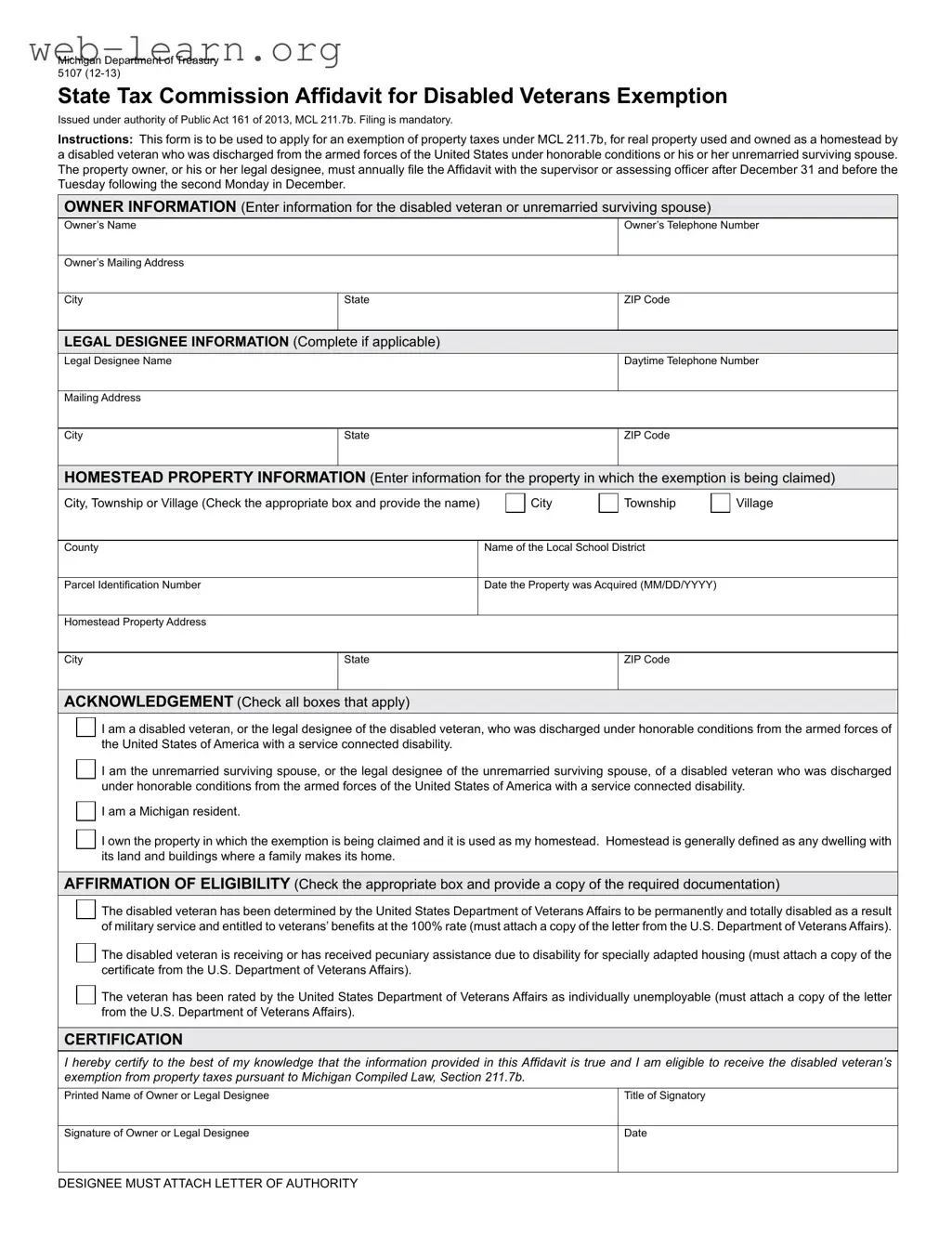
The Michigan 5107 form is an essential document for disabled veterans seeking property tax exemptions. It serves as an affidavit that allows eligible individuals to apply for relief under Michigan Compiled Law 211.7b. This law specifically benefits disabled veterans who have been honorably discharged from the armed forces, as well as their unremarried surviving spouses. To qualify, the property must be owned and used as a homestead. Filing this form is not optional; it is mandatory and must be completed annually. The form requires detailed information about the property owner, including their name, contact information, and specifics about the homestead property itself. Additionally, applicants must affirm their eligibility by checking relevant boxes and providing necessary documentation from the U.S. Department of Veterans Affairs. This includes proof of a service-connected disability or other relevant benefits. Completing the Michigan 5107 form accurately and submitting it on time ensures that disabled veterans can access the financial relief they deserve.
Michigan Department of Treasury 5107
State Tax Commission Afidavit for Disabled Veterans Exemption
Issued under authority of Public Act 161 of 2013, MCL 211.7b. Filing is mandatory.
Instructions: This form is to be used to apply for an exemption of property taxes under MCL 211.7b, for real property used and owned as a homestead by a disabled veteran who was discharged from the armed forces of the United States under honorable conditions or his or her unremarried surviving spouse.
The property owner, or his or her legal designee, must annually ile the Afidavit with the supervisor or assessing oficer after December 31 and before the
Tuesday following the second Monday in December.
OWNER INFORMATION (Enter information for the disabled veteran or unremarried surviving spouse)
Owner’s Name
Owner’s Telephone Number
Owner’s Mailing Address
City
State
ZIP Code
LEGAL DESIGNEE INFORMATION (Complete if applicable)
Legal Designee Name
Daytime Telephone Number
Mailing Address
City
State
ZIP Code
HOMESTEAD PROPERTY INFORMATION (Enter information for the property in which the exemption is being claimed)
City, Township or Village (Check the appropriate box and provide the name)
City
Township
Village
County
Name of the Local School District
Parcel Identiication Number
Date the Property was Acquired (MM/DD/YYYY)
Homestead Property Address
City
State
ZIP Code
ACKNOWLEDGEMENT (Check all boxes that apply)
I am a disabled veteran, or the legal designee of the disabled veteran, who was discharged under honorable conditions from the armed forces of the United States of America with a service connected disability.
I am the unremarried surviving spouse, or the legal designee of the unremarried surviving spouse, of a disabled veteran who was discharged under honorable conditions from the armed forces of the United States of America with a service connected disability.
I am a Michigan resident.
I own the property in which the exemption is being claimed and it is used as my homestead. Homestead is generally deined as any dwelling with
its land and buildings where a family makes its home.
AFFIRMATION OF ELIGIBILITY (Check the appropriate box and provide a copy of the required documentation)
The disabled veteran has been determined by the United States Department of Veterans Affairs to be permanently and totally disabled as a result
of military service and entitled to veterans’ beneits at the 100% rate (must attach a copy of the letter from the U.S. Department of Veterans Affairs).
The disabled veteran is receiving or has received pecuniary assistance due to disability for specially adapted housing (must attach a copy of the certiicate from the U.S. Department of Veterans Affairs).
The veteran has been rated by the United States Department of Veterans Affairs as individually unemployable (must attach a copy of the letter from the U.S. Department of Veterans Affairs).
CERTIFICATION
I hereby certify to the best of my knowledge that the information provided in this Afidavit is true and I am eligible to receive the disabled veteran’s exemption from property taxes pursuant to Michigan Compiled Law, Section 211.7b.
Printed Name of Owner or Legal Designee
Title of Signatory
Signature of Owner or Legal Designee
Date
DESIGNEE MUST ATTACH LETTER OF AUTHORITY
| Fact Name | Fact Details |
|---|---|
| Form Title | Michigan Department of Treasury 5107 |
| Governing Law | Issued under authority of Public Act 161 of 2013, MCL 211.7b |
| Purpose | This form applies for an exemption of property taxes for disabled veterans or their unremarried surviving spouses. |
| Filing Requirement | Filing is mandatory for eligible individuals. |
| Filing Timeline | The affidavit must be filed annually after December 31 and before the Tuesday following the second Monday in December. |
| Eligibility Criteria | The applicant must be a disabled veteran or the unremarried surviving spouse of one, discharged under honorable conditions. |
| Homestead Definition | Homestead is defined as any dwelling with its land and buildings where a family makes its home. |
| Required Documentation | Supporting documents from the U.S. Department of Veterans Affairs are required to verify eligibility. |
| Certification Statement | The signer certifies that the information provided is true and that they are eligible for the exemption under MCL 211.7b. |
Filling out the Michigan 5107 form is an important step for disabled veterans or their unremarried surviving spouses seeking a property tax exemption. After completing the form, it must be submitted to the local supervisor or assessing officer within the specified timeframe. Below are the steps to ensure the form is filled out correctly.
What is the Michigan 5107 form?
The Michigan 5107 form is an affidavit used to apply for a property tax exemption for disabled veterans in Michigan. This exemption applies to real property that is owned and used as a homestead by a disabled veteran who was honorably discharged from the U.S. armed forces, or by their unremarried surviving spouse.
Who is eligible to file the Michigan 5107 form?
Eligibility for this form is granted to:
When should the Michigan 5107 form be filed?
The affidavit must be filed annually after December 31 and before the Tuesday following the second Monday in December. It is essential to adhere to this timeline to ensure that the exemption is granted for the upcoming tax year.
What information is required on the form?
The form requires detailed information including:
What documentation must be attached to the form?
Applicants must provide proof of eligibility by attaching relevant documentation. This could include:
Where should the completed form be submitted?
The completed Michigan 5107 form should be submitted to the local supervisor or assessing officer of the property where the exemption is being claimed. It is advisable to keep a copy of the submitted form for personal records.
What happens if the form is not filed?
If the Michigan 5107 form is not filed within the specified timeframe, the property owner may lose the opportunity to receive the tax exemption for that tax year. It is crucial to meet all filing requirements to avoid unnecessary tax liabilities.
Filling out the Michigan 5107 form can seem straightforward, but many people make common mistakes that can delay their application for a property tax exemption. One frequent error is failing to provide complete owner information. This includes not only the owner's name but also their telephone number and mailing address. Omitting any of these details can lead to confusion and may result in the form being rejected.
Another mistake involves not checking the appropriate boxes in the acknowledgment section. Applicants must confirm their status as either a disabled veteran or the unremarried surviving spouse of a disabled veteran. If this section is not properly completed, the application may not be processed. It's essential to review this part carefully to ensure all applicable boxes are checked.
Many individuals also overlook the importance of including required documentation. For example, if claiming eligibility based on a disability rating, applicants must attach the appropriate letter from the U.S. Department of Veterans Affairs. Failing to include these documents can lead to delays or denials of the exemption.
In addition, some applicants forget to provide the correct parcel identification number for the property in question. This number is crucial for the local tax assessor to identify the property accurately. Without it, the application may not be linked to the right property, causing further complications.
Another common error is not signing and dating the form. Certification of the information provided is a critical step in the process. An unsigned or undated form may be considered incomplete and could lead to the application being returned.
Applicants also sometimes fail to meet the filing deadline. The Michigan 5107 form must be submitted after December 31 and before the Tuesday following the second Monday in December. Missing this window can mean waiting another year to apply for the exemption.
Lastly, many individuals neglect to include a letter of authority if they are filling out the form as a legal designee. This letter is necessary to confirm that the designee has the authority to act on behalf of the disabled veteran or surviving spouse. Without it, the application may not be accepted.
The Michigan 5107 form is an essential document for disabled veterans seeking property tax exemptions. However, several other forms and documents may be required or beneficial to accompany it. Understanding these documents can streamline the application process and ensure that all necessary information is provided. Below is a list of commonly used forms alongside the Michigan 5107.
By gathering these documents, applicants can enhance their chances of a successful application for the property tax exemption. Each form serves a specific purpose and contributes to a clearer understanding of the applicant's eligibility. Ensuring all necessary paperwork is submitted can help avoid delays and facilitate a smoother process.
The Michigan 5107 form is important for disabled veterans seeking property tax exemptions. There are several other documents that serve similar purposes in different contexts. Here’s a list of those documents:
Each of these forms plays a crucial role in ensuring that veterans and their families receive the benefits they deserve. Understanding these similarities can help streamline the process of applying for various benefits.
When filling out the Michigan 5107 form, it is essential to follow specific guidelines to ensure the application is processed smoothly. Below is a list of things you should and shouldn't do:
Understanding the Michigan 5107 form is essential for disabled veterans and their families seeking property tax exemptions. However, there are several misconceptions that can lead to confusion. Here are four common misconceptions explained:
By addressing these misconceptions, individuals can better navigate the process and ensure they receive the benefits they are entitled to. It’s important to stay informed and seek assistance if needed.
When filling out and using the Michigan 5107 form, consider the following key takeaways: