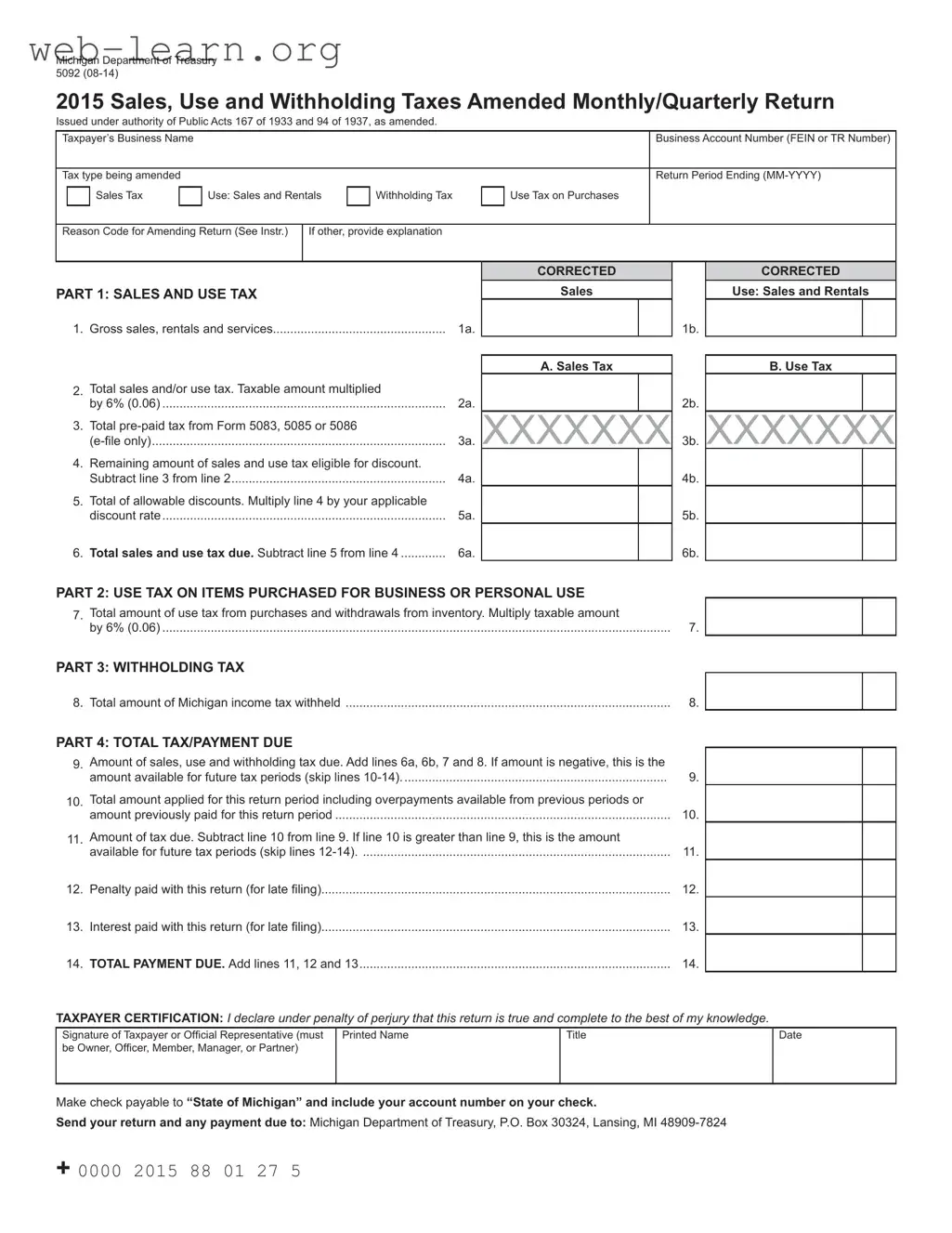
The Michigan 5092 form serves as an essential document for businesses needing to amend their Sales, Use, and Withholding Taxes for a given monthly or quarterly period. Issued by the Michigan Department of Treasury, this form is utilized under the authority of specific public acts and provides taxpayers with a structured way to correct previously submitted tax returns. Key components of the form include sections for detailing the taxpayer's business name and account number, the tax type being amended, and the return period ending date. Taxpayers must also indicate the reason for amending the return, selecting from a predefined list of codes that address various scenarios such as increasing or decreasing tax liability, or correcting previously reported information. The form is divided into several parts: the first part focuses on sales and use tax, requiring gross sales figures and calculations for total tax due; the second part addresses use tax on items purchased; the third part details withholding tax; and the final part summarizes the total tax or payment due. Each section prompts the taxpayer to input specific financial figures, ensuring a comprehensive overview of their tax obligations. Completing the Michigan 5092 form accurately is crucial, as any errors may lead to penalties and interest charges on unpaid taxes.
Michigan Department of Treasury 5092
2015 Sales, Use and Withholding Taxes Amended Monthly/Quarterly Return
Issued under authority of Public Acts 167 of 1933 and 94 of 1937, as amended.
Taxpayer’s Business Name |
|
|
|
|
|
Business Account Number (FEIN or TR Number) |
|||
|
|
|
|
|
|
|
|
|
|
Tax type being amended |
|
|
|
|
|
Return Period Ending |
|||
|
|
|
|
|
|
|
|
|
|
|
|
Sales Tax |
|
Use: Sales and Rentals |
|
Withholding Tax |
|
Use Tax on Purchases |
|
|
|
|
|
|
|
|
|
|
|
|
|
|
|
|
|
|
|
|
|
Reason Code for Amending Return (See Instr.)
If other, provide explanation
PART 1: SAlES AnD USE TAx
1. Gross sales, rentals and services |
1a. |
CORRECTED
Sales
1b.
CORRECTED
Use: Sales and Rentals
2.Total sales and/or use tax. Taxable amount multiplied
by 6% (0.06) ..................................................................................
3.Total
4.Remaining amount of sales and use tax eligible for discount. Subtract line 3 from line 2..............................................................
5.Total of allowable discounts. Multiply line 4 by your applicable discount rate..................................................................................
6.Total sales and use tax due. Subtract line 5 from line 4 .............
2a.
3a.
4a.
5a.
6a.
A. Sales Tax
XXXXXXX
2b.
3b.
4b.
5b.
6b.
B. Use Tax
XXXXXXX
PART 2: USE TAx On ITEMS PURChASED fOR BUSInESS OR PERSOnAl USE
7. Total amount of use tax from purchases and withdrawals from inventory. Multiply taxable amount |
|
by 6% (0.06) |
7. |
PART 3: WIThhOlDIng TAx
8. Total amount of Michigan income tax withheld |
8. |
PART 4: TOTAl TAx/PAyMEnT DUE
9. |
Amount of sales, use and withholding tax due. Add lines 6a, 6b, 7 and 8. If amount is negative, this is the |
|
|
amount available for future tax periods (skip lines |
9. |
10. |
Total amount applied for this return period including overpayments available from previous periods or |
|
|
amount previously paid for this return period |
10. |
11. |
Amount of tax due. Subtract line 10 from line 9. If line 10 is greater than line 9, this is the amount |
|
|
available for future tax periods (skip lines |
11. |
12. |
Penalty paid with this return (for late iling) |
12. |
13. |
Interest paid with this return (for late iling) |
13. |
14. |
TOTAl PAyMEnT DUE. Add lines 11, 12 and 13 |
14. |
TAxPAyER CERTIfICATIOn: I declare under penalty of perjury that this return is true and complete to the best of my knowledge.
Signature of Taxpayer or Oficial Representative (must be Owner, Oficer, Member, Manager, or Partner)
Printed Name
Title
Date
Make check payable to “State of Michigan” and include your account number on your check.
Send your return and any payment due to: Michigan Department of Treasury, P.O. Box 30324, Lansing, MI
+ 0000 2015 88 01 27 5
Instructions for Sales, Use and Withholding Taxes Amended Monthly/Quarterly Return (form 5092)
NOTE: You must use Form 165 to amend tax years prior to 2015.
Form 5092 is used to amend monthly/quarterly periods in the current year. Complete the return with the corrected figures. Check the box for each tax type you are amending and provide the amended reason code located in the instructions. If the reason code is “Other,” write an explanation for the amendment.
IMPORTANT: This is a return for Sales Tax, Use Tax, and/ or Withholding Tax. If the taxpayer inserts a zero on (or leaves blank) any line for reporting Sales Tax, Use Tax, or Withholding Tax, the taxpayer is certifying that no tax is owed for that tax type. If it is determined that tax is owed, the taxpayer will be liable for the deficiency as well as penalty and interest.
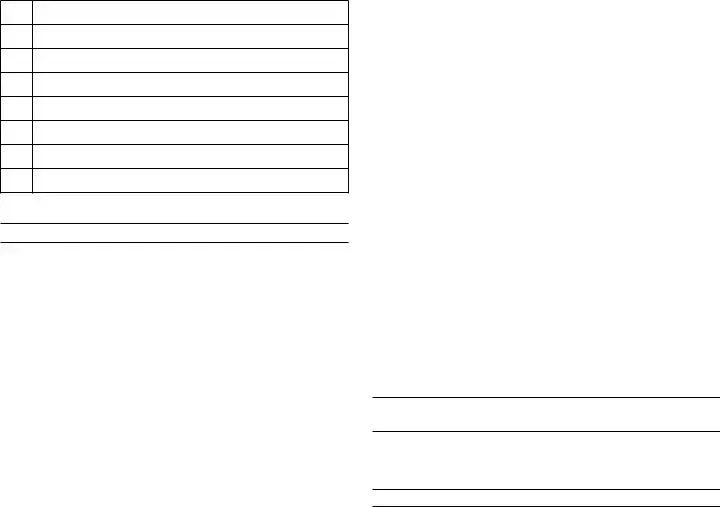
Reason code for amending return: Using the table below, select the
01Increasing tax liability
02Decreasing tax liability
03Incorrect information/igures reported on original return
04Original return was missing information/incomplete
05Claiming previously unclaimed
06Dispute an adjustment
07Tax Exempt
08Other
PART 1: SAlES AnD USE TAx
Line 1a: Total gross sales for tax period being reported. Enter the total of your Michigan sales of tangible personal property including cash, credit and installment transactions and any costs incurred before ownership of the property is transferred to the buyer (including shipping, handling, and delivery charges).
Line 1b: This line is used to report the following:
•
•Lessors of tangible personal property: Enter amount of total rental receipts.
•Persons providing accommodations: This would include but not limited to hotel, motel, and vacation home rentals. This also includes assessments imposed under the Convention and Tourism Act, the Convention Facility Development Act, the Regional Tourism Marketing Act, the Community Convention or Tourism Marketing Act.
•Telecommunications Services: Enter gross income from telecommunications services.
Line 2a: Total sales tax. Negative figures are not allowed or valid.
Line 2b: Total use tax. Negative figures not allowed or valid.
Line 5: Enter total allowable discounts. Discounts apply only to 2/3 (0.6667) of the sales and/or use tax collected at the 6 percent tax rate. See below to calculate your discount based on filing frequency:
Monthly Filer
•If the tax is less than $9, calculate the discount by multiplying the tax by 2/3 (.6667).
•Enter $6 if tax is $9 to $1,200 and paid by the 12th, or $9 to $1,800 and paid by the 20th .
•If the tax is more than $1,200 and paid by the 12th,
calculate discount using this formula: (Tax x .6667 x .0075). The maximum discount is $20,000 for the tax period.
•If the tax is more than $1,800 and paid by the 20th,
calculate discount using this formula: (Tax x .6667 x .005). The maximum discount is $15,000 for the tax period.
Quarterly Filer
•If the tax is less than $27, calculate the discount by multiplying the tax by 2/3 (.6667)
•Enter $18 if tax is $27 to $3,600 and paid by the 12th, or $27 to $5,400 and paid by the 20th.
•If the tax is more than $3,600 and paid by the 12th,
calculate discount using this formula: (Tax x .6667 x .0075). The maximum discount is $20,000 for the tax period.
•If the tax is more than $5,400 and paid by the 20th,
calculate discount using this formula: (Tax x .6667 x .005). The maximum discount is $15,000 for the tax period.
Accelerated Filer
•If the tax is paid by the 12th, calculate discount using this formula: (Tax x .6667 x .0075).
•If the tax is paid by the 20th, calculate discount using this formula: (Tax x .6667 x .005).
PART 2: USE TAx On ITEMS PURChASED fOR BUSInESS OR PERSOnAl USE
Line 7: To determine your use tax due from purchases and withdrawals, multiply the total amount of your inventory value by 6% (0.06) and enter here.
PART 3: WIThhOlDIng TAx
Line 8: Enter the total Michigan income tax withheld for the tax period.

PART 4: TOTAl TAx/PAyMEnT DUE
Line 9: If amount is negative, this is the amount available for
future tax periods (skip lines
Line 10: Enter any payments you submitted for this period, enter any payments for this period including any overpayments available from previous periods. If you are using an overpayment from a previous period only enter the amount needed to pay the total liability for this return. In the event an overpayment still exists declare it on the next return you file with a liability. (Liability minus overpayments/prior payment for this period must be greater than or equal to zero).
how to Compute Penalty and Interest
If your return is filed with additional tax due, include penalty and interest with your payment. Penalty is 5% of the tax due and increases by an additional 5% per month or fraction thereof, after the second month, to a maximum of 25%. Interest is charged daily using the average prime rate, plus 1 percent.
Refer to www.michigan.gov/taxes for current interest rate information or help in calculating late payment fees.
| Fact Name | Description |
|---|---|
| Form Purpose | The Michigan 5092 form is used to amend Sales, Use, and Withholding Taxes for monthly or quarterly periods. |
| Governing Laws | This form is issued under the authority of Public Acts 167 of 1933 and 94 of 1937, as amended. |
| Tax Types | It allows taxpayers to amend Sales Tax, Use Tax, and Withholding Tax amounts. |
| Amendment Reasons | Taxpayers must provide a reason code for amending the return, with options ranging from increasing tax liability to claiming tax exemptions. |
| Discount Eligibility | Taxpayers may qualify for discounts based on their filing frequency and the amount of tax due. |
| Signature Requirement | A signature from the taxpayer or an official representative is required, confirming the return's accuracy under penalty of perjury. |
| Filing Frequency | Form 5092 is specifically for use in the current tax year and cannot be used for prior years; Form 165 is required for those amendments. |
| Payment Instructions | Payments must be made payable to the "State of Michigan," and the taxpayer's account number should be included on the check. |
| Late Filing Penalties | If filed late, penalties and interest may apply, calculated based on the amount due and the time elapsed since the due date. |
Filling out the Michigan 5092 form requires careful attention to detail to ensure accuracy. This form is used to amend previously submitted tax returns related to sales, use, and withholding taxes. After completing the form, it must be submitted to the Michigan Department of Treasury along with any payment due.
The Michigan 5092 form is utilized to amend previously filed Sales, Use, and Withholding Taxes for monthly or quarterly periods within the current year. It allows taxpayers to correct errors or make adjustments to their tax liabilities.
Any business or individual who has previously submitted a Sales, Use, or Withholding Tax return and needs to make corrections must file this form. This includes those who have found errors in their reported figures or wish to claim previously unclaimed pre-paid sales tax.
Begin by entering your business name and account number. Specify the tax type being amended and the return period ending date. Fill out the sections for Sales and Use Tax, Use Tax on items purchased, and Withholding Tax. Ensure that you provide corrected figures and check the appropriate boxes for the tax types you are amending.
When completing the form, you must select a two-digit reason code that best describes your amendment. The options include:
If you leave a line blank or enter zero for any tax type, you are certifying that no tax is owed for that type. If it is later determined that tax is due, you may be held responsible for the deficiency, including any applicable penalties and interest.
Late filing incurs a penalty of 5% of the tax due. This penalty increases by an additional 5% for each month or fraction thereof after the second month, capping at a maximum of 25%. Additionally, interest is charged daily based on the average prime rate plus 1 percent.
Once completed, the form and any payment due should be sent to the Michigan Department of Treasury at P.O. Box 30324, Lansing, MI 48909-7824. Ensure that your check is made payable to the “State of Michigan” and includes your account number.
Completing the Michigan 5092 form can be challenging, and several common mistakes can lead to complications. One frequent error is neglecting to provide the correct business account number. This number is essential for identifying the taxpayer's account and ensuring that the return is processed accurately. If it is missing or incorrect, it can delay processing and lead to potential penalties.
Another common mistake involves failing to accurately report the gross sales, rentals, and services on line 1. Taxpayers should include all relevant income, including cash, credit, and installment transactions. Omitting any amounts can result in an underreporting of tax liability, which may trigger penalties and interest.
Some individuals also mistakenly leave lines blank or insert a zero on any line for reporting Sales Tax, Use Tax, or Withholding Tax. By doing so, they inadvertently certify that no tax is owed for that tax type. If it is later determined that tax is due, the taxpayer may face significant penalties.
Additionally, choosing the wrong reason code for amending the return can create confusion. Taxpayers must select the code that accurately reflects their reason for amending the return. Failing to do so can lead to misunderstandings and potential delays in processing.
Many taxpayers overlook the importance of calculating the total sales and use tax correctly. This amount must be derived from the taxable amount multiplied by the correct tax rate. Errors in this calculation can lead to incorrect tax liabilities being reported.
Another mistake occurs when taxpayers do not include any allowable discounts on line 5. Discounts can significantly reduce the total tax due, and failing to account for them can result in overpayment. Understanding the discount calculations based on filing frequency is crucial to ensure accuracy.
In some cases, individuals may forget to sign the form or provide the printed name and title of the taxpayer or official representative. This step is essential for validating the return. An unsigned return may be considered incomplete and could be rejected.
Finally, sending the form and payment to the wrong address can cause delays. Taxpayers should ensure that they are sending their return and any payment to the correct location, which is specified in the instructions. Taking the time to double-check these details can help avoid unnecessary complications.
The Michigan 5092 form is essential for amending sales, use, and withholding tax returns. It is often accompanied by other forms and documents that help clarify or support the information provided. Below is a list of commonly used forms that you may need to consider when filing the Michigan 5092.
When preparing your tax documents, ensure that you have all necessary forms ready. This will help you file accurately and on time, reducing the risk of penalties or interest charges. Stay organized and proactive in your tax management to avoid complications.
When filling out the Michigan 5092 form, it is crucial to approach the task with care and attention to detail. Here are four important do's and don'ts to keep in mind:
By following these guidelines, you can help ensure that your submission is processed smoothly and avoid potential issues down the line.
Understanding the Michigan 5092 form can be challenging, and there are several misconceptions that can lead to confusion. Here are six common misunderstandings about this form:
Being aware of these misconceptions can help ensure that your filing process goes smoothly and that you remain compliant with tax regulations. Always double-check the instructions and consider consulting a tax professional if you have questions.
The Michigan 5092 form is essential for amending Sales, Use, and Withholding Taxes for monthly or quarterly periods. Below are key takeaways regarding its use: