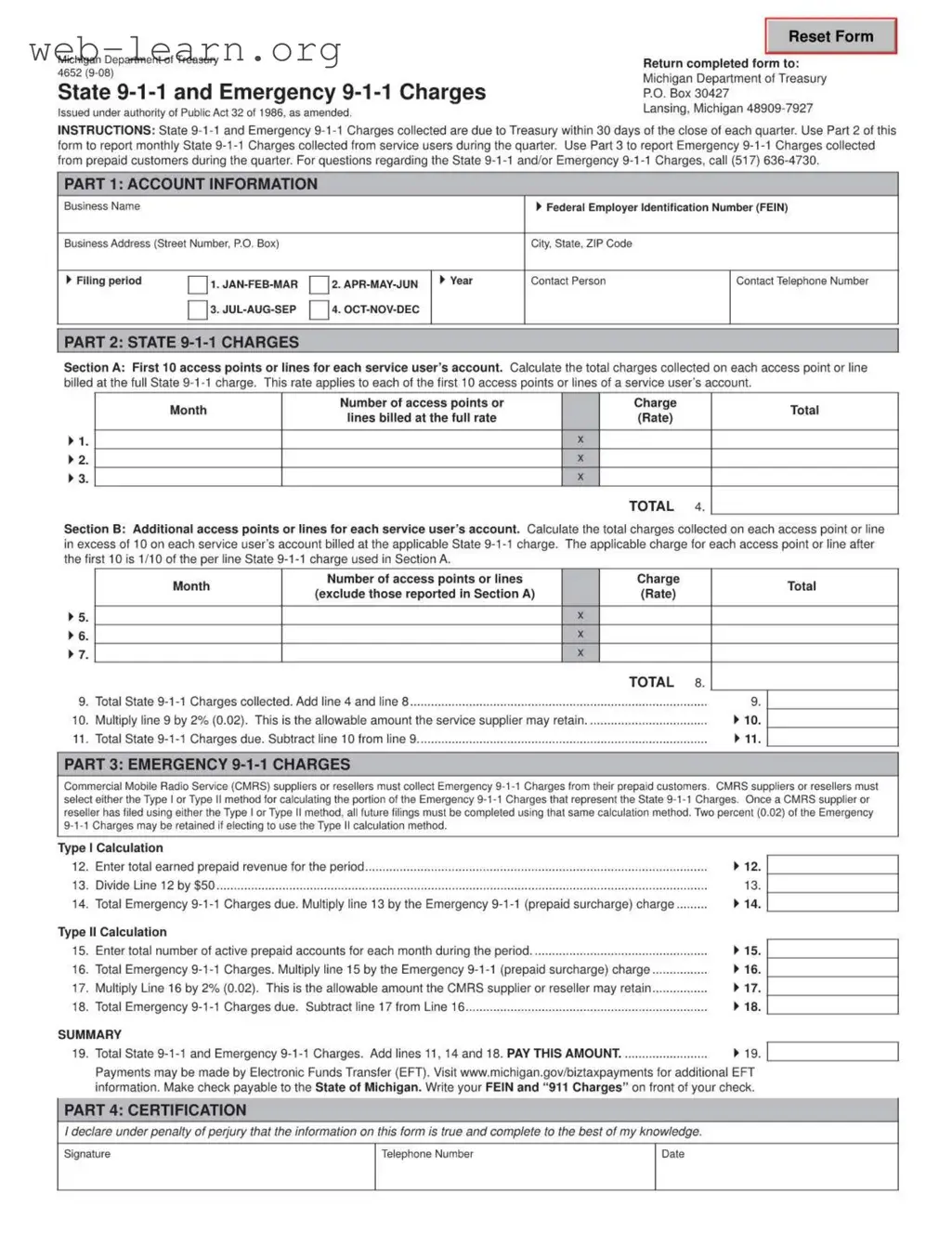
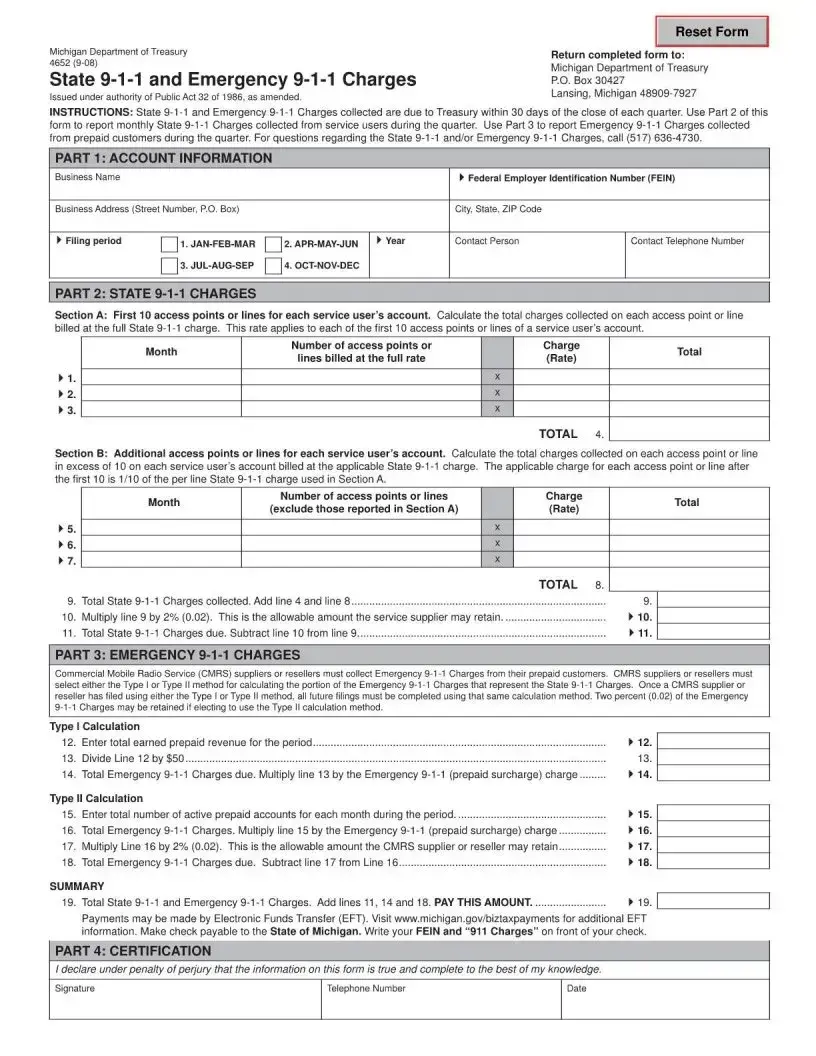
The Michigan 4652 form is an essential document for businesses that collect State 9-1-1 and Emergency 9-1-1 charges. Issued by the Michigan Department of Treasury, this form is governed by Public Act 32 of 1986 and must be submitted within 30 days after the end of each quarter. It consists of several parts that guide service providers in reporting the charges they have collected from customers. Part 2 focuses on State 9-1-1 charges, requiring businesses to detail the number of access points or lines billed at the full rate and any additional lines beyond the initial ten. Part 3 addresses Emergency 9-1-1 charges specifically for Commercial Mobile Radio Service (CMRS) suppliers or resellers, who must choose between two calculation methods for reporting these charges. The form also includes a summary section for total charges due and outlines payment options, including Electronic Funds Transfer. Completing this form accurately is crucial for compliance and helps ensure that emergency services are adequately funded.
| Fact Name | Description |
|---|---|
| Form Purpose | The Michigan 4652 form is used to report State 9-1-1 and Emergency 9-1-1 Charges collected by service suppliers. |
| Governing Law | This form is issued under the authority of Public Act 32 of 1986, which has been amended over the years. |
| Submission Deadline | Completed forms must be returned to the Michigan Department of Treasury within 30 days after the close of each quarter. |
| Contact Information | For questions regarding the charges, individuals can call (517) 636-4730 for assistance. |
| Filing Period | Service suppliers must specify the filing period on the form, which can be quarterly: January-March, April-June, July-September, or October-December. |
| Charge Calculation | Section A of the form is used to calculate charges for the first 10 access points or lines billed at the full State 9-1-1 charge. |
| Additional Charges | Section B allows for the reporting of additional access points or lines beyond the initial 10, billed at a reduced rate. |
| Emergency Charges Method | CMRS suppliers can choose between Type I and Type II methods for calculating Emergency 9-1-1 Charges from prepaid customers. |
| Payment Options | Payments for the charges can be made via Electronic Funds Transfer (EFT) or by check, with specific instructions provided on the form. |
Filling out the Michigan 4652 form is an important step in reporting State 9-1-1 and Emergency 9-1-1 Charges. Ensure that you have all necessary information ready before starting. Follow these steps carefully to complete the form accurately.
After completing the form, ensure that all information is accurate before submitting it to the Michigan Department of Treasury at the specified address. This will help avoid any delays or issues with your report.
What is the purpose of the Michigan 4652 form?
The Michigan 4652 form is used to report State 9-1-1 and Emergency 9-1-1 Charges collected by service suppliers. This form ensures that these charges are reported accurately and submitted to the Michigan Department of Treasury within the required timeframe. It is essential for maintaining compliance with Public Act 32 of 1986, which governs the collection and remittance of these charges.
Who needs to file the Michigan 4652 form?
Any business or service supplier that collects State 9-1-1 and Emergency 9-1-1 Charges from customers must file this form. This includes Commercial Mobile Radio Service (CMRS) suppliers and resellers who offer prepaid services. It is important for these entities to ensure that they are accurately reporting the charges they collect from their customers.
When is the Michigan 4652 form due?
The completed Michigan 4652 form must be submitted to the Michigan Department of Treasury within 30 days after the close of each quarter. This means that if you collect charges during the first quarter (January to March), you must submit the form by the end of April. Timely submission is crucial to avoid potential penalties or compliance issues.
How do I calculate the charges reported on the form?
The form has designated sections for calculating State 9-1-1 Charges and Emergency 9-1-1 Charges. In Part 2, you will report the total charges collected from service users. This includes the first 10 access points or lines billed at the full rate and any additional access points billed at a reduced rate. Part 3 focuses on Emergency 9-1-1 Charges collected from prepaid customers, allowing you to choose between two calculation methods. Detailed instructions are provided on the form to assist you in these calculations.
What should I do if I have questions about the form?
If you encounter any questions or need assistance while filling out the Michigan 4652 form, you can contact the Michigan Department of Treasury at (517) 636-4730. They can provide guidance and clarify any uncertainties regarding the form or the charges you are required to report.
How should I submit the completed Michigan 4652 form?
You should return the completed form to the Michigan Department of Treasury at the following address: P.O. Box 30427, Lansing, Michigan 48909-7927. Payments for the charges can be made via Electronic Funds Transfer (EFT) or by check. If you choose to pay by check, ensure that it is made payable to the State of Michigan and includes your Federal Employer Identification Number (FEIN) along with the notation “911 Charges” on the front.
Filling out the Michigan 4652 form can be straightforward, but many people make common mistakes that can lead to delays or issues. One frequent error is failing to include the Federal Employer Identification Number (FEIN). This number is essential for identifying your business, and without it, your submission may be rejected.
Another mistake is not reporting the correct filing period. It's crucial to ensure that you select the right quarter and year. If you accidentally choose the wrong period, it could complicate your accounting and lead to penalties.
Many people overlook the importance of providing accurate contact information. Ensure that the contact person's name and telephone number are correct. This information is vital for any follow-up questions or clarifications the Treasury may have.
When calculating the State 9-1-1 Charges, errors in the math can lead to incorrect totals. Double-check your calculations in Sections A and B. It’s easy to miscalculate the number of access points or the total charges, which can impact your final submission.
Some individuals fail to include all necessary access points or lines when reporting. Remember, the first ten lines are charged at a full rate, while any additional lines are billed at a reduced rate. Missing any of these can affect the overall amount due.
Additionally, people sometimes forget to carry over totals correctly. In the summary section, make sure that you add up the totals from the previous sections accurately. A simple addition error can lead to significant discrepancies.
Another common oversight is not retaining the allowable amount. If you are using the Type II calculation method, remember to calculate and subtract the 2% retention from the total Emergency 9-1-1 Charges due. This step is often missed, leading to an inflated amount due.
Lastly, don’t forget to sign and date the form. This certification is essential, as it confirms that the information provided is accurate to the best of your knowledge. Without a signature, the form will not be processed.
By being aware of these common mistakes, you can ensure that your Michigan 4652 form is filled out correctly, helping you avoid delays and potential penalties.
The Michigan 4652 form is essential for reporting State and Emergency 9-1-1 Charges. However, several other documents are often used in conjunction with it to ensure compliance and proper reporting. Below is a list of related forms and documents that may be necessary.
These documents play a significant role in the proper management and reporting of 9-1-1 charges. Ensure you have all necessary forms in order to comply with state regulations and maintain accurate records.
The Michigan 4652 form serves a specific purpose in reporting State 9-1-1 and Emergency 9-1-1 charges. However, several other documents share similarities in their structure and function. Here are five such documents:
When filling out the Michigan 4652 form, attention to detail is crucial. Here are ten essential do's and don'ts to guide you through the process:
Completing this form accurately and promptly is vital to comply with Michigan's regulations. Follow these guidelines to avoid any issues.
Understanding the Michigan 4652 form can be challenging due to various misconceptions. Here are seven common misunderstandings clarified:
It is crucial for businesses to have a clear understanding of these points to ensure compliance and avoid potential issues with the Michigan Department of Treasury.
Here are some key takeaways about filling out and using the Michigan 4652 form:
Ensure all information is accurate and complete before submission to avoid penalties.