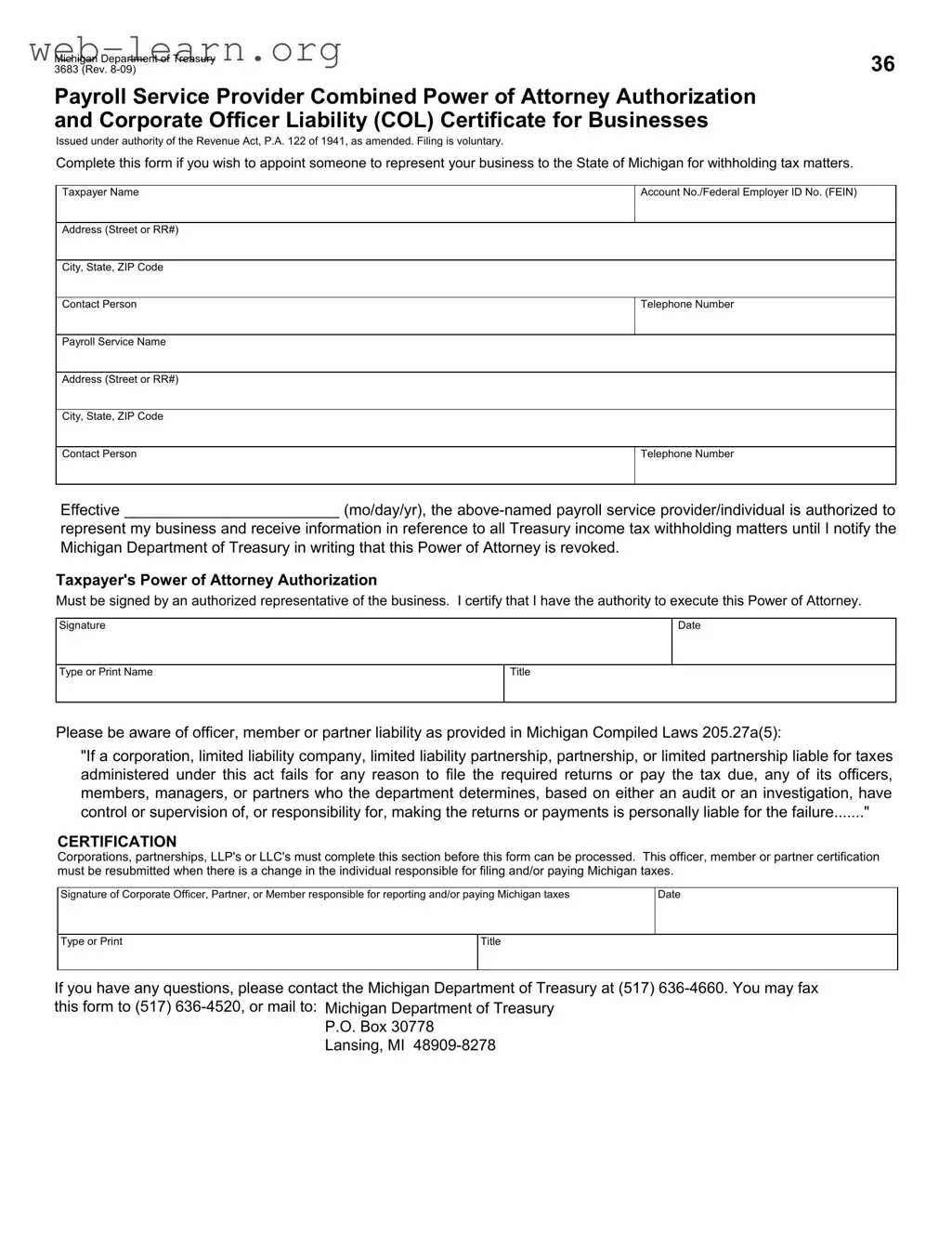
The Michigan 3683 form serves as a crucial tool for businesses operating within the state, specifically designed to facilitate the appointment of a payroll service provider or an individual representative for tax-related matters. This form, officially titled the Payroll Service Provider Combined Power of Attorney Authorization and Corporate Officer Liability Certificate, is issued by the Michigan Department of Treasury. Its primary purpose is to allow business owners to authorize a third party to manage their withholding tax responsibilities on their behalf. While the filing of this form is voluntary, completing it ensures that your chosen representative can receive essential information regarding income tax withholding matters. The document requires specific details, including the taxpayer's name, address, and contact information, as well as the payroll service provider's information. Additionally, it emphasizes the importance of understanding corporate officer liability, which holds individuals accountable if their business fails to meet tax obligations. Before the form can be processed, it must be signed by an authorized representative of the business, underscoring the need for proper certification. If you have any questions or require assistance, the Michigan Department of Treasury provides contact information for further guidance.
Michigan Department of Treasury |
36 |
3683 (Rev. |
Payroll Service Provider Combined Power of Attorney Authorization and Corporate Officer Liability (COL) Certificate for Businesses
Issued under authority of the Revenue Act, P.A. 122 of 1941, as amended. Filing is voluntary.
Complete this form if you wish to appoint someone to represent your business to the State of Michigan for withholding tax matters.
Taxpayer Name
Address (Street or RR#)
City, State, ZIP Code
Contact Person
Payroll Service Name
Address (Street or RR#)
City, State, ZIP Code
Contact Person
Account No./Federal Employer ID No. (FEIN)
Telephone Number
Telephone Number
Effective _________________________ (mo/day/yr), the
represent my business and receive information in reference to all Treasury income tax withholding matters until I notify the Michigan Department of Treasury in writing that this Power of Attorney is revoked.
Taxpayer's Power of Attorney Authorization
Must be signed by an authorized representative of the business. I certify that I have the authority to execute this Power of Attorney.
Signature
Date
Type or Print Name
Title
Please be aware of officer, member or partner liability as provided in Michigan Compiled Laws 205.27a(5):
"If a corporation, limited liability company, limited liability partnership, partnership, or limited partnership liable for taxes administered under this act fails for any reason to file the required returns or pay the tax due, any of its officers, members, managers, or partners who the department determines, based on either an audit or an investigation, have control or supervision of, or responsibility for, making the returns or payments is personally liable for the failure......."
CERTIFICATION
Corporations, partnerships, LLP's or LLC's must complete this section before this form can be processed. This officer, member or partner certification must be resubmitted when there is a change in the individual responsible for filing and/or paying Michigan taxes.
Signature of Corporate Officer, Partner, or Member responsible for reporting and/or paying Michigan taxes
Date
Type or Print
Title
If you have any questions, please contact the Michigan Department of Treasury at (517)
| Fact Name | Details |
|---|---|
| Form Title | Payroll Service Provider Combined Power of Attorney Authorization and Corporate Officer Liability (COL) Certificate for Businesses |
| Issuing Authority | Michigan Department of Treasury |
| Governing Law | Revenue Act, P.A. 122 of 1941, as amended |
| Filing Status | Filing is voluntary |
| Purpose | To appoint a representative for withholding tax matters |
| Taxpayer Information | Requires taxpayer name, address, and contact person details |
| Authorization Duration | Effective until revoked in writing to the Michigan Department of Treasury |
| Signature Requirement | Must be signed by an authorized representative of the business |
| Liability Notice | Officers, members, or partners may be personally liable for tax failures as per Michigan Compiled Laws 205.27a(5) |
Filling out the Michigan 3683 form is a straightforward process that allows you to appoint a representative for your business regarding withholding tax matters. Once completed, the form must be submitted to the Michigan Department of Treasury. Below are the steps to guide you through the process of filling out this form.
After completing these steps, you may choose to fax the form to (517) 636-4520 or mail it to the Michigan Department of Treasury at P.O. Box 30778, Lansing, MI 48909-8278. If you have questions during the process, do not hesitate to reach out to the Michigan Department of Treasury at (517) 636-4660 for assistance.
What is the Michigan 3683 form?
The Michigan 3683 form, also known as the Payroll Service Provider Combined Power of Attorney Authorization and Corporate Officer Liability Certificate, is a document used by businesses in Michigan. This form allows a business to appoint a payroll service provider or individual to represent it in matters related to state withholding tax. By completing this form, businesses can streamline their tax processes and ensure compliance with state regulations.
Who needs to complete the Michigan 3683 form?
Any business entity in Michigan that wishes to authorize a third party, such as a payroll service provider, to handle its withholding tax matters should complete the Michigan 3683 form. This includes corporations, limited liability companies (LLCs), partnerships, and limited liability partnerships (LLPs). Additionally, an authorized representative of the business must sign the form, certifying their authority to do so.
What information is required to fill out the form?
To complete the Michigan 3683 form, the following information is necessary:
Each of these details ensures that the appointed representative can effectively manage the business's tax obligations.
How long does the authorization last?
The authorization granted through the Michigan 3683 form remains in effect until the business notifies the Michigan Department of Treasury in writing that the Power of Attorney has been revoked. This means that businesses should keep track of their authorizations and can update or revoke them as needed.
What are the liabilities associated with this form?
It is crucial for businesses to understand that under Michigan law, specifically Michigan Compiled Laws 205.27a(5), certain individuals within a business can be held personally liable for the failure to file required tax returns or pay taxes due. This liability applies to officers, members, managers, or partners who have control or responsibility for tax matters. Therefore, appointing a representative does not absolve these individuals of their responsibilities.
How can I submit the Michigan 3683 form?
The completed Michigan 3683 form can be submitted to the Michigan Department of Treasury via several methods:
For any questions or further assistance, businesses can contact the Michigan Department of Treasury at (517) 636-4660.
Filling out the Michigan 3683 form can be straightforward, but many people make common mistakes that can lead to delays or complications. One frequent error is failing to provide accurate contact information. It's essential to ensure that the names, addresses, and phone numbers of both the taxpayer and the payroll service provider are correct. Missing or incorrect details can hinder communication and create unnecessary confusion.
Another mistake involves not signing the form. The Power of Attorney section must be signed by an authorized representative of the business. Without this signature, the form is incomplete and cannot be processed. It’s crucial to double-check that the appropriate person has signed and that the signature matches the name printed on the form.
People often overlook the effective date of the authorization. This date should be clearly indicated on the form. If left blank, it can lead to misunderstandings about when the payroll service provider is authorized to act on behalf of the business. Providing a specific date ensures clarity and prevents any potential issues regarding the timing of representation.
Another common oversight is neglecting to complete the certification section. Corporations, partnerships, and LLCs must certify that the individual signing is indeed responsible for reporting and paying taxes. This step is crucial for the processing of the form. If this section is incomplete, it can result in delays or rejection of the form.
Finally, many individuals fail to keep a copy of the submitted form. Retaining a copy is essential for record-keeping and future reference. If any issues arise, having a copy can help clarify what was submitted and when. It’s always a good practice to maintain thorough records of all important documents.
The Michigan 3683 form is essential for businesses that wish to appoint a representative for withholding tax matters. In addition to this form, several other documents are commonly used to ensure compliance and facilitate communication with the Michigan Department of Treasury. Below is a list of these documents, each with a brief description.
Understanding these documents can help ensure that businesses remain compliant with state and federal tax obligations. It is advisable to keep all forms organized and readily accessible for reference and filing purposes.
When filling out the Michigan 3683 form, it is essential to approach the task with care and attention to detail. Here is a list of things you should and shouldn't do to ensure your submission is accurate and complete.
By following these guidelines, you can help ensure that your experience with the Michigan 3683 form is smooth and efficient.
Understanding the Michigan 3683 form is essential for businesses operating in the state. However, there are several misconceptions that can lead to confusion. Below is a list of common misunderstandings regarding this form, along with clarifications for each.
By addressing these misconceptions, businesses can better navigate their responsibilities and ensure compliance with Michigan tax laws. Understanding the nuances of the Michigan 3683 form is crucial for effective tax management.
When filling out and using the Michigan 3683 form, keep the following key takeaways in mind: