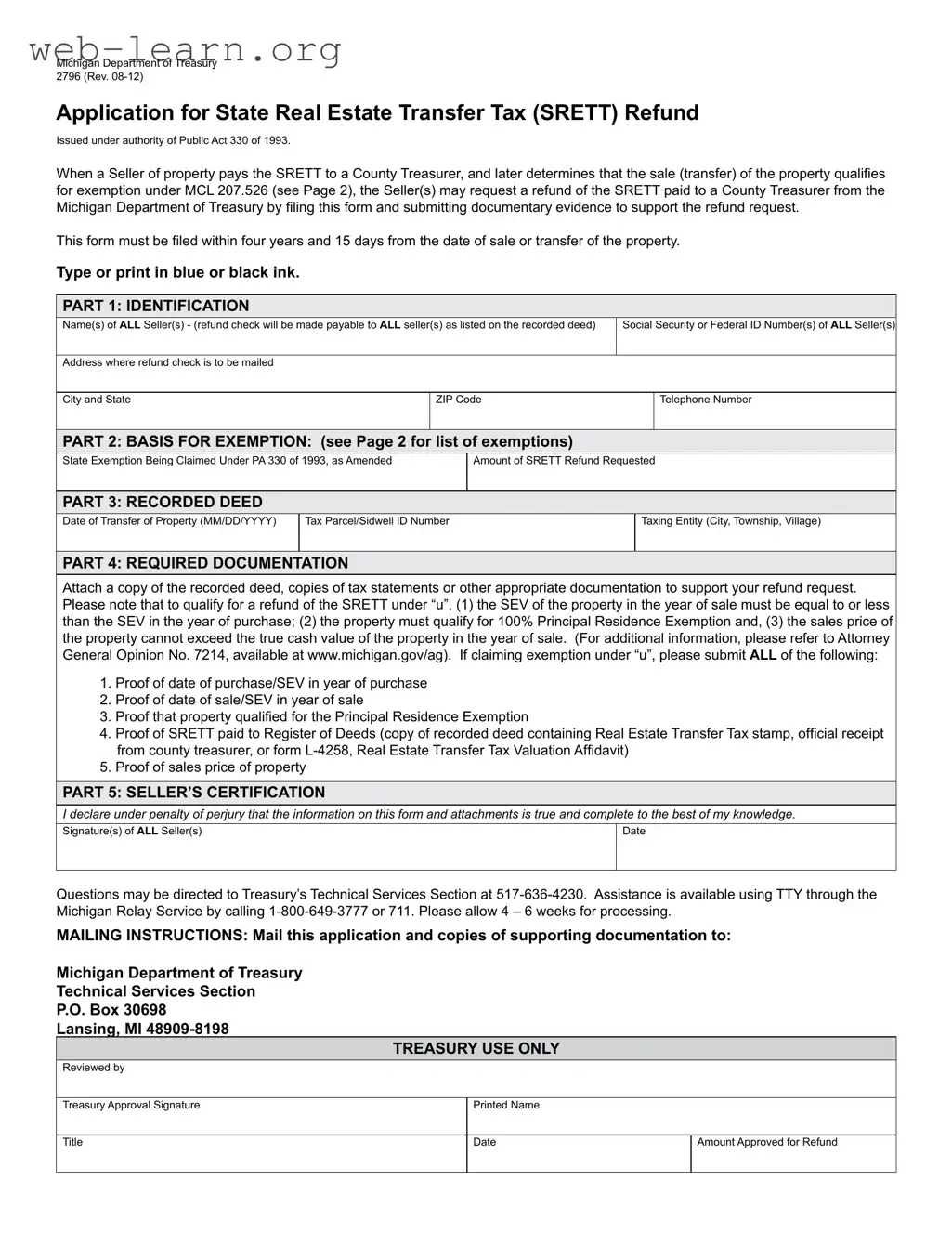
The Michigan 2796 form is an essential document for sellers of real estate who have paid the State Real Estate Transfer Tax (SRETT) and later find that their sale qualifies for a refund. This form allows sellers to formally request a refund from the Michigan Department of Treasury, provided they can demonstrate that their transaction meets specific exemption criteria outlined in the law. The application must be submitted within four years and 15 days from the date of the property transfer. The form consists of several parts, including sections for seller identification, the basis for claiming an exemption, details about the recorded deed, and required documentation to support the refund request. Sellers must provide information such as their names, Social Security numbers, and the address where they want the refund check mailed. Additionally, they need to indicate the exemption being claimed and the amount of refund requested. Supporting documents, like a copy of the recorded deed and tax statements, must be attached to validate the claim. The form also requires sellers to certify the accuracy of the information provided under penalty of perjury. Understanding the requirements and ensuring accurate completion of the Michigan 2796 form can significantly ease the process of obtaining a refund for the SRETT paid.
Michigan Department of Treasury 2796 (Rev.
Application for State Real Estate Transfer Tax (SRETT) Refund
Issued under authority of Public Act 330 of 1993.
When a Seller of property pays the SRETT to a County Treasurer, and later determines that the sale (transfer) of the property qualiies
for exemption under MCL 207.526 (see Page 2), the Seller(s) may request a refund of the SRETT paid to a County Treasurer from the
Michigan Department of Treasury by iling this form and submitting documentary evidence to support the refund request. This form must be iled within four years and 15 days from the date of sale or transfer of the property.
Type or print in blue or black ink.
PART 1: IDENTIFICATION
Name(s) of ALL Seller(s) - (refund check will be made payable to ALL seller(s) as listed on the recorded deed)
Social Security or Federal ID Number(s) of ALL Seller(s)
Address where refund check is to be mailed
City and State
ZIP Code
Telephone Number
PART 2: BASIS FOR EXEMPTION: (see Page 2 for list of exemptions)
State Exemption Being Claimed Under PA 330 of 1993, as Amended
Amount of SRETT Refund Requested
PART 3: RECORDED DEED
Date of Transfer of Property (MM/DD/YYYY)
Tax Parcel/Sidwell ID Number
Taxing Entity (City, Township, Village)
PART 4: REQUIRED DOCUMENTATION
Attach a copy of the recorded deed, copies of tax statements or other appropriate documentation to support your refund request.
Please note that to qualify for a refund of the SRETT under “u”, (1) the SEV of the property in the year of sale must be equal to or less than the SEV in the year of purchase; (2) the property must qualify for 100% Principal Residence Exemption and, (3) the sales price of
the property cannot exceed the true cash value of the property in the year of sale. (For additional information, please refer to Attorney
General Opinion No. 7214, available at www.michigan.gov/ag). If claiming exemption under “u”, please submit ALL of the following:
1.Proof of date of purchase/SEV in year of purchase
2.Proof of date of sale/SEV in year of sale
3.Proof that property qualiied for the Principal Residence Exemption
4.Proof of SRETT paid to Register of Deeds (copy of recorded deed containing Real Estate Transfer Tax stamp, oficial receipt from county treasurer, or form
5.Proof of sales price of property
PART 5: SELLER’S CERTIFICATION
I declare under penalty of perjury that the information on this form and attachments is true and complete to the best of my knowledge.
Signature(s) of ALL Seller(s)
Date
Questions may be directed to Treasury’s Technical Services Section at
Michigan Relay Service by calling
MAILING INSTRUCTIONS: Mail this application and copies of supporting documentation to:
Michigan Department of Treasury
Technical Services Section
P.O. Box 30698
Lansing, MI
TREASURY USE ONLY
Reviewed by
Treasury Approval Signature
Printed Name
Title
Date
Amount Approved for Refund
2796, Page 2 |
Exemptions to State Real Estate Transfer Tax (SRETT) |
|
Under Section 6 of PA 330 of 1993, as amended, you may claim an exemption from the SRETT for one of the reasons listed below. Enter the section number for the exemption you are claiming in Part 2 of form 2796.
(a)A written instrument in which the value of the consideration for the property is less than $100.00.
(b)A written instrument evidencing a contract or transfer that is not to be performed wholly within this state only to the extent the written instrument includes land lying outside of this state.
(c)A written instrument that this state is prohibited from taxing under the United States constitution or federal statutes.
(d)A written instrument given as security or an assignment or discharge of the security interest.
(e)A written instrument evidencing a lease, including an oil and gas lease, or a transfer of a leasehold interest.
(f)A written instrument evidencing an interest that is assessable as personal property.
(g)A written instrument evidencing the transfer of a right and interest for underground gas storage purposes.
(h)Any of the following written instruments:
(i)A written instrument in which the grantor is the United States, this state, a political subdivision or municipality of this state, or an oficer of the United States or of this state, or a political subdivision or municipality of this state, acting in his or her oficial capacity.
(ii)A written instrument given in foreclosure or in lieu of foreclosure of a loan made, guaranteed, or insured by the United States, this state, a political subdivision or municipality of this state, or an oficer of the United States or of this state, or a political subdivision or municipality of this state, acting in his or her oficial capacity.
(iii)A written instrument given to the United States, this state, or 1 of their oficers acting in an oficial capacity as grantee, pursuant to the terms or guarantee or insurance of a loan guaranteed or insured by the grantee.
(i)A conveyance from a husband or wife or husband and wife creating or disjoining a tenancy by the entireties in the grantors or the grantor and his or her spouse.
(j)A conveyance from an individual to that individual’s child, stepchild, or adopted child.
(k)A conveyance from an individual to that individual’s grandchild,
(l)A judgment or order of a court of record making or ordering a transfer, unless a speciic monetary consideration is speciied or ordered by the court for the transfer.
(m)A written instrument used to straighten boundary lines if no monetary consideration is given.
(n)A written instrument to conirm title already vested in a grantee, including a quitclaim deed to correct a law in title.
(o)A land contract in which the legal title does not pass to the grantee until the total consideration speciied in the contract has been paid.
(p)A conveyance that meets 1 of the following:
(i)A transfer between any corporation and its stockholders or creditors, between any limited liability company and its members or creditors, between any partnership and its partners or creditors, or between a trust and its beneiciaries or creditors when the transfer
is to effectuate a dissolution of the corporation, limited liability company, partnership, or trust and it is necessary to transfer the title of real property from the entity to the stockholders, members, partners, beneiciaries, or creditors.
(ii)A transfer between any limited liability company and its members if the ownership interests in the limited liability company are held by the same persons and in the same proportion as in the limited liability company prior to the transfer.
(iii)A transfer between any partnership and its partners if the ownership interests in the partnership are held by the same persons and in the same proportion as in the partnership prior to the transfer.
(iv)A transfer of a controlling interest in an entity with an interest in real property if the transfer of the real property would qualify for exemption if the transfer had been accomplished by deed to the real property between the persons that were parties to the transfer of the controlling interest.
(v)A transfer in connection with the reorganization of an entity and the beneicial ownership is not changed.
(q)A written instrument evidencing the transfer of mineral rights and interests.
(r)A written instrument creating a joint tenancy between 2 or more persons if at least 1 of the persons already owns the property.
(s)A transfer made pursuant to a bona ide sales agreement made before the date the tax is imposed under sections 3 and 4, if the sales agreement cannot be withdrawn or altered, or contains a ixed price not subject to change or modiication.
(t)A written instrument evidencing a contract or transfer of property to a person suficiently related to the transferor to be considered a single employer with the transferor under section 414(b) or (c) of the internal revenue code of 1986, 26 USC 414.
(u)A written instrument conveying an interest in property for which an exemption is claimed under section 7cc of the general property tax act,
1893 PA 206, MCL 211.7cc, if the state equalized valuation of that property is equal to or lesser than the state equalized valuation on the date of purchase or on the date of acquisition by the seller or transferor for that same interest in property. If after an exemption is claimed under this subsection, the sale or transfer of property is found by the treasurer to be at a value other than the true cash value, then a penalty equal to
20% of the tax shall be assessed in addition to the tax due under this act to the seller or transferor.
(v)A written instrument transferring an interest in property pursuant to a foreclosure of a mortgage including a written instrument given in lieu of foreclosure of a mortgage. This exemption does not apply to a subsequent transfer of the foreclosed property by the entity that foreclosed on the mortgage.
(w)A written instrument conveying an interest from a religious society in property exempt from the collection of taxes under section 7s of the general property tax act, 1893 PA 206, MCL 211.7s, to a religious society if that property continues to be exempt from the collection of taxes under section 7s of the general property tax act, 1893 PA 206, MCL 211.7s.
| Fact Name | Fact Description |
|---|---|
| Form Title | Michigan Department of Treasury 2796 (Rev. 08-12) Application for State Real Estate Transfer Tax (SRETT) Refund |
| Governing Law | Issued under authority of Public Act 330 of 1993. |
| Refund Eligibility | Sellers may request a refund if the property sale qualifies for exemption under MCL 207.526. |
| Filing Deadline | The form must be filed within four years and 15 days from the date of the property sale or transfer. |
| Required Documentation | Attach a copy of the recorded deed and other supporting documents to request a refund. |
| Principal Residence Exemption | To qualify for a refund, the property must meet specific criteria related to the Principal Residence Exemption. |
| Processing Time | Allow 4 to 6 weeks for processing after submission of the application. |
| Contact Information | Questions can be directed to Treasury’s Technical Services Section at 517-636-4230. |
Completing the Michigan 2796 form requires attention to detail and accurate information. This form is essential for sellers who believe they qualify for a refund of the State Real Estate Transfer Tax (SRETT). After filling out the form, it must be submitted along with supporting documentation to the Michigan Department of Treasury.
Once submitted, allow 4 to 6 weeks for processing. If you have any questions during the process, assistance is available through the Treasury’s Technical Services Section.
What is the Michigan 2796 form?
The Michigan 2796 form is an application for a refund of the State Real Estate Transfer Tax (SRETT). This tax is paid by the seller of a property to the County Treasurer at the time of sale. If the sale qualifies for an exemption under specific laws, the seller can file this form to request a refund from the Michigan Department of Treasury.
Who is eligible to file the Michigan 2796 form?
Any seller who has paid the SRETT and later determines that the sale qualifies for an exemption can file this form. All sellers listed on the recorded deed must sign the form, as the refund check will be made payable to all sellers. It's important to note that the form must be submitted within four years and 15 days from the date of the property transfer.
What documentation is required to support the refund request?
To successfully claim a refund, sellers must attach several documents, including:
Each piece of documentation must clearly support the claim for exemption.
How long does it take to process the Michigan 2796 form?
Once the Michigan Department of Treasury receives the completed form and all required documentation, processing typically takes about 4 to 6 weeks. Sellers should ensure that their application is complete to avoid delays.
Where should I send the completed Michigan 2796 form?
Mail the completed form along with all supporting documentation to:
Michigan Department of Treasury
Technical Services Section
P.O. Box 30698
Lansing, MI 48909-8198
Ensure that the mailing address is correct to facilitate timely processing of your refund request.
Filling out the Michigan 2796 form can be straightforward, but many people make common mistakes that can delay their refund. One frequent error is failing to include the names of all sellers. The refund check will be issued to everyone listed on the recorded deed. Omitting a seller can lead to complications and unnecessary delays in processing.
Another mistake is not providing accurate Social Security or Federal ID numbers. These numbers are crucial for identification purposes. If they are incorrect, it can result in the rejection of the refund request. Always double-check these details before submitting the form.
Many individuals also overlook the importance of the mailing address. The address where the refund check is to be sent must be complete and accurate. A small error in the address can lead to lost checks and further delays.
In Part 2, some applicants fail to clearly state the exemption being claimed. It's essential to refer to the list of exemptions on Page 2 and select the correct one. Incorrectly identifying the exemption can lead to a denial of the refund request.
Providing insufficient documentation is another common pitfall. The form requires specific attachments, such as a copy of the recorded deed and proof of the SRETT paid. Missing any of these documents can result in processing delays or outright rejection of the application.
Some applicants forget to sign the form. The Seller's Certification section requires the signature of all sellers. A missing signature can render the application invalid, leading to further complications.
Another mistake involves the submission timeline. The form must be filed within four years and 15 days from the date of the sale or transfer. Many people miss this deadline, which can result in losing the right to a refund altogether.
Inaccurate dates are also a frequent error. Ensure that the date of transfer is entered correctly in MM/DD/YYYY format. An incorrect date can lead to confusion and potential rejection of the refund request.
Some applicants neglect to provide a clear basis for the exemption. This should be clearly stated in Part 2 of the form. Failing to do so can create ambiguity and may lead to a denial of the request.
Lastly, not keeping a copy of the submitted form and all supporting documents can be a significant oversight. Retaining copies is essential for tracking the application and addressing any issues that may arise during processing.
When applying for a refund of the State Real Estate Transfer Tax (SRETT) in Michigan using the Michigan 2796 form, several other documents and forms may be required to support your application. Below is a list of essential forms that are often used in conjunction with the Michigan 2796 form, along with a brief description of each.
Gathering these documents promptly will facilitate a smoother refund application process. Ensure that all forms are completed accurately and submitted within the required time frame to avoid any delays. If you have questions or need assistance, consider reaching out to the appropriate authorities for guidance.
The Michigan Department of Treasury Form 2796 is specifically designed for individuals seeking a refund of the State Real Estate Transfer Tax (SRETT) after a property sale. Several other documents serve similar purposes in different contexts. Here’s a look at eight documents that share characteristics with the Michigan 2796 form:
Each of these forms serves its own specific purpose but shares the fundamental elements of identifying the claimant, stating the basis for the request, and providing supporting documentation. Understanding these similarities can help individuals navigate the often complex world of tax refunds more effectively.
When filling out the Michigan 2796 form, it is essential to follow certain guidelines to ensure a smooth application process. Below are four key do's and don'ts to consider.
Understanding the Michigan 2796 form is crucial for anyone seeking a refund of the State Real Estate Transfer Tax (SRETT). However, several misconceptions can lead to confusion. Here are seven common misconceptions about this form:
In reality, the form must be filed within four years and 15 days from the date of sale or transfer of the property. Missing this deadline means you forfeit your right to a refund.
All sellers listed on the recorded deed must sign the form. The refund check will be made payable to all sellers, ensuring everyone involved in the transaction is acknowledged.
Supporting documentation is essential. You must attach a copy of the recorded deed and other relevant documents to substantiate your refund request.
Not all property sales qualify for a refund. The sale must meet specific exemption criteria outlined in the form, such as the property qualifying for a 100% Principal Residence Exemption.
Processing your refund request takes time. Generally, you should allow 4 to 6 weeks for the Michigan Department of Treasury to process your application.
The form specifically requires that you type or print in blue or black ink. Using other colors may lead to processing delays.
You can direct any questions regarding your application to the Treasury’s Technical Services Section. They can provide you with updates and assistance as needed.
When dealing with the Michigan 2796 form, understanding its purpose and requirements is essential for a smooth refund process. Here are key takeaways to consider:
Taking the time to carefully fill out the Michigan 2796 form can help ensure that your request for a refund is processed efficiently and accurately.