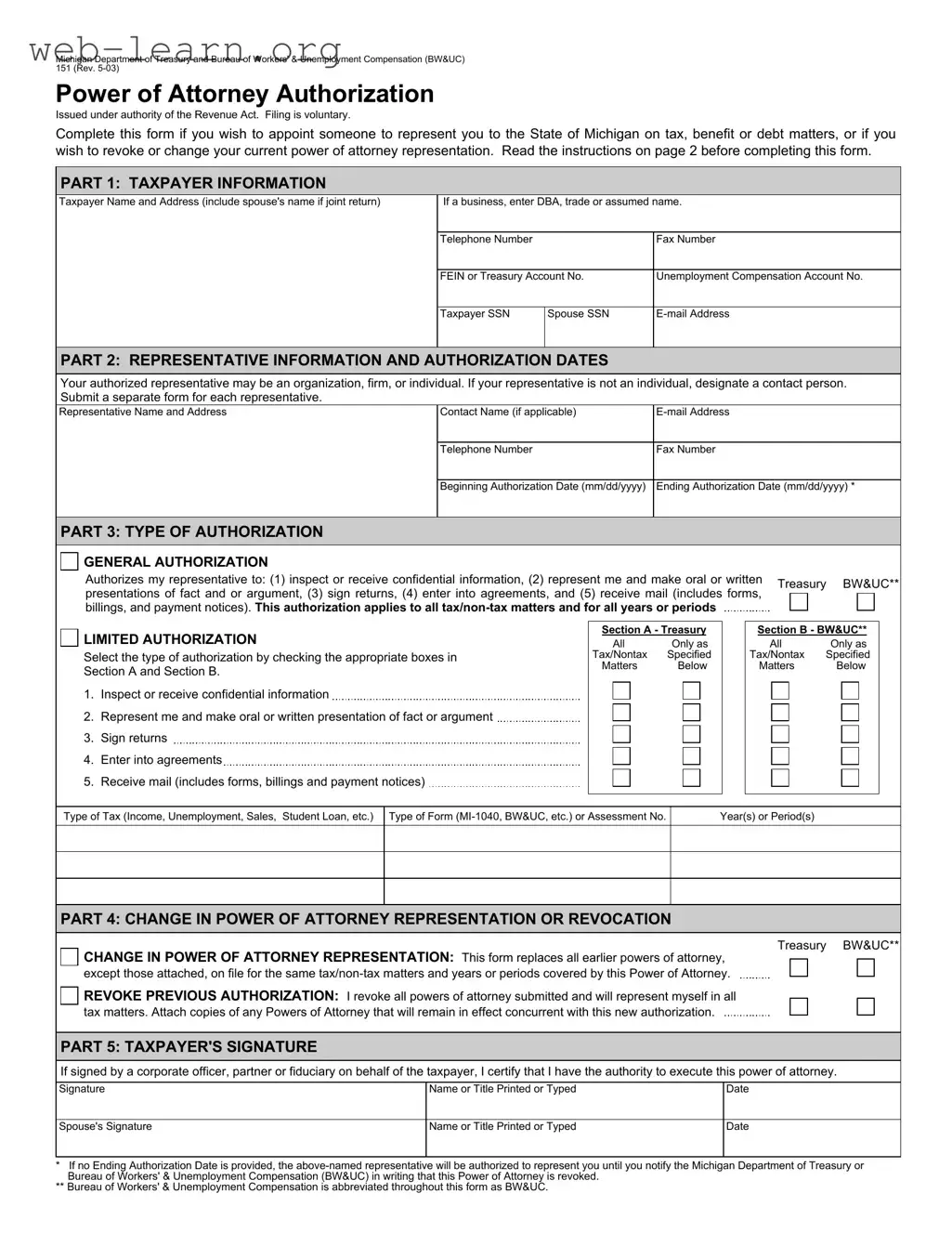
The Michigan 151 form serves as a vital tool for individuals and businesses seeking representation in tax, benefit, or debt matters before the State of Michigan. This form allows taxpayers to appoint a representative, whether an individual, firm, or organization, to act on their behalf, ensuring that their interests are effectively communicated and protected. It is essential for those who wish to authorize someone to inspect confidential information, make oral or written presentations, sign returns, enter agreements, and receive important correspondence. Moreover, taxpayers can also use this form to revoke or modify any existing powers of attorney, providing a clear and organized way to manage their representation. By completing the Michigan 151 form, individuals can navigate complex tax issues with the support of a trusted representative, making the process less daunting. Before filling out the form, it is advisable to read the accompanying instructions carefully to ensure all necessary information is provided accurately.

Michigan Department of Treasury and Bureau of Workers' & Unemployment Compensation (BW&UC) 151 (Rev.
Power of Attorney Authorization
Issued under authority of the Revenue Act. Filing is voluntary.
Complete this form if you wish to appoint someone to represent you to the State of Michigan on tax, benefit or debt matters, or if you wish to revoke or change your current power of attorney representation. Read the instructions on page 2 before completing this form.
PART 1: TAXPAYER INFORMATION
Taxpayer Name and Address (include spouse's name if joint return) |
If a business, enter DBA, trade or assumed name. |
||
|
|
|
|
|
Telephone Number |
|
Fax Number |
|
|
|
|
|
FEIN or Treasury Account No. |
Unemployment Compensation Account No. |
|
|
|
|
|
|
Taxpayer SSN |
Spouse SSN |
|
|
|
|
|
PART 2: REPRESENTATIVE INFORMATION AND AUTHORIZATION DATES
Your authorized representative may be an organization, firm, or individual. If your representative is not an individual, designate a contact person. Submit a separate form for each representative.
Representative Name and Address |
Contact Name (if applicable) |
|
|
|
|
|
Telephone Number |
Fax Number |
|
|
|
|
Beginning Authorization Date (mm/dd/yyyy) |
Ending Authorization Date (mm/dd/yyyy) * |
|
|
|
PART 3: TYPE OF AUTHORIZATION
GENERAL AUTHORIZATION
Authorizes my representative to: (1) inspect or receive confidential information, (2) represent me and make oral or written Treasury BW&UC** presentations of fact and or argument, (3) sign returns, (4) enter into agreements, and (5) receive mail (includes forms,
billings, and payment notices). This authorization applies to all
|
|
LIMITED AUTHORIZATION |
Section A - Treasury |
|
Section B - BW&UC** |
|
||||||||||||||
|
|
|
|
|||||||||||||||||
|
|
|
All |
|
Only as |
|
All |
Only as |
|
|||||||||||
|
|
|
|
|
|
|
|
|
||||||||||||
|
|
Select the type of authorization by checking the appropriate boxes in |
Tax/Nontax |
Specified |
|
Tax/Nontax |
Specified |
|
||||||||||||
|
|
Section A and Section B. |
Matters |
|
Below |
|
Matters |
Below |
|
|||||||||||
|
|
|
|
|
|
|
|
|
|
|
|
|
|
|
|
|
|
|||
|
1. |
Inspect or receive confidential information |
|
|
|
|
|
|
|
|
|
|
|
|
|
|
|
|
||
|
|
|
|
|
|
|
|
|
|
|
|
|
|
|
|
|
||||
|
2. |
Represent me and make oral or written presentation of fact or argument |
|
|
|
|
|
|
|
|
|
|
|
|
|
|
|
|
||
|
|
|
|
|
|
|
|
|
|
|
|
|
|
|
|
|
||||
|
3. |
Sign returns |
|
|
|
|
|
|
|
|
|
|
|
|
|
|
|
|
||
|
|
|
|
|
|
|
|
|
|
|
|
|
|
|
|
|
||||
|
4. |
Enter into agreements |
|
|
|
|
|
|
|
|
|
|
|
|
|
|
|
|
||
|
|
|
|
|
|
|
|
|
|
|
|
|
|
|
|
|
||||
|
5. |
Receive mail (includes forms, billings and payment notices) |
|
|
|
|
|
|
|
|
|
|
|
|
|
|
|
|
||
|
|
|
|
|
|
|
|
|
|
|
|
|
|
|
|
|
||||
|
|
|
|
|
|
|
|
|
|
|
|
|
|
|
|
|
|
|
|
|
|
|
|
|
|
|
|
|
|
|
|
|
|
|
|||||||
|
Type of Tax (Income, Unemployment, Sales, Student Loan, etc.) |
Type of Form |
No. |
|
|
|
|
Year(s) or Period(s) |
|
|
|
|
||||||||
|
|
|
|
|
|
|
|
|
|
|
|
|
|
|
|
|
|
|
|
|
|
|
|
|
|
|
|
|
|
|
|
|
|
|
|
|
|
|
|
|
|
|
|
|
|
|
|
|
|
|
|
|
|
|
|
|
|
|
|
|
|
|
|
|
|
|
|
|
|
|
|
|
|
|
|
|
|
|
|
|
|
|
|
PART 4: CHANGE IN POWER OF ATTORNEY REPRESENTATION OR REVOCATION
Treasury BW&UC**
CHANGE IN POWER OF ATTORNEY REPRESENTATION: This form replaces all earlier powers of attorney, except those attached, on file for the same
REVOKE PREVIOUS AUTHORIZATION: I revoke all powers of attorney submitted and will represent myself in all tax matters. Attach copies of any Powers of Attorney that will remain in effect concurrent with this new authorization.
PART 5: TAXPAYER'S SIGNATURE
If signed by a corporate officer, partner or fiduciary on behalf of the taxpayer, I certify that I have the authority to execute this power of attorney.
Signature |
Name or Title Printed or Typed |
Date |
|
|
|
Spouse's Signature |
Name or Title Printed or Typed |
Date |
|
|
|
*If no Ending Authorization Date is provided, the
** Bureau of Workers' & Unemployment Compensation is abbreviated throughout this form as BW&UC.

Instructions for Power of Attorney Authorization (Form 151)
Complete and file a Power of Attorney Authorization (Form 151) if you wish to appoint an individual, firm, or organization as your representative in tax or debt matters before the State of Michigan. Failure to complete this form will prohibit Treasury or the Bureau of Workers’ & Unemployment Compensation (BW&UC) from discussing or releasing your tax return/tax return information with or to another person including your spouse.
PART 1: TAXPAYER INFORMATION
Enter the taxpayer’s name, address, telephone number, fax number, and
PART 2: REPRESENTATIVE INFORMATION AND AUTHORIZATION DATES
You must submit a separate form for each representative. Enter the authorized representative’s telephone number, fax number, and
PART 3: TYPE OF AUTHORIZATION
Check the GeneralAuthorization box to allow your representative to act on your behalf to do all of the following: (1) inspect and receive confidential information, (2) represent you and make oral or written presentations of act and/or argument, (3) sign returns,
(4)enter into agreements, and (5) receive all (includes forms, billings, and payment notices. This authorization applies to all
You may restrict your representative’s authorization to act on your behalf by checking the Limited Authorization box, and checking the appropriate boxes in Section A and/or B. To limit the authorization for specific tax matters, check the appropriate “Only as Specified Below” boxes, and indicate the type of tax, type of form, and years/periods for which you are granting authorization in the space provided.
Check this box if your representative is authorized to:
1.Inspect or receive confidential information
2.Represent you and make oral or written presentation of fact or argument.
3.Sign tax returns.
4.Enter into agreements (such as payment plans).
5.Receive mail.
PART 4: CHANGE IN POWER OF ATTORNEY REPRESENTATION OR REVOCATION
Unless otherwise specified, this Power of Attorney Authorization replaces or revokes any previous power of attorney authorizations on file with the Michigan Department of Treasury or the Bureau of Worker’s & Unemployment Compensation for the same tax matters identified on this form.
You must identify any previous authorizations that are to remain in effect, and attach a copy of the authorizations to this form when filed.
PART 5: TAXPAYER SIGNATURE
You and your spouse, if a joint return, must sign and date the form.
FILING
Except as noted below, mail this form to the Registration Section. Treasury will forward your form to BW&UC.
Customer Contact Center
Registration Section
Michigan Department of Treasury
P.O. Box 30477
Lansing, MI
If the Michigan Accounts Receivable Collection System (MARCS) has requested you to file this form, mail your completed form and any attachments to:
MARCS
P.O. Box 30158
Lansing, MI
If a district office representative has requested you to file this form, mail it to that representative.
If the Treasury Collection Division has requested you to file this form, mail it to:
Collection Division
Michigan Department of Treasury
P.O. Box 30199
Lansing, MI 48909
If BW&UC has asked you to file this form, mail it to:
BW&UC Tax Office
P.O. Box 8068
Royal Oak, MI
Or fax to:
If you are an individual taxpayer (not representing a business), mail this form to:
Customer Contact Center Individual Correspondence Section Michigan Department of Treasury Lansing, MI 48922
| Fact Name | Details |
|---|---|
| Form Title | Michigan Department of Treasury and Bureau of Workers' & Unemployment Compensation (BW&UC) 151 |
| Form Purpose | This form allows individuals to appoint a representative for tax, benefit, or debt matters before the State of Michigan. |
| Governing Law | Issued under the authority of the Revenue Act. |
| Filing Status | Filing this form is voluntary. |
| Taxpayer Information | Includes name, address, telephone number, and Social Security numbers for taxpayers and spouses. |
| Representative Information | Must provide contact details for the authorized representative and specify authorization dates. |
| Types of Authorization | Includes general authorization for all tax matters or limited authorization for specific issues. |
| Change of Representation | This form replaces all earlier powers of attorney unless specified otherwise. |
| Signature Requirement | Both taxpayer and spouse must sign if filing a joint return. |
| Filing Instructions | Mail the completed form to the appropriate department based on the request or situation. |
Filling out the Michigan 151 form is a straightforward process. This form allows you to appoint someone to represent you in tax or debt matters with the State of Michigan. After completing the form, it needs to be mailed or faxed to the appropriate department, depending on your situation.
The Michigan 151 form, officially known as the Power of Attorney Authorization, allows individuals or businesses to appoint a representative to act on their behalf regarding tax, benefit, or debt matters with the State of Michigan. This form is issued by the Michigan Department of Treasury and the Bureau of Workers' & Unemployment Compensation (BW&UC) and is a voluntary filing.
You have the option to appoint an individual, firm, or organization as your representative. If your representative is not an individual, it's important to designate a contact person. Each representative requires a separate form, so be sure to complete one for each person or entity you wish to authorize.
The Michigan 151 form offers two types of authorization: General Authorization and Limited Authorization. A General Authorization allows your representative to perform a wide range of actions on your behalf, including:
On the other hand, Limited Authorization allows you to specify certain actions or types of taxes for which your representative is authorized to act.
If you wish to revoke a previous Power of Attorney, you can do so by completing the Michigan 151 form. This form will replace all earlier powers of attorney for the same tax matters, unless you specify otherwise. Additionally, you may need to attach copies of any Powers of Attorney that you want to remain in effect.
When completing the Michigan 151 form, you'll need to provide detailed information, including:
Accurate information is crucial, as it ensures that your representative can effectively act on your behalf.
The filing location for the Michigan 151 form depends on your specific situation. Generally, you would mail it to the Customer Contact Center at the Michigan Department of Treasury. However, if you received a request from a specific division, such as the Michigan Accounts Receivable Collection System (MARCS) or the Bureau of Workers' & Unemployment Compensation, you should send it to the address provided in that request.
If you do not complete and file the Michigan 151 form, the Michigan Department of Treasury and BW&UC will be unable to discuss or release your tax information to anyone else, including your spouse. This could hinder your ability to receive assistance or representation regarding your tax matters.
Filling out the Michigan 151 form can be straightforward, but many people make common mistakes that can lead to delays or complications. One frequent error is failing to provide complete taxpayer information. It’s essential to include not only your name and address but also the correct Social Security number and any applicable business identification numbers. Omitting any of this information can cause the form to be rejected or processed incorrectly.
Another common mistake is not specifying the representative's information accurately. If you are appointing someone to represent you, make sure to include their full name, address, and contact details. Some individuals forget to designate a contact person if the representative is an organization. This oversight can lead to confusion about who is authorized to act on your behalf.
Many people also struggle with the authorization dates. It’s crucial to fill in both the beginning and ending authorization dates. If you leave the ending date blank, the representative may be authorized indefinitely, which can create issues later on. Always double-check that these dates are clear and correctly formatted.
Another mistake occurs in the section regarding the type of authorization. Some individuals select the wrong boxes or fail to check any at all. Be sure to indicate whether you want a general or limited authorization. If you choose limited, specify the types of tax matters clearly. Failing to do so can limit your representative's ability to assist you effectively.
In addition, people often forget to sign the form. Both the taxpayer and, if applicable, the spouse must sign and date the document. A missing signature can halt the processing of your request entirely. Always review the form to ensure all required signatures are present.
Lastly, many individuals neglect to follow the mailing instructions carefully. Each situation may require sending the form to a different address, depending on the nature of the request. Make sure you know where to send your form to avoid unnecessary delays. If you are unsure, it is worth taking the time to verify the correct mailing address before sending your submission.
The Michigan 151 form is an important document for anyone looking to appoint a representative for tax or debt matters. Along with this form, there are several other documents that may be necessary to ensure a smooth process. Below is a list of commonly used forms that often accompany the Michigan 151 form.
Understanding these forms can help you navigate your tax responsibilities more effectively. Make sure to gather all necessary documents to streamline the process and avoid any potential issues with your filings.
IRS Form 2848 - Power of Attorney and Declaration of Representative: Similar to the Michigan 151 form, this IRS form allows taxpayers to appoint a representative to act on their behalf regarding federal tax matters. It includes sections for taxpayer and representative information, as well as the scope of authority granted.
California Form 3520 - Power of Attorney: This form serves a similar purpose in California, allowing individuals to appoint someone to represent them in tax matters before the California Franchise Tax Board. It also requires specific information about the taxpayer and the representative.
New York State Form POA-1 - Power of Attorney: This form allows New York residents to designate a representative for tax matters. Like the Michigan 151 form, it includes sections for authorizing different types of representation and revoking previous powers of attorney.
Florida Form DR-835 - Power of Attorney: In Florida, this form grants authority to a representative for tax-related issues. It outlines the scope of representation and requires taxpayer information, similar to the Michigan 151 form.
Texas Form 05-102 - Power of Attorney: This Texas form permits taxpayers to appoint a representative for tax matters. It includes sections for specifying the type of authorization and revoking prior powers of attorney, paralleling the structure of the Michigan 151 form.
Illinois Form CRT-1 - Power of Attorney: Illinois taxpayers can use this form to authorize a representative for tax matters. It includes provisions for detailing the scope of representation, akin to the Michigan 151 form.
Ohio Form IT 1040 - Power of Attorney: This form allows Ohio residents to appoint a representative for state tax purposes. It shares similarities with the Michigan 151 form in its layout and the information required from both the taxpayer and the representative.
Pennsylvania Form REV-677 - Power of Attorney: This form is used by Pennsylvania taxpayers to designate a representative for tax matters. It includes sections for the taxpayer's information and the scope of authority, much like the Michigan 151 form.
Virginia Form 760 - Power of Attorney: Virginia residents can use this form to authorize someone to act on their behalf for state tax matters. It follows a similar format to the Michigan 151 form, including sections for revocation of previous authorizations.
Massachusetts Form M-2848 - Power of Attorney: This form allows Massachusetts taxpayers to appoint a representative for tax-related issues. Its structure and requirements for information closely resemble those of the Michigan 151 form.
When filling out the Michigan 151 form, it’s important to follow certain guidelines to ensure your submission is accurate and effective. Here are nine things to keep in mind:
By adhering to these guidelines, you can help ensure that your Power of Attorney Authorization is processed smoothly and efficiently.
Understanding the Michigan 151 form is essential for anyone looking to appoint a representative for tax or debt matters. However, several misconceptions often arise regarding its use and implications. Here are seven common misunderstandings:
Addressing these misconceptions can help taxpayers navigate the process more effectively and ensure their interests are properly represented.
Here are some important points to remember when filling out and using the Michigan 151 form: