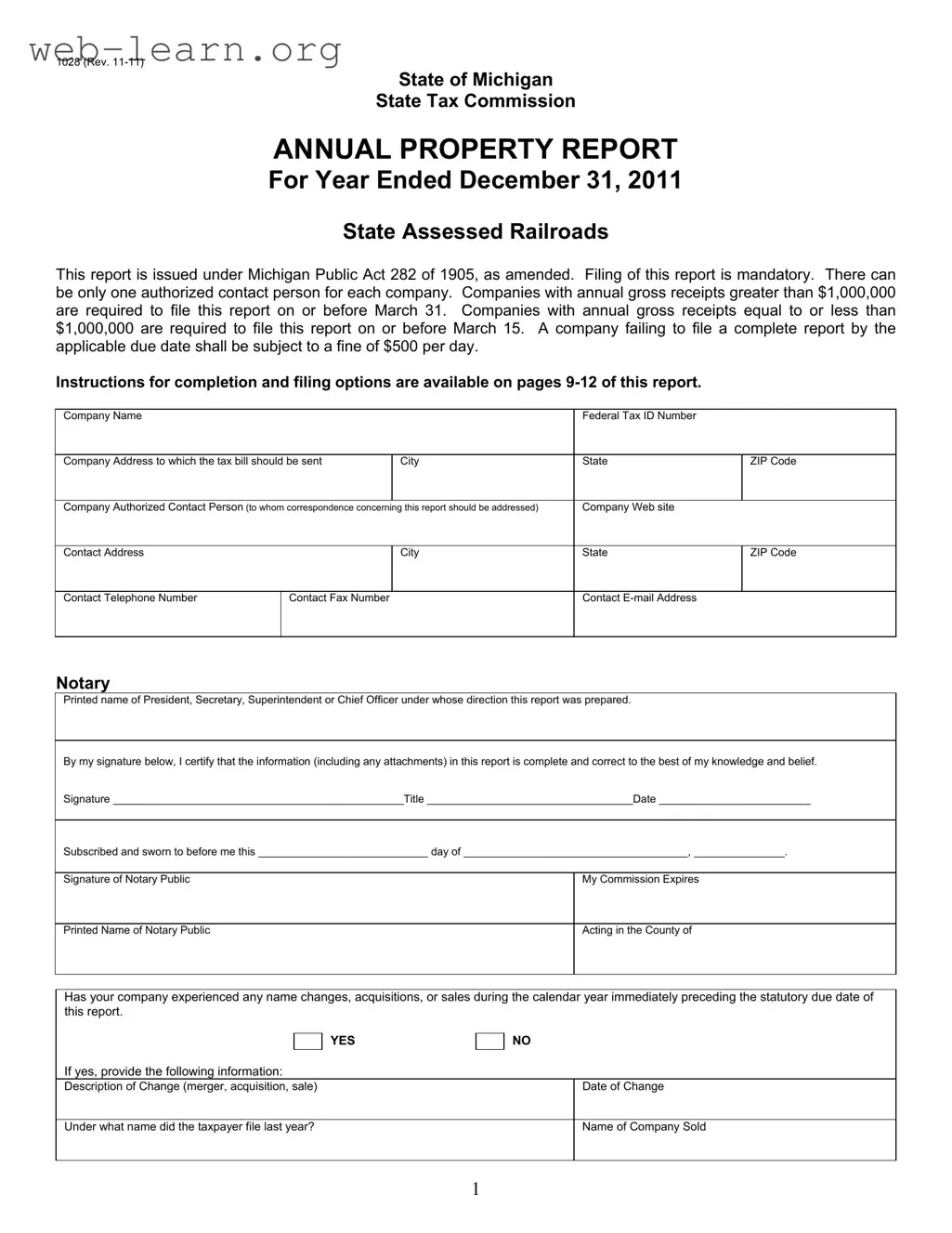
The Michigan 1028 form, known as the Annual Property Report, serves a crucial role in the state's property tax assessment process for railroads. This mandatory report is issued under Michigan Public Act 282 of 1905 and must be filed annually by companies with gross receipts over $1,000,000 by March 31, while those with lower receipts have a deadline of March 15. Failure to submit a complete report by the due date incurs a daily fine of $500. The form requires essential company information, including the name, Federal Tax ID number, and contact details for an authorized representative. It also mandates a certification statement from a company officer, confirming the accuracy of the reported information. The report includes several schedules, such as a statement of the total cost of rolling stock, investment in road property, and various financial metrics related to railway operations. Additionally, companies must disclose any changes in ownership or property status during the previous year. Accurate completion of this form is vital for compliance with state tax regulations and impacts the assessment of property taxes for the railroad industry in Michigan.
1028 (Rev.
State of Michigan
State Tax Commission
ANNUAL PROPERTY REPORT
For Year Ended December 31, 2011
State Assessed Railroads
This report is issued under Michigan Public Act 282 of 1905, as amended. Filing of this report is mandatory. There can be only one authorized contact person for each company. Companies with annual gross receipts greater than $1,000,000 are required to file this report on or before March 31. Companies with annual gross receipts equal to or less than $1,000,000 are required to file this report on or before March 15. A company failing to file a complete report by the applicable due date shall be subject to a fine of $500 per day.
Instructions for completion and filing options are available on pages
Company Name |
|
|
Federal Tax ID Number |
|
|
|
|
|
|
Company Address to which the tax bill should be sent |
City |
State |
ZIP Code |
|
|
|
|
|
|
Company Authorized Contact Person (to whom correspondence concerning this report should be addressed) |
Company Web site |
|
||
|
|
|
|
|
Contact Address |
|
City |
State |
ZIP Code |
|
|
|
|
|
Contact Telephone Number |
Contact Fax Number |
|
Contact |
|
|
|
|
|
|
Notary
Printed name of President, Secretary, Superintendent or Chief Officer under whose direction this report was prepared.
By my signature below, I certify that the information (including any attachments) in this report is complete and correct to the best of my knowledge and belief.
Signature ________________________________________________Title __________________________________Date _________________________
Subscribed and sworn to before me this ____________________________ day of _____________________________________, _______________.
Signature of Notary Public |
My Commission Expires |
Printed Name of Notary Public
Acting in the County of
Has your company experienced any name changes, acquisitions, or sales during the calendar year immediately preceding the statutory due date of this report.
YES
If yes, provide the following information:
NO
Description of Change (merger, acquisition, sale)
Date of Change
Under what name did the taxpayer file last year?
Name of Company Sold
1

Schedule 1, Statement of Total Cost of Rolling Stock Owned or Leased by Year of Acquisition (Includes Locomotives, Freight Cars, Passenger Cars, Highway and Work Equipment)
|
|
|
|
|
|
|
|
TRUE |
|
|
|
|
|
|
|
|
CASH |
|
No. of |
COSTS |
|
|
|
REPORTABLE |
|
VALUE |
YEAR OF |
Units |
REPORTED |
LOSSES |
ADDITIONS |
|
COSTS |
|
(office |
ACQUISITION |
Reported |
PRIOR |
(office use |
(office use |
NO. OF |
CURRENT |
|
use |
|
Prior Year |
YEAR |
only) |
only) |
UNITS |
YEAR |
MULTIPLIER |
only) |
|
|
(office use) |
|
|
|
|
|
|
2011 |
|
|
|
|
|
|
0.8900 |
|
2010 |
|
|
|
|
|
|
0.7600 |
|
2009 |
|
|
|
|
|
|
0.6700 |
|
2008 |
|
|
|
|
|
|
0.6000 |
|
2007 |
|
|
|
|
|
|
0.5400 |
|
2006 |
|
|
|
|
|
|
0.4900 |
|
2005 |
|
|
|
|
|
|
0.4500 |
|
2004 |
|
|
|
|
|
|
0.4200 |
|
2003 |
|
|
|
|
|
|
0.3800 |
|
2002 |
|
|
|
|
|
|
0.3600 |
|
2001 |
|
|
|
|
|
|
0.3300 |
|
2000 |
|
|
|
|
|
|
0.3100 |
|
1999 |
|
|
|
|
|
|
0.2900 |
|
1998 |
|
|
|
|
|
|
0.2800 |
|
Prior |
|
|
|
|
|
|
0.2300 |
|
TOTALS |
|
|
|
|
|
|
|
|
|
|
|
|
|
|
|
|
|
Schedule 1 Total True Cash Value
Schedule 2, Investment in Road Property Used in Transportation Service with Additions and Retirements for the Year (Michigan Only)
Column A |
Column B |
Column C |
Column D |
Column E |
Column F |
Column G |
Column H |
Previous |
Original Cost |
Accumulated |
Expenditures for |
Depreciation |
Plant Balance |
Accumulated |
Net Book Value |
Year |
of |
Depreciation of |
Additions During |
of New Additions |
at Year End |
Depreciation |
= F - G |
Plant Balance |
Retirements |
Retirements at |
the Calendar |
During the |
= A - B + D |
at Year End |
|
from last |
Made During |
Beginning of |
Year |
Calendar Year |
|
|
|
Year’s |
Calendar |
Calendar Year |
|
|
|
|
|
Column F |
Year |
|
|
|
|
|
|
|
|
|
|
|
|
|
|
|
|
|
|
|
|
|
|
If your prior year plant ending balance is not equivalent to the amount in Column A that was carried forward from last year’s report, please indicate the revised amount and provide an explanation.
Revised Column A: _________
Explanation: |
_______ |
_ |
_ |
|
|
|
plus |
Construction in Progress (CIP) |
x .50 = Adjusted CIP |
||
|
_________ |
|
|
(incurred cost to date) |
equals |
||
_________
Schedule 2 True Cash Value
_________
Note: Inventory is exempt from assessment. Inventory does not include personal property under lease or principally intended for lease or rental (operating), rather than sale. Property allowed a cost recovery allowance or depreciation under the Internal Revenue Code is not inventory. Motor vehicles registered with the Michigan Secretary of State on Tax Day (December 31st) are exempt.
2

Schedule 3
A. Interest Paid on Debt From Railway Operations (National)
|
Last Four Year Results as Previously Reported |
|
|
Balance at Close of |
|
|
|
|
||||
|
|
|
Calendar Year |
|
|
Five Year Average |
|
|||||
|
|
|
(office use only) |
|
|
|
|
|
|
|||
|
|
|
|
|
|
(December 31st) |
|
|||||
|
|
|
|
|
|
|
|
|
|
(office use only) |
|
|
|
year - 4 |
|
year - 3 |
year - 2 |
year - 1 |
|
|
|
|
|
|
|
|
|
|
|
|
|
|
|
|
||||
|
|
|
|
|
|
|
|
|
|
|
|
|
B. Total Net Operating from Railway Operations (National)
Last Four Year Results as Previously Reported
(office use only)
year - 4 |
year - 3 |
year - 2 |
year - 1 |
|
|
|
|
Balance at Close of
Calendar Year
(December 31st)
Five Year Average
(office use only)
Schedule 4, Statement of Allocation Factors
Note: "National" includes all North American Activity (U.S., Canada, and Mexico), "Michigan" only includes those items attributable to the State of Michigan.
|
Ar e y ou r op e r a t ion s e n t ir e ly w it h in t h e St a t e of M ich ig a n ? |
|
|
|||||||
|
Yes |
_ _ _ |
|
No |
_ _ _ |
|
|
|
|
|
|
I f Yes, y ou do not need t o pr ov ide t he follow ing in for m at ion . |
|
|
|||||||
|
I f No, please pr ov ide t he follow in g in for m at ion below ( Car Miles an d Rev en u es) . |
|
||||||||
|
Car Miles |
|
|
|
|
National |
Michigan |
|||
|
1. |
Freight Car Miles (Loaded and Empty) |
|
|
|
|||||
|
2. |
All Other Car Miles |
|
|
|
|
|
|
||
|
3. |
Total Car Miles (1+2) |
|
|
|
|
|
|
||
|
4. |
Percentage Attributable to Michigan |
|
|
|
|||||
|
Revenues (please enter full dollar amounts) |
National |
Michigan |
|||||||
|
1. |
Freight Revenue |
|
|
|
|
|
|
||
|
2. |
All Other Revenue from Operation |
|
|
|
|||||
|
3. |
Total Operating Revenue (1+2) |
|
|
|
|||||
|
4. |
Percentage Attributable to Michigan |
|
|
|
|||||
Schedule 5, Sales and Transfers of Car Marks
Did any sales or transfers of car marks occur during the calendar year immediately preceding the statutory due date of this report?
Yes |
____ |
No |
____ |
If Yes, describe any sales or transfers that occurred.
__________________________________________________________________________________
__________________________________________________________________________________
__________________________________________________________________________________
__________________________________________________________________________________
3

Schedule 6, Statement of Railcar Mileage Traveled Over Track Operated by your Company (itemize by Car Mark)
Car Mark
Mileage
Car Mark
Mileage
Car Mark
Mileage
Schedule 7, Real Property
Have there been any changes (additions or losses) to your Real Property in the calendar year immediately preceding the statutory filing date of this report?
Yes ____
No ____
If yes, please describe losses and/or additions in box below:
4
NOTE
All summary calculations will be completed AFTER the Assessment and Certification Division has reviewed and processed the information contained in this Annual Property Report. Once all processing is complete, you may view the summary calculations (worksheets) by requesting a personal identification number (PIN) and accessing your company's secure, online account. For additional information on how to request a PIN to access your account, please refer to the "How to file this report" section of the instructions.
Tentative values will be posted on or about May 15, and final values will be posted on or about June 15. Each state assessed company will receive a final tax bill by mail and any taxes due are payable on July 1.
5
2012
Application for Tax Credit for Maintenance and Improvement of Rights of Way
Section 13 of PA 282 of 1905, as amended allows credit for eligible expenses incurred in the State of Michigan by railroad companies for maintenance or improvement of rights of way, including those items, except depreciation, in the official
Eligibility Requirements
In order to be eligible for the tax credit for maintenance and improvement of rights of way under MCL 207.13(2), the railroad companies must fulfill the statutory requirements detailed in Section 13 of PA 282 of 1905 (MCL 207.13(3)). In addition to providing the requested summary information on this application for credit, each company must complete and file [3 copies of] the report described in Section 13 with the State Tax Commission that includes, but is not limited to, detailed information of the nature and location of expenses. A summary of the eligibility and reporting requirements are listed in the attached instructions on pages
Eligible and
Examples of Eligible and
Maximum Credit Available
The maintenance of way expense credits are not refundable or deferrable. Expenses in excess of a company's property tax liability are not eligible for credit against prior or subsequent years' liability.
***NOTE*** Filing of this credit application does not relieve the company of the statutory requirement of filing [3 copies] of the detailed expense report described in Section 13(3). You are still required to provide that to the State Tax Commission at the following address:
|
|
Mailing Address: |
For Overnight Package Delivery: |
Michigan Department of Treasury |
Michigan Department of Treasury |
Michigan State Tax Commission |
Michigan State Tax Commission |
P O Box 30471 |
Austin Building |
Lansing, MI |
430 W. Allegan Street |
|
Lansing, MI 48922 |
|
|
Company Name
Eligibilty
Has your company incurred eligible expenses, and submitted three (3) copies of the required expense report as described above?
Yes ___
No ___
If Yes, please enter total eligible expenses below.
If No, you are NOT ELIGIBLE for credit. DO NOT SUBMIT EXPENSES.
Total Eligible Expenses for Maintenance and Improvement of Rights of Way in Michigan which you have reported in the above described report.
$
___________________________
6
2012
Application for Tax Credit for Maintenance and Improvement
of Qualified Rolling Stock in Michigan
Section 13a of Public Act 282 of 1905, as amended, allows a credit for eligible expenses incurred in the State of Michigan by railroad and car companies for maintenance or improvement of eligible companies' qualified rolling stock.
Eligible Company is defined as:
Railroad companies, union station and depot companies, sleeping car companies, express companies, car loaning companies, stock car companies, refrigerator car companies, fast freight line companies, and all other companies owning, leasing, running, or operating any freight, stock, refrigerator, or any other cars not the exclusive property of a railroad company paying taxes upon its rolling stock under this act, over or upon the line or lines of any railroad in this state.
Eligible Expenses are expenses for repairs and maintenance that satisfy all of the following criteria:
1.Eligible expenses must have been incurred during the calendar year immediately preceding the statutory due date of this report.
2.Eligible expenses must have been incurred in the State of Michigan.
3.Eligible expenses must be made for the maintenance or improvement of rolling stock which are subject to taxation by the State under PA 282 of 1905 as amended.
Examples of Eligible and
Maximum Credit Available:
This credit is not refundable or deferrable. Expenses in excess of a company's property tax liability are not eligible for credit against prior or subsequent years' liability.
Company Name
Eligibility
Are you an "eligible company" which has incurred expenses that satisfy ALL of the requirements listed above?
Yes ___
No ___
If Yes, please enter total eligible expenses below.
If No, you are NOT ELIGIBLE for credit. DO NOT SUBMIT EXPENSES.
Total Eligible Expenses for Maintenance and Improvement of Qualified Rolling Stock in Michigan (include labor, material, overhead, and payments to others for work done).
$
7
Instructions for Completion of the Annual Report by State Assessed Railroads
Who must file this report? (MCL 207.6)
All railroad companies, union station and depot companies, and switching and terminal companies operating in the State of Michigan pursuant to Section 6 of PA 282 of 1905.
When is this report due? (MCL 207.6)
If your annual gross receipts exceed $1,000,000, this report is due by March 31st.
If your annual gross receipts do not exceed $1,000,000, this report is due by March 15th.
How to submit this report:
This report may be submitted electronically or mailed in paper format. If you wish to submit this form electronically, please visit the following web site at www.michigan.gov/stateassessedproperty or you may call (517)
If submitting this form by mail, please complete and sign the declaration on page one and send the entire completed form to:
Mailing Address: |
For Overnight Package Delivery: |
Michigan Department of Treasury |
Michigan Department of Treasury |
Michigan State Tax Commission |
Michigan State Tax Commission |
P O Box 30471 |
Austin Building |
Lansing, MI |
430 W. Allegan Street |
|
Lansing, MI 48922 |
What property is subject to taxation? (MCL 207.5)
The term "property having a situs in this state", includes all property, real and personal, of the persons, corporations, companies,
Schedule 1
List all rolling stock which is owned or leased by you. List the number of units reported as well as reportable current year costs. Property must be listed at its full original cost new, in the year that it was new. If the original/new acquisition cost of a railcar that was initially purchased by another company can be obtained, that information must be reported. If the original/new acquisition cost of a railcar that was initially purchased by another company cannot be obtained, then the original/new acquisition cost shall be equal to the subsequent price paid by the reporting company upon acquiring the used railcar. All betterments, including capital improvements, mandated betterments, capital upgrades, safety features, and mandated repairs should be reported in the year the expenditure is booked as a fixed asset.
The "Costs Reported Prior Year", "Losses", "Additions", and "True Cash Value" columns are for Assessment and Certification Division (ACD) use only. To view the values and calculations entered by the Assessment and Certification Division, please fill out form 4435 to obtain a Personal Identification Number (PIN) for access to the online reporting form available at www.michigan.gov/taxes (please see "How to submit this report" section above for specific website location). Tentative Values will be electronically posted on or about May 15th, and Final Values will be electronically posted on or about June 15th.
Schedule 2
This is to be submitted by all railroads and calls for summary data relating to investment for the company(s) properties in Michigan. Investment in account 732 (improvements on leased property) shall also be reported on Schedule 2. The "Previous Year Plant Balance" column is for Assessment and Certification Division office use only. List any retirements that have occurred during the calendar year immediately preceding the statutory due date of this report. List the accumulated depreciation for those retirements in the column designated.
8
List any expenditures for additions that occurred during the calendar year immediately preceding the statutory due date of this report. Exclude
In the Accumulated Depreciation column, list the accumulated depreciation for assets in place at year end.
List the balance of costs at calendar year end (December 31st). The "True Cash Value" column is for Assessment and Certification division office use only.
List the current year construction in progress. Report all costs that have been incurred including overheads, installation costs incurred, sales tax and freight. Reporting of costs should be separated by project. Property which is placed in service on or before December 31st is considered placed in service that year and should be entirely reported on the line which represents the year that it was considered placed in service. Similarly, the cost of all assets must be reported as acquired in the year that they were placed in service, rather than the year of purchase, if those years differ. The adjusted construction in progress and the Schedule 2 True Cash Value will be calculated by the Assessment and Certification Division.
Schedule 3
A.Enter the Total Interest Paid to service debt to finance railway operations. Interest must be for short term and long term debt. The columns provide for the amounts from the last four years. The
B.Enter the Total Net Operating Income from Railway Operations. The columns provide for the amounts reported from the last four years.
Schedule 4
If your company's property (whether owned or leased) is used entirely within the State of Michigan, you are not required to provide allocation information. If your company's property (whether owned or leased) is used partly within and partly without the State of Michigan, provide the allocation information based on the system as a whole, and the portion attributable to Michigan. For further details on reporting specifications, consult the Uniform System of Accounts for Railroad Companies. (49 CFR 1201 et.seq.)
Schedule 5
Please check the appropriate box indicating whether any sales or transfers of car marks have occurred in the calendar year immediately preceding the statutory due date of this report. If you select yes, please describe any sales and transfers of car marks that occurred.
Schedule 6
Enter the total annual mileage traveled during the calendar year immediately preceding the statutory due date of this report, over track that you operate (whether owned or leased). Please provide the mileage by individual car mark.
Schedule 7
Indicate whether there have been any changes to your real property as compared to the prior year’s information and provide information about any changes in the reporting box.
Losses to Real Property
Losses mean the decrease in value which has not been reflected in the assessment unit’s immediately preceding year’s assessment roll. Losses include removal or destruction of real property, newly exempt property, or newly contaminated property.
Additions to Real Property
Additions mean an increase in value which has not been reflected on the assessment unit’s immediately preceding year’s assessment roll. Additions include omitted property, new or replacement construction, and increases in value due to new public services and/or contamination remediation.
9
Instructions for Tax Credit for Maintenance and Improvement of Right of Way
Sec. 13 of PA 282 of 1905, as amended, (more specifically MCL 207.13(2) and MCL 207.13a(5)(b)(ii)), allows credit against the tax imposed, for eligible expenses incurred in the State of Michigan by railroad companies for maintenance or improvement of rights of way, including those items, except depreciation, in the official
Additional Statutory Requirements for Eligibility (MCL 207.13(2) - (5))
In order to be eligible for the tax credit for maintenance and improvement of rights of way, the railroad companies must complete and file [3 COPIES OF] an annual report with the State Tax Commission that includes the following:
1.Detailed data of right of way work conducted in this state during the past calendar year separated by costs of labor and materials on each project and itemized in the following categories:
(a)Miles of track laid
(b)Tons of new ballast installed
(c)Number of ties installed
(d)Miles of track surfaced
(e)Signals installed
(f)Under drainage work done
2.The number of notices of violation from the railway inspectors by railroad section,
3.A detailed account of the location and nature of the work defined by railroad section or mile posts surrounding the work area plus the county, city, or township in which the work was performed,
4. Demonstration that the highest priority of expenditures for the maintenance and improvement of rights of way has been given to rail lines that handle hazardous materials, especially those that are located in urban or residential areas, and detailed data on the tonnages of hazardous materials handled in relation to tonnages of other traffic handled over the rail line for which a tax credit is being applied.
In addition, the company must grant to another railroad company, upon application by the latter, trackage rights over its line for trains, providing that the train operations do not interfere with the movement of Michigan freight using the same trackage, if operations can be accomplished safely in the opinion of the grantor and if trackage arrangements and train operations are approved by the interstate commerce commission.
***NOTE*** Filing of the credit application does not relieve you of the requirement of filing 3 copies of the above defined report with the State Tax Commission. You are still required to provide the above information in a separate report.
What expenses are eligible for credit against the tax levied? MCL 207.13(2)
Eligible Expenses:
1.Eligible expenses must have been incurred during the calendar year immediately preceding the statutory due date of this report.
2.Eligible expenses must have been incurred in the State of Michigan.
3.Examples of Eligible Capital Expenses for Road and Equipment include, but are not limited to items from the following categories:
(1) |
Engineering exp. directly related to R & E Property |
(23) |
Wharves and Docks |
(3) |
Other |
(24) |
Coal and Ore Wharves |
(4) |
Grading |
(25) |
TOFC/COFC Terminals |
(5) |
Tunnels and Subways |
(26) |
Communication Systems |
(6) |
Bridges, trestles, and culverts |
(27) |
Signals and Interlockers |
(7) |
Elevated Structures |
(37) |
Roadway Machines |
(8, 9, 10, 11) Ties, Rails and other Track Material |
(38) |
Roadway small tools |
|
(12) Track Laying and Surfacing |
(39) |
Public Improvements - Construction |
|
(13) Fences, Snowsheds, and Signs |
(43) |
Other Expenses - Road |
|
(17) Roadway Buildings (portion housing MOW equipment and engineering)
10
| Fact Name | Description |
|---|---|
| Governing Law | The Michigan 1028 form is issued under Michigan Public Act 282 of 1905, as amended. |
| Filing Requirement | Filing this report is mandatory for companies with annual gross receipts over $1,000,000 by March 31, and for those with receipts of $1,000,000 or less by March 15. |
| Late Filing Penalty | A fine of $500 per day applies for companies that fail to file a complete report by the due date. |
| Authorized Contact | Each company must designate one authorized contact person for correspondence related to this report. |
Completing the Michigan 1028 form is essential for companies operating within the state. This form needs to be filled out accurately and submitted by the designated deadlines to avoid penalties. Below are the steps to fill out the form correctly.
After completing the form, it must be submitted by the appropriate deadline. Companies with annual gross receipts exceeding $1,000,000 must file by March 31, while those below this threshold must file by March 15. Failure to submit on time may result in daily fines. Keep an eye out for further instructions and updates regarding your submission and any potential tax liabilities.
What is the Michigan 1028 form?
The Michigan 1028 form is the Annual Property Report required for state-assessed railroads. It is issued under Michigan Public Act 282 of 1905 and must be completed and filed by companies operating within the state. The report collects essential information regarding a company's property, including rolling stock and real property, for taxation purposes.
Who is required to file the Michigan 1028 form?
All companies assessed by the state that operate railroads must file the Michigan 1028 form. Specifically, companies with annual gross receipts greater than $1,000,000 must submit the report by March 31, while those with receipts equal to or less than $1,000,000 must file by March 15.
What happens if a company fails to file the report on time?
If a company does not file a complete report by the applicable due date, it faces a penalty of $500 for each day the report is late. Timely submission is crucial to avoid these fines.
What information is required in the Michigan 1028 form?
The form requires various details, including:
Are there exemptions to the property reported on the form?
Yes, certain items are exempt from assessment. Inventory is exempt, as are motor vehicles registered with the Michigan Secretary of State on Tax Day (December 31). Additionally, computer software purchased separately may also be exempt.
How can companies access their summary calculations after filing?
Once the Assessment and Certification Division has reviewed the submitted information, companies can request a personal identification number (PIN) to access their secure online account. This allows them to view summary calculations of their report.
When are tentative and final values posted?
Tentative values are typically posted around May 15, while final values are made available by June 15. Companies will receive a final tax bill by mail, and any taxes due must be paid by July 1.
What should companies do if they experience changes in their operations?
Companies must report any name changes, acquisitions, or sales during the calendar year preceding the filing date. Detailed descriptions of these changes, including dates and previous names, must be included in the form.
Who must certify the information provided in the report?
The report must be certified by the President, Secretary, Superintendent, or Chief Officer of the company. Their signature verifies that the information submitted is complete and accurate to the best of their knowledge.
Filling out the Michigan 1028 form can be a daunting task, and many individuals make common mistakes that can lead to complications. One frequent error is failing to provide the correct Federal Tax ID Number. This number is crucial for identifying the company and ensuring that the report is processed accurately. Without it, the filing may be deemed incomplete, leading to potential fines.
Another mistake involves misreporting the company's gross receipts. Companies with gross receipts greater than $1,000,000 must file by March 31, while those with lesser amounts have a deadline of March 15. Misunderstanding these thresholds can result in late filings, which incur fines of $500 per day. It is essential to double-check the figures to avoid unnecessary penalties.
Many filers overlook the requirement to name a single authorized contact person for the company. This person should be designated clearly on the form. If multiple contacts are listed, it can create confusion and delay the processing of the report.
In addition, failing to address any name changes, acquisitions, or sales that occurred during the previous calendar year can lead to significant issues. If any changes have taken place, they must be clearly documented on the form. Ignoring this requirement can result in discrepancies that complicate the assessment process.
Another common pitfall is neglecting to sign the form or provide the title and date next to the signature. This step is vital, as the certification of accuracy is a legal requirement. Without a proper signature, the report may be considered invalid.
Some individuals mistakenly skip the notary section, which is essential for validating the report. This oversight can render the entire submission ineffective. It is important to ensure that a notary public is present to witness the signing and to provide their details as required.
Additionally, errors in reporting the true cash value of rolling stock and road property can lead to inaccurate assessments. Each entry must be carefully calculated and verified against previous reports to ensure consistency and accuracy.
Another frequent error is failing to provide adequate explanations for any discrepancies or revisions made in the report. If the prior year’s ending balance differs from the current report, a clear explanation must accompany the revised figures. This transparency helps the assessment team understand the changes better.
Lastly, filers often overlook the specifics regarding inventory exemptions. Understanding what qualifies as inventory and what does not is crucial for accurate reporting. Misclassifying items can lead to incorrect assessments and potential fines.
By being aware of these common mistakes, individuals can approach the Michigan 1028 form with greater confidence and accuracy, ensuring compliance and avoiding unnecessary complications.
The Michigan 1028 form, known as the Annual Property Report, is a critical document for companies operating railroads in Michigan. It provides essential information regarding the company's property, including its rolling stock and real property. Along with this form, several other documents may be required to ensure compliance with state regulations. Below is a list of these documents, each serving a unique purpose in the reporting process.
These documents, when used in conjunction with the Michigan 1028 form, provide a comprehensive picture of a company's property and financial standing. Proper completion and timely submission of these forms are vital for compliance and to avoid potential penalties. Understanding each document's role can help streamline the reporting process and ensure accuracy in the information provided to the state.
When filling out the Michigan 1028 form, it is important to follow specific guidelines to ensure accuracy and compliance. Below is a list of dos and don'ts that can help streamline the process.
Understanding the Michigan 1028 form is crucial for companies operating in the state. However, several misconceptions can lead to confusion. Here are six common misconceptions:
Being aware of these misconceptions can help ensure compliance and avoid unnecessary penalties. Companies should take the time to understand their obligations under the Michigan 1028 form.
Filling out the Michigan 1028 form is an important task for companies operating in the state. Here are some key takeaways to keep in mind:
Understanding these points can help ensure a smooth filing process and compliance with state regulations.