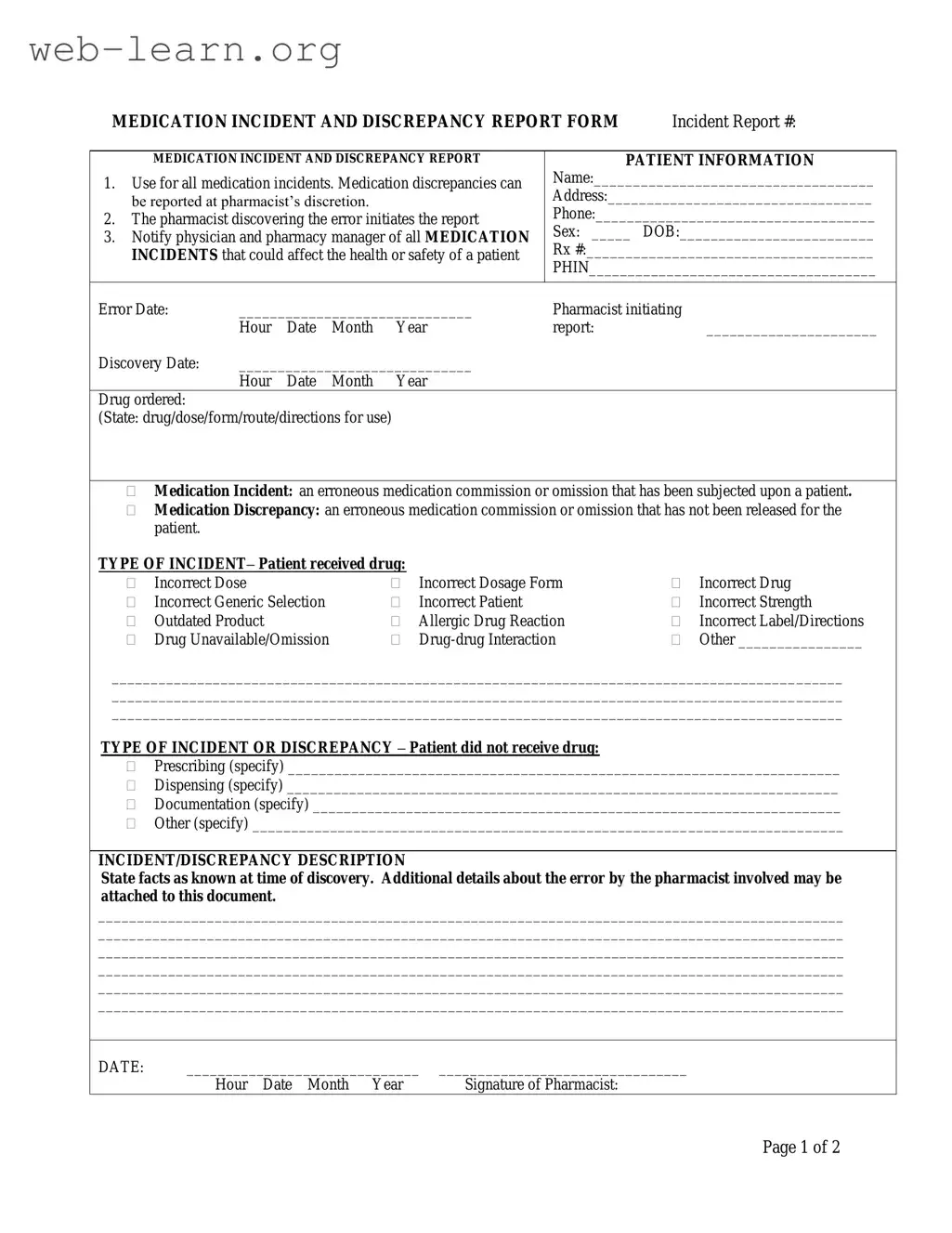
Medication errors can have serious consequences for patient safety and health. To address these incidents effectively, the Medication Incident and Discrepancy Report Form serves as a crucial tool for pharmacists. This form is designed to document all medication incidents, whether they involve an actual error affecting a patient or a discrepancy that has not yet reached the patient. The process begins with the pharmacist who discovers the error, who is responsible for initiating the report. Key sections of the form include patient information, details about the medication involved, and the type of incident or discrepancy. For example, it allows the pharmacist to specify if the patient received an incorrect dose, an outdated product, or if there was a documentation issue. Additionally, the form requires the pharmacist to identify contributing factors, such as improper patient identification or misinterpreted drug orders. Notification of both the patient and the physician is also a critical part of the process, ensuring that all parties are informed of the incident. Lastly, the form includes a section for follow-up actions, which can help prevent future errors by addressing underlying issues. By using this form, pharmacists can enhance communication, promote safety, and contribute to a culture of accountability in medication management.

MEDICATION INCIDENT AND DISCREPANCY REPORT FORM |
Incident Report #: |
MEDICATION INCIDENT AND DISCREPANCY REPORT
1.Use for all medication incidents. Medication discrepancies can be reported at pharmacist’s discretion.
2.The pharmacist discovering the error initiates the report
3.Notify physician and pharmacy manager of all MEDICATION INCIDENTS that could affect the health or safety of a patient
PATIENT INFORMATION
Name:____________________________________
Address:__________________________________
Phone:____________________________________
Sex: _____ DOB:_________________________
Rx #:_____________________________________
PHIN_____________________________________
Error Date: |
______________________________ |
Pharmacist initiating |
|
|||
|
Hour |
Date |
Month |
Year |
report: |
______________________ |
Discovery Date: |
______________________________ |
|
|
|||
|
Hour |
Date |
Month |
Year |
|
|
Drug ordered: |
|
|
|
|
|
|
(State: drug/dose/form/route/directions for use) |
|
|
|
|||
Medication Incident: an erroneous medication commission or omission that has been subjected upon a patient.
Medication Discrepancy: an erroneous medication commission or omission that has not been released for the patient.
TYPE OF INCIDENT– Patient received drug: |
|
|
|
||
|
Incorrect Dose |
|
Incorrect Dosage Form |
|
Incorrect Drug |
|
Incorrect Generic Selection |
|
Incorrect Patient |
|
Incorrect Strength |
|
Outdated Product |
|
Allergic Drug Reaction |
|
Incorrect Label/Directions |
|
Drug Unavailable/Omission |
|
|
Other ________________ |
|
______________________________________________________________________________________________
______________________________________________________________________________________________
______________________________________________________________________________________________
TYPE OF INCIDENT OR DISCREPANCY – Patient did not receive drug:
Prescribing (specify) _______________________________________________________________________
Dispensing (specify) _______________________________________________________________________
Documentation (specify) ____________________________________________________________________
Other (specify) ____________________________________________________________________________
INCIDENT/DISCREPANCY DESCRIPTION
State facts as known at time of discovery. Additional details about the error by the pharmacist involved may be attached to this document.
________________________________________________________________________________________________
________________________________________________________________________________________________
________________________________________________________________________________________________
________________________________________________________________________________________________
________________________________________________________________________________________________
________________________________________________________________________________________________
DATE: |
______________________________ |
________________________________ |
|
Hour Date Month Year |
Signature of Pharmacist: |
Page 1 of 2

CONTRIBUTING FACTORS
(To be completed by pharmacist responsible)
|
Improper patient identification |
Misread/misinterpreted drug order (include verbal orders) |
|
|
Incorrect transcription |
|
Drug unavailable |
Lack of patient counselling |
|
Other |
|
|
DATE: |
______________________________ |
__________________ |
|
|
||||
|
|
Hour Date Month Year |
Signature |
|
|
|
|||
|
NOTIFICATION – Complete the following information according to Standards of Practice. |
||||||||
1. |
Patient notified: |
|
|
|
|
|
|
|
|
|
|
|
___________________________ |
|
|||||
|
|
|
Hour |
Date |
Month |
Year |
|||
2. |
Physician notified: ____ |
______________________________ |
|
||||||
|
|
Yes/No |
Hour |
Date |
Month |
Year |
|||
|
|
|
|
|
|
|
|
|
|
|
SEVERITY |
|
|
|
|
|
|
|
|
|
|
None |
|
No change in patient’s condition: no medical intervention |
|||||
|
|
Minor |
|
|
|
required |
|
|
|
|
|
Major |
|
Produces a temporary systemic or localized response: does |
|||||
|
|
|
|
|
|
not cause ongoing complications |
|||
|
|
|
|
Requires immediate medical intervention |
|||||
|
OUTCOME OF INVESTIGATION |
|
|
|
|
|
|
|
|
|
|
|
|
|
|
|
|
|
|
|
|
|
|
|
|
|
|
||
|
Problem Identification |
|
|
|
Action |
|
|
|
|
|
|
Lack of knowledge |
|
|
Education provided |
||||
|
|
Performance problem |
|
|
Policy/procedure changed |
||||
|
|
Administration problem |
|
|
System changed |
|
|
||
|
|
Other |
|
|
Individual awareness |
||||
|
|
|
|
|
Group awareness |
||||
|
|
|
|
|
Other |
|
|
|
|
|
|
|
|
|
|||||
|
RESOLUTION OF PROBLEM THAT RESULTED IN THE ERROR BEING MADE: |
||||||||
|
|
|
|
|
|
|
|
||
|
Signature: |
Date: |
Signature: |
Date: |
|||||
|
(Pharmacist filling out the form) |
|
|
|
(Pharmacy Manager) |
||||
PHARMACY USE ONLY
Page 2 of 2
| Fact Name | Description |
|---|---|
| Purpose | This form is used to report all medication incidents and discrepancies. Pharmacists can report discrepancies at their discretion. |
| Initiation | The pharmacist who discovers the error is responsible for initiating the report. |
| Notification Requirement | It is mandatory to notify both the physician and pharmacy manager about any medication incidents that could affect patient health or safety. |
| Patient Information | Essential patient details, including name, address, phone number, sex, date of birth, and prescription number, must be included. |
| Incident Types | The form categorizes incidents into various types, such as incorrect dose, incorrect drug, and allergic reactions. |
| Discrepancy Types | Discrepancies can include prescribing, dispensing, or documentation errors, with space for specifics. |
| Contributing Factors | Pharmacists must identify contributing factors, such as improper patient identification or misinterpretation of drug orders. |
| Severity Assessment | The form includes a section to assess the severity of the incident, ranging from no change in patient condition to requiring immediate medical intervention. |
| Follow-Up Actions | After the incident, follow-up actions are documented, including education provided or changes to policies and procedures. |
Completing the Medication Error form is a crucial step in addressing medication incidents and discrepancies. This form ensures that all relevant details are documented accurately, allowing for a thorough investigation and appropriate follow-up. After filling out the form, it will be reviewed by the pharmacy manager and used to implement necessary changes to prevent future errors.
The Medication Error form is designed to document any medication incidents or discrepancies that occur within a pharmacy setting. This includes errors where a patient receives the wrong medication or dose, as well as situations where a medication was not provided to the patient at all. The form serves as a critical tool for ensuring patient safety, facilitating communication among healthcare professionals, and identifying areas for improvement in medication management.
The pharmacist who discovers the error is responsible for initiating the Medication Error form. It is crucial that this report is filled out as soon as possible to ensure accurate documentation of the incident. Timely reporting allows for immediate notification of the physician and pharmacy manager, which is essential for addressing any potential health or safety risks to the patient involved.
The form is intended for all medication incidents, which can include:
Each incident type must be clearly indicated on the form, allowing for comprehensive tracking and analysis of medication errors.
Once the Medication Error form is completed, it triggers a series of follow-up actions. The pharmacist responsible for the error will identify contributing factors, such as improper patient identification or misinterpretation of drug orders. The pharmacist must also notify the patient and physician, documenting these communications on the form. Following the investigation, appropriate actions are taken to resolve the issue, which may include education for staff, changes in policies, or system improvements to prevent future errors.
When filling out the Medication Error form, individuals often make critical mistakes that can lead to confusion and delays in addressing the issue. One common error is failing to provide complete patient information. This includes omitting essential details such as the patient's name, address, or phone number. Incomplete information can hinder effective communication and follow-up.
Another frequent mistake is not specifying the type of incident accurately. When selecting the type of medication incident or discrepancy, it's crucial to choose the correct options. Misclassifying the incident can result in inappropriate responses and may affect patient safety.
People also tend to overlook the incident/discrepancy description. A vague or incomplete description can lead to misunderstandings. Providing clear and detailed facts about what happened is essential for a thorough investigation and resolution.
Additionally, the date and time fields are sometimes filled out incorrectly. Accurate timestamps are vital for tracking the timeline of events. Errors in this section can complicate the investigation process and lead to further errors.
Another mistake is failing to notify the physician and pharmacy manager properly. It's important to document whether these parties have been informed, as this can impact the patient's care and the overall response to the incident.
Some individuals neglect to identify contributing factors accurately. This section is crucial for understanding why the error occurred and how to prevent it in the future. Without this information, it becomes challenging to implement effective changes.
Moreover, individuals often forget to sign and date the form. This oversight can lead to questions about accountability and responsibility. Signatures are essential for validating the report and ensuring that it is taken seriously.
Finally, failing to follow up on the resolution of the problem can leave gaps in the process. It's important to document any actions taken to resolve the issue. This not only helps in preventing future errors but also ensures that all involved parties are aware of the steps taken.
When a medication error occurs, several other forms and documents may be utilized to ensure proper reporting, investigation, and resolution of the incident. These documents help maintain patient safety and improve pharmacy practices. Below is a list of commonly used forms that accompany the Medication Error form.
Utilizing these forms and documents in conjunction with the Medication Error form creates a comprehensive approach to managing medication incidents. Each document plays a specific role in enhancing patient safety and fostering an environment of continuous improvement within healthcare settings.
When filling out the Medication Error form, it is important to follow certain guidelines to ensure clarity and accuracy. Here is a list of things to do and avoid:
By adhering to these guidelines, the form will serve its purpose effectively and contribute to patient safety and care improvement.
Misconception 1: The Medication Error form is only for serious incidents.
This is incorrect. The form should be used for all medication incidents, regardless of their perceived severity. Reporting every incident helps improve safety protocols.
Misconception 2: Only pharmacists can initiate the report.
While it is true that the pharmacist discovering the error initiates the report, anyone involved in the incident can provide information. Collaboration is key to accurate reporting.
Misconception 3: Patients do not need to be notified if an error occurs.
This is a dangerous assumption. Patients must be notified of any medication incidents that could affect their health or safety. Transparency is essential for trust and safety.
Misconception 4: The form is only for medication discrepancies, not for incidents.
In reality, the form addresses both medication incidents and discrepancies. Understanding the difference helps ensure proper documentation and follow-up actions.
Use the form for all medication incidents. It is essential to report any discrepancies at the pharmacist’s discretion.
The pharmacist who discovers the error must initiate the report. This ensures accountability and accuracy in reporting.
Notify both the physician and the pharmacy manager about any medication incidents that could impact patient health or safety.
Complete all patient information fields accurately. This includes the patient's name, address, phone number, sex, date of birth, and prescription number.
Clearly indicate the error date and the date the pharmacist initiated the report. This helps track the timeline of the incident.
Specify the type of incident that occurred. Options include incorrect dose, incorrect drug, allergic reaction, and more.
Provide a detailed description of the incident or discrepancy. Include all known facts at the time of discovery.
Identify contributing factors that may have led to the error. This can include improper patient identification or misinterpretation of drug orders.
Complete the notification section, confirming whether the patient and physician were informed about the incident.