Homepage Blank Medication Count Sheet Form
Outline

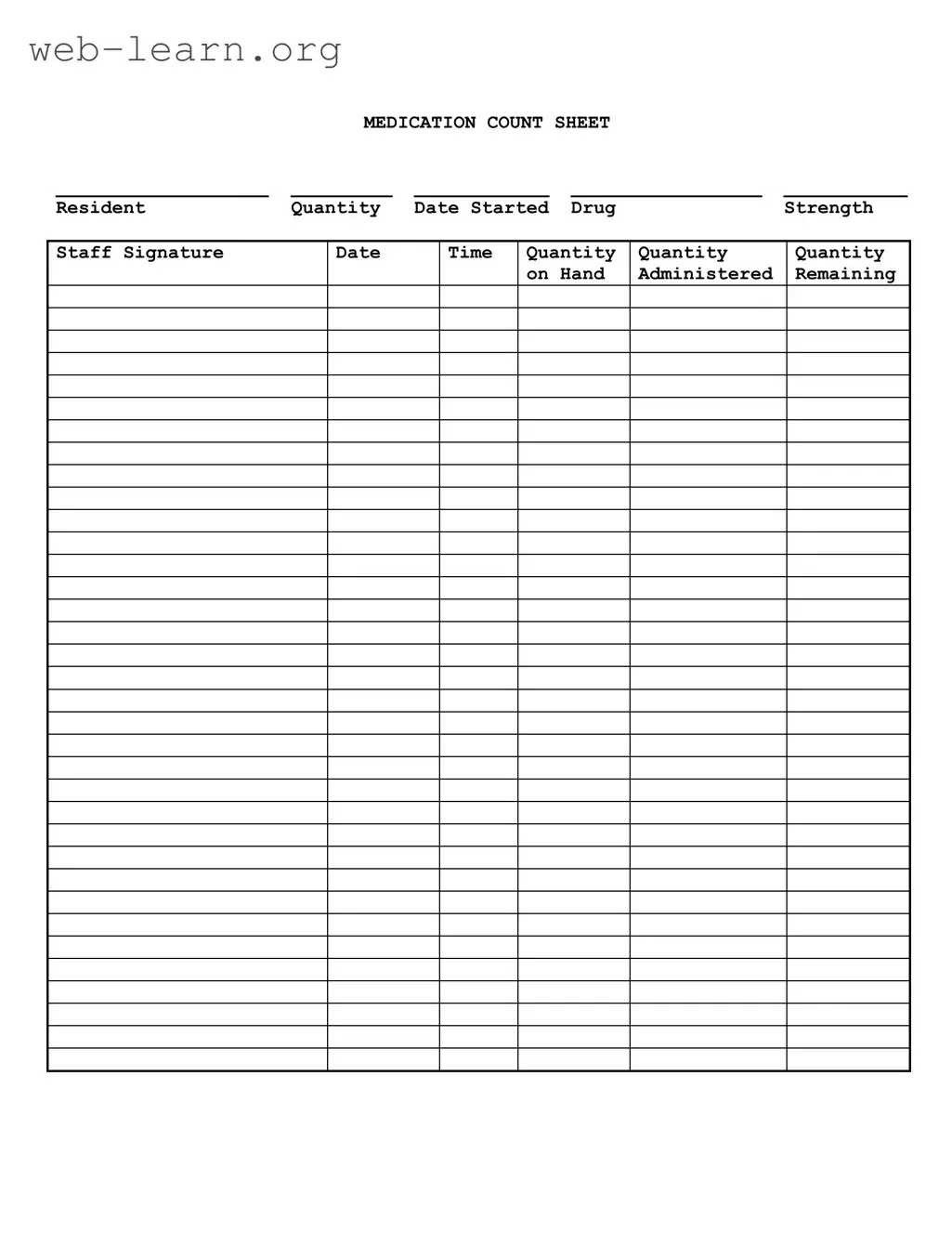
In the realm of healthcare, maintaining accurate records is essential for ensuring patient safety and effective medication management. One critical tool in this process is the Medication Count Sheet form. This form serves as a comprehensive log, meticulously tracking the administration of medications to residents. It includes vital information such as the resident's name, the quantity of medication prescribed, and the date the medication regimen was initiated. Each entry also captures the drug's strength, providing clarity on the dosage being administered. Staff members play a crucial role in this documentation, as their signatures confirm the accuracy of the records. The form includes sections for recording the date and time of administration, allowing for precise monitoring of medication schedules. Additionally, it facilitates a count of the quantities on hand, those administered, and what remains, ensuring that discrepancies can be swiftly identified and addressed. By utilizing the Medication Count Sheet, healthcare providers can enhance their accountability and uphold the highest standards of care for their patients.

Sample - Medication Count Sheet Form


MEDICATION COUNT SHEET


___________________

_________

____________

_________________

___________

Resident

Quantity

Date Started

Drug

Strength

Staff Signature

Date

Time

Quantity

Quantity

Quantity

on Hand

Administered

Remaining


Form Information

Fact Name Description
Purpose The Medication Count Sheet is used to track the administration and inventory of medications for residents.
Required Information Essential details include resident name, drug strength, quantity administered, and remaining quantity on hand.
Staff Accountability Staff members must sign the sheet to confirm medication administration, ensuring accountability and traceability.
Frequency of Use This form should be updated each time medication is administered or a new supply is received.
State-Specific Regulations In California, the governing law is Title 22, Section 87505, which mandates accurate medication records.
Importance of Accuracy Accurate record-keeping is crucial for patient safety and compliance with healthcare regulations.

Detailed Guide for Filling Out Medication Count Sheet

After completing the Medication Count Sheet form, you will have a clear record of the medication inventory for the resident. This ensures accountability and helps maintain accurate medication management. Follow the steps below to fill out the form correctly.

  1. Start by entering the Resident's Name in the first blank space.
  2. Fill in the Date Started for the medication in the next blank space.
  3. Write the Drug Name in the corresponding section.
  4. Indicate the Strength of the medication in the next blank.
  5. In the Quantity section, enter the total amount of medication available.
  6. Record the Staff Signature of the person completing the form.
  7. Fill in the Date of the count in the appropriate space.
  8. Enter the Time when the count was taken.
  9. For each administration, fill in the Quantity Administered in the designated spaces.
  10. After administering the medication, calculate and write the Remaining Quantity on hand.

Obtain Answers on Medication Count Sheet

  1. What is the purpose of the Medication Count Sheet?

    The Medication Count Sheet is designed to track the administration and inventory of medications for residents. It helps ensure that medications are given correctly and that there is an accurate record of what is on hand.

  2. What information is included on the Medication Count Sheet?

    The form includes several key pieces of information:

    • Resident's name
    • Quantity of medication
    • Date the medication was started
    • Drug strength
    • Staff signature
    • Date and time of administration
    • Quantity administered
    • Quantity remaining
  3. Who is responsible for filling out the Medication Count Sheet?

    Staff members who administer medications are responsible for completing the Medication Count Sheet. They must ensure that all sections are filled out accurately to maintain proper records.

  4. How often should the Medication Count Sheet be updated?

    The Medication Count Sheet should be updated each time medication is administered. This ensures that the quantity on hand reflects the most current information and helps prevent errors.

  5. What should be done if there is a discrepancy in the medication count?

    If a discrepancy is found, staff should immediately investigate the issue. This may involve checking records, recounting medications, and discussing with other staff members. It is important to resolve discrepancies promptly to ensure the safety of residents.

Common mistakes

Filling out the Medication Count Sheet form accurately is crucial for ensuring proper medication management. However, many individuals make common mistakes that can lead to serious issues. One frequent error is failing to record the date clearly. Without a precise date, tracking medication administration becomes challenging. It can lead to confusion about when a medication was started or administered, which is vital for maintaining the health and safety of residents.

Another mistake often seen is neglecting to update the quantity on hand after administering medication. This oversight can result in discrepancies in the medication count. If the amount remaining is not adjusted, staff may mistakenly believe there is more medication available than there actually is. This could lead to medication shortages or overdoses, both of which pose significant risks to patient safety.

Additionally, some staff members forget to include their signature on the form. The signature serves as a verification that the medication was administered as recorded. Without it, there is no accountability, and it can become difficult to trace who was responsible for the medication administration. This lack of accountability can have serious implications during audits or investigations.

Lastly, people often skip filling out the time of administration. Recording the time is essential for monitoring medication schedules. If the time is left blank, it can lead to confusion about when the last dose was given. This is particularly important for medications that need to be administered at specific intervals. Accurate time recording helps ensure that residents receive their medications safely and on schedule.

Documents used along the form

The Medication Count Sheet is a crucial tool for tracking medication administration and inventory in healthcare settings. However, it is often accompanied by several other forms and documents that help ensure accurate record-keeping and compliance with regulations. Here’s a brief overview of some of these documents.

  • Medication Administration Record (MAR): This document provides a detailed log of all medications administered to a resident, including dosage, time, and the staff member responsible for the administration. It serves as a comprehensive record that complements the Medication Count Sheet.
  • Prescription Order: A formal document from a licensed healthcare provider that specifies the medication, dosage, and administration route for a resident. This ensures that all medications given are authorized and properly documented.
  • Incident Report: This form is used to document any adverse events or medication errors that occur during medication administration. It helps in identifying trends and improving safety protocols within the facility.
  • Inventory Control Log: This log tracks the overall inventory of medications, including receipts, usage, and wastage. It helps maintain accurate stock levels and ensures that medications are available when needed.
  • Patient Consent Form: A document that confirms a resident’s agreement to receive specific medications. It ensures that residents are informed about their treatment and have given their consent.

Utilizing these forms alongside the Medication Count Sheet enhances accountability and ensures a high standard of care. Accurate documentation is essential in maintaining the integrity of medication management systems in healthcare facilities.

Similar forms

The Medication Count Sheet form is an essential tool in healthcare settings, particularly in managing and tracking medication administration. Several other documents serve similar purposes in ensuring accurate medication management. Here are four such documents:

  • Medication Administration Record (MAR): This document details each medication administered to a patient, including the date, time, dosage, and the staff member who administered it. Like the Medication Count Sheet, it helps maintain a clear record of medication usage and accountability.
  • Controlled Substance Log: This log is specifically designed for tracking controlled substances, providing a detailed account of each transaction. Similar to the Medication Count Sheet, it ensures that the quantity of medication is monitored closely, preventing misuse or errors.
  • Prescription Order Form: This form outlines the medications prescribed by a healthcare provider, including dosage and frequency. It aligns with the Medication Count Sheet by serving as a reference for what medications should be available and administered to the patient.
  • Inventory Management Sheet: This document tracks the overall inventory of medications within a facility. It shares a common goal with the Medication Count Sheet, which is to ensure that the right quantities of medications are available and accounted for at all times.

Dos and Don'ts

When filling out the Medication Count Sheet form, attention to detail is crucial. Here are some important dos and don'ts to keep in mind:

  • Do ensure all sections are completed accurately, including the resident's name, quantity, and drug strength.
  • Do double-check the date and time of administration for accuracy.
  • Do have a second staff member verify the counts when discrepancies arise.
  • Do keep the form in a secure location to protect patient confidentiality.
  • Don't leave any fields blank; this can lead to confusion and errors.
  • Don't use abbreviations that may not be universally understood.
  • Don't alter the form after it has been filled out; this can compromise its integrity.
  • Don't forget to sign and date the form after completion to ensure accountability.

Misconceptions

Understanding the Medication Count Sheet form is crucial for ensuring proper medication management. However, several misconceptions can lead to confusion. Here’s a list of ten common misunderstandings about this important document.

  1. It’s only for nursing staff. Many believe that only nurses need to fill out this form. In reality, any staff member involved in medication administration should be familiar with it.
  2. It’s optional. Some think that using the Medication Count Sheet is optional. However, it is a required tool for tracking medication accurately and ensuring safety.
  3. Only controlled substances need to be counted. While controlled substances do require strict monitoring, all medications should be documented on the sheet to maintain complete records.
  4. It’s only filled out at the end of the day. Some people assume the form is only completed once daily. In fact, it should be updated every time medication is administered.
  5. The quantity on hand is the same as what was ordered. A common error is thinking that the quantity on hand matches the quantity ordered. Discrepancies can occur due to administration, loss, or waste.
  6. Staff signatures are not necessary. Some may think signatures are optional. However, each entry should be signed to maintain accountability and traceability.
  7. The form is only for residents. It’s a misconception that the Medication Count Sheet is only for residents in a facility. It can also be used for patients in outpatient settings.
  8. Errors can be corrected without documentation. Many believe that mistakes can be fixed without noting them. All errors should be documented to provide a clear record of what happened.
  9. It’s a one-size-fits-all document. Some think the form is standardized for all facilities. In reality, different facilities may have specific requirements that modify how the sheet is used.
  10. Training is not needed to use the form. Many assume that anyone can fill out the sheet without training. Proper training ensures that staff understand how to accurately complete and interpret the form.

By addressing these misconceptions, individuals can better understand the Medication Count Sheet form and its vital role in medication management. Accurate documentation promotes safety and accountability in healthcare settings.

Key takeaways

When using the Medication Count Sheet form, it is essential to follow specific guidelines to ensure accuracy and compliance. Here are some key takeaways:

  • Accuracy is crucial: Each entry must be precise, including the quantity of medication on hand, administered, and remaining. This helps prevent medication errors.
  • Document promptly: Staff should fill out the form immediately after administering medication. This practice minimizes the risk of forgetting details and ensures that records are up-to-date.
  • Signatures matter: Each staff member responsible for medication administration must sign the form. This adds accountability and allows for tracking who administered the medication.
  • Regular audits: Conducting routine checks of the Medication Count Sheet can help identify discrepancies early. This proactive approach ensures that any issues are addressed promptly.