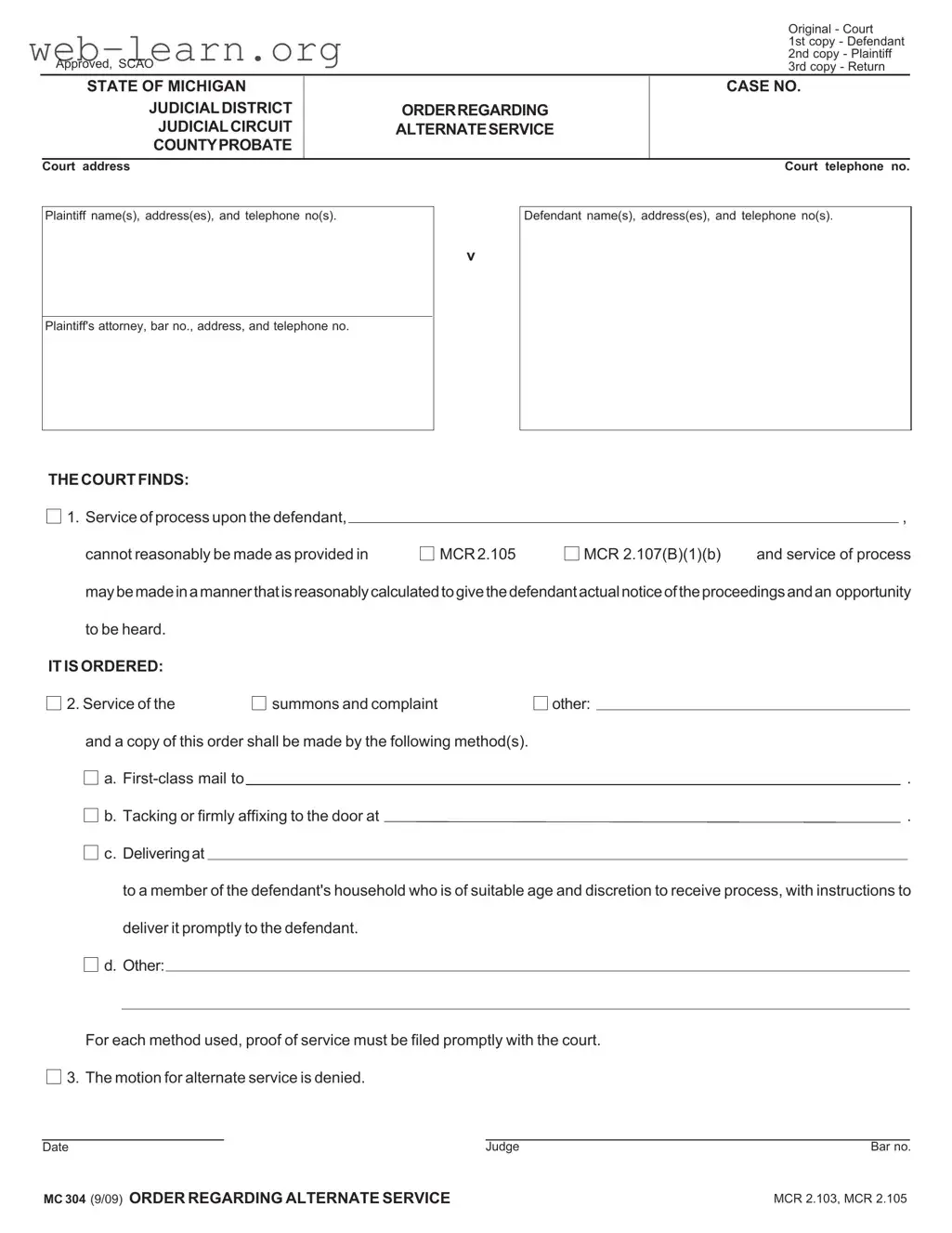
The MC 304 Michigan form plays a crucial role in the legal process, particularly when traditional methods of serving legal documents to a defendant are not feasible. This form is often utilized in situations where the court finds that service of process cannot be reasonably achieved as outlined in the Michigan Court Rules. Instead, the court may allow alternative methods of service that ensure the defendant receives actual notice of the proceedings. The form includes sections for the court to specify the methods of service approved, which may include options such as first-class mail, affixing documents to the defendant's door, or delivering them to a suitable member of the defendant's household. Additionally, it outlines the necessity for proof of service to be filed promptly with the court, ensuring that all actions taken are documented and verified. The form also contains provisions for the certification of service by a process server, detailing their actions and affirming that the service was completed in accordance with the court's order. Understanding the MC 304 form is essential for both plaintiffs and defendants, as it ensures that all parties are properly notified and can participate in the legal process.

|
Original - Court |
|
1st copy - Defendant |
Approved, SCAO |
2nd copy - Plaintiff |
3rd copy - Return |
STATE OF MICHIGAN JUDICIALDISTRICT JUDICIALCIRCUIT COUNTYPROBATE
ORDERREGARDING ALTERNATESERVICE
CASE NO.
Court address |
Court telephone no. |
Plaintiff name(s), address(es), and telephone no(s).
Defendant name(s), address(es), and telephone no(s).
v
Plaintiff's attorney, bar no., address, and telephone no.
THECOURTFINDS: |
|
|
|
|
|
1. Service of process upon the defendant, |
|
|
|
|
, |
cannot reasonably be made as provided in |
MCR2.105 |
MCR 2.107(B)(1)(b) |
and service of process |
||
maybemadeinamannerthatisreasonablycalculatedtogivethedefendantactualnoticeoftheproceedingsandan opportunity
to be heard. |
|
|
|
|
ITISORDERED: |
|
|
|
|
2. Service of the |
summons and complaint |
other: |
||
and a copy of this order shall be made by the following method(s). |
|
|
|
|
a. |
|
|
. |
|
b. Tacking or firmly affixing to the door at |
. |
|||
c. Deliveringat
to a member of the defendant's household who is of suitable age and discretion to receive process, with instructions to deliver it promptly to the defendant.
d. Other:
For each method used, proof of service must be filed promptly with the court.
3. The motion for alternate service is denied.
Date |
|
Judge |
Bar no. |
MC 304 (9/09) ORDER REGARDING ALTERNATE SERVICE |
MCR 2.103, MCR 2.105 |

PROOF OF SERVICE
ORDERREGARDINGALTERNATESERVICE
Case No.
TO PROCESS SERVER: You must serve the copies of the order regarding alternate service and file proof of service with the court clerk. If you are unable to complete service, you must return this original and all copies to the court clerk.
CERTIFICATE / AFFIDAVIT OF SERVICE / NONSERVICE
|
OFFICER CERTIFICATE |
OR |
|
AFFIDAVIT OF PROCESS SERVER |
||||||||||||||
I certify that I am a sheriff, deputy sheriff, bailiff, appointed |
|
|
Being first duly sworn, I state that I am a legally |
|||||||||||||||
court officer, or attorney for a party (MCR 2.104[A][2]), and |
|
|
competent adult who is not a party or an officer of |
|||||||||||||||
that: (notarization not required) |
|
|
|
|
|
a corporate party, and that: |
(notarization required) |
|||||||||||
|
|
|
|
|
|
|
|
|
||||||||||
I served a copy of the |
summons and complaint |
|
other: |
|
|
|
|
|
||||||||||
|
|
|
|
|
|
|||||||||||||
and a copy of the order for alternate service upon |
|
|
|
|
|
|
|
|
|
by |
||||||||
1. |
|
|
|
|
|
|
|
|
, on |
|
|
. |
||||||
|
|
|
|
|
|
|
|
|
|
|
|
|
|
Date |
|
|
|
|
2. |
Tacking or firmly affixing to the door at |
|
|
|
|
|
, on |
|
|
. |
||||||||
|
|
|
|
|
|
|
|
|
|
|
|
|
|
Date |
|
|
|
|
3. |
Deliveringat |
|
|
|
|
|
|
|
|
, on |
|
|
|
. |
||||
|
|
|
|
|
|
|
|
|
|
|
|
|
|
Date |
|
|
|
|
|
to a member of the defendant's household who is of suitable age and discretion to receive process, with instructions to deliver |
|||||||||||||||||
|
it promptly to the defendant. |
|
|
|
|
|
|
|
|
|
|
|
||||||
4. |
Other: |
|
|
|
|
|
|
|
|
, on |
|
|
. |
|||||
|
|
specify |
|
|
|
|
|
|
|
|
Date |
|
|
|
|
|||
I declare that the statements above are true to the best of my information, knowledge, and belief.
Service fee |
Miles traveled Fee |
$ |
|
$ |
|
Incorrect address fee |
Miles traveled Fee |
TOTAL FEE |
|
$ |
|
$ |
|
|
$ |
||
|
|
|
|
Subscribed and sworn to before me on
Date
Signature
Name (type or print)
Title
, |
|
County, Michigan. |
My commission expires: |
|
|
Signature: |
|
|
|
Date |
|
Deputy court clerk/Notary public |
||
Notary public, State of Michigan, County of |
|
|
|
|
|
| Fact Name | Description |
|---|---|
| Purpose | The MC 304 form is used in Michigan to request alternate service of process when traditional methods cannot be reasonably employed. |
| Governing Laws | This form is governed by the Michigan Court Rules (MCR) 2.103 and 2.105. |
| Copies Required | When filed, the MC 304 form requires multiple copies: one for the court, one for the defendant, and one for the plaintiff. |
| Service Methods | Service can be made through various methods including first-class mail, tacking to the door, or delivering to a household member of suitable age. |
| Proof of Service | Proof of service must be filed promptly with the court after the alternate service methods are executed. |
| Denial of Motion | The court may deny the motion for alternate service if it finds that service can be reasonably made using traditional methods. |
| Signature Requirements | The form requires signatures from the process server and may need notarization depending on the circumstances. |
Filling out the MC 304 form is an important step in the legal process when traditional service methods are not possible. After completing the form, it will need to be filed with the court. The court will then review the request for alternate service.
What is the purpose of the MC 304 form?
The MC 304 form, titled "Order Regarding Alternate Service," is used in Michigan courts when traditional methods of serving legal documents to a defendant are not feasible. This form allows the court to authorize alternative methods of service that can reasonably provide the defendant with actual notice of the proceedings. The goal is to ensure that the defendant has the opportunity to respond and participate in the legal process.
How is service of process determined using the MC 304 form?
The court evaluates whether service can be made as outlined in the Michigan Court Rules. If standard methods, such as personal service, are not possible, the court may approve alternate methods. These can include:
Each method chosen must be documented, and proof of service must be filed with the court promptly.
What should be included in the proof of service?
Proof of service must detail how and when the documents were served. This includes:
It is essential to provide accurate information, as this will be reviewed by the court to ensure that service was properly executed.
What happens if the motion for alternate service is denied?
If the court denies the motion for alternate service, it means that the proposed methods of service are not acceptable. The plaintiff must then find another way to serve the defendant, typically through traditional methods. The court may provide guidance on how to proceed, but it is ultimately the responsibility of the plaintiff to ensure that the defendant is properly notified of the legal action.
Who can serve the documents once the MC 304 form is approved?
Documents can be served by a variety of individuals, including:
It is crucial that the person serving the documents is not a party to the case, ensuring that the process remains impartial and valid.
Filling out the MC 304 Michigan form can be a straightforward process, but several common mistakes can lead to delays or complications. One significant error occurs when individuals fail to provide complete and accurate information about the parties involved. Missing details, such as the full names, addresses, or telephone numbers of either the plaintiff or defendant, can result in improper service of process.
Another frequent mistake is neglecting to specify the method of service clearly. The form outlines various options, including first-class mail and tacking or affixing to a door. If a method is not chosen or if the description is vague, the court may reject the submission. Clarity in this section is essential for ensuring that the defendant receives proper notice.
People often overlook the requirement for proof of service. After the service is completed, individuals must file proof with the court promptly. Failing to do so can lead to complications in the case, as the court needs to verify that the defendant has been notified of the proceedings.
Inaccurate dates also present a problem. When filling out the form, it is crucial to ensure that all dates, especially those related to the service of process, are correct. Incorrect dates can raise questions about the validity of the service and may lead to legal challenges.
Another common oversight involves the signature section. Individuals must ensure that the form is signed by the appropriate parties. Whether it’s the process server or the plaintiff’s attorney, an unsigned document can be deemed incomplete, causing delays in the court's processing.
People sometimes forget to include the case number. This number is vital for the court to track the case and link it to the correct files. Without it, the form may be misfiled or lost in the system, leading to unnecessary complications.
Lastly, individuals may not pay attention to the fees associated with service. The form requires a breakdown of service fees and any additional costs incurred. Omitting this information can result in further delays, as the court will need to follow up for clarification.
The MC 304 Michigan form is used to request an order for alternate service when standard service methods are not feasible. Along with this form, several other documents are commonly utilized in legal proceedings. Each document plays a specific role in ensuring that all parties are properly notified and that the court's procedures are followed. Below is a list of these documents.
These documents work together to facilitate the legal process, ensuring that all parties receive proper notification and that the court's procedures are adhered to. Understanding each document's purpose can help streamline legal proceedings and improve communication among involved parties.
The MC 304 Michigan form is a legal document used in situations where traditional service of process on a defendant is not feasible. It allows for alternative methods of serving legal documents. Several other documents serve similar purposes in various legal contexts. Here are ten documents that share similarities with the MC 304 form:
When filling out the MC 304 Michigan form, it's important to follow specific guidelines to ensure your submission is correct. Here are six things to do and avoid:
By following these guidelines, you can help ensure that your form is processed smoothly and efficiently. If you have any questions, seek assistance to clarify any uncertainties.
The MC 304 form is an important legal document used in Michigan courts for cases where traditional methods of serving a defendant are not feasible. However, there are several misconceptions surrounding this form that can lead to confusion. Below is a list of ten common misconceptions about the MC 304 form, along with clarifications for each.
This form is applicable to various types of civil cases, not just divorce. It is used whenever alternate service methods are necessary.
It is essential to file the MC 304 form if you cannot serve the defendant through standard means. This form documents your request for alternate service.
The court must review and approve your request for alternate service. Simply filing the form does not guarantee approval.
The MC 304 form outlines specific methods for alternate service that the court must approve. You cannot use arbitrary methods.
Proof of service is required for each method used to serve the defendant. This must be filed promptly with the court.
The form is used for any situation where traditional service is impractical, not just for defendants who are avoiding being served.
Only a qualified individual, such as a sheriff or an appointed process server, can complete the service portion of the form.
While the defendant may not receive the summons directly, the methods of alternate service are designed to ensure they receive actual notice of the proceedings.
The MC 304 form is part of a larger process that includes filing other documents, such as the summons and complaint.
Even if alternate service is granted, the defendant has the right to contest the service or the case itself, which can lead to further legal proceedings.
Understanding these misconceptions can help individuals navigate the legal process more effectively and ensure that their rights are protected. Proper use of the MC 304 form is crucial for achieving the desired outcomes in legal proceedings.
Filling out and using the MC 304 Michigan form can be a critical step in ensuring that legal proceedings are conducted fairly and efficiently. Here are some key takeaways to keep in mind:
Using the MC 304 form effectively can help facilitate communication in legal matters and ensure that all parties are given proper notice of proceedings.