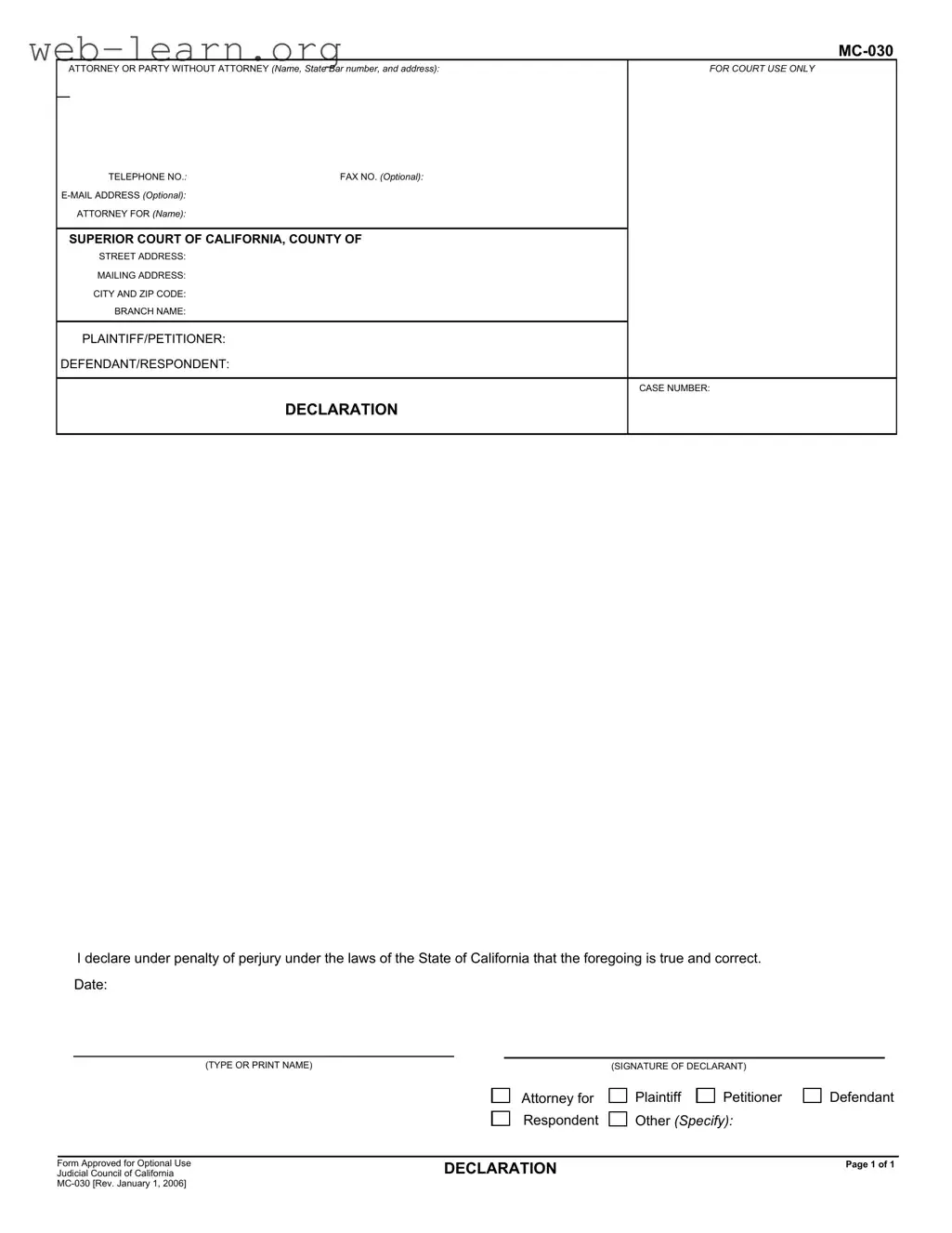
The MC-030 form plays a crucial role in the legal process within California's court system. Designed for use by attorneys or parties representing themselves, this form serves multiple purposes in various legal proceedings. It includes essential information such as the names of the parties involved, their respective roles as plaintiffs or defendants, and the case number. Additionally, it requires the declaration of truthfulness, where the signatory affirms the accuracy of the information provided under penalty of perjury. This form also allows for the inclusion of contact details, such as telephone numbers and email addresses, facilitating communication between the court and the involved parties. By ensuring that all necessary information is clearly presented, the MC-030 form helps streamline court processes, making it easier for judges and clerks to manage cases effectively. Understanding how to correctly fill out and submit this form is vital for anyone navigating the California legal system.
ATTORNEY OR PARTY WITHOUT ATTORNEY (Name, State Bar number, and address): |
FOR COURT USE ONLY |
TELEPHONE NO.: |
FAX NO. (Optional): |
|
|
ATTORNEY FOR (Name): |
|
SUPERIOR COURT OF CALIFORNIA, COUNTY OF
STREET ADDRESS:
MAILING ADDRESS:
CITY AND ZIP CODE:
BRANCH NAME:
PLAINTIFF/PETITIONER:
DEFENDANT/RESPONDENT:
CASE NUMBER:
DECLARATION
I declare under penalty of perjury under the laws of the State of California that the foregoing is true and correct.
Date:
(TYPE OR PRINT NAME) |
(SIGNATURE OF DECLARANT) |
|
|
|
||||||
|
|
Attorney for |
|
Plaintiff |
|
|
Petitioner |
|
|
Defendant |
|
|
|
|
|
|
|
||||
|
|
|
|
|
|
|||||
|
|
Respondent |
|
Other (Specify): |
|
|
|
|||
|
|
|
|
|
|
|||||
Form Approved for Optional Use Judicial Council of California
DECLARATION
Page 1 of 1
| Fact Name | Details |
|---|---|
| Form Purpose | The MC-030 form is used for declarations in court proceedings in California. |
| Governing Law | This form is governed by the California Code of Civil Procedure. |
| Optional Information | Fax number and email address are optional fields on the form. |
| Signature Requirement | A signature is required from the declarant, affirming the truth of the declaration. |
| Form Approval | The MC-030 form has been approved for optional use by the Judicial Council of California. |
| Revision Date | The current version of the form was revised on January 1, 2006. |
Filling out the MC-030 form requires careful attention to detail. This form is used for declarations in California court cases. After completing the form, it must be submitted to the appropriate court along with any required fees or additional documents.
The MC-030 form is a declaration form used in California courts. It is primarily utilized by attorneys or parties representing themselves to declare certain facts under penalty of perjury. This form helps provide the court with essential information regarding the case and the individuals involved.
The form can be used by attorneys and self-represented parties. It allows individuals to submit declarations that support their case. Whether you are a plaintiff, petitioner, defendant, or respondent, you can use this form to present your declarations to the court.
The form requires several key pieces of information, including:
To fill out the MC-030 form, start by entering your name and contact information at the top. Include the name of the party you represent. Next, provide the details of the case, including the case number and the names of the plaintiff/petitioner and defendant/respondent. Finally, complete the declaration statement and sign the form.
The declaration statement is a legal assertion made under penalty of perjury. By signing this statement, the declarant confirms that the information provided is true and correct to the best of their knowledge. This adds credibility to the information presented to the court.
The MC-030 form is not mandatory for all cases. However, it is often required when a party needs to submit a declaration to support a motion or other court proceeding. Always check the specific requirements for your case or consult with legal counsel.
The MC-030 form is available online through the California Judicial Council's website. You can also find it at local courthouses. Ensure you are using the most recent version of the form, as updates may occur.
Many California courts allow electronic filing of documents, including the MC-030 form. However, the rules may vary by jurisdiction. Check with your local court to confirm their electronic filing procedures and any specific requirements.
After completing the MC-030 form, review it for accuracy. Once you are satisfied that all information is correct, sign the declaration. You will then need to file the form with the appropriate court, either in person or electronically, depending on the court's rules.
Providing false information on the MC-030 form can have serious legal consequences. It may result in penalties, including fines or other sanctions. The court takes declarations under penalty of perjury seriously, so it is essential to ensure that all information is truthful and accurate.
Filling out the MC-030 form can seem straightforward, but there are common mistakes that individuals often make. One of the most frequent errors is neglecting to include all required contact information. This includes not just your name, but also your phone number and email address if applicable. Without this information, the court may struggle to reach you, which can lead to delays in your case.
Another common mistake is failing to clearly identify whether you are the attorney or the party representing yourself. This distinction is crucial. If you are representing yourself, make sure to check the appropriate box and provide your name clearly. Misidentifying your role can lead to confusion and may affect how your case is processed.
Many people also forget to sign the declaration. The form requires a signature to validate the information provided. If you leave this section blank, the court may reject your submission, requiring you to start over. Always double-check that you have signed and dated the form before submitting it.
Inaccurate case numbers are another common pitfall. It's essential to ensure that you enter the correct case number. An incorrect number can lead to your documents being filed in the wrong case, causing unnecessary complications. Take a moment to verify this detail before proceeding.
Some individuals overlook the importance of using legible handwriting or clear typing. If the court cannot read your information, it may result in misunderstandings or delays. Always aim for clarity to ensure that your form is processed smoothly.
Additionally, people sometimes misinterpret the instructions on the form. Each section has specific requirements, and skipping over these can lead to incomplete submissions. Take the time to read the instructions carefully to avoid missing any important details.
Another mistake is not providing accurate information about the opposing party. This includes their name and address. If this information is incorrect, it can affect the court’s ability to notify the other party, which is crucial for fair proceedings.
Finally, many individuals fail to keep a copy of the completed form for their records. It’s wise to retain a copy in case any questions arise later. This practice can help you track your submissions and provide necessary documentation if needed.
The MC-030 form is commonly used in California courts for declarations. When filing this form, you may also need to submit additional documents. Here’s a list of related forms that can help you through the process.
Using these forms in conjunction with the MC-030 can streamline your legal process and ensure that all necessary information is communicated effectively. Always check for the latest versions of these forms to ensure compliance with current legal standards.
The MC-030 form is a declaration form used in California courts, primarily for parties involved in legal proceedings. There are several other documents that serve similar purposes in various legal contexts. Below is a list of five documents that share similarities with the MC-030 form:
When filling out the MC-030 form, it's important to get it right. Here are some tips on what to do and what to avoid.
Understanding the MC-030 form can be challenging, and there are several misconceptions that often arise. Here are five common misunderstandings:
This form can be used by both attorneys and individuals representing themselves in court. It is designed to accommodate anyone who needs to submit a declaration in a legal matter.
Not every case necessitates this form. It is specifically used when a declaration is needed, such as to provide evidence or support a motion. Always check the requirements for your specific case.
Filing this form does not guarantee that the court will rule in your favor. It is simply a means to present your declaration and support your position in the case.
A signature is essential on the MC-030 form. By signing, you affirm that the information provided is true and correct under penalty of perjury, which adds weight to your declaration.
Filling out the MC-030 form is an essential step in the legal process for various parties involved in a case. Here are some key takeaways to keep in mind: