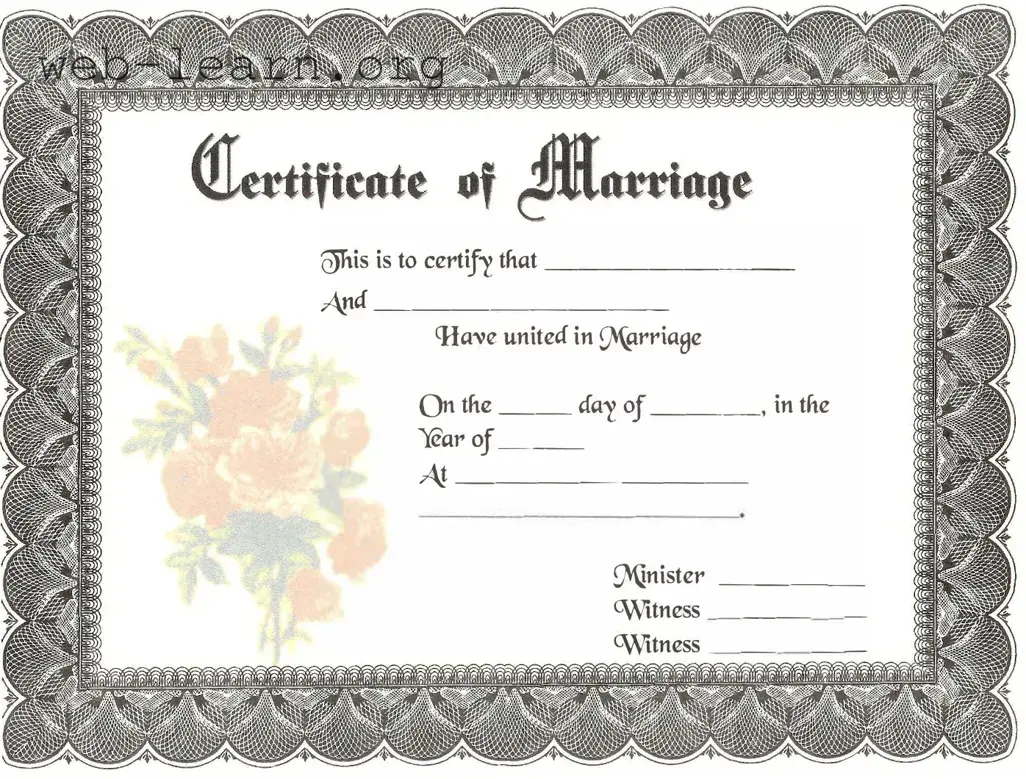
Homepage Blank Marriage Certificate Form
Outline

When planning a wedding, one of the essential documents you will need is the Marriage Certificate form. This form serves as a legal record of your union and is required to obtain your official marriage certificate. It typically includes vital information such as the full names of both parties, their dates of birth, and their places of residence. Additionally, the form may require details about the officiant, as well as the date and location of the ceremony. It's important to ensure that all information is accurate and complete, as any discrepancies can lead to delays or complications in the marriage registration process. Understanding the requirements and details of the Marriage Certificate form can help make your wedding planning smoother and more efficient, allowing you to focus on celebrating your love.
Sample - Marriage Certificate Form

@Ji

if


is is to cert y tftat _______

A_


nd ________


g


СИаvс unitcd in


rria c


y

f

___, in tftc


o


Оп tftc __ da


Лt-------

__

nistcr


_

_

C\Vitness ___

_

C\Vitncss _____

Form Information

Fact Name Description
Definition A marriage certificate is a legal document that officially records the marriage between two individuals.
Purpose This document serves as proof of marriage and may be required for various legal purposes, such as applying for spousal benefits.
State-Specific Forms Each state has its own marriage certificate form, which must be filled out according to local requirements.
Governing Law In the United States, marriage laws are determined at the state level, meaning requirements can vary significantly.
Filing Process After the marriage ceremony, the signed marriage license must be filed with the appropriate state office to obtain the certificate.
Fees Obtaining a marriage certificate usually involves a fee, which can differ by state and county.
Copy Availability Certified copies of the marriage certificate can often be requested for a fee, providing legal proof of the marriage.
Amendments If there are errors on the marriage certificate, amendments can be made through the appropriate state office.
Confidentiality Some states offer confidential marriage certificates, which are not publicly accessible, providing privacy for the couple.

Detailed Guide for Filling Out Marriage Certificate

Once you have the Marriage Certificate form in hand, it's important to fill it out accurately. This form will need to be submitted to the appropriate office to proceed with your marriage process. Follow the steps below to ensure that you complete the form correctly.

  1. Start by writing the full names of both parties getting married. Make sure to include any middle names.
  2. Provide the date of the marriage. This should be the date you plan to get married.
  3. Enter the place of marriage. This could be a specific venue or city and state where the ceremony will take place.
  4. Fill in the addresses of both parties. Include the street address, city, state, and zip code.
  5. Indicate the ages of both parties at the time of marriage. If either party is under 18, additional information may be required.
  6. List the occupations of both individuals. This helps to provide a complete picture of each person.
  7. Provide the names of the parents of both parties. Include their full names and any relevant details.
  8. Sign and date the form. Both parties must sign to validate the information provided.

After completing the form, review it carefully to ensure all information is correct. Once verified, you can submit it to the designated office for processing. Make sure to keep a copy for your records.

Obtain Answers on Marriage Certificate

  1. What is a marriage certificate?

    A marriage certificate is a legal document that officially recognizes the union between two individuals. It serves as proof that a marriage has taken place and is often required for various legal purposes, such as changing one's name, applying for spousal benefits, or filing taxes jointly.

  2. How do I obtain a marriage certificate?

    To obtain a marriage certificate, couples typically need to follow these steps:

    • Visit the local or state office responsible for vital records, often the county clerk's office.
    • Complete the marriage certificate application form, which may be available online or in person.
    • Provide necessary identification, such as a driver's license or passport.
    • Pay any applicable fees associated with the issuance of the certificate.

    It’s important to check the specific requirements for your state, as they can vary.

  3. How long does it take to receive a marriage certificate?

    The time frame for receiving a marriage certificate can vary widely. In some cases, couples may receive their certificate on the same day they apply. However, in other situations, it may take several weeks, especially if the application is submitted by mail or if there are any issues with the paperwork. To avoid delays, ensure all information is accurate and complete when submitting your application.

  4. Can I get a copy of my marriage certificate if I lose it?

    Yes, if you lose your marriage certificate, you can request a replacement copy. The process generally involves:

    • Contacting the vital records office where the original certificate was issued.
    • Filling out a request form for a duplicate certificate.
    • Providing identification and paying any required fees.

    Keep in mind that some states may have specific rules regarding the issuance of duplicate certificates, so it’s wise to check local regulations.

  5. Is a marriage certificate the same as a marriage license?

    No, a marriage certificate and a marriage license are not the same. A marriage license is a legal document that allows a couple to marry. It is obtained before the wedding ceremony and must be signed by the officiant and witnesses during the ceremony. After the marriage takes place, the signed license is then filed with the appropriate government office to create the marriage certificate, which serves as official proof of the marriage.

Common mistakes

When filling out a Marriage Certificate form, individuals often overlook important details that can lead to complications later on. One common mistake is providing incorrect personal information. Names should match official identification documents exactly. A simple misspelling can create issues when the certificate is needed for legal purposes, such as changing a name or applying for benefits.

Another frequent error is neglecting to include required signatures. Both parties typically need to sign the form, along with witnesses in some jurisdictions. Failing to obtain all necessary signatures can result in delays or even the rejection of the application. It’s crucial to check the specific requirements of the state or county where the marriage is being registered.

People also often forget to review the residency requirements. Some states have specific rules about where individuals must reside before they can apply for a marriage certificate. Not adhering to these guidelines can lead to unnecessary complications. Always verify local laws to ensure compliance.

Lastly, many couples underestimate the importance of understanding the fees associated with obtaining a marriage certificate. Each state has different costs, and some may require payment in cash or specific forms of payment. Being unprepared for these fees can lead to frustration and delays in receiving the certificate. Planning ahead can save time and reduce stress during what should be a joyful occasion.

Documents used along the form

When couples prepare for their wedding, several important documents accompany the Marriage Certificate form. These documents ensure that the marriage is legally recognized and that all necessary legal requirements are met. Below is a list of common forms and documents often used alongside the Marriage Certificate.

  • Marriage License: This document must be obtained before the wedding ceremony. It grants permission for the couple to marry and is typically issued by a local government office.
  • Application for Marriage License: Couples must complete this form to apply for their marriage license. It usually requires personal information, identification, and sometimes a fee.
  • Identification Documents: Valid forms of ID, such as a driver's license or passport, are often required when applying for a marriage license to verify the identities of both parties.
  • Divorce Decree (if applicable): If either party has been previously married, a copy of the final divorce decree may be required to prove that the previous marriage has been legally dissolved.
  • Death Certificate (if applicable): In cases where one party is a widow or widower, a death certificate of the deceased spouse may be necessary to validate the new marriage.
  • Consent Forms: If either party is underage, parental or guardian consent forms may be needed to legally proceed with the marriage.
  • Witness Statements: Some jurisdictions require a witness to sign the marriage certificate, verifying that they witnessed the marriage ceremony.
  • Prenuptial Agreement: Couples may choose to create this legal document before marriage to outline the distribution of assets and responsibilities in case of divorce.

Having these documents prepared and organized can help streamline the marriage process. Couples should ensure that they understand the requirements in their state or locality to avoid any delays or complications on their wedding day.

Similar forms

The Marriage Certificate form shares similarities with several other important documents. Each document serves a specific purpose and holds significant value in various legal and personal contexts. Below is a list of documents that are similar to the Marriage Certificate form:

  • Birth Certificate: This document records an individual's birth details, including date, place, and parentage, much like how a Marriage Certificate records the union of two individuals.
  • Divorce Decree: A legal document that finalizes the dissolution of a marriage. It provides official recognition of the end of a marital relationship, similar to how a Marriage Certificate confirms the beginning.
  • Death Certificate: This document certifies the passing of an individual. It is essential for legal matters regarding inheritance and estate management, paralleling the Marriage Certificate's role in marital status.
  • Adoption Papers: These documents formalize the legal process of adopting a child. They establish a legal relationship similar to how a Marriage Certificate establishes a legal partnership.
  • Civil Union Certificate: This document recognizes a civil union between two individuals, providing similar legal rights and responsibilities as a Marriage Certificate.
  • Domestic Partnership Agreement: This document outlines the rights and responsibilities of partners in a domestic partnership, akin to the legal recognition provided by a Marriage Certificate.
  • Name Change Certificate: This document officially recognizes a person's change of name, which can occur after marriage, similar to how a Marriage Certificate can lead to a name change.
  • Property Deed: A legal document that conveys ownership of property. It often requires marital status to be disclosed, just as a Marriage Certificate does.
  • Power of Attorney: This document grants one person the authority to act on behalf of another in legal or financial matters. It may be influenced by marital status, similar to the implications of a Marriage Certificate.

Dos and Don'ts

When filling out a Marriage Certificate form, it’s important to ensure accuracy and completeness. Here are some dos and don’ts to keep in mind:

  • Do read the instructions carefully before starting.
  • Do double-check all names and dates for accuracy.
  • Do provide all required information, including identification details.
  • Do sign and date the form where indicated.
  • Don't leave any sections blank unless specified.
  • Don't use nicknames or informal names; use legal names only.

By following these guidelines, you can help ensure that your Marriage Certificate is processed smoothly and without delays.

Misconceptions

Marriage certificates are important legal documents, but there are many misconceptions surrounding them. Understanding these misconceptions can help individuals navigate the process more effectively. Here are ten common misunderstandings about marriage certificates:

  1. Anyone can issue a marriage certificate. In reality, only authorized government entities can issue marriage certificates. This ensures that the marriage is legally recognized.
  2. A marriage certificate is the same as a marriage license. A marriage license allows a couple to get married, while a marriage certificate is the official record of the marriage after it has taken place.
  3. You can get married without a marriage certificate. While couples can have a ceremony without one, a marriage certificate is essential for legal recognition of the marriage.
  4. All states require the same information on a marriage certificate. Each state has its own requirements regarding what information must be included on the certificate.
  5. A marriage certificate is only needed for legal purposes. Many couples also want a marriage certificate for personal reasons, such as changing their last name or for insurance benefits.
  6. Once issued, a marriage certificate cannot be changed. In some cases, corrections can be made if there are errors, but this typically requires a formal process.
  7. Marriage certificates are only needed for heterosexual couples. Marriage certificates are valid for all couples, regardless of sexual orientation, in jurisdictions where same-sex marriage is legal.
  8. You can obtain a marriage certificate immediately after the ceremony. There is often a processing period after the marriage ceremony before the certificate is issued.
  9. A marriage certificate expires after a certain period. Marriage certificates do not expire; they remain valid as long as the marriage is recognized by law.
  10. Only one copy of the marriage certificate is issued. Couples can request multiple copies of their marriage certificate, which can be useful for various legal and personal needs.

Being aware of these misconceptions can help individuals better understand the importance and role of marriage certificates in their lives. Knowledge is key to navigating the legal landscape surrounding marriage.

Key takeaways

Filling out and using a Marriage Certificate form is an important step in the legal recognition of a marriage. Here are some key takeaways to consider:

  1. Understand the Purpose: The Marriage Certificate serves as an official record of the marriage, necessary for legal identification and benefits.
  2. Know the Requirements: Each state has specific requirements for obtaining a Marriage Certificate. Check local regulations to ensure compliance.
  3. Gather Necessary Information: Collect all required information, such as full names, dates of birth, and places of birth for both partners.
  4. Provide Identification: Most states require valid identification, such as a driver's license or passport, to accompany the application.
  5. Complete the Form Accurately: Fill out the form carefully. Mistakes can lead to delays or complications in processing.
  6. Sign the Form: Both parties must sign the form. This signature confirms that the information provided is true and accurate.
  7. Submit the Form Timely: Submit the completed form to the appropriate government office as soon as possible to avoid any delays.
  8. Pay the Fees: Be prepared to pay any required fees. These can vary by state and may include processing or filing fees.
  9. Request Copies: After the certificate is issued, consider requesting additional certified copies for personal records or legal purposes.
  10. Store Safely: Keep the Marriage Certificate in a safe place. It may be needed for name changes, insurance, or legal matters in the future.

By following these steps, individuals can ensure a smooth process in obtaining and utilizing their Marriage Certificate.