Homepage Attorney-Approved Marital Separation Agreement Template
Outline

When couples decide to separate, a Marital Separation Agreement can provide a clear framework for addressing various important issues. This document outlines the terms of the separation, including the division of assets and debts, child custody arrangements, and spousal support. By detailing these aspects, the agreement helps both parties understand their rights and responsibilities during this challenging time. It can serve as a valuable tool for reducing conflict and promoting cooperation, ensuring that both individuals have a mutual understanding of their situation. Additionally, this agreement can be tailored to meet the specific needs of the couple, reflecting their unique circumstances and preferences. As a result, having a well-drafted Marital Separation Agreement can facilitate a smoother transition for both parties as they navigate the complexities of separation.

Sample - Marital Separation Agreement Form

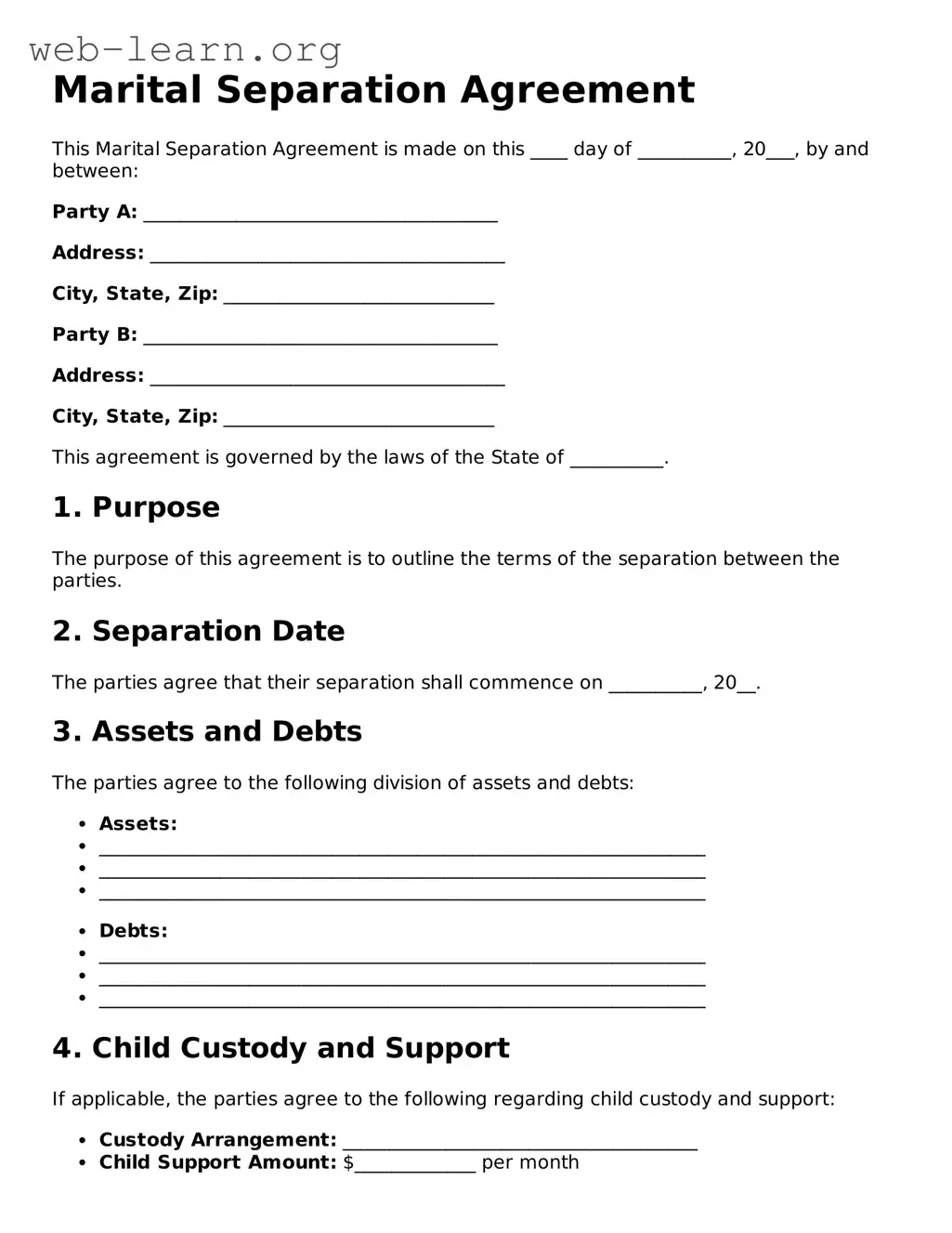
Marital Separation Agreement

This Marital Separation Agreement is made on this ____ day of __________, 20___, by and between:

Party A: ______________________________________

Address: ______________________________________

City, State, Zip: _____________________________

Party B: ______________________________________

Address: ______________________________________

City, State, Zip: _____________________________

This agreement is governed by the laws of the State of __________.

1. Purpose

The purpose of this agreement is to outline the terms of the separation between the parties.

2. Separation Date

The parties agree that their separation shall commence on __________, 20__.

3. Assets and Debts

The parties agree to the following division of assets and debts:

  • Assets:
  • _________________________________________________________________
  • _________________________________________________________________
  • _________________________________________________________________
  • Debts:
  • _________________________________________________________________
  • _________________________________________________________________
  • _________________________________________________________________

4. Child Custody and Support

If applicable, the parties agree to the following regarding child custody and support:

  • Custody Arrangement: ______________________________________
  • Child Support Amount: $_____________ per month
  • Payment Due Date: ____________ of each month

5. Spousal Support

Party A/Party B shall pay spousal support in the amount of $_____________ per month for a duration of ____________.

6. Miscellaneous Provisions

The parties agree to the following additional terms:

  • _________________________________________________________________
  • _________________________________________________________________
  • _________________________________________________________________

7. Signatures

By signing below, both parties acknowledge and agree to the terms of this Marital Separation Agreement.

Party A Signature: ____________________________ Date: ____________

Party B Signature: ____________________________ Date: ____________

File Characteristics

Fact Name Details
Definition A Marital Separation Agreement is a written document outlining the terms of separation between spouses.
Purpose This agreement helps clarify rights and responsibilities during separation, covering issues like property division and child custody.
Governing Law The laws governing marital separation agreements vary by state. For example, California Family Code Section 1500 applies in California.
Voluntary Agreement Both parties must willingly agree to the terms outlined in the separation agreement.
Modification Changes can be made to the agreement if both parties consent and sign the new document.
Legal Representation It is advisable for each spouse to have separate legal representation when creating the agreement.
Enforceability Once signed, the agreement can be enforced in court, provided it meets state requirements.
Not Final Divorce A separation agreement does not finalize a divorce; it simply outlines terms until a divorce is granted.

Detailed Guide for Filling Out Marital Separation Agreement

Filling out a Marital Separation Agreement form can feel overwhelming, but taking it step by step makes the process easier. Once you complete the form, you can move forward with the next steps in your separation journey.

  1. Begin by gathering necessary information. This includes your full name, your spouse's full name, and the date of your marriage.
  2. Next, provide your current address and your spouse's current address. Make sure this information is accurate.
  3. Detail any children involved. List their names and ages. This is important for any custody or support arrangements.
  4. Outline the division of property. Clearly state how you plan to divide any shared assets, such as bank accounts, real estate, and personal belongings.
  5. Include information about debts. List any joint debts and clarify how you plan to handle them.
  6. Discuss spousal support, if applicable. Indicate whether one party will pay the other, and if so, specify the amount and duration.
  7. Review the completed form for accuracy. Ensure all information is correct and reflects your intentions.
  8. Sign and date the form. Both parties should do this to acknowledge agreement.
  9. Consider having the document notarized. This adds an extra layer of validation to your agreement.

Obtain Answers on Marital Separation Agreement

  1. What is a Marital Separation Agreement?

    A Marital Separation Agreement is a legal document that outlines the terms of a couple's separation. This agreement addresses various aspects such as division of property, child custody, child support, and spousal support. It serves to clarify the rights and responsibilities of each spouse during the separation period. The goal is to create a framework that both parties can agree upon, reducing potential conflicts and misunderstandings.

  2. Why should I consider a Marital Separation Agreement?

    Opting for a Marital Separation Agreement can provide several benefits:

    • It helps establish clear expectations regarding financial responsibilities and living arrangements.
    • It can simplify the divorce process later on, as many issues will have already been resolved.
    • It offers a structured approach to co-parenting, ensuring that both parents are on the same page regarding their children's needs.

    Having this agreement in place can lead to a smoother transition during a difficult time.

  3. How do I create a Marital Separation Agreement?

    Creating a Marital Separation Agreement typically involves several steps:

    • Discuss your needs and preferences with your spouse. Open communication is key.
    • List out all assets, debts, and responsibilities that need to be addressed.
    • Consider consulting a legal professional to ensure that your agreement complies with state laws and protects your interests.
    • Draft the agreement, including all necessary details. Both parties should review it thoroughly.
    • Sign the agreement in the presence of a notary, if required by your state.

    Taking these steps can help ensure that your agreement is fair and legally binding.

  4. Can a Marital Separation Agreement be modified?

    Yes, a Marital Separation Agreement can be modified if both parties agree to the changes. Life circumstances can change, and it’s important that the agreement remains relevant. To modify the agreement:

    • Discuss the desired changes with your spouse.
    • Draft an amendment to the original agreement that outlines the new terms.
    • Both parties should sign the amendment, and it may be beneficial to have it notarized.

    Keeping the agreement updated can help maintain a positive co-parenting relationship and ensure that both parties' needs are met.

Common mistakes

When completing a Marital Separation Agreement form, many individuals make common mistakes that can lead to complications later on. One frequent error is failing to include all necessary personal information. It is essential to provide full names, addresses, and contact details for both parties. Omitting this information can create confusion and delay the process.

Another mistake is neglecting to specify the date of separation. This date is crucial as it can affect the division of assets and liabilities. Without a clear date, disputes may arise regarding property rights and responsibilities.

Many people also overlook the importance of detailing the division of property. It is vital to list all marital assets and debts, specifying who will retain what. Vague language can lead to misunderstandings and disagreements in the future.

Inadequate child custody and support provisions often cause issues. Parents should clearly outline custody arrangements, visitation schedules, and child support amounts. Failing to address these matters can lead to conflicts and legal complications later on.

Another common error is not considering tax implications. Individuals should think about how their separation will impact their tax situation. Ignoring this can result in unexpected financial burdens after the separation is finalized.

Some individuals forget to include a dispute resolution clause. This clause outlines how future disagreements will be handled, whether through mediation or arbitration. Without this provision, resolving conflicts can become more challenging.

Additionally, people sometimes rush through the form without fully understanding its terms. It is crucial to read and comprehend every section before signing. Misunderstandings can lead to unintended consequences.

Failing to have the agreement reviewed by a legal professional is another mistake. While it may seem unnecessary, having an attorney review the document can provide valuable insights and help avoid potential pitfalls.

Moreover, individuals often forget to sign and date the agreement correctly. Missing signatures or incorrect dates can invalidate the document, causing further delays in the separation process.

Lastly, not keeping copies of the completed agreement can lead to issues later on. It is important to retain a signed copy for personal records and to provide one to the other party. This ensures that both individuals have access to the same information.

Documents used along the form

A Marital Separation Agreement is an important document that outlines the terms of separation between spouses. Alongside this agreement, several other forms and documents may be necessary to ensure a comprehensive understanding of rights and responsibilities during the separation process. Here are some commonly used documents:

  • Separation Notice: This document formally notifies relevant parties, such as employers or insurance providers, about the separation. It helps in managing benefits and responsibilities during the separation period.
  • Child Custody Agreement: If children are involved, this document outlines the custody arrangements, visitation rights, and parental responsibilities. It aims to prioritize the best interests of the child.
  • Child Support Agreement: This form specifies the financial support obligations of the non-custodial parent. It details the amount, frequency, and duration of payments required for the child's welfare.
  • Property Settlement Agreement: This document addresses the division of marital assets and debts. It clarifies who gets what, helping to avoid disputes over property in the future.
  • Spousal Support Agreement: This outlines any financial support one spouse may provide to the other after separation. It can include terms regarding the amount and duration of support payments.
  • Financial Affidavit: A financial affidavit provides a detailed account of each spouse’s financial situation, including income, expenses, assets, and debts. This transparency is crucial for fair negotiations.
  • Divorce Petition: If the separation leads to divorce, a divorce petition is filed with the court. It initiates the legal process and outlines the grounds for divorce and any related requests.
  • Release of Liability: This document releases one spouse from future claims or liabilities related to the marriage. It can protect both parties from potential legal issues after the separation.

Each of these documents serves a specific purpose in the separation process. Together, they help ensure clarity and mutual understanding, paving the way for a smoother transition for both parties involved.

Similar forms

  • Separation Agreement: This document outlines the terms under which a couple agrees to live apart. It addresses issues like property division, child custody, and support obligations, similar to a Marital Separation Agreement.
  • Divorce Agreement: When a couple decides to end their marriage, a Divorce Agreement formalizes the terms of the divorce, including asset distribution and child arrangements, much like a Marital Separation Agreement but with a focus on finalizing the divorce.
  • Child Custody Agreement: This document specifically addresses the custody and visitation rights of children after parents separate or divorce. It shares similarities with a Marital Separation Agreement in that it prioritizes the welfare of the children involved.
  • Property Settlement Agreement: This agreement details how a couple’s assets and debts will be divided. It serves a similar purpose to the property division section of a Marital Separation Agreement.
  • Postnuptial Agreement: Created after marriage, this document outlines how assets will be handled in the event of separation or divorce. Like a Marital Separation Agreement, it can help clarify financial responsibilities.
  • Prenuptial Agreement: Established before marriage, this agreement lays out the financial arrangements should the marriage end. It shares the same goal of providing clarity and protection as a Marital Separation Agreement does during separation.
  • Memorandum of Understanding: Often used in various legal contexts, this document outlines the terms of an agreement between parties. In the context of marital separation, it can serve as a preliminary agreement similar to a Marital Separation Agreement.

Dos and Don'ts

When filling out a Marital Separation Agreement form, it's essential to approach the process thoughtfully. Here are some key things to consider:

  • Do be honest about your assets and debts. Transparency is crucial for a fair agreement.
  • Don't rush through the form. Take your time to ensure all information is accurate.
  • Do clearly outline custody arrangements if children are involved. Their well-being is a priority.
  • Don't ignore legal advice. Consulting a lawyer can help protect your rights.
  • Do discuss the agreement with your spouse. Open communication can lead to a smoother process.
  • Don't forget to review the completed form before signing. Mistakes can lead to complications later.
  • Do keep a copy of the signed agreement for your records. It’s important to have documentation.

By following these guidelines, you can navigate the process more effectively and ensure that your interests are represented in the agreement.

Misconceptions

Understanding a Marital Separation Agreement can be challenging. Here are nine common misconceptions about this important legal document:

  1. It is the same as a divorce decree. Many people believe that a marital separation agreement is the same as a divorce decree. In reality, a separation agreement outlines the terms of living apart while a divorce decree finalizes the end of a marriage.
  2. It is only for couples who are getting divorced. Some assume that a separation agreement is only necessary for couples who plan to divorce. However, it can also be used by couples who need to separate for a period while considering their options.
  3. It cannot be modified. There is a misconception that once a marital separation agreement is signed, it cannot be changed. In fact, couples can modify the agreement if both parties agree to the changes.
  4. It covers all legal issues. Many believe that a separation agreement addresses every legal issue. However, it typically focuses on specific areas such as child custody, support, and division of property, leaving other legal matters to be resolved later.
  5. It is not legally binding. Some think that a marital separation agreement is just a casual arrangement. In reality, it is a legally binding document that can be enforced in court.
  6. It is only necessary if children are involved. There is a belief that only couples with children need a separation agreement. However, any couple can benefit from having a clear understanding of their rights and responsibilities during separation.
  7. It guarantees a quick divorce. Some people think that having a separation agreement will speed up the divorce process. While it can streamline certain aspects, it does not guarantee a quick resolution to the divorce itself.
  8. It is a one-size-fits-all document. Many assume that a standard form will suffice for all couples. In reality, every situation is unique, and agreements should be tailored to fit the specific needs of the individuals involved.
  9. It does not require legal assistance. Some believe they can create a separation agreement without legal help. While it is possible, consulting with a lawyer can ensure that the agreement is comprehensive and legally sound.

Clearing up these misconceptions can help individuals make informed decisions about their marital separation agreements.

Key takeaways

Filling out a Marital Separation Agreement form can be a significant step in navigating the complexities of a separation. Here are some key takeaways to keep in mind:

  1. Understand the Purpose: This agreement outlines the terms of the separation, including asset division, child custody, and support arrangements.
  2. Be Honest and Transparent: Full disclosure of assets, debts, and income is crucial. This helps to avoid future disputes.
  3. Consider Legal Advice: Consulting with a lawyer can provide clarity on your rights and responsibilities, ensuring the agreement is fair and legally binding.
  4. Tailor to Your Needs: Every situation is unique. Customize the agreement to reflect your specific circumstances and preferences.
  5. Include Important Details: Clearly specify who gets what. Include details about property, bank accounts, and personal belongings.
  6. Address Child Custody: If children are involved, outline custody arrangements, visitation schedules, and child support obligations.
  7. Review and Revise: Take the time to review the agreement multiple times. Make necessary revisions to ensure it meets both parties' needs.
  8. Sign and Date: Once both parties agree, sign and date the document. This step is essential for the agreement to be enforceable.
  9. Keep Copies: Each party should retain a copy of the signed agreement for their records. This can be helpful for future reference.

By keeping these takeaways in mind, individuals can navigate the process of creating a Marital Separation Agreement with greater confidence and clarity.