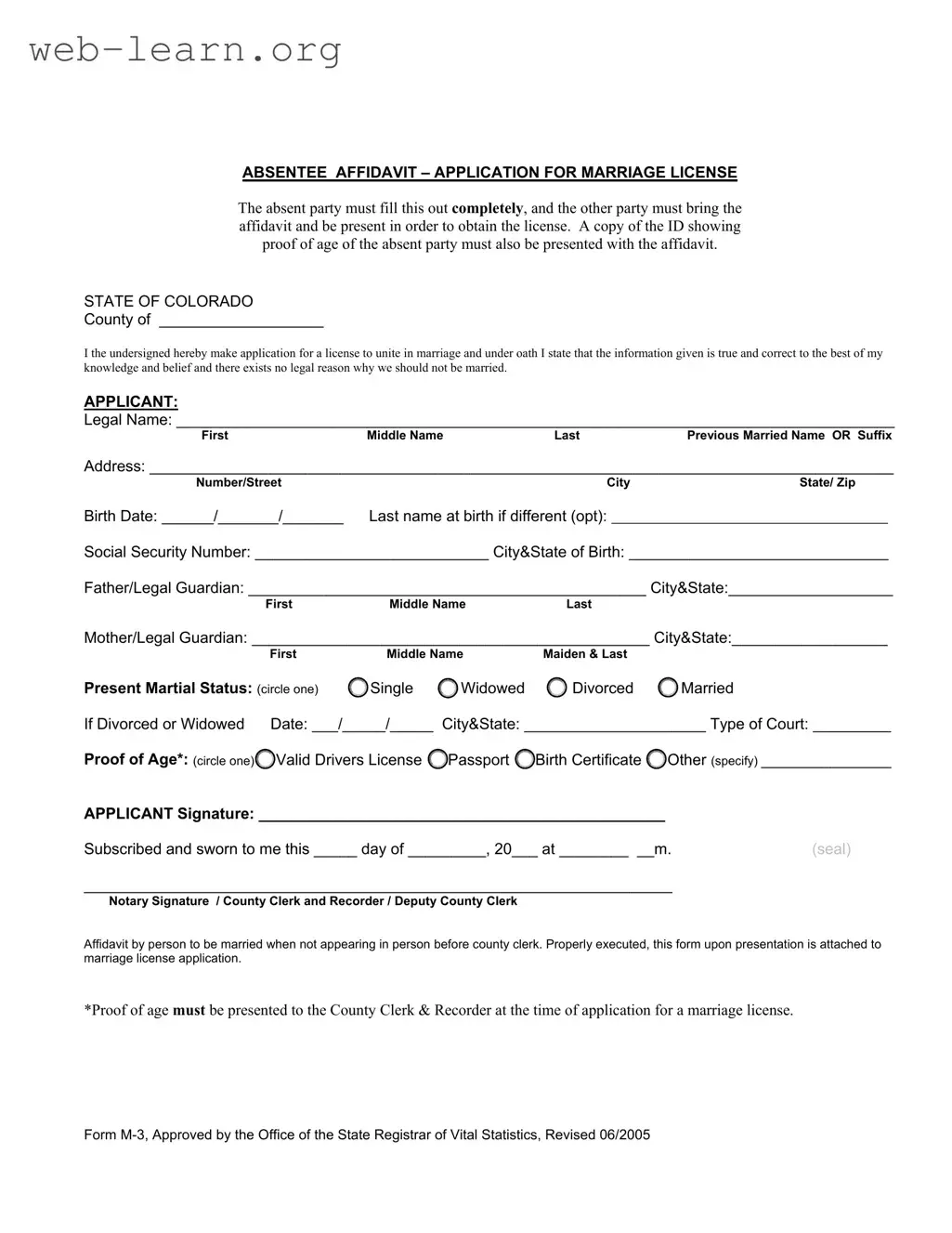
When planning a wedding, navigating the legal requirements can feel overwhelming, especially when one party is unable to appear in person. The M 3 Colorado form serves as a critical tool for couples in this situation, allowing an absent party to apply for a marriage license through an affidavit. This form requires the absent individual to provide essential personal information, including their legal name, address, date of birth, and social security number. Additionally, it mandates the inclusion of a valid form of identification to prove the absent party's age. The presence of the other party is necessary when submitting the affidavit, ensuring that both individuals are committed to the union. Furthermore, the form includes sections for disclosing parental information and current marital status, which are vital for the application process. By understanding the requirements and completing the M 3 form accurately, couples can streamline their path to obtaining a marriage license, even when faced with the challenge of distance.

ABSENTEE AFFIDAVIT – APPLICATION FOR MARRIAGE LICENSE
The absent party must fill this out completely, and the other party must bring the affidavit and be present in order to obtain the license. A copy of the ID showing proof of age of the absent party must also be presented with the affidavit.
STATE OF COLORADO
County of ___________________
I the undersigned hereby make application for a license to unite in marriage and under oath I state that the information given is true and correct to the best of my knowledge and belief and there exists no legal reason why we should not be married.
APPLICANT:
Legal Name: ___________________________________________________________________________________
FirstMiddle NameLastPrevious Married Name OR Suffix
Address: ______________________________________________________________________________________
Number/Street |
City |
State/ Zip |
Birth Date: ______/_______/_______ |
Last name at birth if different (opt): ________________________________________ |
|
Social Security Number: ___________________________ City&State of Birth: ______________________________
Father/Legal Guardian: ______________________________________________ City&State:___________________
FirstMiddle NameLast
Mother/Legal Guardian: ______________________________________________ City&State:__________________
|
First |
Middle Name |
Maiden & Last |
|
|
Present Martial Status: (circle one) |
Single |
Widowed |
Divorced |
Married |
|
If Divorced or Widowed |
Date: ___/_____/_____ City&State: _____________________ Type of Court: _________ |
||||
Proof of Age*: (circle one) |
Valid Drivers License |
Passport |
Birth Certificate Other (specify) _______________ |
||
APPLICANT Signature: _______________________________________________ |
|
||||
Subscribed and sworn to me this _____ day of _________, 20___ at ________ __m. |
(seal) |
||||
____________________________________________________________________ |
|
||||
Notary Signature / County Clerk and Recorder / Deputy County Clerk |
|
|
|||
Affidavit by person to be married when not appearing in person before county clerk. Properly executed, this form upon presentation is attached to marriage license application.
*Proof of age must be presented to the County Clerk & Recorder at the time of application for a marriage license.
Form
| Fact Name | Details |
|---|---|
| Purpose of the Form | The M 3 Colorado form is an Absentee Affidavit used when one party is unable to be present for a marriage license application. |
| Identification Requirement | A copy of the absent party's ID, which shows proof of age, must be presented along with the affidavit. |
| Notary Requirement | The form must be signed in the presence of a notary or county clerk, who will attest to the signature. |
| Governing Law | This form is governed by Colorado marriage laws, specifically under Title 14 of the Colorado Revised Statutes. |
Completing the M 3 Colorado form is an essential step for obtaining a marriage license when one party is absent. This process requires careful attention to detail to ensure that all necessary information is accurately provided. The following steps outline how to fill out the form correctly.
After completing the M 3 form, ensure that the affidavit and a copy of the absent party's ID are presented to the county clerk. This will facilitate the process of obtaining the marriage license.
What is the M 3 Colorado form?
The M 3 Colorado form, also known as the Absentee Affidavit, is used when one party to a marriage is unable to appear in person to apply for a marriage license. This form must be filled out completely by the absent party, and the other party must bring it along when applying for the license. Additionally, a copy of the absent party's ID that proves their age must be presented.
Who needs to fill out the M 3 form?
The absent party, meaning the individual who cannot be present at the county clerk's office, is responsible for completing the M 3 form. This includes providing personal information such as their legal name, address, birth date, and social security number. The present party must then bring this completed affidavit to the application appointment.
What information is required on the M 3 form?
The form requires several key pieces of information:
Each section must be filled out accurately to ensure the application process goes smoothly.
What is considered proof of age?
Proof of age can be demonstrated through various documents. Acceptable forms include:
It is essential to present this proof at the time of application for the marriage license.
What happens if the absent party is divorced or widowed?
If the absent party has been divorced or widowed, they must provide the date of their previous marriage's dissolution or the date of their spouse's death. This information helps clarify their current marital status and ensures compliance with legal requirements.
Where do I submit the M 3 form?
The completed M 3 form must be submitted to the county clerk's office along with the other party present. It is important to ensure that all required documentation is included, as this will facilitate a smoother application process for the marriage license.
When filling out the M 3 Colorado form, some common mistakes can lead to delays or complications in obtaining a marriage license. One frequent error is leaving out important personal information. Each section must be filled out completely, including the full legal names of both parties. Omitting any part of the name can create confusion and may result in the application being rejected.
Another common mistake is not providing proof of age. The absent party must submit a valid form of identification, such as a driver’s license or birth certificate, along with the affidavit. Failing to include this documentation can prevent the application from being processed.
Many applicants forget to check their marital status accurately. It is essential to circle the correct option, whether it is single, widowed, divorced, or married. Misrepresenting one's status can lead to legal issues down the line.
Additionally, some people neglect to include the correct date of birth. This information must be precise and match the proof of age provided. Errors in the birth date can cause discrepancies that complicate the application process.
Another mistake involves the signatures. Both parties must ensure that their signatures are included where required. If the absent party does not sign the affidavit, the application cannot proceed.
Applicants sometimes overlook the requirement for a notary signature. The affidavit must be notarized to be valid. Without this step, the application will not be accepted by the county clerk.
Providing the wrong city and state of birth is another common error. This information should accurately reflect where the applicant was born. Incorrect details can lead to further verification steps that delay the process.
Some individuals fail to check the expiration date of their identification. If the proof of age is expired, it may not be accepted. Always ensure that the ID is current before submitting the application.
Finally, applicants may forget to bring the affidavit along with the application. The absent party must ensure that this document is present when the other party applies for the marriage license. Without it, the application cannot be processed.
The M 3 Colorado form is an essential document for obtaining a marriage license when one party is absent. However, several other forms and documents may be required or helpful in conjunction with this application. Below is a list of commonly used forms and documents that can assist in the marriage license process.
These forms and documents play a vital role in ensuring that the marriage license application process is smooth and compliant with state regulations. It is essential to gather all necessary paperwork before proceeding with the application to avoid delays.
The M 3 Colorado form, which serves as an Absentee Affidavit for a marriage license application, shares similarities with several other important legal documents. Each of these documents plays a role in affirming identity, legal status, or consent in various contexts. Below are four documents that exhibit these similarities:
When filling out the M 3 Colorado form for an absentee affidavit related to a marriage license, attention to detail is crucial. Below is a list of things to do and avoid to ensure a smooth application process.
By following these guidelines, you can help facilitate a more efficient process for obtaining your marriage license. Each detail matters, and being thorough will assist in avoiding unnecessary delays.
Understanding the M 3 Colorado form is crucial for those applying for a marriage license. Here are four common misconceptions about this form:
Being informed about these misconceptions can help streamline the process and ensure that all requirements are met for a successful marriage license application.
When filling out and using the M 3 Colorado form for an absentee affidavit, it is important to keep the following key takeaways in mind:
Completing the M 3 form accurately will help ensure a smooth process in obtaining your marriage license. Be prepared with all necessary documents and information to avoid delays.