The Louisiana Quitclaim Deed form serves as a vital instrument in the transfer of property rights, allowing individuals to convey their interest in real estate without making any guarantees about the title's validity. This form is particularly useful when the grantor wants to relinquish their claim to a property, often in situations involving family transfers, divorces, or settling estates. Unlike a warranty deed, which provides assurances regarding the title, a quitclaim deed offers no such protections, making it essential for both parties to understand the implications of this type of transfer. In Louisiana, specific requirements must be met for the deed to be valid, including proper execution, notarization, and recording with the appropriate parish office. The simplicity of the quitclaim deed can be both an advantage and a disadvantage; while it facilitates quick transactions, it also leaves the grantee with potential risks regarding the property's title. Understanding these key aspects is crucial for anyone considering the use of a quitclaim deed in Louisiana, as it can significantly impact future ownership rights and responsibilities.
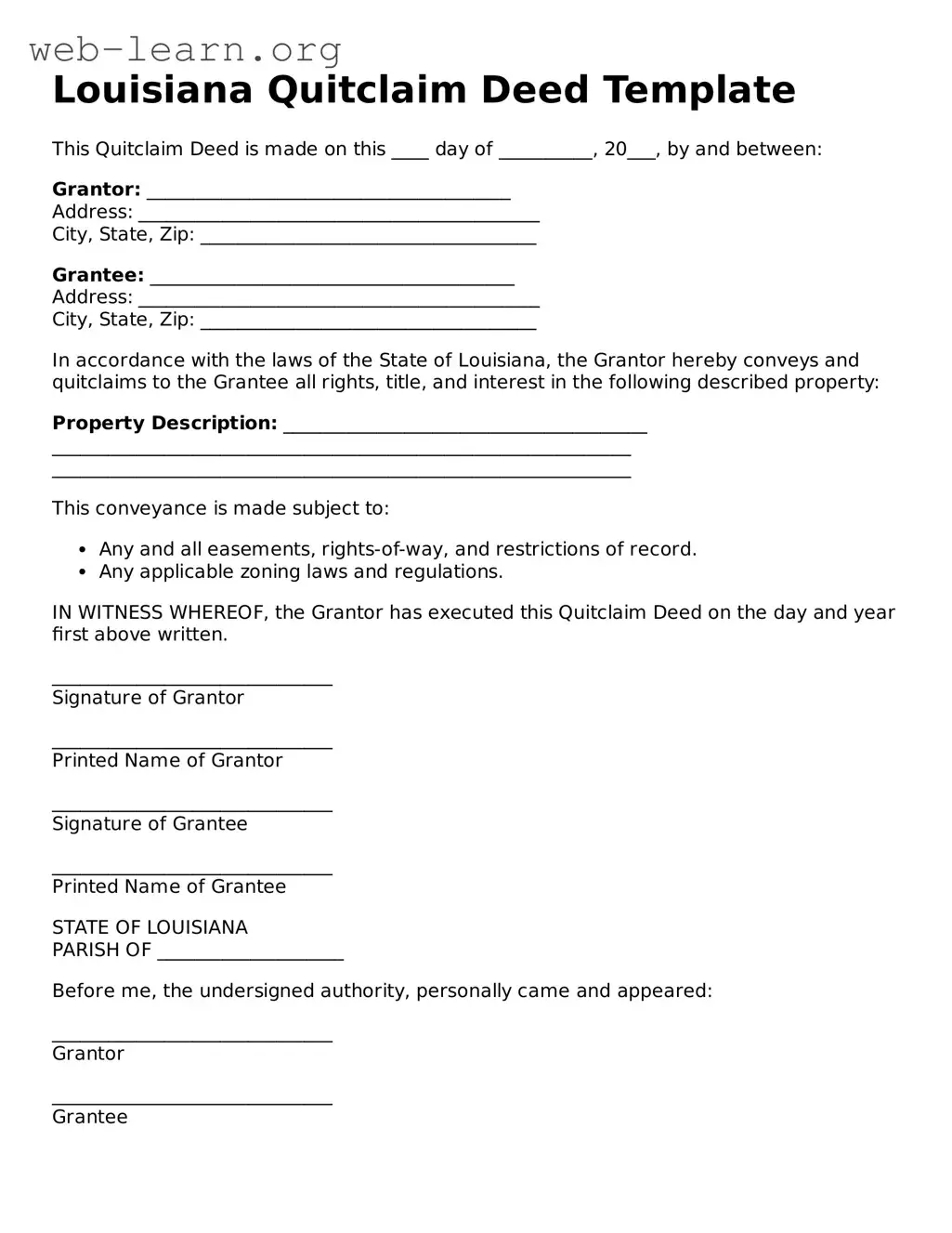
Louisiana Quitclaim Deed Template
This Quitclaim Deed is made on this ____ day of __________, 20___, by and between:
Grantor: _______________________________________
Address: ___________________________________________
City, State, Zip: ____________________________________
Grantee: _______________________________________
Address: ___________________________________________
City, State, Zip: ____________________________________
In accordance with the laws of the State of Louisiana, the Grantor hereby conveys and quitclaims to the Grantee all rights, title, and interest in the following described property:
Property Description: _______________________________________
______________________________________________________________
______________________________________________________________
This conveyance is made subject to:
IN WITNESS WHEREOF, the Grantor has executed this Quitclaim Deed on the day and year first above written.
______________________________
Signature of Grantor
______________________________
Printed Name of Grantor
______________________________
Signature of Grantee
______________________________
Printed Name of Grantee
STATE OF LOUISIANA
PARISH OF ____________________
Before me, the undersigned authority, personally came and appeared:
______________________________
Grantor
______________________________
Grantee
Who are known to me or satisfactorily proven to be the persons whose names are subscribed to the foregoing instrument, and acknowledged that they executed the same for the purposes therein contained.
Given under my hand and seal this ____ day of __________, 20___.
______________________________
Notary Public
My Commission Expires: ____________
| Fact Name | Description |
|---|---|
| Definition | A quitclaim deed is a legal document that transfers ownership of property without any warranties regarding the title. |
| Use | Commonly used to transfer property between family members, in divorce settlements, or to clear up title issues. |
| Governing Law | In Louisiana, quitclaim deeds are governed by the Louisiana Civil Code, specifically Articles 2440-2445. |
| Title Transfer | The grantor conveys whatever interest they have in the property, but does not guarantee that the title is free of defects. |
| Formality | While a quitclaim deed does not require notarization, having it notarized can provide additional legal protection. |
| Recording | To ensure the deed is effective against third parties, it should be recorded in the parish where the property is located. |
| Consideration | Typically, no monetary consideration is required for a quitclaim deed, but a nominal amount may be stated. |
| Limitations | It does not clear any liens or encumbrances on the property; the new owner may still be responsible for these issues. |
After obtaining the Louisiana Quitclaim Deed form, you will need to complete it accurately. This document is essential for transferring property rights from one party to another. Follow the steps below to ensure that you fill it out correctly.
What is a Quitclaim Deed in Louisiana?
A Quitclaim Deed is a legal document used to transfer ownership of real estate from one party to another. Unlike a warranty deed, it does not guarantee that the property is free of liens or claims. The seller, or grantor, essentially "quits" any claim they have to the property, transferring whatever interest they may have to the buyer, or grantee.
When should I use a Quitclaim Deed?
This type of deed is commonly used in situations such as transferring property between family members, clearing up title issues, or when one spouse is relinquishing their interest in a property during a divorce. It’s a quick way to transfer ownership without extensive legal processes.
What information is required on a Louisiana Quitclaim Deed?
A Quitclaim Deed in Louisiana must include:
Do I need to have the Quitclaim Deed notarized?
Yes, the signature of the grantor must be notarized for the Quitclaim Deed to be valid. This step ensures that the identity of the grantor is verified and helps prevent fraud.
Is it necessary to record the Quitclaim Deed?
While it is not mandatory to record a Quitclaim Deed, it is highly recommended. Recording the deed with the local parish clerk’s office provides public notice of the ownership transfer and protects the grantee’s interest in the property.
Are there any fees associated with filing a Quitclaim Deed?
Yes, there may be fees for recording the Quitclaim Deed. These fees can vary by parish, so it’s advisable to check with the local clerk’s office for specific amounts.
Can a Quitclaim Deed be revoked?
Once a Quitclaim Deed is executed and recorded, it cannot be revoked. However, the grantor can create a new deed to transfer the property back, if desired. This new deed would need to follow the same legal requirements as the original Quitclaim Deed.
What are the risks of using a Quitclaim Deed?
The primary risk is that the grantor does not guarantee the title is clear of liens or other claims. If there are issues with the title, the grantee may face legal challenges in the future. It is wise to conduct a title search or consult with a real estate attorney before proceeding.
Can I use a Quitclaim Deed for commercial property?
Yes, a Quitclaim Deed can be used for both residential and commercial properties. The same legal principles apply, but it’s important to ensure that all parties understand the implications of the transfer.
Where can I obtain a Quitclaim Deed form in Louisiana?
Quitclaim Deed forms can often be found online through legal document websites, at local office supply stores, or from a real estate attorney. Ensure that the form you use complies with Louisiana state laws.
Filling out a Louisiana Quitclaim Deed form can be a straightforward process, but many individuals make common mistakes that can lead to complications down the line. Understanding these pitfalls is essential for ensuring that your property transfer goes smoothly.
One frequent error is not including the correct legal description of the property. The legal description should be precise, detailing the boundaries and location. A vague or inaccurate description can create confusion and even legal disputes later on.
Another common mistake involves failing to properly identify the grantor and grantee. It's crucial to ensure that names are spelled correctly and that the individuals listed have the legal capacity to transfer or receive property. Any errors in this section can render the deed invalid.
Many people overlook the importance of signatures. A Quitclaim Deed must be signed by the grantor, and in some cases, the grantee may also need to sign. Failing to include all necessary signatures can lead to delays in processing or even invalidate the deed.
Not having the document notarized is another significant oversight. In Louisiana, a Quitclaim Deed typically requires notarization to be legally binding. Without this step, the deed may not hold up in court if challenged.
Additionally, some individuals forget to include the date of the transfer. This date is important for record-keeping and can affect the timeline of ownership. Leaving it blank can create confusion regarding when the transfer actually took place.
Another mistake is neglecting to check for any outstanding liens or encumbrances on the property. If there are existing debts tied to the property, the new owner may inherit these issues. It's vital to conduct a title search before completing the deed.
Many people also fail to provide adequate consideration. While a Quitclaim Deed does not require a significant monetary exchange, stating some form of consideration is necessary to validate the transfer. Omitting this detail can lead to complications.
Some individuals may not file the deed with the appropriate local authority after completing it. Filing is crucial, as it officially records the transfer of ownership. Without this step, the new ownership may not be recognized, causing potential legal issues.
Lastly, people often overlook the importance of consulting with a professional. While it may seem like a simple form, the implications of errors can be significant. Seeking legal advice can help avoid these mistakes and ensure a smooth property transfer.
When handling property transfers in Louisiana, the Quitclaim Deed is a crucial document. However, several other forms and documents often accompany it to ensure a smooth transaction. Below is a list of these essential documents, each serving a specific purpose in the property transfer process.
Utilizing these documents in conjunction with the Louisiana Quitclaim Deed can help facilitate a more efficient and secure property transfer. Each form plays a unique role, ensuring that all parties are protected and informed throughout the process.
The Quitclaim Deed form shares similarities with several other legal documents that facilitate the transfer of property rights. Below is a list of nine documents that are comparable in nature, along with a brief explanation of how they relate to the Quitclaim Deed.
When filling out the Louisiana Quitclaim Deed form, it's important to follow certain guidelines to ensure accuracy and compliance. Here’s a list of what to do and what to avoid:
There are several misconceptions surrounding the Louisiana Quitclaim Deed form. Understanding these can help individuals navigate property transactions more effectively. Below are six common misconceptions:
A Quitclaim Deed transfers ownership of property. This is not entirely accurate. A Quitclaim Deed transfers the interest that the grantor has in the property, but it does not guarantee that the grantor actually owns the property or has the right to transfer it.
A Quitclaim Deed is the same as a Warranty Deed. This is a common misunderstanding. Unlike a Warranty Deed, which provides guarantees about the title, a Quitclaim Deed offers no warranties. The buyer assumes all risks regarding the title.
A Quitclaim Deed is only used in divorce cases. While it is often used in divorce proceedings to transfer property between spouses, it is also used in various other situations, such as transferring property between family members or clearing up title issues.
A Quitclaim Deed can be used to eliminate mortgage obligations. This is incorrect. A Quitclaim Deed does not remove any existing mortgage obligations. The responsibility for the mortgage remains with the original borrower, regardless of the deed transfer.
A Quitclaim Deed is a complex legal document. In reality, a Quitclaim Deed is relatively straightforward. It typically includes basic information such as the names of the parties involved, a description of the property, and the signatures of the grantor and grantee.
Once a Quitclaim Deed is signed, it cannot be revoked. This is a misconception. While a Quitclaim Deed is generally considered final, the grantor may have the ability to revoke it under certain conditions, depending on state laws and the specific circumstances of the transaction.
Being informed about these misconceptions can aid in making better decisions regarding property transactions in Louisiana.
When dealing with property transfers in Louisiana, a Quitclaim Deed can be a useful tool. Here are some key takeaways to keep in mind when filling out and using this form:
By following these key points, you can navigate the Quitclaim Deed process in Louisiana more effectively.
Quit Claim Deed Form Hawaii - A Quitclaim Deed can be used to add or remove a name from a title.
How to File a Quit Claim Deed in Kentucky - The deed should be executed in accordance with state laws.