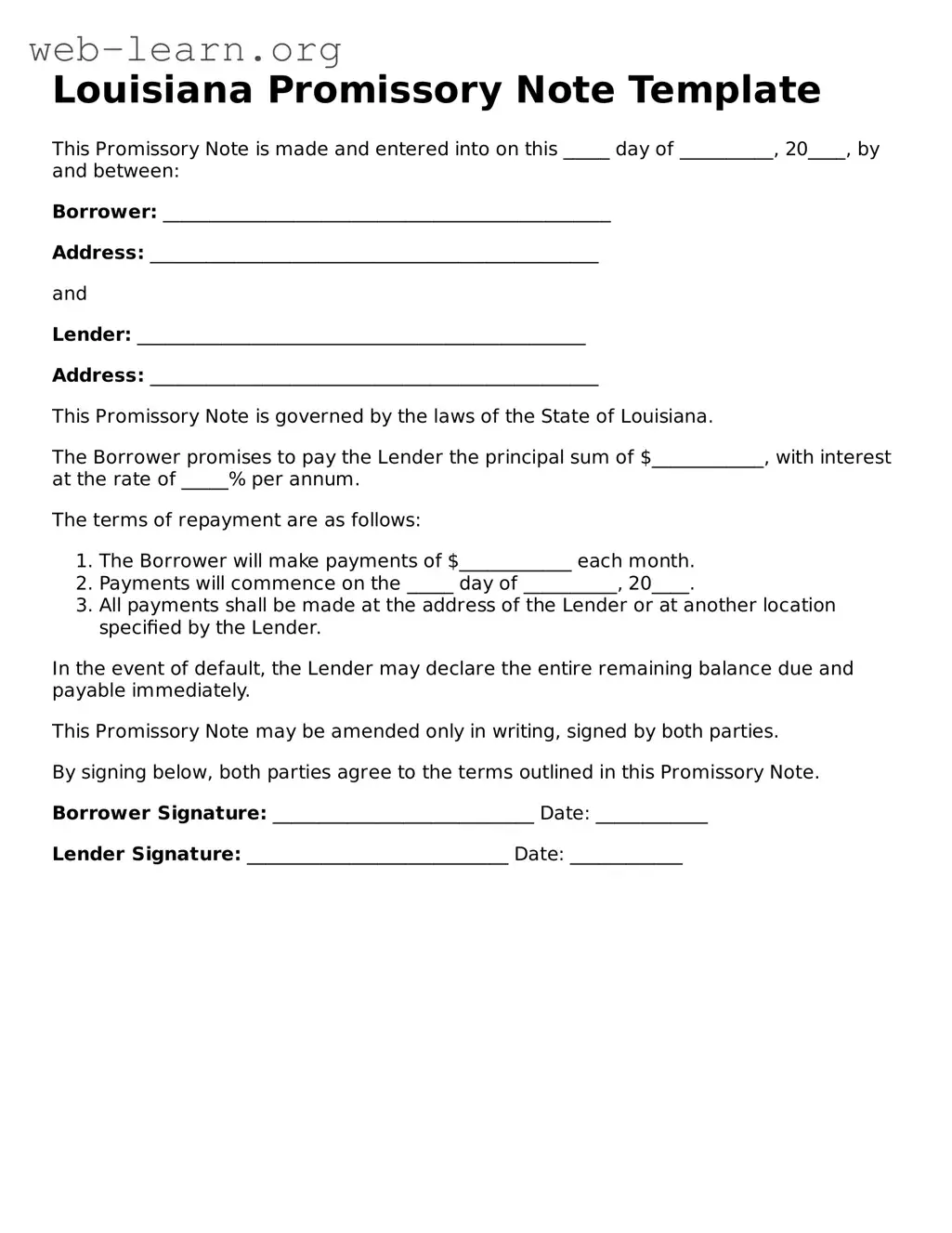
When entering into a loan agreement in Louisiana, understanding the Promissory Note form is crucial for both borrowers and lenders. This essential document outlines the specific terms of the loan, detailing the amount borrowed, the interest rate, and the repayment schedule. It serves as a legal promise from the borrower to repay the loan under the agreed-upon conditions. Additionally, the form includes provisions for late fees, prepayment options, and potential consequences in case of default. By clearly articulating these terms, the Promissory Note not only protects the lender's interests but also provides the borrower with a clear understanding of their obligations. Moreover, Louisiana's unique legal framework may influence certain aspects of the note, making it important for parties to be aware of local regulations. Overall, the Promissory Note is more than just a piece of paper; it is a foundational element of trust and accountability in financial transactions.
Louisiana Promissory Note Template
This Promissory Note is made and entered into on this _____ day of __________, 20____, by and between:
Borrower: ________________________________________________
Address: ________________________________________________
and
Lender: ________________________________________________
Address: ________________________________________________
This Promissory Note is governed by the laws of the State of Louisiana.
The Borrower promises to pay the Lender the principal sum of $____________, with interest at the rate of _____% per annum.
The terms of repayment are as follows:
In the event of default, the Lender may declare the entire remaining balance due and payable immediately.
This Promissory Note may be amended only in writing, signed by both parties.
By signing below, both parties agree to the terms outlined in this Promissory Note.
Borrower Signature: ____________________________ Date: ____________
Lender Signature: ____________________________ Date: ____________
| Fact Name | Description |
|---|---|
| Definition | A Louisiana Promissory Note is a written promise to pay a specific amount of money to a designated person or entity at a specified time. |
| Governing Law | The Louisiana Promissory Note is governed by the Louisiana Civil Code, specifically Articles 3131-3139. |
| Parties Involved | Typically, there are two parties: the maker (the person who promises to pay) and the payee (the person who receives the payment). |
| Interest Rate | The note may specify an interest rate, which must comply with Louisiana's usury laws. |
| Payment Terms | Payment terms, including due dates and installment amounts, should be clearly outlined in the document. |
| Signature Requirement | The maker's signature is required for the note to be valid, indicating their agreement to the terms. |
| Enforceability | If properly executed, a Louisiana Promissory Note is legally enforceable in a court of law. |
| Default Consequences | In the event of default, the payee may have the right to pursue legal action to recover the owed amount. |
Once you have the Louisiana Promissory Note form in front of you, it's time to fill it out carefully. This document will require specific information about the borrower and lender, as well as the terms of the loan. Make sure you have all necessary details at hand before you begin.
After completing the form, both parties should review it to ensure all information is accurate. Once confirmed, the document can be shared and stored safely. It’s a good idea to keep it in a secure location, as it serves as a record of the loan agreement.
What is a Louisiana Promissory Note?
A Louisiana Promissory Note is a legal document in which one party (the borrower) promises to pay a specified sum of money to another party (the lender) at a designated time or upon demand. This note outlines the terms of the loan, including the interest rate, repayment schedule, and any penalties for late payments.
Why is a Promissory Note important?
This document serves as a formal agreement between the borrower and lender, providing legal protection for both parties. It clarifies the expectations regarding repayment, helping to prevent misunderstandings and disputes in the future.
What information is typically included in a Louisiana Promissory Note?
Is it necessary to have a lawyer draft the Promissory Note?
While it is not mandatory to have a lawyer draft the note, it is highly recommended. A legal expert can ensure that the document complies with Louisiana laws and adequately protects your interests.
Can a Promissory Note be modified after it is signed?
Yes, a Promissory Note can be modified, but both parties must agree to the changes. It is advisable to document any modifications in writing and have both parties sign the amended agreement to avoid future disputes.
What happens if the borrower fails to repay the loan?
If the borrower defaults on the loan, the lender has the right to take legal action. This may include filing a lawsuit to recover the owed amount or pursuing collection efforts. The terms outlined in the Promissory Note will guide the lender’s actions.
Are there different types of Promissory Notes?
Yes, there are various types of Promissory Notes, including secured and unsecured notes. A secured note is backed by collateral, while an unsecured note is not. The choice between these options depends on the level of risk involved for the lender.
Do I need witnesses or notarization for a Promissory Note in Louisiana?
While Louisiana does not require witnesses or notarization for a Promissory Note to be valid, having it notarized can add an extra layer of protection and credibility. It can help verify the identities of the parties involved and the authenticity of the signatures.
How long is a Promissory Note valid?
The validity of a Promissory Note can vary based on the terms agreed upon by both parties. Generally, the note remains valid until the debt is fully repaid. However, if the borrower does not repay the loan, the lender may have a limited time to take legal action, depending on Louisiana's statute of limitations.
Where can I find a Louisiana Promissory Note template?
Templates for Louisiana Promissory Notes can be found online, but it is essential to ensure that any template used complies with state laws. Consulting a legal professional is advisable to ensure that the document meets all necessary requirements and protects your interests.
Filling out a Louisiana Promissory Note form can seem straightforward, but there are common mistakes that people often make. One frequent error is not including all necessary parties. Make sure to clearly identify the borrower and lender, including their full names and addresses. Omitting this information can lead to confusion later on.
Another common mistake is neglecting to specify the loan amount. It’s essential to write the exact amount being borrowed in both numerical and written form. This helps prevent any disputes about the loan terms. If these details are missing or unclear, it could complicate the repayment process.
People also often forget to include the interest rate. Clearly stating the interest rate is crucial. If you leave it out, the loan may be considered interest-free, which could be a significant financial oversight. Make sure to double-check that this information is accurate and clearly noted.
Additionally, many individuals overlook the repayment terms. Specify when the borrower must repay the loan. Include the due date and any installment details. Without this information, the borrower may not understand when payments are expected, leading to potential defaults.
Another mistake is failing to sign and date the document. Both parties should sign the Promissory Note to make it legally binding. Without signatures, the agreement may not hold up in court. Ensure that both parties date the document to establish a clear timeline.
Some people forget to include a default clause. This clause outlines what happens if the borrower fails to make payments. Including this information protects the lender and clarifies the consequences for the borrower.
Another common oversight is not having a witness or notary present during the signing. While not always required, having a witness can add an extra layer of legitimacy to the document. A notary can also help verify the identities of both parties, reducing the risk of fraud.
People sometimes use vague language. It’s important to be clear and specific in your wording. Ambiguities can lead to misunderstandings and disputes. Use straightforward language to ensure that both parties understand the terms of the agreement.
Lastly, failing to keep copies of the signed Promissory Note is a mistake that can lead to problems down the line. Both parties should retain a copy for their records. This ensures that everyone has access to the terms of the agreement, should any issues arise in the future.
When engaging in a financial transaction that involves a Louisiana Promissory Note, several other forms and documents may be necessary to ensure clarity and protect the interests of all parties involved. Understanding these documents can help facilitate smoother transactions and provide additional legal backing.
Incorporating these documents alongside a Louisiana Promissory Note can provide a more robust framework for financial transactions. By clearly defining terms and expectations, all parties can navigate the lending process with greater confidence and security.
A Promissory Note is a financial document that outlines a promise to pay a specific amount of money to a designated party. While it serves a unique purpose, several other documents share similarities with it. Here are six such documents:
Understanding these documents can help clarify their roles in financial transactions and the obligations they create. Each serves a unique purpose, yet they all revolve around the central theme of a promise to pay.
When filling out the Louisiana Promissory Note form, it's important to be careful and thorough. Here are six key things to keep in mind:
Understanding the Louisiana Promissory Note form is crucial for anyone involved in lending or borrowing money. However, several misconceptions can lead to confusion. Here are seven common misconceptions explained:
Addressing these misconceptions can help ensure that both lenders and borrowers understand their rights and responsibilities under the Louisiana Promissory Note form.
When dealing with a Louisiana Promissory Note, understanding the key elements is crucial for both lenders and borrowers. Here are some important takeaways to keep in mind:
Using this form correctly can help protect the interests of both parties and ensure a smooth transaction.
Notarized Promissory Note Sample - They can help facilitate smoother transactions by clearly defining the terms of the loan.
Promissory Note Hawaii - Promissory notes are often used in business transactions to secure financing.
Promissory Note Friendly Loan Agreement Format - Promissory notes can help establish a positive credit history when repaid as agreed.