The Louisiana Power of Attorney for a Child form serves as an important legal tool for parents and guardians, allowing them to designate another individual to make decisions on behalf of their child in specific situations. This form is particularly useful when a parent is unable to care for their child temporarily due to various reasons such as travel, illness, or other personal circumstances. The designated individual, often referred to as the agent, can be granted authority to handle matters related to the child's education, healthcare, and general welfare. It is essential for the form to be completed accurately, as it outlines the scope of authority granted and the duration of the power of attorney. Parents should ensure that the chosen agent is someone they trust and who understands the responsibilities involved. Additionally, the form must be signed and dated by the parent or guardian, and it is advisable to have it notarized to enhance its legal validity. Understanding the key elements of this form can help families navigate temporary changes in caregiving arrangements with greater ease and confidence.
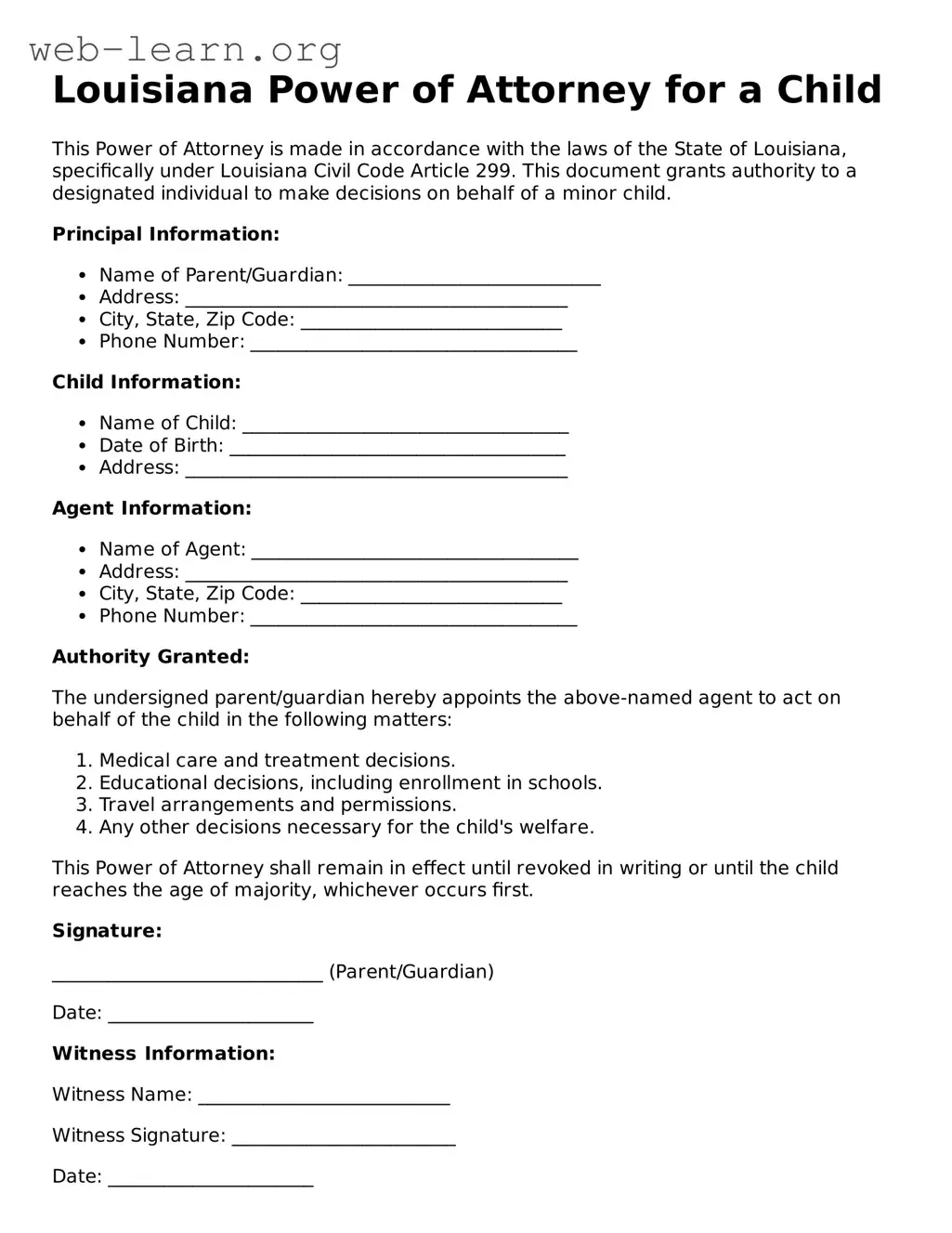
Louisiana Power of Attorney for a Child
This Power of Attorney is made in accordance with the laws of the State of Louisiana, specifically under Louisiana Civil Code Article 299. This document grants authority to a designated individual to make decisions on behalf of a minor child.
Principal Information:
Child Information:
Agent Information:
Authority Granted:
The undersigned parent/guardian hereby appoints the above-named agent to act on behalf of the child in the following matters:
This Power of Attorney shall remain in effect until revoked in writing or until the child reaches the age of majority, whichever occurs first.
Signature:
_____________________________ (Parent/Guardian)
Date: ______________________
Witness Information:
Witness Name: ___________________________
Witness Signature: ________________________
Date: ______________________
Notary Public:
State of Louisiana
Parish of ___________________________
On this _____ day of ___________, 20___, before me, a notary public, personally appeared ___________________________, known to me to be the person whose name is subscribed to the within instrument, and acknowledged that he/she executed the same for the purposes therein contained.
_____________________________ (Notary Public)
My commission expires: ____________________
| Fact Name | Details |
|---|---|
| Purpose | The Louisiana Power of Attorney for a Child form allows a parent or legal guardian to designate another adult to make decisions for their child. |
| Governing Law | This form is governed by Louisiana Civil Code Article 2630, which outlines the requirements and limitations of powers of attorney for minors. |
| Duration | The power of attorney can be effective for a specific period or until revoked by the parent or guardian. |
| Eligibility | Only a parent or legal guardian can create this power of attorney. The appointed adult must be at least 18 years old. |
| Scope of Authority | The appointed individual can make decisions regarding education, health care, and other day-to-day matters affecting the child. |
| Revocation | A parent or guardian can revoke the power of attorney at any time, provided they do so in writing. |
| Notarization | The form must be signed in the presence of a notary public to be considered valid. |
| Limitations | This power of attorney does not grant the appointed individual the authority to consent to marriage or adoption of the child. |
Filling out the Louisiana Power of Attorney for a Child form is a crucial step in ensuring that your child's needs are met in your absence. This form allows you to designate someone to make decisions on behalf of your child. Follow these steps carefully to complete the form accurately.
After completing the form, it is advisable to discuss the responsibilities and expectations with the appointed agent. Open communication will help ensure that your child's best interests are prioritized during the time the Power of Attorney is in effect.
What is a Power of Attorney for a Child in Louisiana?
A Power of Attorney for a Child in Louisiana is a legal document that allows a parent or legal guardian to grant another adult the authority to make decisions on behalf of their child. This authority can cover various aspects, including medical care, education, and general welfare. It is often used when a parent needs to be away for an extended period or when the child is in the care of someone else temporarily.
Who can be appointed as an attorney-in-fact?
Any adult can be appointed as an attorney-in-fact, provided they are willing to take on the responsibilities. This could be a relative, friend, or trusted neighbor. However, it is important to choose someone who is responsible and capable of making decisions in the best interest of the child.
What powers can be granted through this document?
The powers granted can vary depending on the needs of the child and the preferences of the parent. Common powers include:
Parents can specify the extent of the authority in the document, ensuring it aligns with their wishes.
How long does a Power of Attorney for a Child last?
The duration of a Power of Attorney for a Child can be specified in the document. It may be set for a specific period, such as a few months, or it can remain in effect until revoked by the parent or legal guardian. If no end date is specified, the authority generally lasts until the child reaches the age of majority, which is 18 in Louisiana.
Can the Power of Attorney be revoked?
Yes, a Power of Attorney for a Child can be revoked at any time by the parent or legal guardian. To revoke it, the parent should create a written notice stating the revocation and provide it to the attorney-in-fact. It is advisable to inform any relevant parties, such as schools or medical providers, about the revocation to avoid confusion.
Is it necessary to have the document notarized?
While it is not strictly required, having the Power of Attorney for a Child notarized is highly recommended. Notarization adds an extra layer of validity and can help prevent disputes regarding the document's authenticity. It may also be required by certain institutions, such as schools or medical facilities, when the attorney-in-fact is exercising their authority.
Filling out a Power of Attorney for a Child form in Louisiana can be a straightforward process, but many people make mistakes that can lead to complications down the line. One common error is not specifying the powers granted. When you leave this section vague, it can create confusion about what the designated agent can and cannot do. Clearly outlining the powers ensures that the agent understands their responsibilities and limits.
Another mistake is failing to date the document. A Power of Attorney is only valid if it is properly dated. Without a date, it may be difficult to determine when the authority was granted, which can lead to disputes or challenges regarding its validity.
Many individuals also overlook the need for notarization. In Louisiana, a Power of Attorney for a Child must be notarized to be legally binding. Skipping this step can render the document ineffective, which could create problems when the designated agent attempts to act on behalf of the child.
Additionally, some people forget to include the full names of both the child and the agent. Using nicknames or initials may lead to confusion and could potentially invalidate the document. Always use the full legal names to ensure clarity and avoid any legal issues.
Another frequent oversight is neglecting to discuss the arrangement with the child. Depending on their age, children may have preferences or opinions about who should act on their behalf. Involving them in the conversation can help ease any anxiety they may feel about the situation.
People often fail to consider the duration of the Power of Attorney. Without specifying an end date or conditions for termination, the authority granted may continue longer than intended. It is crucial to state how long the agent will have power or under what circumstances the authority will end.
Moreover, many individuals do not provide a backup agent. Life can be unpredictable, and the primary agent may not always be available to act on behalf of the child. Designating a secondary agent can ensure that there is always someone ready to step in when needed.
Some forms are submitted without checking for errors. Typos or incorrect information can lead to significant issues. Carefully reviewing the document before submission can help catch mistakes that might otherwise go unnoticed.
Lastly, individuals sometimes forget to distribute copies of the completed form to relevant parties. Once the Power of Attorney is executed, it’s essential to provide copies to the designated agent, the child’s school, and any healthcare providers. This ensures that everyone is aware of the arrangement and can act accordingly.
When preparing a Louisiana Power of Attorney for a Child form, it may be beneficial to consider additional documents that can support the legal process. Each of these forms serves a specific purpose and can enhance the clarity and effectiveness of your legal arrangements.
Incorporating these documents alongside the Louisiana Power of Attorney for a Child can provide a comprehensive approach to child care and legal responsibilities. Each form plays a vital role in ensuring that the child's best interests are prioritized and that all parties involved understand their rights and obligations.
When filling out the Louisiana Power of Attorney for a Child form, it's essential to proceed with care. Here are five important dos and don'ts to keep in mind:
Taking these steps can help ensure that the Power of Attorney is executed correctly and serves its intended purpose effectively.
The Louisiana Power of Attorney for a Child form is a useful tool for parents and guardians, but several misconceptions surround it. Here are five common misunderstandings:
Many believe this form is only necessary in urgent situations. In reality, it can be beneficial for planned events, such as vacations or long-term travel, where a child will be under someone else's care.
Some think that signing this form means giving up custody. However, the Power of Attorney for a Child allows temporary authority for specific decisions without relinquishing parental rights.
While notarization can add an extra layer of authenticity, it is not always a requirement for the Power of Attorney for a Child to be legally binding in Louisiana.
This form is often associated with medical care, but it can also grant authority for educational and other important decisions regarding the child's welfare.
People may think the form is standardized and doesn't need customization. In fact, it should be tailored to fit the specific needs and circumstances of the child and the designated caregiver.
The Louisiana Power of Attorney for a Child form is a crucial document for parents or legal guardians who need to designate another adult to make decisions on behalf of a minor child. Here are key takeaways regarding its use:
Temporary Poa for Child - Parents should inform schools and caregivers about the appointed agent.
How to Get Power of Attorney in Arkansas - It serves as a legal safeguard for both the child and the appointed caregiver.
Michigan Power of Attorney - Having a Power of Attorney for a Child can help avoid complications in emergencies.