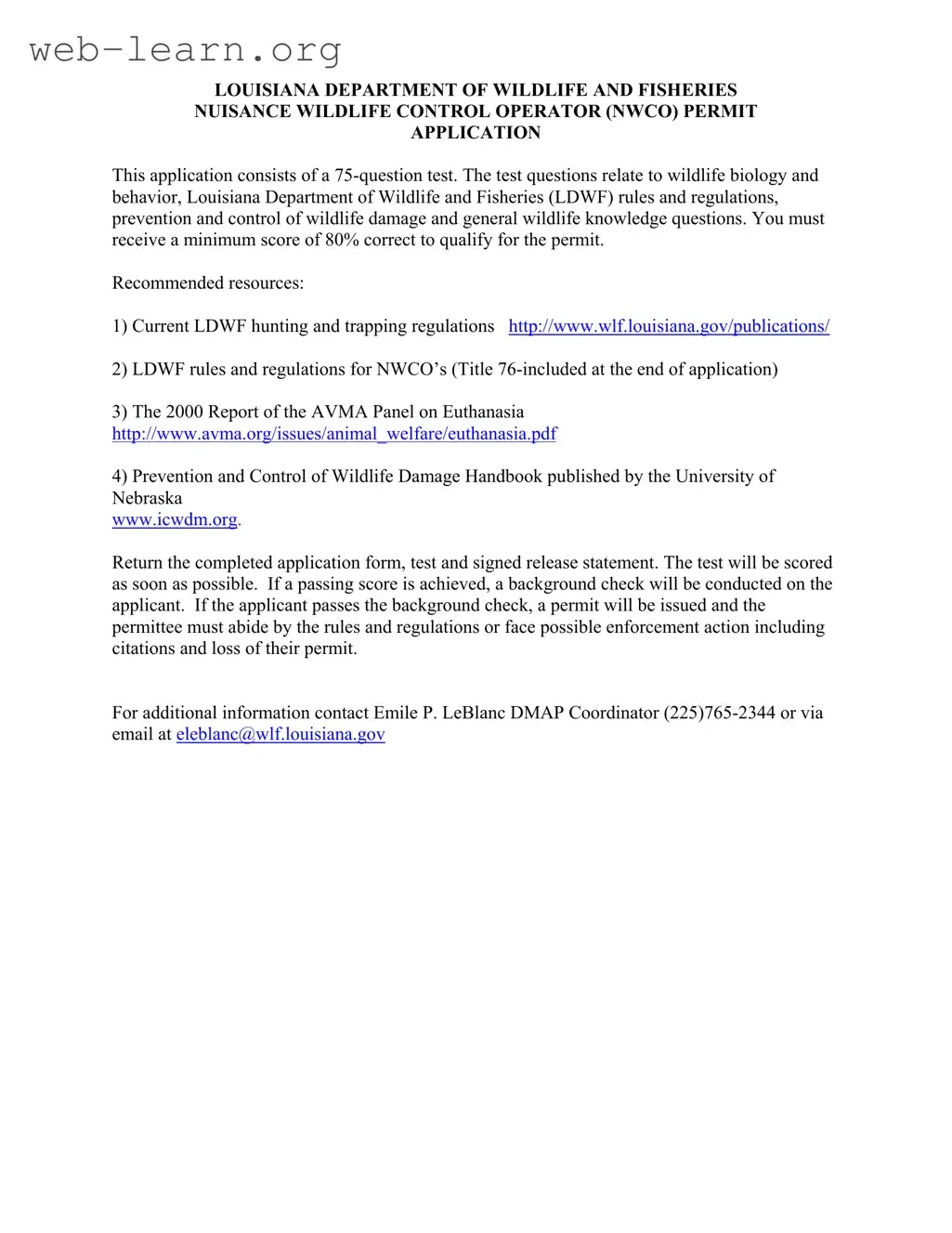
The Louisiana Nuisance Wildlife Control Operator (NWCO) Test form is an essential component of the permit application process for individuals seeking to manage nuisance wildlife in the state. This application includes a comprehensive 75-question test that assesses knowledge in various areas crucial for effective wildlife management. Key topics covered in the test include wildlife biology and behavior, relevant Louisiana Department of Wildlife and Fisheries (LDWF) rules and regulations, and strategies for preventing and controlling wildlife damage. To qualify for the NWCO permit, applicants must achieve a minimum score of 80% on the test. Resources recommended for preparation include current LDWF hunting and trapping regulations, specific NWCO rules, and guidelines from the American Veterinary Medical Association on euthanasia. After submitting the completed application, test, and signed release statement, the scoring process begins promptly. A passing score leads to a background check, and upon successful completion, the permit is issued. It is crucial for permit holders to adhere to all regulations, as non-compliance may result in enforcement actions, including the potential loss of the permit. For further inquiries, applicants can reach out to the designated DMAP Coordinator at the LDWF.
LOUISIANA DEPARTMENT OF WILDLIFE AND FISHERIES NUISANCE WILDLIFE CONTROL OPERATOR (NWCO) PERMIT APPLICATION
This application consists of a
Recommended resources:
1) Current LDWF hunting and trapping regulations http://www.wlf.louisiana.gov/publications/
2)LDWF rules and regulations for NWCO’s (Title
3)The 2000 Report of the AVMA Panel on Euthanasia http://www.avma.org/issues/animal_welfare/euthanasia.pdf
4)Prevention and Control of Wildlife Damage Handbook published by the University of Nebraska
www.icwdm.org.
Return the completed application form, test and signed release statement. The test will be scored as soon as possible. If a passing score is achieved, a background check will be conducted on the applicant. If the applicant passes the background check, a permit will be issued and the permittee must abide by the rules and regulations or face possible enforcement action including citations and loss of their permit.
For additional information contact Emile P. LeBlanc DMAP Coordinator
APPLICATION FOR NUISANCE WILDLIFE CONTROL OPERATOR (NWCO) PERMIT
***Providing false information will result in denial of permit***
NAME |
|
|
|
DATE: |
|
||||||||
ADDRESS: |
|
|
|
CITY: |
|
||||||||
STATE: |
|
|
ZIP: |
|
PARISH: |
|
|||||||
PHONE: H( ) |
W( ) |
Date of Birth: |
|||||||||||
|
|
|
|
|
|
|
|||||||
DRIVERS LICENSE # |
|
|
SSN: |
|
|||||||||
LOUISIANA TRAPPING LICENSE # __________________________________
SPECIES WILLING TO WORK WITH _____________________________________________
PARISHES WILLING TO WORK IN ______________________________________________
Please Return To:
LOUISIANA DEPARTMENT OF WILDLIFE & FISHERIES
WILDLIFE DIVISION
ATTN: Emile P. LeBlanc
P.O. BOX 98000
BATON ROUGE, LA
(225)
Be sure to return the signed release statement and the test.

NWCO PERMIT APPLICATION RELEASE STATEMENT
This statement must be signed and returned with the application before a Nuisance Wildlife Control Operator Permit can be issued.
“I have been advised and do understand that by applying for and accepting a permit issued by the Louisiana Department of Wildlife and Fisheries, I am being allowed to engage in an activity which would otherwise be prohibited by law or for which a permit is required. I understand that the permit is not a license and confers no property right upon me. I specifically agree to abide by all State and Federal fish and wildlife laws and regulations, and all State and Federal laws and regulations which relate to this permit or the permitted activity, and by all other terms and conditions of this permit. I understand that the permit for which I am applying may be suspended, canceled or revoked at any time by the Louisiana Department of Wildlife and Fisheries. I agree to immediately surrender the permit issued to me upon demand made upon me by any authorized employee of the Louisiana Department of Wildlife and Fisheries. I understand that my failure to fully and completely comply with the laws, regulations, terms, and conditions referred to herein could result in the immediate suspension, cancellation or revocation of this and other permits issued to me by the Department and that I may be denied future permits as a consequence of my actions. I understand and agree that any permit issued to me by the Louisiana Department of Wildlife and Fisheries is in the nature of a privilege which is being voluntarily extended to me by the Department and the failure on my part to cooperate fully and completely with the Department or its employees can result in the loss of the privilege conferred and the denial of future requests for permits. By accepting this permit, I evidence my agreement to be bound by all conditions and stipulations set forth herein.”
_____________________________________ |
|
Signature |
Date |
NUISANCE WILDLIFE CONTROL OPERATOR EXAM
MULTIPLE CHOICE – CHOOSE THE ONE BEST ANSWER
1)Which of the following is NOT and approved method of euthanasia for raccoons according to the American Veterinary Medical Association (AVMA)?
a.drowning
b.gunshot
c.penetrating captive bolt
d.CO2 chamber
2) Annual reports of nuisance wildlife control activities shall be submitted |
. |
a. on the expiration date of the permit
b. within 30 days of the expiration date of the permit c. every six months
d. no later than 10 days after the expiration date of the permit
3)You receive a call from a person who is concerned that the high numbers of bobcats in an area are reducing the rabbit population. It is early summertime and they want to get rid of as many bobcats as possible before rabbit season. The best solution by the NWCO to this problem would be:
a.capture as many bobcats as you can in live traps and relocate them, and then start using snares.
b.explain to the person that you cannot provide that type of service because this does not constitute a valid nuisance wildlife complaint
c.apply for a special
d.advise the landowner that he should put out poison for the bobcats by injecting dead chickens with rat poison and placing them in areas where bobcats are seen.
4)Which of the following MAY NOT be taken under the authority of a NWCO permit?
a.big brown bat
b.red fox
c.Rock doves
d.woodpeckers
5)Which of the following methods are legal for taking coyotes?
a.leghold traps
b.snares
c.daylight shooting
d.All of the above
6)A permitted NWCO may use poison to control wildlife if:
a.he/she possesses a commercial pesticide applicators license and the chemical is registered for use against the target species
b.he/she has verbal authorization from a Louisiana Department of Wildlife and Fisheries biologist
c.the animal is inside a human dwelling
d.the poison is registered for use on agricultural crops
7)The most common species of venomous snakes in Louisiana are the:
a.green snake and king snake
b.ground rattler and canebrake rattlesnake
c.coral snake and bull snake
d.cottonmouth and copperhead
8)Before shooting, under the conditions of the NWCO permit, the NWCO must
a.attach a silencer to the weapon
b.abide by all state and municipal firearms restrictions
c.wait until nightfall
d.use steel shot only
9)A potential client calls about raccoons and opossums that have been getting into their garbage cans. Which one of the following offers the best long term solution to the problem?
a.capture the animals in live traps and relocate them
b.recommend preventative measures to keep animals from accessing garbage
c.place
d.capture the animals in live traps and euthanize them
10). How many assistants can you designate to operate under your NWCO permit?
a.none
b.one
c.two
d.unlimited
11)Which of the following method is useful in preventing woodpecker damage to wood siding?
a.hanging netting over the affected area
b.using visual or auditory frightening methods
c.applying a sticky repellant to the affected area
d.all of the above
12). You capture a raccoon and determine it has a litter of young inside a wall or attic. Upon investigating, you find that its kits still have their eyes closed, but you can’t reach them. The client doesn’t want you to cut any holes in the wall to get them out. Which of the following offers the best alternative?
a. pour
b. place the live trap (with the female still in it) close to the opening so that the young hear her and come out when they get hungry
c. place solid deodorizer blocks in the opening and then seal it up
d. release the mother at the site and check the next morning to see if the disturbance caused her to move her young during the night
13)Which of the following species of venomous snake is native to Louisiana?
a.Western diamondback rattlesnake
b.Eastern diamondback rattlesnake
c.Sidewinder rattlesnake
d.Diamondback water snake
14)Which of the following birds can be legally killed in Louisiana without any special permits?
a.egrets
b.rock doves
c.chicken hawks
d.all of the above
15)NWCO’s may control nuisance alligators _______.
a.if the alligator is less than 4 feet long
b.if the alligator is released alive
c.always
d.never
16)Wolves pose a particularly difficult problem for the NWCO because_______.
a.they are too big for live traps
b.they rarely leave enough evidence behind to identify
c.there are no wild wolves in Louisiana
c. they are extremely dangerous to approach when caught in a trap
17)NWCO’s may keep which parts of animals taken under the authority of the NWCO permit?
a.skins
b.skulls
c.teeth
d.none

18) Traps must be checked and all animals removed a minimum of once every |
|
hours. |
a.12
b.24
c.36
d.48
19)is NOT an authorized method of capture.
a.padded leghold trap
b.steel jaw leghold trap
c.toothed leghold trap
d.snare
20)All traps and other capture devices shall be set in a manner that
a.is out of the view of the general public.
b.will maximize the risk to
c.is approved by the American Veterinary Medical Association (AVMA).
d.is securely attached to a stake driven into the ground.
21)A homeowner calls and complains that something has killed several of his chickens but doesn’t know what. When you arrive to investigate, you find the dead chickens in the pen neatly
stacked in a pile. Immediately you suspect the predator is a |
|
. |
a.raccoon
b.opossum
c.fox
d.mink
22) |
The most versatile control tool for coyotes are size |
|
leghold traps. |
|
|
|
a. one and two |
|
|
|
|
|
b. two and three |
|
|
|
|
|
c. three and four |
|
|
|
|
|
d. four and five |
|
|
|
|
23) |
Removing brush piles and weed patches to control rabbits is an example of |
. |
|||
|
a. landscape management |
|
|
|
|
|
b. habitat modification |
|
|
|
|
|
c. indirect control |
|
|
|
|
|
d. population manipulation |
|
|
|
|

24) When presented with an abundance of food, |
|
may kill more animals than they can eat. |
a.snakes
b.opossums
c.hawks
d.mink
25) The use of in most situations where beavers are causing damage is the most
effective, practical and environmentally safe method of control.
a.firearms
b.traps
c.repellants
d.trained dogs
26)Bats in Louisiana can be grouped into what category?
a.fruit bats
b.insectivorous bats
c.vampire bats
d.house bats
27)A beaver colony usually consists of_______ related beavers
a.4 to 8
b.0 to 20
c.1 to 5
d.more than 20
28)_______ can be used to prevent birds from roosting in the rafters of buildings.
a.ladders
b.high frequency sounds
c.netting
d.roach bombs
29)_______ are responsible for most raptor depredation problems.
a.chicken hawks
b.Great Horned owls
c.
d.Falcons
30)Characteristic signs of _______ activity are shallow holes
a.snake
b.coyote
c.weasel
d.armadillo

31)You respond to a complaint from a landowner who has had some adult turkeys killed. You find a turkey carcass hidden under a pile of leaves and soil. What animal would you suspect is responsible?
a.coyote
b.fox
c.Great Horned owl
d.bobcat
32)_______ often kill calves by eating into the anus or abdominal area.
a.coyotes
b.bobcats
c.hawks
d.foxes
33)A Conibear© type, # 330 is one of the most effective types of
a.snakes
b.mink
c.beavers
d.coyotes
34)A toxic perch is
a.a perforated metal tube containing a wick saturated with a contact toxicant
b.a fish dipped in poison used to kill nuisance otter and mink
c.a perforated metal tube containing a sticky repellant
d.a bird roosting area contaminated by histoplasmosis spores
35)A homeowner calls and complains that something is killing his chickens but doesn’t know what. When you arrive to investigate, you find a chicken pen that is in a state of disrepair and has several places where a predator may enter the pen. The best solution to this problem is
.
a.Advise the owner to repair the pen to prevent any predators from entering.
b.Place a handful of mothballs at the holes in the pen to discourage predators.
c.Try to identify the predator and set an appropriate trap to remove the animal.
d.Block the holes in the pen with boards or bricks.
36)Foxes may cause serious problems for _______ producers.
a.blueberry
b.crawfish
c.poultry
d.all of the above
37)To prevent mink from entering fenced livestock enclosures, seal all openings larger than_______.
a.1 foot
b.1 inch
c.1 centimeter
d.1 millimeter
38)Poultry killed by _______ usually have bloody puncture wounds in the back and breast.
a.skunks
b.opossums
c.raccoons
d.raptors
39)Recommended baits for
a.crawfish
b.small chunks of raw beef
c.sweet potatoes
d.oranges
40)A charged trip wire placed
a.coyotes
b.minks
c.snakes
d.armadillos
TRUE/FALSE QUESTIONS
41.Wildlife may be released on
a.true
b.false
42.There are no repellents registered to discourage rabbits.
a.true
b.false
43.You must submit an annual report of your activities related to nuisance wildlife control.
a.true
b.false
| Fact Name | Fact Description |
|---|---|
| Test Structure | The NWCO test consists of 75 questions focused on wildlife biology, behavior, and regulations. |
| Passing Score | Applicants must achieve a minimum score of 80% to qualify for the NWCO permit. |
| Resources for Study | Recommended resources include LDWF regulations and the AVMA Panel on Euthanasia report. |
| Application Submission | Completed applications must be returned with the test and signed release statement. |
| Background Check | After passing the test, a background check will be conducted on the applicant. |
| Governing Laws | The NWCO permit is governed by Louisiana wildlife regulations, specifically Title 76. |
| Consequences of Non-Compliance | Failure to comply with regulations may result in permit suspension or revocation. |
Completing the Louisiana Nuisance Wildlife Control Operator (NWCO) Test form requires careful attention to detail. The application process includes filling out personal information, selecting species and parishes of interest, and signing a release statement. After submitting the form, the test will be scored, and a background check will follow for qualified applicants.
What is the Louisiana NWCO Test Form?
The Louisiana Nuisance Wildlife Control Operator (NWCO) Test Form is an application that includes a 75-question test. This test assesses knowledge on various topics, including wildlife biology, behavior, and the rules and regulations set forth by the Louisiana Department of Wildlife and Fisheries (LDWF). To qualify for the NWCO permit, applicants must achieve a minimum score of 80% on this test.
What topics are covered in the NWCO test?
The test encompasses a range of subjects, such as:
These topics are crucial for ensuring that wildlife is managed responsibly and in accordance with state laws.
How can I prepare for the NWCO test?
To prepare effectively, consider utilizing the following resources:
These materials will provide valuable insights and knowledge necessary for passing the test.
What happens after I submit my application and test?
Once the completed application form, test, and signed release statement are submitted, the test will be scored promptly. If you achieve a passing score, a background check will be conducted. Upon successful completion of the background check, you will receive your NWCO permit.
What are the consequences of providing false information on the application?
Providing false information can lead to the denial of your permit application. It is essential to be truthful and accurate when filling out the application, as integrity is crucial in wildlife management.
What are my responsibilities as a NWCO permit holder?
As a permit holder, you must abide by all state and federal fish and wildlife laws and regulations. This includes submitting annual reports of your nuisance wildlife control activities and adhering to the terms and conditions of your permit. Failure to comply can result in enforcement actions, including citations or loss of your permit.
Who can I contact for additional information regarding the NWCO permit?
If you have further questions or need assistance, you can reach out to Emile P. LeBlanc, the DMAP Coordinator, at (225) 765-2344 or via email at [email protected]. He can provide guidance and answer any concerns you may have about the application process or the NWCO permit.
Filling out the Louisiana Nuisance Wildlife Control Operator (NWCO) Test form can be straightforward, but many applicants make common mistakes that could hinder their progress. One frequent error is failing to provide accurate personal information. Applicants often overlook details such as their full name, address, or contact information. Incomplete or incorrect information can lead to delays in processing the application or even denial of the permit.
Another mistake involves not carefully reading the instructions. The application requires a signed release statement to be submitted along with the completed test. Some applicants may forget this step, thinking that submitting the test alone is sufficient. This oversight can result in significant delays, as the application will not be considered complete without the necessary documentation.
Many applicants also misjudge the importance of preparation for the test. The NWCO test consists of 75 questions, and a minimum score of 80% is needed to qualify for the permit. Relying solely on prior knowledge without reviewing the recommended resources can lead to disappointing results. It is essential to study the Louisiana Department of Wildlife and Fisheries regulations and other relevant materials before attempting the test.
Another common error is underestimating the significance of the background check. Some applicants may not be aware that passing the test does not guarantee a permit. A background check is mandatory, and any issues revealed during this process can result in denial. It is wise to ensure that there are no outstanding legal issues that could impact the application.
Finally, applicants sometimes fail to adhere to the submission guidelines. The completed application must be sent to the correct address, and it should include all required documents. Submitting the application to the wrong department or omitting essential materials can cause significant delays. Taking the time to double-check the submission package can save applicants from unnecessary setbacks.
The Louisiana Nuisance Wildlife Control Operator (NWCO) Permit Application is an important document for those looking to engage in wildlife control activities legally. Along with this application, several other forms and documents are often necessary to ensure compliance with regulations. Understanding these documents can help applicants navigate the process more smoothly.
Being familiar with these documents will help streamline the application process for the NWCO permit. Each form plays a vital role in ensuring that wildlife control is conducted responsibly and in accordance with the law. Taking the time to understand these requirements can lead to a successful application and a rewarding experience in wildlife management.
The Louisiana Nuisance Wildlife Control Operator (NWCO) Test form shares similarities with various other documents related to wildlife management and control. Here’s a breakdown of nine documents that resemble the NWCO Test form:
Each of these documents plays a critical role in ensuring that individuals engaged in wildlife control and management are knowledgeable and compliant with relevant laws and regulations. Understanding the similarities can help applicants prepare effectively for the NWCO Test and related processes.
When filling out the Louisiana Nuisance Wildlife Control Operator (NWCO) Test form, it is essential to follow specific guidelines to ensure a smooth application process. Here are seven things you should and shouldn't do:
Here are ten misconceptions about the Louisiana Nuisance Wildlife Control Operator (NWCO) Test form, along with clarifications for each:
When filling out and using the Louisiana Nuisance Wildlife Control Operator (NWCO) Test form, there are several important points to keep in mind.