In the state of Louisiana, the Living Will form serves as a vital document that allows individuals to express their wishes regarding medical treatment in the event they become unable to communicate their preferences. This form is particularly important for those who want to ensure that their healthcare decisions align with their personal values and beliefs, especially in critical situations where life-sustaining measures may be considered. By completing a Living Will, individuals can specify their desires concerning the use of artificial nutrition and hydration, resuscitation efforts, and other medical interventions. This document not only provides clarity to healthcare providers but also alleviates the emotional burden on family members during challenging times. Furthermore, the form must be signed in the presence of witnesses or a notary to ensure its validity, reflecting the state's commitment to honoring the individual's autonomy and choices in healthcare matters. Understanding the nuances of this form is essential for anyone looking to take proactive steps in planning for their future healthcare needs.
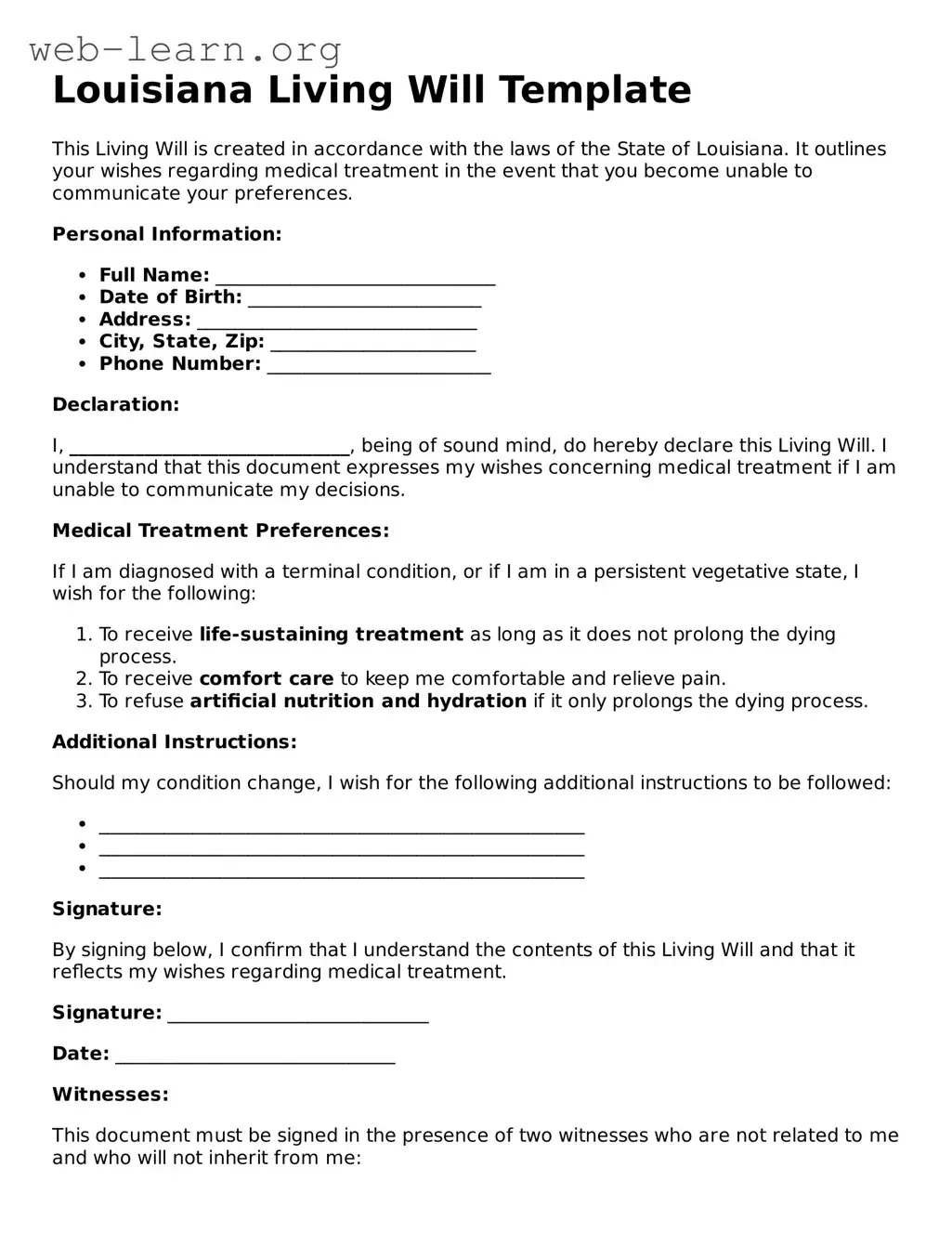
Louisiana Living Will Template
This Living Will is created in accordance with the laws of the State of Louisiana. It outlines your wishes regarding medical treatment in the event that you become unable to communicate your preferences.
Personal Information:
Declaration:
I, ______________________________, being of sound mind, do hereby declare this Living Will. I understand that this document expresses my wishes concerning medical treatment if I am unable to communicate my decisions.
Medical Treatment Preferences:
If I am diagnosed with a terminal condition, or if I am in a persistent vegetative state, I wish for the following:
Additional Instructions:
Should my condition change, I wish for the following additional instructions to be followed:
Signature:
By signing below, I confirm that I understand the contents of this Living Will and that it reflects my wishes regarding medical treatment.
Signature: ____________________________
Date: ______________________________
Witnesses:
This document must be signed in the presence of two witnesses who are not related to me and who will not inherit from me:
In the event that I am unable to make my own medical decisions, I trust that my wishes will be honored as stated in this Living Will.
| Fact Name | Description |
|---|---|
| Definition | A Louisiana Living Will is a legal document that allows individuals to express their wishes regarding medical treatment in the event they become terminally ill or incapacitated. |
| Governing Law | The Louisiana Living Will is governed by Louisiana Revised Statutes, Title 40, Section 1151.2. |
| Eligibility | Any adult who is of sound mind can create a Living Will in Louisiana. |
| Witness Requirement | The form must be signed in the presence of two witnesses or notarized to be valid. |
| Revocation | Individuals can revoke their Living Will at any time, either verbally or in writing. |
| Health Care Proxy | A Living Will does not appoint a health care proxy; a separate document is needed for that purpose. |
| Specific Instructions | Individuals can specify which medical treatments they wish to receive or refuse, such as life-sustaining measures. |
| Durable Power of Attorney | A Living Will is different from a Durable Power of Attorney for health care, which allows someone to make decisions on behalf of the individual. |
| Accessibility | The form is available through various legal resources and healthcare providers in Louisiana. |
After obtaining the Louisiana Living Will form, you will need to complete it with accurate information. This form allows individuals to express their wishes regarding medical treatment in case they become unable to communicate their preferences. Follow the steps outlined below to fill out the form correctly.
A Living Will is a legal document that allows you to express your wishes regarding medical treatment in case you become unable to communicate your preferences. This document specifically addresses situations where you may be terminally ill or in a persistent vegetative state. By creating a Living Will, you ensure that your healthcare choices are respected, even if you cannot speak for yourself.
In Louisiana, any adult who is at least 18 years old and of sound mind can create a Living Will. This means you should be able to understand the nature and consequences of your decisions. If you meet these criteria, you can take the important step of documenting your healthcare preferences.
Your Living Will should clearly outline your wishes regarding medical treatments you do or do not want in specific situations. This may include:
Be as specific as possible to avoid any confusion among your healthcare providers and loved ones.
While it is not required to have a lawyer to create a Living Will in Louisiana, seeking legal advice can be beneficial. A lawyer can help ensure that your document meets all legal requirements and accurately reflects your wishes. If you have complex medical or family situations, professional guidance can provide added peace of mind.
To make your Living Will official in Louisiana, you must sign it in the presence of two witnesses or have it notarized. The witnesses cannot be related to you by blood or marriage, nor can they be entitled to any portion of your estate. This process helps confirm that the document reflects your true intentions.
Yes, you have the right to change or revoke your Living Will at any time, as long as you are still of sound mind. To make changes, you can create a new Living Will or simply write a statement revoking the previous one. Be sure to inform your healthcare providers and loved ones about any changes to ensure your wishes are followed.
Filling out the Louisiana Living Will form can be a crucial step in ensuring that your healthcare wishes are respected. However, many people make mistakes that could lead to confusion or even legal issues. One common mistake is not signing the document in front of the required witnesses. In Louisiana, two witnesses must be present when you sign your Living Will. Failing to do this can render the document invalid.
Another frequent error is not dating the form. It’s essential to include the date when you complete the Living Will. Without a date, it may be difficult to determine the validity of the document or when your wishes were expressed.
Some individuals neglect to discuss their wishes with family members or healthcare providers. Open communication is vital. If your loved ones are unaware of your preferences, they may struggle to make decisions on your behalf during a critical time.
Additionally, people often overlook the importance of being specific about their medical preferences. Vague language can lead to misinterpretation. Clearly stating your wishes regarding life-sustaining treatments and other medical interventions can help avoid confusion later.
Another mistake is failing to update the Living Will when circumstances change. Life events, such as a new diagnosis or changes in personal beliefs, may necessitate a revision of your wishes. Regularly reviewing and updating the document ensures it reflects your current preferences.
Some individuals also make the mistake of not providing copies of the Living Will to relevant parties. It’s important to give copies to your healthcare providers and family members. This way, they will have access to your wishes when needed.
Another common oversight is not considering alternative decision-makers. While a Living Will outlines your preferences, appointing a healthcare proxy can provide additional clarity. This person can make decisions on your behalf if you are unable to do so.
Lastly, many people fail to read the entire form carefully before signing. Understanding every section of the Living Will is crucial. Taking the time to review the document ensures that you are fully aware of what you are agreeing to and can help prevent any misunderstandings.
A Louisiana Living Will is an important document that outlines your wishes regarding medical treatment in the event you become unable to communicate. However, there are several other forms and documents that may complement a Living Will, helping to ensure your healthcare preferences are respected. Below is a list of commonly used documents that individuals often consider alongside a Living Will.
Each of these documents serves a unique purpose, contributing to a comprehensive plan for your healthcare and end-of-life decisions. By considering these forms in conjunction with your Living Will, you can create a clear and thorough outline of your wishes, providing peace of mind for both you and your loved ones.
A Living Will is a document that outlines a person's preferences regarding medical treatment in the event they become unable to communicate their wishes. Several other documents serve similar purposes in guiding healthcare decisions. Here are ten documents that are comparable to a Living Will:
When filling out the Louisiana Living Will form, it's important to be mindful of certain dos and don'ts to ensure your wishes are clearly communicated. Below is a helpful list to guide you.
Following these guidelines will help ensure that your Living Will accurately reflects your healthcare preferences and is legally valid in Louisiana.
Many people have misunderstandings about the Louisiana Living Will form. Here are five common misconceptions:
A Living Will specifically addresses medical decisions and end-of-life care, while a Last Will and Testament deals with the distribution of a person's assets after death.
A Living Will can be created at any time, as long as the individual is of sound mind. It is a proactive measure to outline wishes for future medical treatment.
While Living Wills are recognized in many states, each state has its own laws and requirements. The Louisiana Living Will may not be valid in other states without proper modifications.
Once a valid Living Will is in place, it reflects the individual's wishes. Family members cannot override these wishes unless the document is deemed invalid or if there are legal challenges.
Anyone over the age of 18 can create a Living Will. It is a personal decision that can benefit individuals of any age who wish to express their medical preferences.
When filling out and using the Louisiana Living Will form, it is essential to keep several key points in mind:
Connecticut Life Sustaining Treatment Choices - A Living Will can provide guidance in situations where recovery is unlikely.
Can I Write My Own Will in New York State - Having a Living Will can bring peace of mind, knowing that your wishes will be honored even if you cannot voice them yourself.