When entering into a rental agreement in Louisiana, understanding the Louisiana Lease Agreement form is essential for both landlords and tenants. This document outlines the rights and responsibilities of each party, establishing a clear framework for the rental relationship. Key components typically include details about the rental property, such as its address and description, as well as the duration of the lease, which can vary from month-to-month to a fixed term. Additionally, the form addresses the rental amount, payment due dates, and any applicable late fees. It also covers security deposits, maintenance responsibilities, and rules regarding pets, ensuring that both parties have a mutual understanding of expectations. By thoroughly reviewing and completing this form, landlords and tenants can foster a more harmonious living arrangement, minimizing the potential for disputes and misunderstandings throughout the lease term.
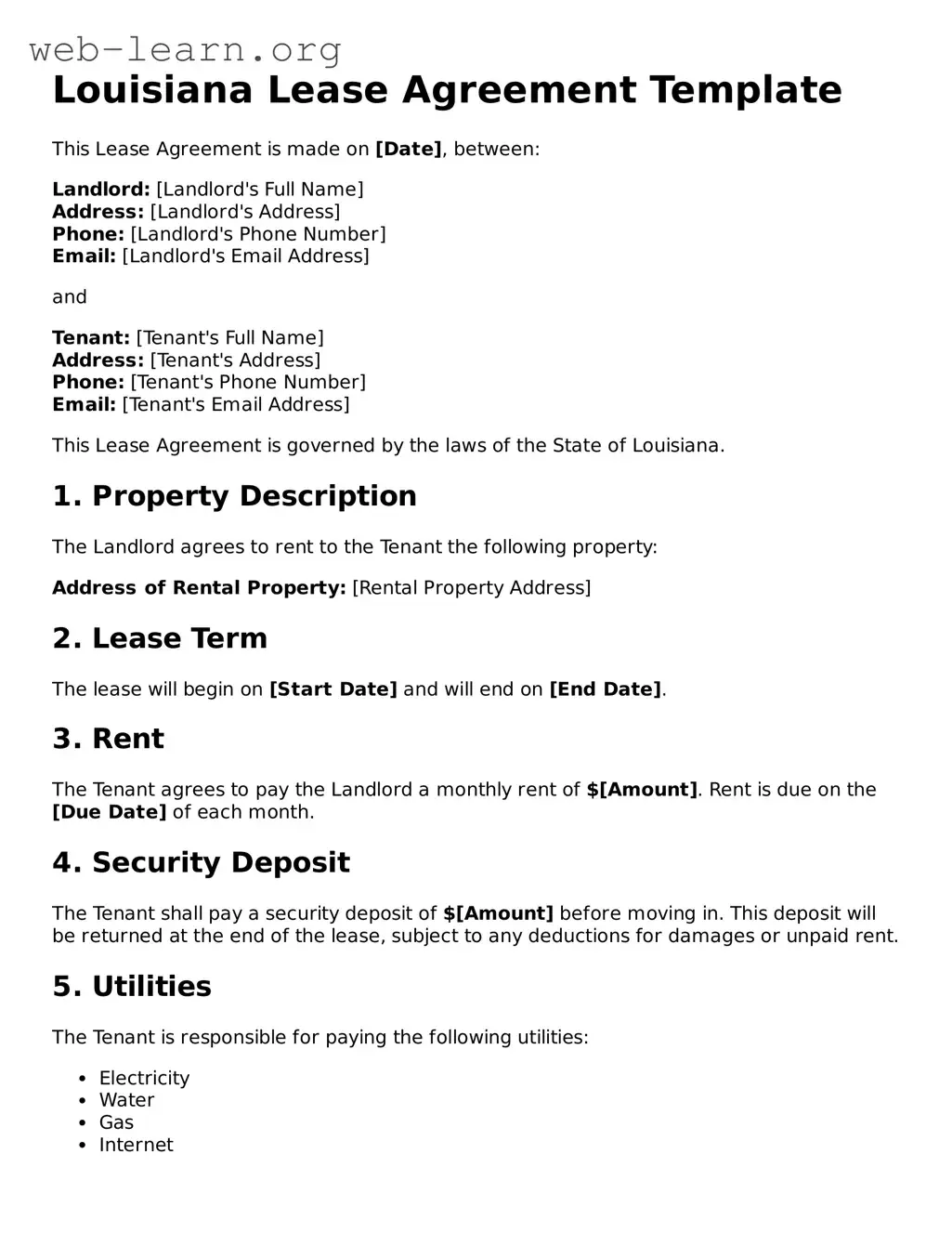
Louisiana Lease Agreement Template
This Lease Agreement is made on [Date], between:
Landlord: [Landlord's Full Name]
Address: [Landlord's Address]
Phone: [Landlord's Phone Number]
Email: [Landlord's Email Address]
and
Tenant: [Tenant's Full Name]
Address: [Tenant's Address]
Phone: [Tenant's Phone Number]
Email: [Tenant's Email Address]
This Lease Agreement is governed by the laws of the State of Louisiana.
1. Property Description
The Landlord agrees to rent to the Tenant the following property:
Address of Rental Property: [Rental Property Address]
2. Lease Term
The lease will begin on [Start Date] and will end on [End Date].
3. Rent
The Tenant agrees to pay the Landlord a monthly rent of $[Amount]. Rent is due on the [Due Date] of each month.
4. Security Deposit
The Tenant shall pay a security deposit of $[Amount] before moving in. This deposit will be returned at the end of the lease, subject to any deductions for damages or unpaid rent.
5. Utilities
The Tenant is responsible for paying the following utilities:
6. Maintenance and Repairs
The Tenant agrees to keep the property clean and in good condition. Any necessary repairs should be reported to the Landlord promptly.
7. Termination
Either party may terminate this lease with a written notice of [Notice Period, e.g., 30 days] before the lease end date.
8. Governing Law
This Lease Agreement shall be governed by the laws of the State of Louisiana.
IN WITNESS WHEREOF, the parties have executed this Lease Agreement as of the date first above written.
Landlord's Signature: ___________________________
Date: _______________
Tenant's Signature: ___________________________
Date: _______________
| Fact Name | Description |
|---|---|
| Governing Law | The Louisiana Lease Agreement is governed by the Louisiana Civil Code, particularly Articles 2668 to 2721, which outline the rights and obligations of landlords and tenants. |
| Written Agreement | While verbal agreements can be legally binding, a written Louisiana Lease Agreement is highly recommended to clarify terms and prevent disputes. |
| Security Deposits | In Louisiana, landlords can charge a security deposit, but it cannot exceed one month's rent for residential leases. |
| Lease Duration | The lease can be for a fixed term or a month-to-month arrangement, with specific rules governing each type. |
| Termination Notice | For month-to-month leases, either party must provide a written notice of at least 30 days before terminating the agreement. |
Filling out the Louisiana Lease Agreement form is an important step in establishing the terms of a rental arrangement. It is essential to complete the form accurately to ensure that both the landlord and tenant understand their rights and responsibilities. Follow these steps to fill out the form properly.
After completing these steps, review the form for accuracy. Make sure all information is correct before providing copies to all parties involved. This will help prevent misunderstandings in the future.
What is a Louisiana Lease Agreement?
A Louisiana Lease Agreement is a legally binding document between a landlord and a tenant. It outlines the terms and conditions under which a tenant can occupy a rental property. This agreement typically includes details about rent, duration of the lease, maintenance responsibilities, and other important provisions.
What should be included in a Louisiana Lease Agreement?
Essential elements of a Louisiana Lease Agreement include:
How long does a Louisiana Lease Agreement typically last?
Lease agreements in Louisiana can vary in duration. They may be short-term, lasting a few months, or long-term, extending for a year or more. The specific duration should be clearly stated in the agreement.
Can a landlord increase rent during a lease term?
Generally, landlords cannot increase rent during the term of a lease unless it is explicitly stated in the agreement. Rent increases usually take effect at the beginning of a new lease term, provided proper notice is given to the tenant.
What is a security deposit, and how is it handled?
A security deposit is a sum of money paid by the tenant to the landlord before moving in. It serves as protection for the landlord against potential damages or unpaid rent. In Louisiana, the law requires landlords to return the security deposit within one month after the lease ends, minus any deductions for damages or unpaid rent.
What rights do tenants have under a Louisiana Lease Agreement?
Tenants in Louisiana have several rights, including:
What happens if a tenant wants to break the lease early?
If a tenant needs to break the lease before it ends, they should review the lease agreement for any specific terms regarding early termination. Often, tenants may be required to give notice and may have to pay a fee. Communication with the landlord is crucial to discuss options and potential consequences.
Are verbal agreements enforceable in Louisiana?
While verbal agreements can be made, they are not recommended for lease agreements. Written agreements provide clear evidence of the terms and protect both parties. It is always best to have a written Louisiana Lease Agreement to avoid misunderstandings.
When filling out the Louisiana Lease Agreement form, many individuals unknowingly make mistakes that can lead to misunderstandings or disputes later on. One common error is failing to include all necessary parties in the agreement. If a tenant or co-tenant is omitted, it can create complications regarding responsibility for rent and property care.
Another frequent mistake involves not specifying the lease term. It’s crucial to clearly state whether the lease is for a fixed term or is month-to-month. Without this information, both parties may have different interpretations of the agreement’s duration, leading to potential conflicts.
People often overlook the importance of detailing the rental amount and payment terms. Simply stating the rent amount without specifying due dates or acceptable payment methods can lead to confusion. It’s advisable to outline when rent is due, how it should be paid, and any penalties for late payments.
Additionally, some individuals neglect to address security deposits adequately. The agreement should specify the amount of the deposit, the conditions under which it may be withheld, and the timeline for its return. Without this clarity, disputes may arise when the lease ends.
Another mistake is failing to outline maintenance responsibilities. Both landlords and tenants should understand who is responsible for repairs and upkeep. A lack of clarity can lead to frustration and financial burden for one party or the other.
Some people make the error of not including provisions for breaking the lease. It’s important to outline the conditions under which either party can terminate the lease early. This helps to protect both the landlord and tenant in case of unforeseen circumstances.
Misunderstanding the rules regarding pets is also common. If the lease does not explicitly state whether pets are allowed or if there are any restrictions, it can lead to disputes. Clear communication about pet policies is essential for maintaining a good landlord-tenant relationship.
Many individuals forget to include the property address in full detail. This includes not only the street address but also any unit number, city, and zip code. An incomplete address can create confusion and may complicate legal matters down the line.
Another common oversight is not addressing the issue of subleasing. If the lease does not specify whether subleasing is permitted, it can lead to misunderstandings. Both parties should agree on this aspect to avoid potential conflicts in the future.
Finally, some people fail to read the entire lease agreement before signing. It’s vital to understand every clause and provision. Skipping this step can result in agreeing to terms that may not be favorable or understood, leading to issues later on.
When entering into a lease agreement in Louisiana, several additional forms and documents may be necessary to ensure clarity and legal compliance. Below is a list of commonly used documents that complement the Louisiana Lease Agreement.
Having these documents prepared and organized can help streamline the leasing process and protect the interests of both landlords and tenants. It is advisable to review each document carefully to ensure compliance with local laws and regulations.
A Lease Agreement is a crucial document in the realm of real estate and property management. It outlines the terms under which one party agrees to rent property owned by another. Several other documents share similarities with a Lease Agreement, each serving specific purposes in various contexts. Here are four documents that are similar to a Lease Agreement:
When filling out the Louisiana Lease Agreement form, it’s important to approach the task with care. Here are four key dos and don’ts to keep in mind:
Understanding the Louisiana Lease Agreement form can be challenging due to various misconceptions. Here are ten common misunderstandings that people often have:
Many believe that lease agreements are uniform across states. In reality, Louisiana has specific laws and requirements that differ from other states.
Some think that only the landlord's signature is necessary for a lease to be valid. Both the landlord and tenant must sign the agreement to make it legally binding.
Many assume that a verbal agreement is enough. However, written agreements are crucial for clarity and legal protection.
While many terms can be negotiated, some aspects of the lease must comply with Louisiana law and cannot be altered.
Some people think that landlords can charge any amount for a security deposit. In Louisiana, there are limits and regulations that landlords must follow.
This misconception overlooks that lease agreements are also used for commercial properties, each with its own specific considerations.
Many tenants believe they can leave without consequences. Breaking a lease can lead to legal penalties and financial repercussions.
While landlords have certain obligations, tenants may also have responsibilities for maintenance and upkeep as outlined in the lease.
Some individuals think that once a lease is signed, it never needs to change. However, updating the lease can reflect changes in circumstances or laws.
While the lease is a binding document, communication between landlords and tenants can still lead to adjustments or amendments if both parties agree.
Being aware of these misconceptions can help both landlords and tenants navigate the leasing process more effectively. Understanding the specific nuances of the Louisiana Lease Agreement form is essential for a successful rental experience.
When dealing with the Louisiana Lease Agreement form, there are several important aspects to consider. Understanding these key takeaways can help ensure a smooth leasing process for both landlords and tenants.
By keeping these points in mind, both landlords and tenants can navigate the leasing process more effectively, ensuring a positive rental experience.
Basic Lease Agreement Pdf - It may outline the responsibilities for yard maintenance and landscaping.
Alabama Lease Agreement - It includes provisions for resolving disputes between the landlord and tenant.
Free Rental Agreement Template - The agreement can clarify what happens if the property is sold during the lease term.
Free Idaho Rental Agreement Form - Outlines the rules for common areas if applicable.