Creating a Last Will and Testament is a crucial step in ensuring that your wishes are honored after your passing. In Louisiana, this legal document outlines how your assets will be distributed, who will serve as the executor of your estate, and who will care for any minor children. The form typically includes essential sections such as the identification of the testator, the appointment of an executor, and specific bequests to beneficiaries. Additionally, it may address any debts and funeral arrangements, providing clarity for your loved ones during a difficult time. Understanding the Louisiana Last Will and Testament form is vital for anyone looking to secure their legacy and protect their family’s interests. Taking the time to complete this form can prevent potential disputes and ensure that your intentions are carried out smoothly.
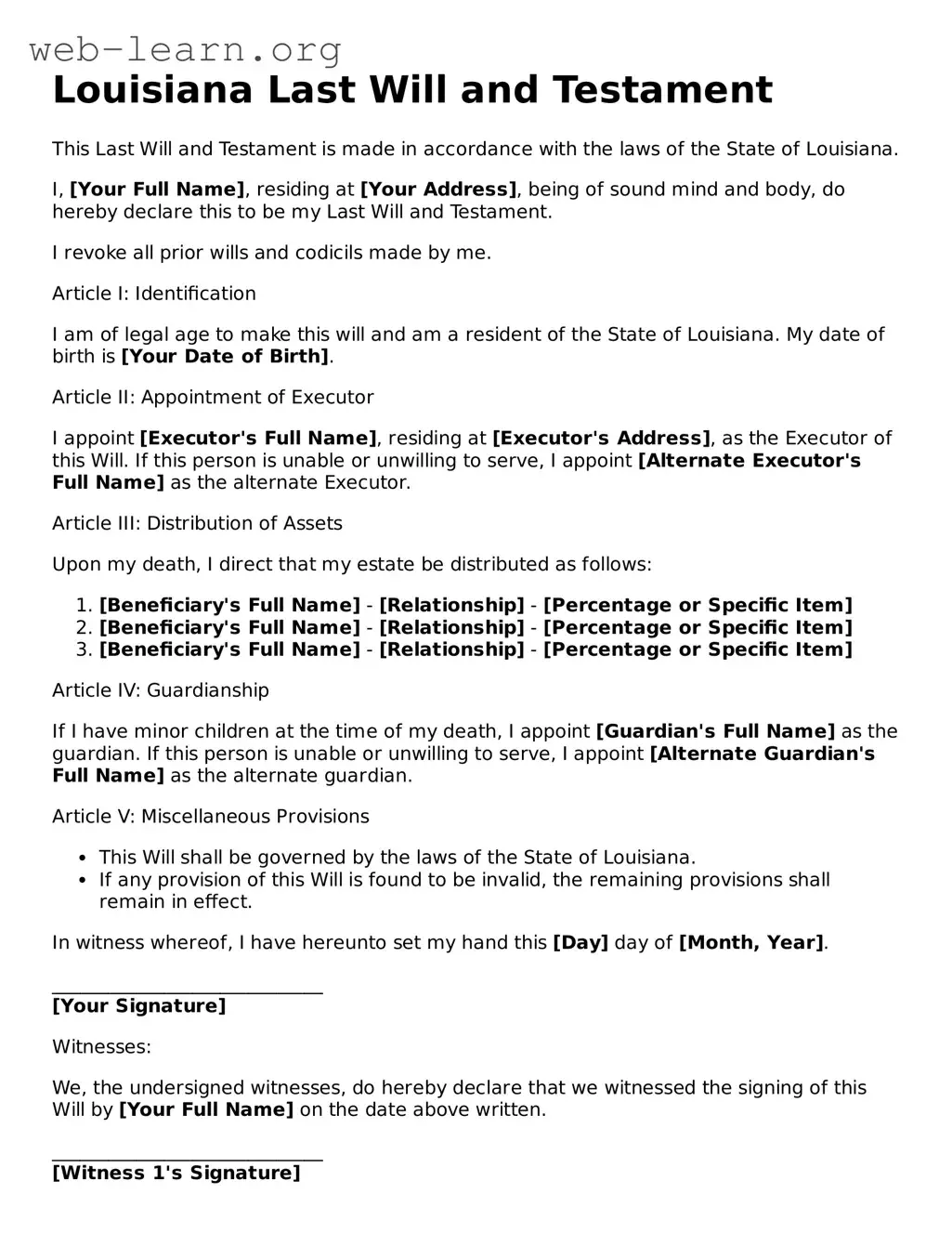
Louisiana Last Will and Testament
This Last Will and Testament is made in accordance with the laws of the State of Louisiana.
I, [Your Full Name], residing at [Your Address], being of sound mind and body, do hereby declare this to be my Last Will and Testament.
I revoke all prior wills and codicils made by me.
Article I: Identification
I am of legal age to make this will and am a resident of the State of Louisiana. My date of birth is [Your Date of Birth].
Article II: Appointment of Executor
I appoint [Executor's Full Name], residing at [Executor's Address], as the Executor of this Will. If this person is unable or unwilling to serve, I appoint [Alternate Executor's Full Name] as the alternate Executor.
Article III: Distribution of Assets
Upon my death, I direct that my estate be distributed as follows:
Article IV: Guardianship
If I have minor children at the time of my death, I appoint [Guardian's Full Name] as the guardian. If this person is unable or unwilling to serve, I appoint [Alternate Guardian's Full Name] as the alternate guardian.
Article V: Miscellaneous Provisions
In witness whereof, I have hereunto set my hand this [Day] day of [Month, Year].
_____________________________
[Your Signature]
Witnesses:
We, the undersigned witnesses, do hereby declare that we witnessed the signing of this Will by [Your Full Name] on the date above written.
_____________________________
[Witness 1's Signature]
[Witness 1's Full Name]
[Witness 1's Address]
_____________________________
[Witness 2's Signature]
[Witness 2's Full Name]
[Witness 2's Address]
| Fact Name | Description |
|---|---|
| Governing Law | The Louisiana Last Will and Testament is governed by the Louisiana Civil Code, specifically Articles 1570-1620. |
| Age Requirement | Testators must be at least 18 years old to create a valid will in Louisiana. |
| Witness Requirement | Two witnesses must sign the will for it to be valid, and they must be present at the same time. |
| Notarization | While notarization is not required, a notary can simplify the process and enhance the will's validity. |
| Revocation | A will can be revoked by a subsequent will or by physically destroying the original document. |
| Holographic Wills | Holographic wills, which are handwritten and signed by the testator, are recognized in Louisiana if they meet certain criteria. |
| Self-Proving Wills | A self-proving will includes an affidavit from the witnesses, making it easier to validate in probate court. |
| Beneficiary Designation | Testators can designate specific beneficiaries for their assets, including property and financial accounts. |
Once you have the Louisiana Last Will and Testament form in front of you, it's time to start filling it out. Take your time to ensure accuracy, as this document will guide the distribution of your assets after your passing. Follow these steps carefully to complete the form correctly.
After completing the form, ensure that it is stored in a safe place. Inform your executor and trusted family members where to find it. This will help ensure that your wishes are honored. Regularly review and update your will as necessary to reflect any changes in your life circumstances.
What is a Last Will and Testament in Louisiana?
A Last Will and Testament is a legal document that outlines how a person's assets and property will be distributed after their death. In Louisiana, this document must comply with specific state laws to be considered valid. It allows individuals to express their wishes regarding the distribution of their estate, appointment of guardians for minor children, and other important matters.
Who can create a Last Will and Testament in Louisiana?
Any person who is at least 18 years old and of sound mind can create a Last Will and Testament in Louisiana. This includes individuals who are residents of the state or have property located in Louisiana. It’s essential that the individual understands the implications of their decisions when drafting the will.
What are the requirements for a valid Last Will and Testament in Louisiana?
To ensure a Last Will and Testament is valid in Louisiana, it must meet the following requirements:
Alternatively, a holographic will, which is handwritten and signed by the testator, can also be valid without witnesses.
Can I change or revoke my Last Will and Testament?
Yes, you can change or revoke your Last Will and Testament at any time while you are alive and of sound mind. To make changes, you can create a new will that explicitly revokes the previous one, or you can add a codicil, which is an amendment to the existing will. It is crucial to follow the same legal requirements when making changes to ensure the validity of the document.
What happens if I die without a Last Will and Testament in Louisiana?
If you die without a Last Will and Testament, you are considered to have died intestate. In this case, Louisiana's intestacy laws will dictate how your assets are distributed. Typically, your estate will be divided among your closest relatives, which may not align with your wishes. To avoid this situation, it is advisable to create a will.
Can I include specific bequests in my Last Will and Testament?
Yes, you can include specific bequests in your Last Will and Testament. This means you can designate particular items or amounts of money to specific individuals or organizations. Clearly stating your wishes helps ensure that your assets are distributed according to your preferences.
Is it necessary to hire an attorney to create a Last Will and Testament in Louisiana?
While it is not legally required to hire an attorney to create a Last Will and Testament in Louisiana, it is highly recommended. An attorney can help ensure that your will complies with state laws and accurately reflects your wishes. This can prevent potential disputes among heirs and ensure a smoother probate process.
How do I ensure my Last Will and Testament is legally binding?
To ensure your Last Will and Testament is legally binding in Louisiana, follow these steps:
Keeping the will in a safe place and informing your executor of its location can also help ensure its validity and accessibility after your passing.
Filling out a Last Will and Testament form in Louisiana can be a straightforward process, but several common mistakes can lead to complications. One frequent error is failing to properly identify the testator, or the person making the will. It is essential to include the full legal name and address to avoid any confusion about the individual’s identity.
Another mistake involves not specifying the beneficiaries clearly. When beneficiaries are not named with full names and relationships, disputes may arise. Vague terms like “my children” without further details can lead to misunderstandings and potential legal challenges.
Many individuals also neglect to sign the will in the presence of witnesses. Louisiana law requires that a will be signed by the testator and witnessed by at least two individuals who are not beneficiaries. Without proper signatures, the will may be deemed invalid.
Additionally, people often overlook the importance of dating the document. A will should always include the date it was executed. This date is crucial for determining the most recent version of the will, especially if multiple wills exist.
Another common error is failing to revoke previous wills. If an individual has made changes to their estate plan, they must clearly state that previous wills are revoked. Otherwise, confusion may arise regarding which will is valid.
Some individuals also forget to consider the appointment of an executor. The executor is responsible for managing the estate after the testator's death. Not naming an executor can lead to delays and complications in the probate process.
Lastly, people may not adequately address specific bequests. If certain items or sums of money are intended for specific individuals, they should be clearly outlined in the will. Without this clarity, there may be disputes over who receives what, leading to potential family conflicts.
When planning for the future and ensuring that your wishes are honored after your passing, it's essential to understand the various documents that complement a Last Will and Testament. Each of these documents serves a unique purpose and can help clarify your intentions regarding your estate and healthcare decisions.
Understanding these documents can empower you to make informed decisions about your estate planning. Each plays a vital role in ensuring that your wishes are honored and that your loved ones are taken care of in accordance with your desires.
The Last Will and Testament is a crucial legal document that outlines how a person's assets and affairs should be managed after their death. However, it shares similarities with several other important documents. Here are seven documents that are comparable to a Last Will and Testament:
Understanding these documents can help ensure that your wishes are carried out effectively and that your loved ones are taken care of in accordance with your desires.
When filling out the Louisiana Last Will and Testament form, it is essential to follow certain guidelines to ensure the document is valid and reflects your intentions. Here is a list of things you should and shouldn't do:
Following these guidelines will help create a clear and enforceable Last Will and Testament in Louisiana.
When it comes to the Louisiana Last Will and Testament form, several misconceptions can lead to confusion. Understanding these can help ensure that individuals create a valid and effective will. Here are four common misconceptions:
While notarization can add an extra layer of authenticity, it is not a requirement for a will to be valid in Louisiana. A handwritten will, known as a holographic will, can be valid as long as it is written and signed by the testator.
Many people believe that only legal professionals can draft a will. In reality, individuals can create their own wills, provided they follow the legal requirements set forth by Louisiana law.
Some may think that the only way to modify a will is to create an entirely new document. However, Louisiana law allows for codicils, which are amendments that can change specific parts of an existing will without needing to rewrite the entire document.
This misconception suggests that a will is set in stone once it is signed. In fact, individuals can change their wills at any time as long as they are of sound mind and follow the proper legal procedures.
Creating a Last Will and Testament is an essential step in ensuring that your wishes are honored after your passing. In Louisiana, this process involves specific considerations. Here are key takeaways to keep in mind when filling out and using the Louisiana Last Will and Testament form:
By following these guidelines, you can create a Last Will and Testament that serves your needs and provides peace of mind for you and your loved ones.
How to Make a Will in Florida - Can be an important tool in minimizing estate taxes and maximizing inheritances.
Kansas Will - Provide peace of mind to your family by having a clear plan in place.