The Louisiana Hold Harmless Agreement form is an important legal document that serves to protect one party from liability for certain risks associated with a specific activity or event. This agreement is commonly used in various contexts, including construction projects, rental agreements, and recreational activities. By signing this form, one party agrees to assume responsibility for any injuries, damages, or losses that may occur, thereby shielding the other party from legal claims. The document typically outlines the scope of the agreement, specifying the activities covered and the extent of liability waived. It is crucial for both parties to clearly understand their rights and obligations under this agreement to ensure enforceability. Additionally, the form may include clauses related to indemnification, insurance requirements, and dispute resolution, which further define the terms of the arrangement. Overall, the Louisiana Hold Harmless Agreement is a valuable tool for managing risk and fostering clear communication between parties involved in potentially hazardous situations.
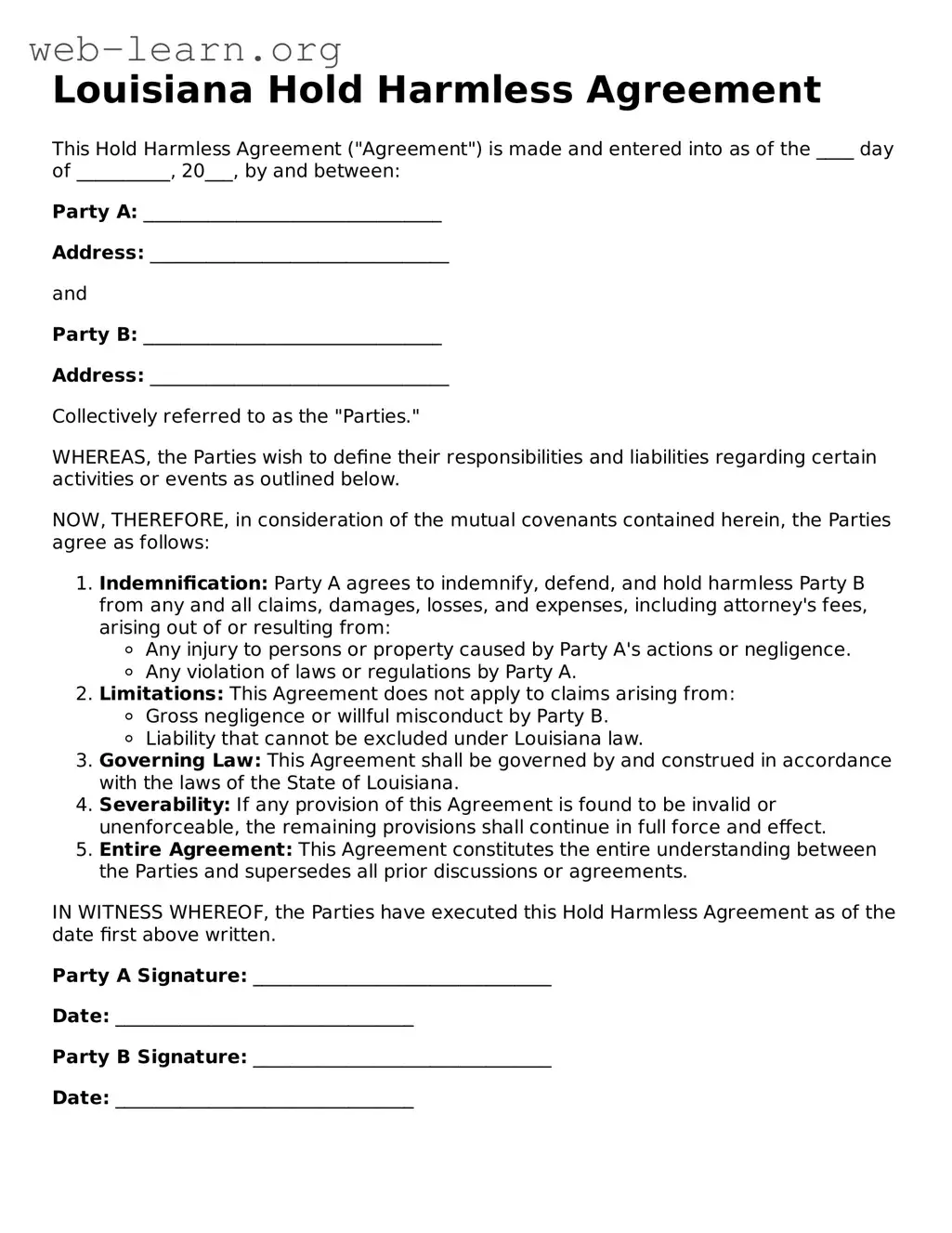
Louisiana Hold Harmless Agreement
This Hold Harmless Agreement ("Agreement") is made and entered into as of the ____ day of __________, 20___, by and between:
Party A: ________________________________
Address: ________________________________
and
Party B: ________________________________
Address: ________________________________
Collectively referred to as the "Parties."
WHEREAS, the Parties wish to define their responsibilities and liabilities regarding certain activities or events as outlined below.
NOW, THEREFORE, in consideration of the mutual covenants contained herein, the Parties agree as follows:
IN WITNESS WHEREOF, the Parties have executed this Hold Harmless Agreement as of the date first above written.
Party A Signature: ________________________________
Date: ________________________________
Party B Signature: ________________________________
Date: ________________________________
| Fact Name | Description |
|---|---|
| Purpose | The Louisiana Hold Harmless Agreement is designed to protect one party from liability for damages or injuries that may occur during a specific event or activity. |
| Governing Law | This agreement is governed by the laws of the State of Louisiana, ensuring compliance with local regulations. |
| Parties Involved | The agreement typically involves two parties: the indemnitor (the party providing protection) and the indemnitee (the party being protected). |
| Scope of Protection | It outlines the extent of protection, which may include injuries, damages, or losses that occur during the specified activity. |
| Written Agreement | For the Hold Harmless Agreement to be enforceable, it must be in writing and signed by both parties. |
| Limitations | The agreement may not protect against intentional misconduct or gross negligence, depending on the language used. |
| Duration | The duration of the agreement typically spans the time of the event or activity, but can be specified further in the document. |
| Legal Advice | It is advisable for both parties to seek legal counsel before signing to ensure understanding and compliance with state laws. |
| Common Uses | This agreement is commonly used in various scenarios, including events, construction projects, and recreational activities. |
Filling out the Louisiana Hold Harmless Agreement form is a straightforward process. By completing this form accurately, you can ensure that both parties are clear about their responsibilities and liabilities. Follow the steps below to fill out the form correctly.
What is a Louisiana Hold Harmless Agreement?
A Louisiana Hold Harmless Agreement is a legal document that protects one party from liability or claims that may arise from the actions of another party. This agreement typically outlines the responsibilities of each party and ensures that one party will not hold the other responsible for any damages or injuries that occur during a specific activity or event. It is commonly used in various situations, such as rental agreements, construction projects, and events where participants may be exposed to risks.
Who should use a Hold Harmless Agreement?
Individuals or organizations that engage in activities with potential risks should consider using a Hold Harmless Agreement. This includes property owners renting their space, contractors working on construction sites, or event organizers hosting gatherings. By using this agreement, they can protect themselves from legal claims that may arise due to accidents or injuries related to their activities.
What are the key components of the agreement?
A Hold Harmless Agreement typically includes the following components:
Is a Hold Harmless Agreement legally binding in Louisiana?
Yes, a Hold Harmless Agreement can be legally binding in Louisiana, provided it meets certain criteria. The agreement must be clear, specific, and voluntarily signed by all parties involved. However, it is important to note that Louisiana law may not enforce certain provisions if they are deemed unconscionable or if they attempt to waive liability for gross negligence or intentional misconduct.
How can I ensure my Hold Harmless Agreement is valid?
To ensure the validity of your Hold Harmless Agreement, consider the following steps:
Filling out a Louisiana Hold Harmless Agreement form can be straightforward, but many individuals make common mistakes that can lead to complications. One frequent error is neglecting to read the entire document before signing. Understanding the terms is essential to ensure that all parties are aware of their responsibilities and liabilities.
Another mistake is failing to provide accurate information. Whether it’s the names of the parties involved or the specific details of the agreement, inaccuracies can render the document ineffective. Always double-check that names are spelled correctly and that all relevant details are included.
Some people forget to date the agreement. A missing date can lead to confusion about when the agreement was made and may affect its enforceability. Always include the date when signing the document to avoid any issues later.
Additionally, individuals sometimes overlook the importance of having witnesses or notarization. Depending on the context, a witness signature or notarization may be required for the agreement to hold up in court. Skipping this step can undermine the validity of the document.
Another common oversight is not specifying the scope of the agreement. It’s vital to clearly outline what activities or situations the Hold Harmless Agreement covers. A vague description can lead to misunderstandings and disputes in the future.
People often forget to discuss the agreement with all parties involved. Open communication ensures that everyone understands their obligations and rights under the agreement. This can prevent conflicts down the line.
Some individuals fail to keep a copy of the signed agreement. Having a record is crucial for reference and can serve as evidence if disputes arise. Always make sure to retain a copy for personal records.
Another mistake is assuming that a Hold Harmless Agreement absolves all liability. While it can provide some protection, it does not cover gross negligence or willful misconduct. Understanding the limits of the agreement is essential.
Finally, people sometimes neglect to consult with a legal professional. While it is possible to fill out the form independently, seeking legal advice can help clarify any uncertainties and ensure that the agreement is legally sound. Taking this extra step can save time and resources in the long run.
A Louisiana Hold Harmless Agreement is often accompanied by various other forms and documents to ensure clarity and legal protection. Below are some commonly used documents that may be relevant in conjunction with this agreement.
These documents work together to establish clear expectations and responsibilities, helping to mitigate risks associated with activities or services in Louisiana.
A Hold Harmless Agreement is a crucial document used to protect one party from liability for certain actions or incidents. It shares similarities with several other legal documents that serve similar purposes. Here are nine documents that are comparable to a Hold Harmless Agreement:
Understanding these documents can help individuals and businesses navigate liability concerns more effectively. Each serves a specific purpose but shares the common goal of mitigating risk and protecting parties involved.
When filling out the Louisiana Hold Harmless Agreement form, it's important to follow certain guidelines to ensure accuracy and clarity. Here is a list of things you should and shouldn't do:
When it comes to the Louisiana Hold Harmless Agreement, there are several misconceptions that can lead to confusion. Understanding these can help you navigate the legal landscape more effectively. Here’s a list of seven common misconceptions:
By clearing up these misconceptions, you can better understand how a Louisiana Hold Harmless Agreement works and how it can be beneficial in various situations.
When filling out and using the Louisiana Hold Harmless Agreement form, there are several important considerations to keep in mind. Below are key takeaways that can help ensure clarity and effectiveness in using this legal document.
Hold Harmless Waiver - This form can help facilitate smoother operations in high-risk environments.
What Is a Hold Harmless Agreement - Parties should consider the duration of the agreement's protection.